Cato Quarterly
Events
Lawmakers Push Back on Tariffs and Presidential Overreach at Cato Events

President Trump has sidestepped Congress with a series of so-called emergencies to implement far-reaching tariffs nearly everywhere in the world. Sens. Rand Paul (R‑KY, middle) and Tim Kaine (D‑VA, left) took aim at that expansion of executive power at a Cato event hosted by Scott Lincicome, the vice president of general economics and Cato’s Herbert A. Stiefel Center for Trade Policy Studies. Paul criticized Trump’s unilateral approach and noted that trade has powered “most of the extraordinary progress of the industrial age.” Kaine, meanwhile, agreed that Congress has “delegated way too much power to the other side of Pennsylvania Avenue.” A tasting of domestic wines and bourbons, which have been hit particularly hard by tariffs, followed the discussion.

Rep. Suzan DelBene (D‑WA, left) joined Cato’s Scott Lincicome for a discussion of legislation she has introduced to reclaim Congress’s constitutional authority to regulate foreign commerce. A representative of the “most tradedependent state in the country,” DelBene said she has heard from many of her constituents about the economic harms caused by tariffs to their businesses and livelihoods. She also noted that Washington’s ports have suffered under months of whiplash during Trump’s second term: “The uncertainty alone is incredibly damaging.”
Libertarianism Versus Conservatism Intern Debate
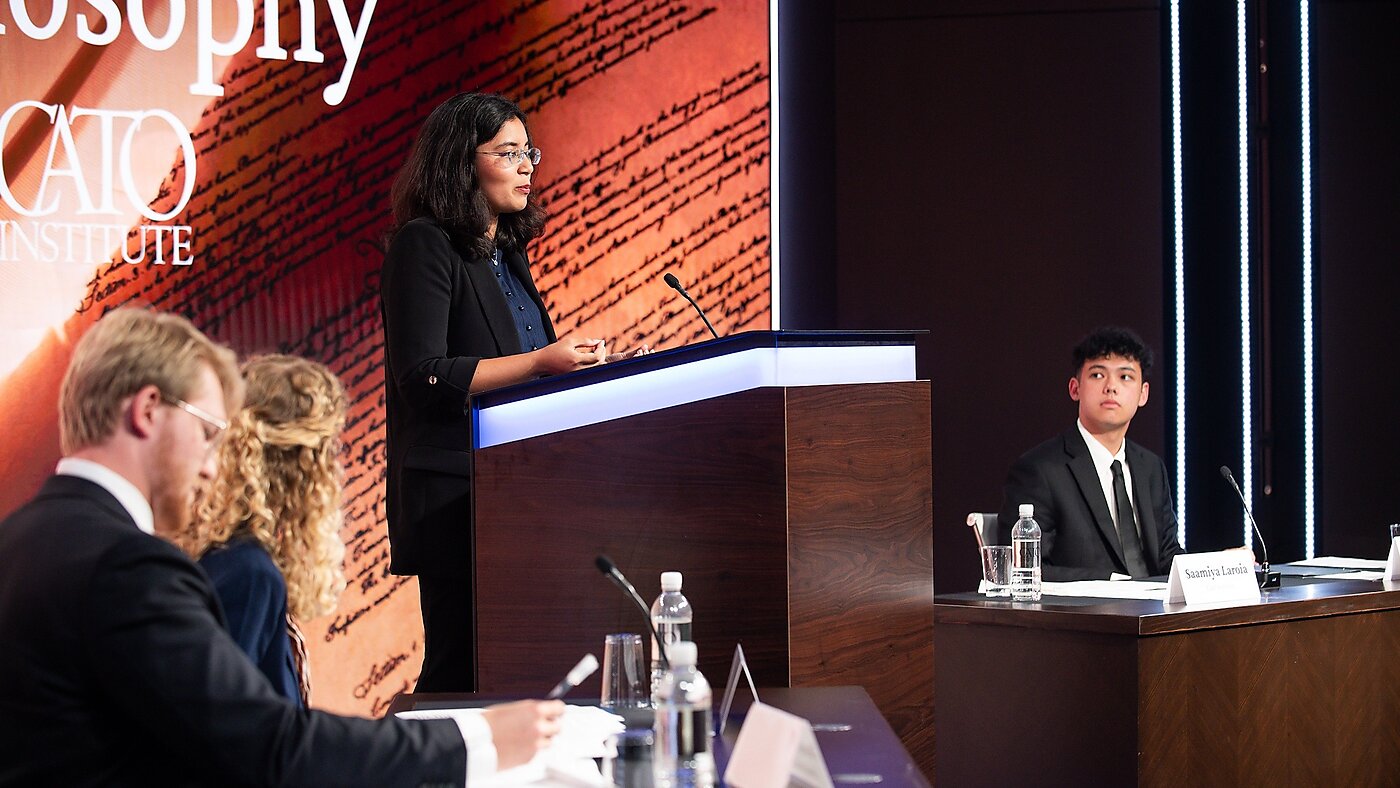
Cato Institute interns faced off against their counterparts at the Heritage Foundation this summer in the annual libertarianism versus conservatism intern debate. Ben Woods, an intern in technology policy studies, and Saamiya Laroia, an intern in trade policy studies, represented Cato. Daniel Davidson, an intern in legal and judicial studies, and Chloe Noller, a government relations intern, represented Heritage. The two sides debated key policy issues in which libertarianism and conservatism differ, including immigration, international trade, defense, drug policy, artificial intelligence (AI) regulation, and other topics. In his closing statement for Cato, Woods shared the story of his mother, who grew up in China in the wake of the Cultural Revolution before moving to the US for college at the age of 23.

Innovation-Friendly Policy Around Artificial Intelligence

Rep. Rich McCormick (R‑GA, left) joined Matt Mittelsteadt, a technology policy research fellow at Cato, for a conversation about evolving US policy on AI. McCormick, who has proposed a 10-year moratorium on new AI regulations at the state level, told Mittelsteadt that the US will “quickly regulate ourselves into oblivion” if all 50 states pursue their own regulatory framework. “It would be catastrophic to the biggest opportunity we have to keep our place in history, and that’s why we’ve got to be really careful with this,” McCormick said.
Publications
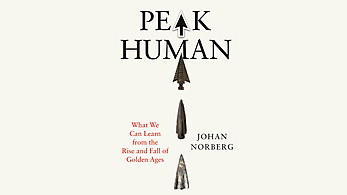
Peak Human: What We Can Learn from the Rise and Fall of Golden Ages
Ancient Greece gave us democracy and the rule of law; out of Abbasid Baghdad came algebra and modern medicine; and the Dutch Republic furnished us with Europe’s greatest artistic movements. All previous golden ages have proven finite, whether through external pressures or internal fracturing. Cato senior fellow Johan Norberg, who has won awards for The Capitalist Manifesto, Open: The Story of Human Progress, and other works, examines seven of humanity’s greatest civilizations. He compares them with today’s civilizations and asks, “How do we ensure that our current golden age doesn’t end?”
“Norberg deftly punctures popular misconceptions.… Could a history book be more timely?”
— The Economist
“Johan Norberg offers a compelling and timely study of what drove history’s most influential civilisations.… The book comes with impeccable timing.… This is an entertaining and informative read for anyone interested in the forces that shape how civilisations progress.”
—Financial Times

Reimagining Social Security: Global Lessons for Retirement Policy Changes
Social Security is on life support. There’s no trust fund, only IOUs from the federal government and trillions in borrowing to keep the program afloat. If nothing changes, benefits will be slashed by 20 percent or more by 2033. Romina Boccia, Cato’s director of budget and entitlement policy, and Ivane Nachkebia, a research consultant for budget and entitlement policy, show how retirement program reforms in Canada, Germany, New Zealand, and Sweden could work in the United States. Combining interviews and new analysis, this book lays out solutions that protect seniors, preserve individual liberty, and fit the American economic model.
“Reimagining Social Security challenges us to think boldly about the future.”
—Olivia S. Mitchell, professor of business economics and policy, the Wharton School of the University of Pennsylvania
“Social Security reform is neither a right- nor left-wing agenda.… I find particularly appealing how [they] illustrate how other countries.… adapt to uncertain demographic shifts in life expectancy and birth rates.”
—Eugene Steuerle, Richard B. Fisher Chair, Urban Institute
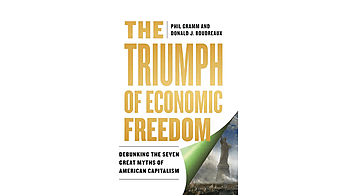
The Triumph of Economic Freedom: Debunking the Seven Great Myths of American Capitalism
Phil Gramm, an economist and former Texas representative, and Donald J. Boudreaux, a professor of economics at George Mason University and adjunct scholar at the Cato Institute, examine the seven events in US history that define, for most Americans, the role of government. To many Americans, the Industrial Revolution, Progressive Era, Great Depression, decline of America’s postwar preeminence in world trade, and Great Recession represent strong evidence for expanding government in American life. Gramm and Boudreaux argue that the evidence points to a contrary verdict: Government interference and failed policies pose the most significant threat to economic freedom.
“This readable and important book makes a strong case that the received version of economic history taught in high schools and colleges across the country is off the mark and that its errors distort current policy debates. It deserves attention from economic policymakers of all persuasions.”
—Lawrence Summers, former secretary of the treasury and president emeritus, Harvard University
Featured Cato Studies

Poll: Nearly 1 in 4 Americans Think They Have a Personal Social Security Account
About three in four adults are aware of the projected shortfalls that Social Security faces in the coming years, but a surprising number are deeply confused about the program’s aims or how it functions. These were the findings of an August survey by Emily Ekins, vice president and director of polling at Cato, and Hunter Johnson, a research associate for the Project on Public Opinion. Only 45 percent of Americans think of Social Security as an anti-poverty program, which was its original aim. The other 55 percent think the program is meant to replace seniors’ incomes in retirement. Nearly a quarter, 23 percent, think the taxes they pay to Social Security are saved in their own personal account, and about a third don’t know how Social Security is funded at all.

