
The US surgeon general has morphed from an apolitical supervisor of medical personnel to a divisive activist who undermines public health. Successive administrations have turned the Office of the Surgeon General into a highly political platform that opines on divisive non–public health issues ranging from gun control and social media to labor and housing policy. Such mission creep undermines the effectiveness of legitimate government public health activities.
The surgeon general oversees the 6,000-member Public Health Service Commissioned Corps—a uniformed, noncombatant service that provides personnel for various federal agencies, including many non–public health roles. The Commissioned Corps takes longer to deploy than civilian alternatives, and many of its functions are redundant. A 2010 report from the Department of Health and Human Services estimated that employing Corps officers costs 15 percent more than hiring civilians. Replacing Corps officers with equivalent civilian employees could save $1.3 billion annually.
Eliminating the surgeon general’s divisive political advocacy would be a step toward restoring trust in public health officials. Congress should dissolve the Office of the Surgeon General and the Commissioned Corps, eliminate their non–public health activities, and reassign any legitimate public health activities to other agencies.
Introduction
Since 1873, the role of US surgeon general (SG) has morphed from an apolitical supervisor of medical personnel to a divisive activist who undermines public health efforts. The Public Health Service Commissioned Corps, which the SG supervises, is an inefficient and accountability-undermining approach to staffing federal agencies. Congress should eliminate the Office of the Surgeon General and phase out the Corps. Estimates indicate that substituting civilian federal employees for Corps personnel could produce significant savings.
The Office of the Surgeon General undermines both the authority of other public health officials and trust in government public health efforts with politically divisive advocacy that reaches beyond the scope of public health. SGs have opined on violent video games, violence on television, pornography, education, business’s societal role, poverty, inequality, economic mobility, guns, infrastructure, racial disparities, and crime.1 More recently, the SG has spent taxpayer dollars to opine on parental mental health, labor conditions, loneliness, and social media. The SG has advocated federal- and state-level labor regulations, tax credits, housing subsidies, nutrition subsidies, and gun control laws.2 Even when SGs stick to health issues, they frequently weigh in on private health matters including drug use, diet, exercise, obesity, mental health, and health literacy.3 The more that prominent public health officials advocate divisive non–public health policies, the more people will distrust or disregard government officials when they offer valuable public health advice.
The SG oversees the Public Health Service Commissioned Corps, which consists of 6,000 physicians and other medical professionals who deploy to various agencies in the federal Public Health Service (PHS).4 Many serve in non–public health roles. Eliminating the Corps would remove a layer of bureaucracy, reduce federal spending, and enhance efficiency. Agencies could access the same services from civilians by hiring, directly contracting, or temporarily borrowing personnel. One government report estimates that converting Corps personnel to civilian federal employees could reduce federal spending on those roles by 22 percent.5
The History and Evolution of the Office of the Surgeon General
The Office of the Surgeon General originated in the Act for the Relief of Sick and Disabled Seamen, which President John Adams signed into law in 1798.6 The act created hospitals along waterways to serve the merchant marine and designated a “supervising surgeon” to oversee them. Congress consolidated these hospitals into the Marine Hospital Service in 1871. In 1875, Congress renamed the supervising surgeon the surgeon general of the Marine Hospital Service and made the position a political appointment.7
A physician from Chicago, John Maynard Woodworth, became the first SG in 1873. Woodworth organized a team of medical personnel to staff the Marine Hospital Service. He dressed his doctors in uniforms and deployed them to hospitals as the military would deploy soldiers to battlefields.8 Congress formalized this team of doctors as the Marine Hospital Service Commissioned Corps in 1889.9 Initially, the Corps consisted only of medical doctors but came to include other health professionals.
According to the Centers for Disease Control and Prevention (CDC), “over time,” the Marine Hospital Service “became responsible for preventing the spread of contagious diseases throughout the United States.” As a result, in 1902, Congress renamed it the Public Health and Marine Hospital Service. In 1912, Congress renamed it again, this time as the PHS.10 By the early 20th century, the Commissioned Corps became a mobile force of health professionals providing services to federal prisons and the Louisiana Leper Home. In 1928, the Corps began providing care to Native Americans on reservations.
The Commissioned Corps became the uniformed branch of the PHS. Along with the National Oceanic and Atmospheric Administration’s Commissioned Corps, the PHS Commissioned Corps is one of the two uniformed services consisting only of commissioned officers.11 The Commissioned Corps are noncombatants.12 With the Public Health Service Act of 1944, Congress reorganized and expanded the scope of the PHS divisions, placing the SG wholly in charge of PHS and the Corps.13
In 1953, Congress created the Department of Health, Education, and Welfare (HEW) and incorporated the PHS into its operations.14 Until 1968, the SG managed all the PHS’s programming, administrative, and financial activities. In 1968, President Lyndon B. Johnson’s reorganization plan abolished the Office of the Surgeon General, transferring these responsibilities to the assistant secretary for health (ASH). Johnson reduced the SG’s role to serving as the principal deputy assistant to the ASH, advising on health matters and acting as a spokesperson on public health issues.
In 1979, Congress split HEW into the Department of Education and the Department of Health and Human Services (HHS) and reestablished the Office of the Surgeon General as a staff office within the ASH’s office. Congress also restored some of the SG’s responsibility for overseeing the Commissioned Corps, particularly regarding deployment and operations.15
Congress did not restore the SG’s oversight of the other public health agencies, and legislative changes further limited the SG’s authority. Section 361 of the Public Health Service Act initially granted the SG the authority to “make and enforce such regulations as in his judgment are necessary to prevent the introduction, transmission, or spread of communicable diseases from foreign countries into the States.”16 Congress transferred these powers to the secretary of HHS, who delegated them to the CDC director and the Food and Drug Administration commissioner.17
The US Public Health Service and Public Health Service Commissioned Corps
HHS has 13 agencies, 10 of which comprise the Public Health Service. The 6,000-member Commissioned Corps is one of these 10 agencies. Corps professionals include therapists, pharmacists, physicians, nurses, dentists, dietitians, veterinarians, scientists, engineers, environmental health specialists, and a wide variety of “health services” professionals ranging from health care administrators to medical technologists and social workers.18 Corps officers work in an array of federal agencies, including many outside of HHS that lack a direct connection to public health or health care (Figure 1).
![Copy: Version 2 Figure 1 [Print]: USPHS Agencies related to public health](https://infogram-thumbs-1024.s3-eu-west-1.amazonaws.com/5b8e718a-d313-4c69-8dc3-427912c2cf22.jpg)
Corps officer activities include “disease prevention, elimination of health disparities, and disaster/emergency preparedness,” and the Corps further “provides leadership and personnel for clinical care, scientific research, and other regulatory service tasks for a variety of federal government entities.”19 During the 2014 Ebola crisis, the SG deployed the Corps to assist the CDC Ebola Response Team.20 The Corps sometimes deploys abroad to respond to public health emergencies. Unlike other uniformed services, Corps officers can choose where they deploy and whether they wish to assist in an emergency. Officers who volunteered deployed to West Africa during the Ebola crisis.21
In addition to crisis response, the Commissioned Corps has supported other missions. For instance, it has assisted the US Navy by delivering care aboard hospital ships.22 The Federal Bureau of Prisons employs 850 Commissioned Corps officers to provide health care services.23
The Corps offers the appeal of “mobile cadres of professionals who can be assigned with little notice to any location and function where their services are necessary, often in hazardous or harsh conditions.”24 Those capabilities do not necessitate a separate Corps and the additional costs it imposes. In 1996, the General Accounting Office (which Congress renamed the Government Accountability Office in 2004) reported that “federal civilian employees are often also assigned to duties similar to those of the Commissioned Corps.” For example, “PHS civilian employees—physicians, nurses, pharmacists, and others” have “responsibilities that are identical to those of PHS Corps officers.” In addition, “other agencies, such as the Environmental Protection Agency, the National Transportation Safety Board, and the Federal Emergency Management Agency, use civilian employees to respond quickly to disasters and other emergency situations.”25
The Corps includes the Ready Reserve Corps, a surge-capacity branch modeled on the Armed Forces Reserves. These part-time officers—who are trained health professionals—remain on standby and can deploy, voluntarily or involuntarily, within five days to support public health response efforts.26 They drill one weekend each month and two weeks per year, earning pay and TRICARE medical coverage (which exists primarily for active-duty and retired military and their families) during both training and active-duty assignments. The Office of the Assistant Secretary for Health covers their wages while they deploy. Officers become eligible for retirement pay after 20 qualifying years of satisfactory service.27 By February 2023, the Ready Reserve had commissioned 91 officers, and the president’s fiscal year (FY) 2024 budget requested $13.6 million to sustain a force of approximately 400.28
Budget and Expenditures of the Commissioned Corps
Both the structure and funding of the Commissioned Corps create unnecessary bureaucracy, contradictory lines of authority, opaque accounting, and inefficiency.
Corps officers’ compensation is unique among all government employees. The host agencies pay the salaries and administrative costs of the officers they employ but are not responsible for funding their health and retirement benefits. HHS pays for these benefits, reducing the average cost to the employing agency in 2010 by $48,000 per employee.29
In 2024, HHS spent $834,613,000 to provide health and retirement benefits to 6,000 active and 7,000 retired Corps officers and their families and survivors, or $64,201 per beneficiary.30 HHS expects this figure to rise to $1 billion by FY 2028 and continue increasing for generations to come.31 As of September 30, 2024, the HHS Office of Finance reported the Corps had an accrued actuarial liability of $20 billion for its retirement benefit plan and $0.9 billion for non-Medicare coverage under the post-retirement medical plan.32
This complicated funding structure, as well as various other special benefits and privileges, contributes to making Corps officers more expensive than other federal employees. In 2010, the average Corps officer cost was $169,000, which at the time was $22,000 or 15 percent higher than the cost of employing a civilian equivalent. The total compensation of all Corps officers in 2009 was $763 million.33
The Corps’ complex structure conceals its total operating cost from taxpayers, since it never appears as a distinct budget item. At the same time, this system encourages agencies to hire Corps officers instead of regular civilian employees, ultimately increasing overall personnel levels, because Corps officers come at a discount relative to otherwise similar agency employees.
Corps officers also receive additional benefits, some of which are Corps-exclusive. Corps benefits include officer relocation (including travel expenses), 30 days of paid vacation, TSA PreCheck, and maximum Servicemembers’ Group Life Insurance coverage of up to $400,000. (The Corps is the only uniformed service offering 100 percent eligibility.)34
Although Corps officers are nonmilitary and noncombatants, they gain access to programs and facilities for soldiers, veterans, and their families. These include TRICARE health insurance and medical services; Space-Available (Space‑A) flights; lodging on military bases; Morale, Welfare, and Recreation (MWR) facilities; shopping privileges at military grocery and department stores; the VA Home Loan Guaranty program; VA disability benefits; survival and death benefits; and Veterans Health Administration care for service-related medical or disability issues.35 When Corps officers use these programs and facilities, it can divert resources from military personnel and veterans.
In accordance with their military pay scale, Corps officers have the privilege of receiving a portion of their salary in the form of housing and subsistence allowances wholly exempt from federal income taxes. The HHS Office of Business Management and Transformation (OBMT) estimates that in 2009 alone, tax advantages for Corps officers reached $48 million. Federal civilian employees receive no such tax advantages.36
Corps officers also face contradictory lines of authority. While officers have some responsibility to the Corps, their main duty is to serve the mission of their employing organization. Corps officers whom host organizations deem “mission critical” generally do not deploy elsewhere to respond to public health crises.37 This hinders the capacity of the Corps to mobilize effectively during public health emergencies.
Maintaining a separate Corps with special compensation arrangements increases federal spending relative to filling these roles with civilian federal workers. In 1996, the General Accounting Office estimated that using civilian employees to carry out the Corps’ functions would reduce federal outlays on those positions by 22 percent.38 In 2010, the OBMT concluded that using civilians instead of Corps officers would save approximately $217 million.39 A back-of-the-envelope calculation suggests that just replacing the Corps with civilians could yield savings comparable to eliminating 2,000 federal positions.40
The OBMT report also estimated that it takes 24 hours or more for Corps officers to deploy during times of emergency, while National Disaster Medical System personnel (an all-civilian force) generally deploy within 12 hours.41
In March 2025, HHS Secretary Robert F. Kennedy Jr. announced a comprehensive restructuring, including a workforce reduction of 10,000 full-time employees. Kennedy estimated this restructuring would reduce outlays by $1.8 billion per year.42 Another back-of-the-envelope calculation, this one using data from the 2010 OBMT report and adjusting for inflation, suggests that disbanding the Corps could yield $1.3 billion in savings annually.43
Public Health and the Surgeon General’s Role
The surgeon general’s activities mirror and exacerbate a trend of public health officials inserting themselves into non–public health issues, including private health matters. This trend reflects a growing desire among government officials to control individuals’ personal health decisions.
In the 19th and early 20th centuries, “the earliest definition of public health’s mission was … control of epidemic disease.”44 The origins of the PHS and the Centers for Disease Control reflect this understanding of public health: It was when the Marine Hospital Service “became responsible for preventing the spread of contagious diseases” that Congress named it the Public Health and Marine Hospital Service. When Congress changed the name again—to the Public Health Service—its “primary task was quarantining persons on ships.”45 And the Centers for Disease Control grew out of the 1942 Malaria Control in War Areas program.46 Practitioners, academics, and government officials understood public health as “directed largely toward communicable diseases and other externalities, such as pollution, with negative health impacts.”47
Traditional public health measures have been perhaps the most successful medical interventions in human history.48 Smallpox vaccination eradicated a disease that had “more than twice the death toll of all the military wars of [the last] century.”49 One estimate suggests additional vaccines “averted 154 million deaths … translating to 10.2 billion years of full health gained.”50
The traditional conception of public health is similar to the economic concept of a “negative externality,” which is a cost that unintentionally falls upon an unwilling third party. Disease transmission and pollution involve negative health externalities: by-products of human activity that directly harm the health of nonconsenting parties.51 Economic theory posits that when private incentives are insufficient to encourage market actors and civil society to produce the optimal quantities of disease or pollution control, government can correct those “market failures” with public health measures that prevent contagion and pollution, or reduce the resulting harms.52 For economists, not everything that affects health is public health. Health conditions and decisions that do not impose significant health costs on nonconsenting parties are private health matters (e.g., obesity).53
The SG frequently issues polarizing health advisories and policy recommendations that extend well beyond traditional public health and even medical expertise. This mission creep results from merging an expansive and ambitious vision of public health with rising paternalism.
Since the early 20th century, practitioners have successfully redefined public health to encompass preventive health, population health, and practically every health condition or decision.54 In 1920, bacteriologist and public health advocate C.E.A. Winslow defined public health as “the science and art of preventing disease, prolonging life, and promoting health through the organized efforts and informed choices of society, organizations, public and private communities, and individuals.”55 Winslow’s approach interprets public health in extremely broad terms to encompass virtually all areas of health and medicine. The public health profession has largely adopted Winslow’s definition.56 Government agencies at the federal, state, and local levels use similar principles to guide policy.57
This definitional shift serves specific economic and policy preferences. Industry lobbyists and political coalitions advocate government intervention into private health matters: to have government subsidize and penalize health-related activities that confer no benefits and impose no harms on nonconsenting parties. Expanding the definition of public health to include private health matters enables paternalists to cloak government interference in private health decisions in the intellectual legitimacy and empirical success of traditional public health. Such advocacy exhibits a strong “bootleggers and Baptists” dynamic wherein sincere, well-meaning activists cooperate with self-interested medical industry players to encourage government to intervene in private health matters. For special interests, expanding the definition of public health provides intellectual cover for them to lobby the government for favors that benefit them at the expense of the public.58
The SG has become a major force behind this trend. In 1964, the SG’s landmark report on smoking initiated a shift from focusing on infectious diseases and related matters to commenting on a wider range of topics. In the 40 years following that initial report on smoking, “more than half of all reports published under the auspices of the Surgeon General … dealt with this issue.”59 The National Library of Medicine writes:
Over the years the [surgeon general’s] reports have addressed an increasing range of health issues … such as … maternal and child health … welfare policy … nutrition and physical exercise.… Finally, several reports have addressed issues previously considered either to lie within the domain of private medicine and of the individual relationship between physician and patient, such as mental health, or to lie outside of medicine altogether, such as suicide, violence, and pornography. The reports have tried to frame these issues in terms of their implications for public health, properly within the purview of the Surgeon General.
Together, the reports … have expanded the very meaning of public health. They show that the definition of public health is not fixed but has changed over time … to include areas such as human behavior and mental health.60
Congress has contributed to this dynamic by requiring the SG to issue “biennial reports on the relationship between nutrition and health” and authorizing the office to issue recommendations in that area.61 Congress also requires the SG to chair the National Prevention, Health Promotion, and Public Health Council.62 Both reporting mandates extend well beyond public health issues.
Even supporters of a broad definition of public health acknowledge this problem: “Public health is sometimes viewed as so expansive in its compass as to have no real core, no institutional, disciplinary, or social boundaries.”63 As a nominee for SG, for example, Vivek Murthy told the US Senate that he did “not intend to use the Surgeon General’s Office as a bully pulpit for gun control.”64 But once he became SG, Murthy declared, “It is now time for us to take [gun control] out of the realm of politics and put it in the realm of public health, the way we did with smoking more than a half century ago.”65 Murthy called on Congress “to ban automatic rifles, introduce universal background checks for purchasing guns, regulate the industry, pass laws that would restrict their use in public spaces and penalize people who fail to safely store their weapons.”66
Public health officials undermine public health when they insert themselves into areas beyond traditional public health matters. First, doing so can distract them from core and high-value public health activities. The “Current Priorities of the Surgeon General,” according to the office’s website, include parental stress and well-being, social media use by young people, loneliness and social isolation, and reducing gun violence.67 These are not public health matters. They are also well outside the SG’s area of expertise. In Table 1, which lists the SG’s current priorities, only one item—COVID-19—constitutes a genuine public health issue.
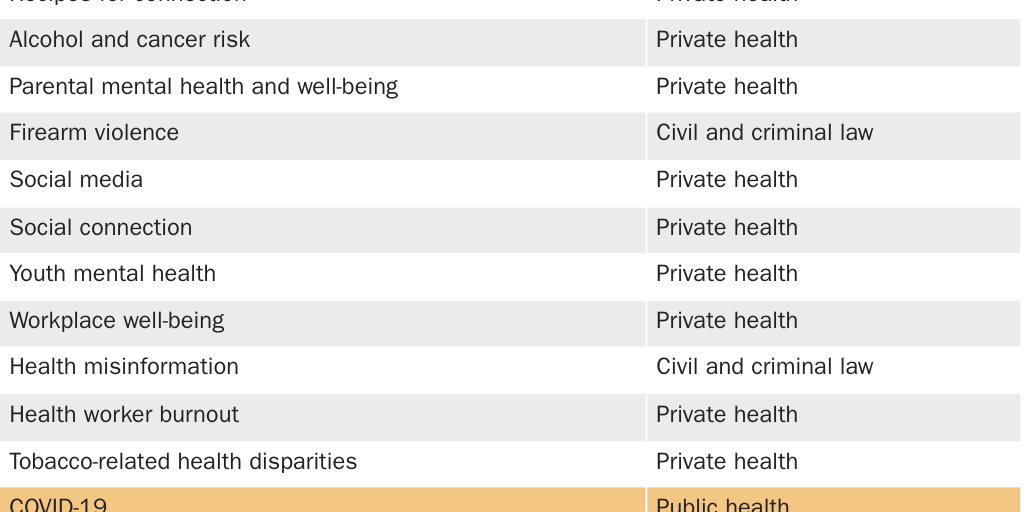
Second, when the SG ventures beyond traditional public health, it can lead the public to distrust and disregard valuable public health guidance. The SG opines on a wide range of divisive topics such as gun violence, abortion, drug use, sexual orientation and gender identity, social media use, climate change, and others.68 No matter what position the SG takes, such advocacy telegraphs to large segments of the population that their government judges their values to be wrong. In the case of gun control and many other issues, the SG openly advocates either denying people the freedom to make choices in accordance with their values or compelling them to support ideas they oppose. Those who do not share the SG’s perspective come to distrust the office, and understandably so.
Third, an increasing focus on divisive political issues has changed what type of people become SG. In the past, SGs were relatively apolitical military appointees. In recent years, they are more likely to be civilian medical practitioners who align with the party of the president.69 In 2014, former SG Dr. Richard Carmona, who served from 2002 to 2006 under President George W. Bush, noted that SG Vivek Murthy’s first nomination was likely due to his role as a cofounder of Doctors for Obama.70
Former SGs have called attention to the office’s politicization. In 2007, Carmona testified before Congress alongside fellow former SGs Dr. C. Everett Koop (1982–1989) and Dr. David Satcher (1998–2002). Each testified that the presidents they served pressured them to deliver ideologically congenial messages and refrain from speaking on topics conflicting with their president’s agenda.71 In 2014, Carmona called for depoliticizing the office by returning to the older practice of nominating people from nonpartisan “career uniformed service ranks” only, rather than civilians with partisan alignments.72
The incentives for such a change are weak, however. The current SG office provides presidents with a mouthpiece to promote their priorities under the guise of scientific neutrality. Future presidents are unlikely to make nonpartisan appointments or refrain from trying to influence the SG’s statements. This is especially unlikely given the increasing levels of polarization across the political spectrum.73
Policy Recommendations
Congress should abolish the Office of the Surgeon General, eliminate the office’s non–public health activities, and reassign its public health responsibilities to the CDC or other appropriate federal agencies. Eliminating the position of SG would send the important message that there is no such thing, and can be no such thing, as “the nation’s doctor.”74 It would allow the assistant secretary for health to focus PHS agencies on public health issues and reduce politically charged advice on matters that clinicians and their patients, or experts in nonmedical fields, should handle instead. Eliminating the office’s divisive political advocacy would be a step toward restoring trust and confidence in federal public health officials.
Congress originally authorized the surgeon general “to make and enforce … regulations … to prevent the introduction, transmission, or spread of communicable diseases from foreign countries into the States or possessions, or from one State or possession into any other State or possession.”75 The HHS’s subsequent delegation of this responsibility to the CDC is indicative of how the SG no longer engages with legitimate public health activities.76
Congress should likewise abolish the PHS Commissioned Corps. Eliminating the Corps would remove financial incentives for non-PHS agencies to expand their workforces and spend taxpayer dollars. Both PHS and non-PHS agencies could directly hire or contract with any Corps officers they wish to retain. Agencies would fund those workers’ health and retirement benefits from their own budgets. In 1996, the General Accounting Office estimated that converting Corps positions to civilian roles could reduce spending on those positions by 22 percent.77 Those employees would have a single line of responsibility to the agency where they work.
Finally, Congress should eliminate the Ready Reserve Corps.78 States and the private sector are nimbler in responding to public health emergencies. Federal emergency responses are typically “slow, disorganized, and profligate,” and they “undermine the role of private institutions and the states in handling disasters.”79 During the COVID-19 pandemic, for example, “confusion ensued, and HHS put repatriates, its own personnel, and nearby communities at risk” because “HHS did not clarify … which HHS agency was responsible for managing infection prevention when it helped repatriate US citizens from abroad.”80 During the subsequent mpox outbreak in 2022, “confusion at state, local, and territorial levels regarding how to request and receive mpox supplies … occurred because HHS agencies involved with the stockpile had not clearly defined roles and responsibilities, thereby complicating response efforts.”81
Conclusion
The US surgeon general is a public health official who undermines public health. The PHS Commissioned Corps places unnecessary burdens on taxpayers and makes federal workers less accountable. Neither entity is necessary. Eliminating them and reassigning legitimate public health activities to other agencies would improve public health and the federal budget outlook.
Citation
Singer, Jeffrey A., Akiva Malamet, Bautista Vivanco, and Michael F. Cannon. “Unnecessary Relics: The Surgeon General and the Public Health Service Commissioned Corps,” Policy Analysis no. 1001, Cato Institute, Washington, DC, July 22, 2025.

About the Authors


This work is licensed under a Creative Commons Attribution-NonCommercial-ShareAlike 4.0 International License.