
A resolution before Congress calls for US withdrawal from the World Trade Organization (WTO). Both international law and US law permit withdrawal. The case for withdrawal, however, is misguided and misinformed. Much of what is said and widely believed about the effects of WTO membership on the United States is simply untrue. In fact, American membership in the WTO has been for decades and remains today enormously beneficial economically to US businesses, workers, and consumers. Withdrawal by the United States from the WTO would result in the loss of many of these economic benefits, including those derived from decades of accumulated trade commitments made by the 165 other member countries on thousands of different US goods and services traded within the WTO legal framework; those resulting from the commercial shield of WTO rules forbidding trade discrimination against US exports; and those emanating from the availability to the United States of an impartial, binding, and enforceable system of WTO trade dispute settlement. Moreover, withdrawal by the United States would cede US leadership in the WTO to other leading trading countries, including the second-largest trading country in the world, China. Trade is a win-win economically for all WTO members. WTO membership maximizes the overall economic gains from engaging in trade. The United States should remain in the WTO and help lead it toward needed reforms that will make it more beneficial to all in the modern global economy of the 21st century.
Introduction
A resolution under consideration by the Congress of the United States proposes that the United States withdraw as one of the 166 member countries of the World Trade Organization (WTO), the international institution based in Geneva, Switzerland, that oversees 98 percent of world commerce. Can this be done? Can the United States withdraw from the WTO? To answer, we must look at international law (specifically, at the WTO Agreement) and, domestically, at US law and the US Constitution.
In December 1994, following the conclusion of the Uruguay Round of multilateral trade negotiations (in which the United States played a leading and affirmative role), the House of Representatives, by a vote of 288–146, and the Senate, by a vote of 76–24, each approved the Uruguay Round Agreements Act enacting into US law the trade commitments made by the United States in those negotiations.1 (Full disclosure: I was one of the six original co-sponsors of this legislation in the House, where I served two terms as a representative from Florida.) The US, having been one of the 23 founding signatories to the General Agreement on Tariffs and Trade (GATT) in 1947, thus also became a founding member of the WTO—the GATT’s successor and a more comprehensive international trade institution.
Related Media
There is no question that the United States can withdraw from the World Trade Organization if it so chooses. Article XV.1 of the Marrakesh Agreement, which established the WTO in 1995 and is part of the overall WTO Agreement, is crystal clear about this: “Any Member may withdraw from this Agreement. Such withdrawal shall apply both to this Agreement and the Multilateral Trade Agreements and shall take effect upon the expiration of six months from the date on which written notice of withdrawal is received by the Director-General of the WTO.”2 So, an American decision to withdraw from the WTO would take effect in six months, and no provision in the WTO Agreement could impede such a decision.
The legal question about WTO withdrawal by the United States is not one under international law; it is one under domestic law and the US Constitution: Can the president withdraw from WTO membership simply by issuing an executive order, or is congressional approval required? There is a long-standing legal debate over the lines dividing executive and legislative authority over foreign trade (which is a subset of the overall and ongoing debate over foreign affairs generally). This debate would be kindled anew if the president sought to withdraw from the organization without first seeking congressional approval, but less so if Congress took the initiative in proposing withdrawal.
On tariffs (which are taxes, often called duties, that are imposed on imports of foreign goods) and on foreign trade in general, Article I, Section 8, clauses 1 and 3 of the US Constitution state: “The Congress shall have Power To lay and collect Taxes, Duties, Imposts and Excises” and “To regulate Commerce with foreign Nations.”3 The Constitution does not mention any presidential authority over foreign commerce; however, the Supreme Court has ruled that the president has broad inherent authority to conduct foreign policy and to negotiate on behalf of the United States.4 In addition, Article II, Section 2 of the Constitution grants the president the power “to make Treaties,” subject to ratification by two-thirds of the Senate.5
Although the Marrakesh Agreement and the other multilateral trade agreements of the Uruguay Round, taken together, are viewed as a treaty under international law by the other members of the WTO, the US treats them collectively as an executive agreement requiring majority approval by both the House and Senate instead of the two-thirds Senate approval required for a treaty. As the Congressional Research Service points out, “Courts have only infrequently opined on the ways in which the United States may enter into foreign trade agreements based on [the] separation of powers. Nevertheless, it is broadly accepted that the United States may enter into trade agreements with other countries via ‘congressional-executive agreements,’ which are negotiated by the President and approved—either in advance or afterward—by Congress.”6
President Trump is not mistaken in thinking that under current US law he has broad sway to make unilateral decisions on international trade, much of this authority—and arguably all of it—delegated to the executive branch by Congress. Beginning during the New Deal with the Reciprocal Trade Agreements Act of 1934 and continuing with the Trade Expansion Act of 1962, the Trade Act of 1974, the International Emergency Economic Powers Act of 1977, and several other relevant statutes, Congress has delegated a great deal of discretion to the executive branch on trade, and on negotiating and applying tariffs in particular.7 Generally, on trade, one option for Congress would be to change the existing law to retrieve some of the power it has delegated to the president. This has been advocated without success by some members of Congress in recent years, and despite some current efforts in response to Trump’s onslaught of tariffs worldwide, a change seems unlikely to happen at this time, with this Congress and this president.8
On the specific issue of WTO withdrawal, though, Section 125 of the Uruguay Round Agreements Act should be determinative.9 This section provides for the possibility of a congressional vote every five years on a joint resolution addressing whether the United States should remain in the WTO. Specifically, Section 125(b) makes it very clear that congressional approval of the WTO Agreement “shall cease to be effective if, and only if,” such a joint resolution is passed by both the House and Senate (emphasis added).10 Votes on such resolutions to leave the WTO in 2000 and 2005 failed by wide margins.11 A resolution was introduced in 2020 but did not come to a vote.12
Importantly for this debate, the next year in which a joint resolution of withdrawal can be introduced is this year, 2025. Procedurally, Section 124 of the Uruguay Round Agreements Act requires the United States Trade Representative (USTR) to submit a report every five years on the participation by the United States in the WTO and, following submission of that report, provides a 90-day window during which members of Congress can introduce a resolution calling for withdrawal from the WTO. The resolution is privileged, which means its author is entitled to a vote on it 45 days after it is introduced.
Given that the United States can withdraw from the WTO, should it do so? On March 3, 2025, the USTR released the statutorily required report, which is critical of what it describes as the WTO’s “persistent systemic failures” and maintains that “while the United States has continued to seek constructive ways to engage at the WTO, renewed efforts and new vision from other WTO Members are necessary if the WTO is to achieve much-needed reform.”13 The report does not recommend withdrawal from the WTO, but since it was issued, the US has complicated the matter by refusing to pay its annual WTO dues, already in arrears.14 The pending resolution would take the additional step of WTO withdrawal.
The Misguided Case Against the WTO
Congressional reservations about membership in the WTO are bipartisan. Many politicians from each major party call the WTO an unwelcome globalist intrusion on the international trade of the United States and other aspects of the making and implementation of US domestic policy.15 They claim that the WTO’s framework of international rules for trade between and among its 166 member countries is an unwarranted interference with the exercise of American sovereignty, both internationally and domestically. Those rules, they say, mandate free trade to the detriment of American businesses and workers while attempting to manage American trade by foreign direction. In these ways, according to these critics, the WTO inhibits US economic growth and harms US trade by hindering the ability of the United States to control it. Furthermore, the WTO is said to deny the US the “policy space” needed to shape its own fate on any number of trade-related issues such as the environment, health, and safety.
In addition, WTO skeptics contend that the jurists who determine the legal outcomes of international trade disputes in WTO dispute settlement are biased against the United States, as revealed by the fact that they almost always rule against the United States, frequently by exceeding the legal scope of the jurisdiction they have been given under the WTO Agreement. Thus, WTO skeptics insist, WTO jurists have been overreaching in their adjudicating of international trade disputes, and the principal victim of this overreach has been the United States. To borrow a phrase attributed to the French diplomat Talleyrand (1754–1838), there is wide bipartisan agreement within the Washington Beltway that American membership in the World Trade Organization is worse than a crime; it is a mistake.16
So, why not correct this alleged mistake by withdrawing from the WTO? One reason is that—despite what may be believed within the Beltway—every accusation against the WTO in the previous two paragraphs is untrue. As I have explained previously, there is a broad gap between the myths about the WTO widely believed in Washington and the actual provenance, governance, structures, and actions of the international trade institution.17 These realities must be seen and recognized by American decisionmakers. Embracing these myths supports the idea of American withdrawal from the WTO; acknowledging reality does not.
Captured by the misconceptions about the WTO, Sen. Josh Hawley (R‑MO) has accused the organization of performing “the role of managing the world economy.”18 This is not so. The WTO is not an institution intended to “manage” its members’ trade. The WTO’s sovereign members make their own decisions about trade, including whether to comply with their WTO obligations. Nor is the WTO a free trade agreement that requires open trade; indeed, the phrase “free trade” does not even appear in the dozen or so multilateral and plurilateral trade agreements that comprise the WTO Agreement.19 Rather, the WTO is mostly a framework of international trade rules intended to provide legal incentives that favor, and that constrain agreed restrictions on, undistorted competition while permitting governments’ actions against unfair trade practices. WTO members can employ these rules to lower tariffs and other barriers to trade if—and only if—they collectively decide to do so. And, for the most part, this can be done only if all WTO members—including the United States—agree to do so by consensus.
This legal framework includes rules that bind members to the trade commitments they choose to make, in an exercise of their sovereignty, and that forbid economically distortive trade discrimination between and among foreign like products (“most-favored-nation treatment”) and in favor of domestic over imported like products (“national treatment”). Under these rules, in the absence of unfair trade practices, there are supposed to be equal competitive opportunities for like domestic and foreign products in both domestic and international markets. Where there are such opportunities, trade gains are maximized overall, and economic growth is thereby enhanced everywhere. Who benefits from these gains from international trade domestically in sovereign WTO member countries—and how much they benefit when compared with others in the same country—are matters left entirely to domestic decisionmaking. The WTO has no role in making such decisions.
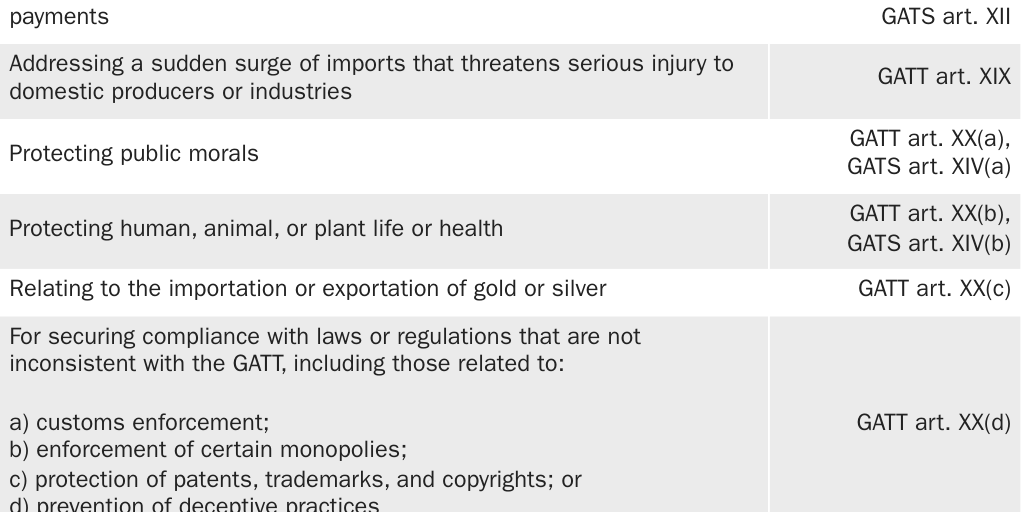
WTO rules leave ample “policy space” for WTO members on matters affecting trade so long as nondiscrimination obligations are respected. Where some important societal goals other than advancing trade are at stake, such as protecting health or preserving the environment, WTO members have latitude to put those goals first. Measures taken to serve these goals are exempted from WTO obligations by Article XX of the GATT if they are not applied in an arbitrary or unjustifiably discriminatory manner and do not comprise a disguised restriction on international trade. In addition, under Article XXI of the GATT and Article XIV bis of the General Agreement on Trade in Services (GATS), measures taken for national security reasons are likewise exempted from what would otherwise be WTO obligations (Table 1).20 These exceptions are not unlimited, of course, and claims to the shelter of these exceptions can lead to disagreement requiring dispute resolution. Recourse to WTO dispute settlement occurs when disputes inevitably arise among some of the members over the precise meaning of the rules in the context of a particular measure—such as a law, regulation, or administrative practice—that one WTO member has applied that affects imports of a traded product or products of another WTO member or members.
Benefits of the WTO to the American Economy (and Costs from Possible Withdrawal)
There is no international mandate of any kind that the United States belong to the WTO; every one of the WTO’s 166 members, including the US, is a member voluntarily with the right to relinquish its membership if it so desires at any time with six months’ notice. Despite their clear ability to do so under the terms of the WTO Agreement, no member of the WTO has ever withdrawn from the organization. Moreover, at last count there are 22 additional countries applying for membership.21 These countries—those already within the WTO-based multilateral trading system and those trying to get into it—have each made a sovereign choice to become WTO members for a variety of reasons, but mainly because of the considerable economic benefits of membership.
What are these benefits?
The volume of world trade today is about 44 times what it was when the GATT was created in the aftermath of World War II—an increase of 4,400 percent from 1950 to 2023. Even more strikingly, the value of world trade is 370 times what it was in 1950 (Figure 1).22 Since the successful conclusion of the Uruguay Round in 1994, which led to the institution of the WTO the following year, “global trade has surged, reaching over US$ 30.4 trillion in 2023, a fivefold increase since 1995. At the same time, tariffs have declined markedly under the WTO, helping to reduce trade costs. This growth in trade has coincided with a significant decrease in poverty worldwide, indicating the impact of trade on supporting economic development and improving people’s lives.”23 These numbers include trade in both goods and services (Figures 2 and 3).
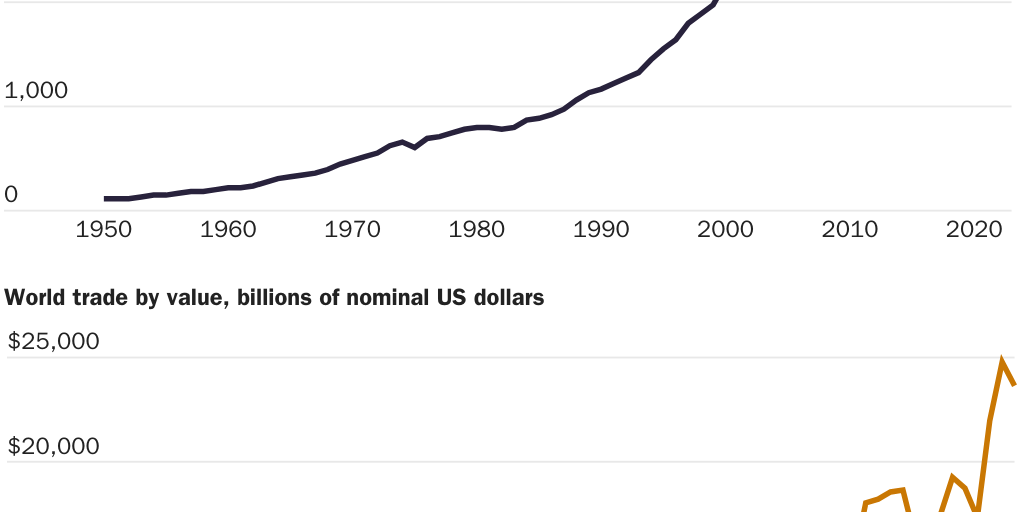
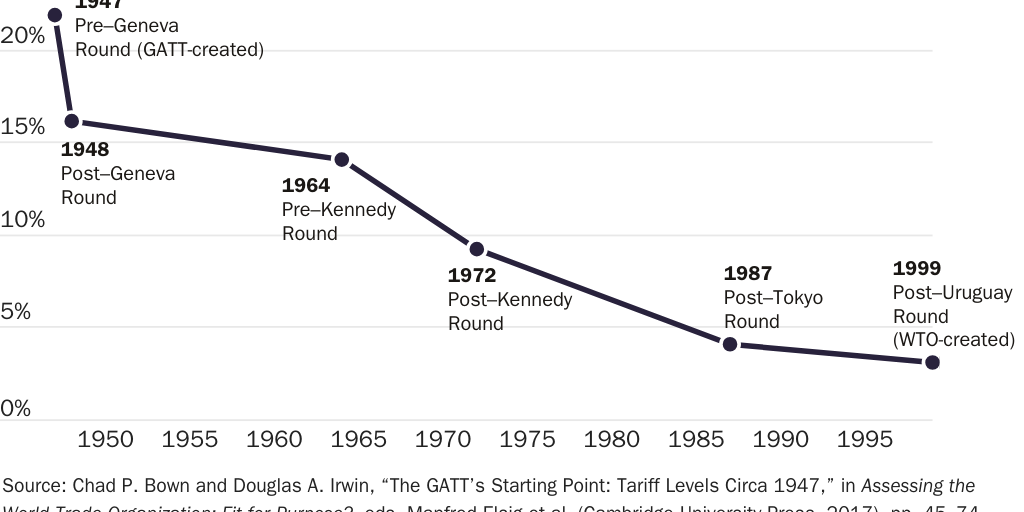
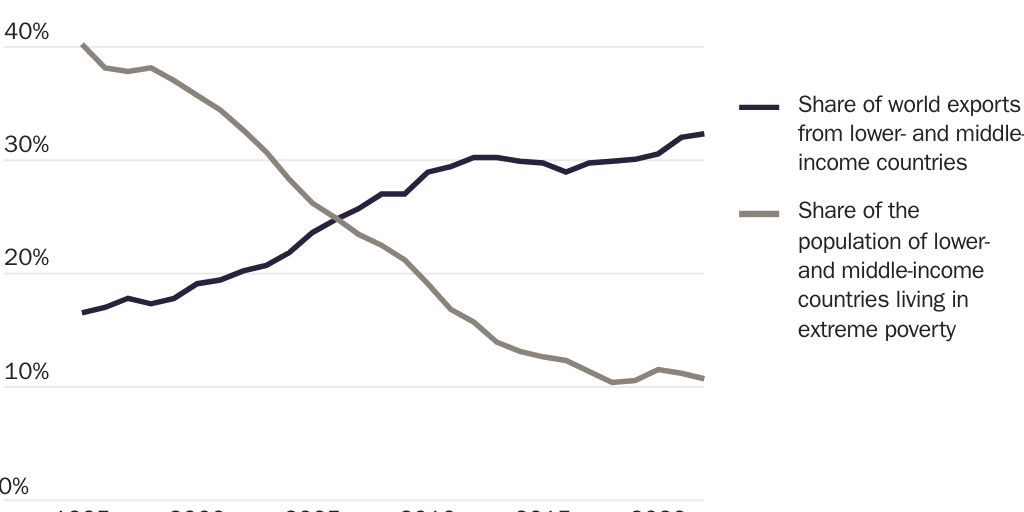
Tariff cuts and the security and predictability of the rule of law in trade, which the WTO’s multilateral trading system provides, are not the only reasons the volume and value of world trade have grown so astronomically in the past three-quarters of a century. Transportation costs have plummeted. Containerization has occurred. Communications costs are a fraction of what they once were. The internet has led to steep growth in digital trade. And more. Yet the role of the WTO in facilitating and maximizing these increases has been significant. Not only does economic theory suggest “a positive impact of Membership on trade through a reduction in trade costs by reducing tariffs and non-tariff barriers and enhancing transparency and predictability,” empirically, real-world commercial experience shows that “on average, GATT/WTO membership increased trade between members by 171% and trade between member and non-member countries by about 88%.”24
The economic benefits to the United States of participating in this rule-based multilateral trading system have been huge. Gary Clyde Hufbauer and Megan Hogan from the Peterson Institute for International Economics have concluded that the US has gained almost $2.6 trillion by engaging in world trade since 1950 (shortly after the start of the GATT).25 These gains, they report, have lifted US gross domestic product (GDP) by 10 percent. Furthermore, they calculate that as of 2022, these gains averaged $7,800 per person and $19,500 per household; Hufbauer and Hogan add that these numbers “would have been considerably larger but for political headwinds that have slowed trade expansion since the global financial crisis of 2008-09.”26
Americans have not made these economic gains at the expense of other WTO members, nor have the gains of other WTO members during the same period come at the expense of Americans. All have benefited through their participation in the WTO. This assertion has been quantified: Looking several years ago at the results of the WTO’s first 25 years, researchers for the Bertelsmann Institute in Germany found that US GDP has increased by about $87 billion annually since the establishment of the WTO in 1995 because of US membership—more than any other country.27 The study found that every WTO member has benefited from its membership in the organization during that time. Generally, whatever their stage of development, countries have benefited from their participation in the rule-based multilateral trading system in rough equivalence with their percentage share of world trade. China is second and Germany third to the US in the sum of their benefits, fitting for the size of their presence in the world economy and world trade. Still, as noted, the United States has benefited the most.28
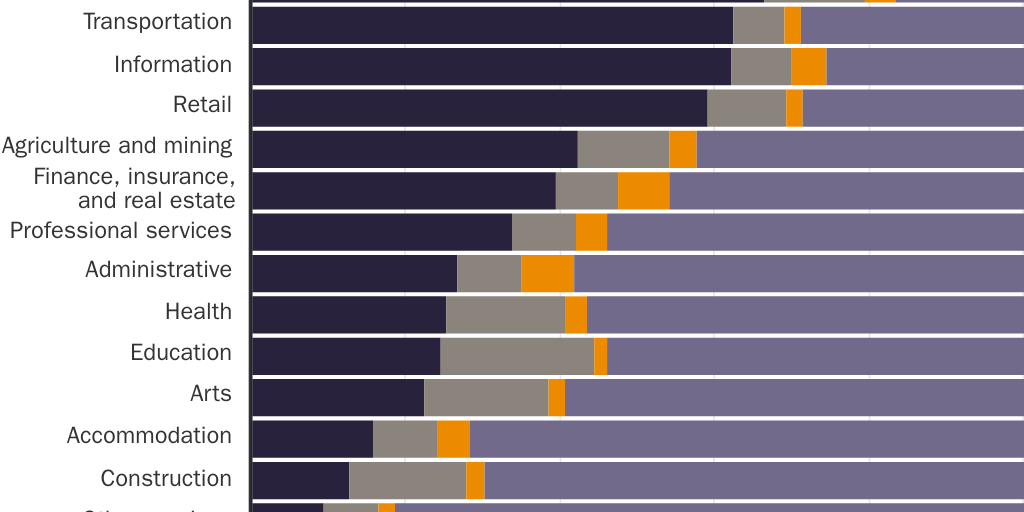
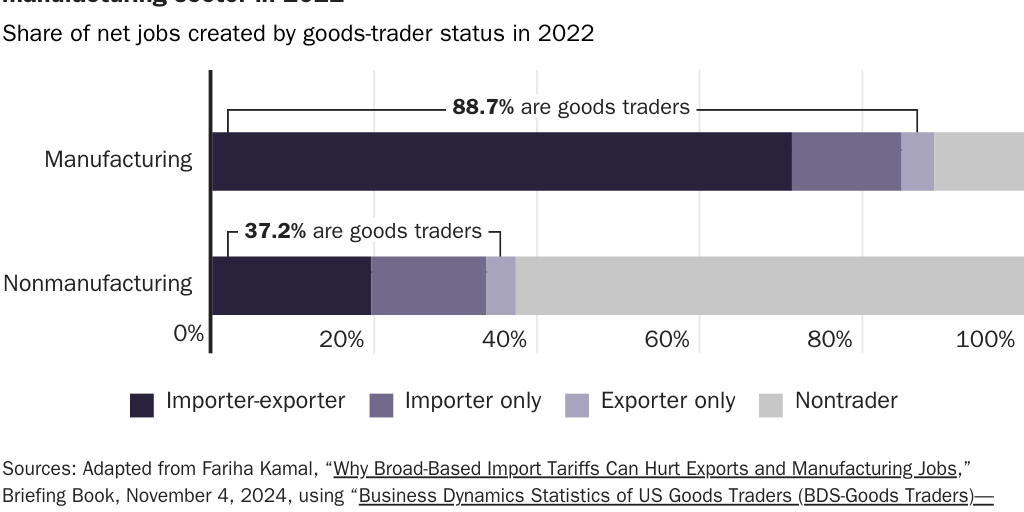
A study commissioned by the Business Roundtable found that international trade supports more than 40 million American jobs.29 In recent years, one in every five American jobs has been linked to imports and exports of goods and services. In the first 25 years following the WTO’s establishment, trade-dependent jobs grew more than four times as fast as US jobs generally. According to this study, about twice as many American jobs are supported by trade now than was the case immediately before the establishment of the WTO in 1995. Trade has had a positive impact on the growth of jobs in both the goods and services sectors of the American economy.30 By 2022, in fact, “exporter-importer” companies employed more than 80 percent of all American manufacturing workers and were responsible for more than three-quarters of all net new jobs created in the manufacturing sector (Figures 4 and 5).31 More than 15 million trade-related jobs are held by minorities. Furthermore, every one of the 50 US states realized net job gains that can be directly attributed to trade.32
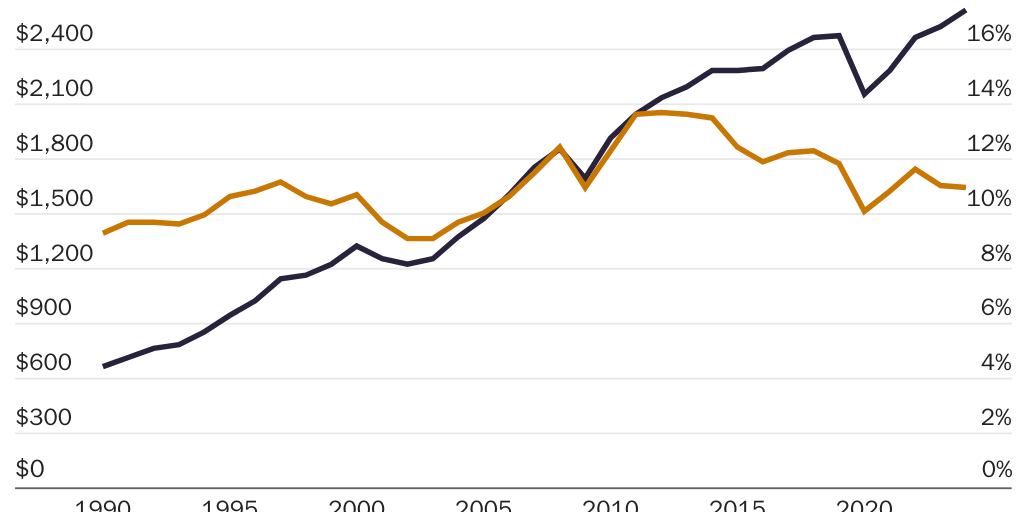
Many of the job gains and other economic benefits derived by the United States from belonging to the rule-based WTO trading system are the result of exports. The fact that only about 5 percent of the people in the world are Americans means that, as the US Chamber of Commerce has emphasized, “selling more American-made goods and services to 95% of the world’s consumers who live outside our borders is a key driver of economic growth.”33 As the Congressional Research Service has reported, “Following the establishment of the GATT in 1947 and the WTO in 1995, global tariff rates declined, spurring trade and opening markets for US exports,” and there has been an increase of 160 percent in the value (adjusted for inflation) of US exports in the three decades since the establishment of the WTO.34 American exports reached an all-time high in November 2024. Even so, and although the US is the third-largest exporter in the world, exports account for only 10 percent of American GDP, much less than that of some other countries; there is abundant opportunity to increase this relatively small percentage if the markets of other WTO members remain open and if they open more to US exports of goods and services (Figure 6).35
The economic benefits to the United States because of WTO membership also result from imports. Although American politicians generally value exports, there is a decided tendency in the American political discourse to overlook the value of imports. Indeed, there is an increasing tendency among many politicians in both major parties to denigrate and demonize imports. Yet as Adam Smith—and legions of other economists, past and present—would readily remind us, the principal reason to trade is to import. This is for the same reason we prefer to buy and use pencils made by others instead of making our own.36 Trade is an exchange in which each trader seeks to profit from obtaining and employing goods and services made by the other for a price less than that of producing those goods and services themselves.
More imports means more supply and more competition and thus, because of the economic law of supply and demand, lower prices. As the Business Roundtable has pointed out, “The largest source of job-creating activity that comes from trade [is] the extra spending power companies, workers and consumers have in their bank accounts, spending power that generates still more job-supporting economic activity. Additional spending power comes from, for example, wages of direct and indirect workers in export-related jobs, from wages of direct and indirect workers in import-related jobs, and from consumers who take advantage of lower prices for goods and services resulting from imports, which in turn supports still more economic activity that supports even more jobs.”37 Lower prices mean more affordable goods and services for American consumers, cheaper inputs for final manufacturing, cheaper products for American businesses and workers, and, not least, lower inflation.
There is an almost universal consensus among economists that these economic gains can be attributed in no small part to the incentive to innovate provided by foreign competition. Without this spark, without this stimulus, without an economy open to the goods and services of the wider world, America would be less competitive with other countries in the world marketplace and Americans would have a lower standard of living and dimmer economic future. Although they do not require openness, WTO rules promote openness. They do so because more openness to the world economy, including through trade, is necessary for enhancing economic growth and economic competitiveness.
Trade Is Win-Win for the United States
History demonstrates that no country has ever grown—and continued to grow over time—without opening economically to the wider world.38 One common characteristic of all high-growth economies in the past half-century has been that “they fully exploited the global economy,” and their sustained growth “became feasible only because the world economy became more open and more tightly integrated.”39 It may be politically expedient to blame foreign competition for our economic travails and to impose tariffs and other trade protectionism. Where there are legitimate claims of unfair trade practices, limited tariffs for a limited time can be justified as a means of trying to end such practices and are permitted under WTO rules. But, over time, a country with a domestic market increasingly closed to the wider world will shrink, both relatively and absolutely.
Related Event
China is beginning to confront this economic reality in its struggle to maintain growth. China no longer seems like an economic juggernaut to anyone who looks beyond the required recitations of “Xi Jinping thought” and the brave face and party line of the Chinese politburo. There are numerous interrelated reasons for China’s slowing growth (debt, inflation, an aging and declining population, a consequent shrinking workforce, a resulting loss of labor-cost advantage, and more), but one important reason is the retreat of the Chinese government from the demonstrated wisdom of its previously beneficial policy of reforming and opening the Chinese economy to market forces. Similarly, the more the United States closes its markets to foreign competition, the slower it will grow in the near term and the more it will decline economically over time.
The need for rules that promote openness is borne out by the global experience with the most common of the many restrictions on trade: tariffs. In 2018, the International Monetary Fund (IMF) studied the economic statistics from 151 countries from 1963 to 2014 and concluded that “tariff increases lead, in the medium term, to economically and statistically significant declines in domestic output and productivity as well as more unemployment and higher inequality.”40 Tariffs are popular among those who propose to put their own country “first” through economic nationalism. But for any country, including the US, imposing and increasing tariffs reduces competitiveness. Open economies enable growth; closed economies decline and die. Competitiveness can be maximized only if there is openness.41 A country that refuses to compete will become less competitive. The United States’ membership in the WTO promotes American competitiveness by encouraging more openness to foreign goods and services—an incalculable economic benefit.
All of this illustrates the enduring truth of a proposition that, if we can trust their current rhetoric, is no longer believed by many American politicians: Trade is win-win. Trade is not zero-sum. All the countries that have participated in the multilateral trading system in the enormous postwar growth in trade worldwide have benefited from it—none more than the United States. Entering 2025, three-quarters of a century after the establishment of this rule-based system, the American economy remained by far the world’s strongest. Even with the recent economic upheavals resulting from President Trump’s trade and other policies, no country would trade economic places with the US. Even with increasing trade competition in recent years, the economic growth of the United States relative to other countries, including its leading economic competitors, has been enviable.
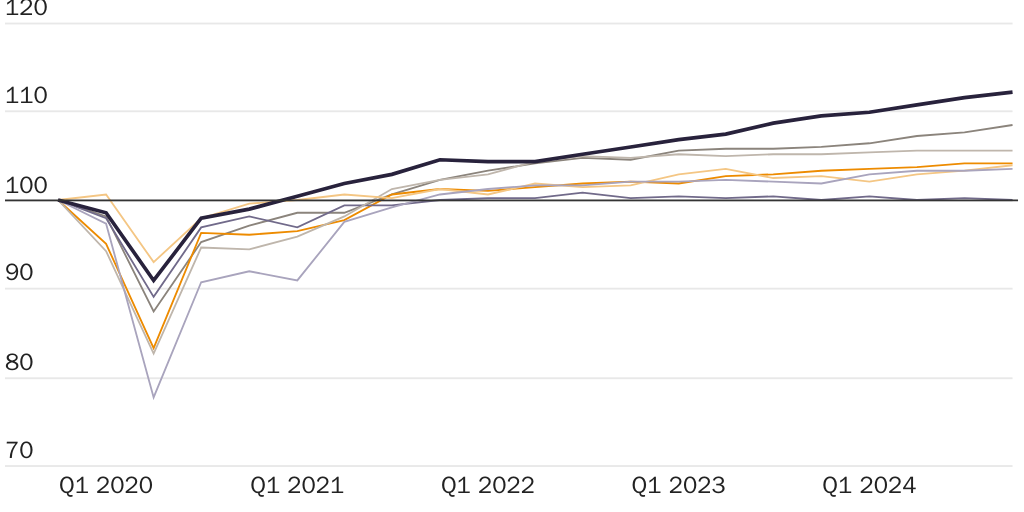
Contrary to what some political voices tell us, the American economy has not been in freefall in recent years, and certainly not because of trade. Economist Tim Harford has put it this way: “The simplest metric for economic performance is real GDP growth, on which measure the US performance has been enviable. The US grew more than 10 per cent between the end of 2019 and the second quarter of 2024. The best of the rest in the G7, Italy and Canada, grew about half as much. The UK grew less than 3 per cent. Germany didn’t grow at all.”42 More specific measures of economic performance, of course, can tell us more about the current economic state of a country and the relative well-being of its people than simply GDP growth, which does not account, among other things, for the unevenness of prosperity or disparities in economic gains. Even so, this contrast between the recent GDP growth of the US economy and that of the other G7 countries is striking (Figure 7).
As for China, according to a recent Reuters poll, the Chinese economy is expected to grow 4.8 percent in 2024 and then slow to 4.5 percent in 2025.43 This is about half the rate of annual growth to which China has been accustomed during its economic ascent of recent decades—assuming this is not an undue exaggeration of growth (the Chinese government has been known to yield to the temptation to give precedence to its annual economic targets over actual economic facts). Even assuming these Reuters poll predictions turn out to be accurate, they do not compare well with those recorded recently by the United States (which, not being burdened by the airy expectations of state planning, are considerably more likely to be accurate).
In contrast to the difficulties facing China, the GDP of the United States grew by 2.8 percent in 2024.44 As a percentage, this rate of increase in the US is only about half that in China (assuming we can believe the Chinese numbers), which causes trepidation among the China hawks in American politics and commerce. What is often forgotten, however, is that the increased growth in the United States is still—even after several decades of China’s economic rise—from a much larger base than in China. Although the Chinese are making headway in some key areas of strategic technological investment, such as artificial intelligence, and although these competitive economic challenges must be urgently addressed domestically by the US with a realistic eye to American national security—all in all, China is still very much playing economic catch-up with America.
Together, the two countries dominate the world economy. In 2024, the United States and China accounted for a combined 43.1 percent of world GDP—approaching half in nominal terms. The GDP of each country is higher than that of their closest economic followers, Japan (nominally) and India (in purchasing power), by a very large margin. Yet there remains a huge economic gap between the United States and China. In purchasing power parity, which equalizes the purchasing power of different currencies by adjusting for price level differences between countries, China now leads the United States. But in nominal terms of actual dollar-valued production, the United States still leads China by $10,894 billion annually—nearly $11 trillion. The US has a population only about one-fourth that of China. Yet the American economy remains, even after China’s long rise, 1.6 times the size of the Chinese economy on an exchange-rate basis.45
Given this and the sizeable difference between the two countries’ populations, the American people are vastly more prosperous on an individual basis than the Chinese people. The Chinese GDP is about two-thirds that of the US. The per capita income in the United States in nominal terms is 6.68 times that in China. Even in purchasing power parity (PPP) terms, Americans per capita have 3.29 times the income of the Chinese. Per capita, the United States is the sixth-richest country in the world, while China ranks 73rd. (The five richest countries are mostly city-states fueled by petroleum wealth.46) Whatever the current economic challenges facing many ordinary Americans, an individual American is on average, by any economic measure, much better off economically than an individual Chinese. There are millions of Americans who are suffering economically, but they would not be better off if they were in China. Millions of Chinese would no doubt love to leave repressive China and emigrate to the US, but how many Americans are emigrating to China?
In particular, in terms of continued relative American economic success, the long-term productivity growth of the United States is, as the Financial Times put it, “the envy of the developed world.”47 Productivity growth is the best measure of an economy’s efficiency in allocating its capital, labor, land, knowledge, and other resources. As the Nobel Prize–winning economist Paul Krugman famously said, “Productivity is not everything, but in the long run, it’s almost everything.”48 The absence of productivity growth means the absence of future economic advancement. Higher productivity growth means higher wages for workers, more private-sector profitability, more governmental tax revenue to provide more public goods and services, and, overall, a higher standard of living. By this measure, the American economy has been moving in the right direction in recent years, despite what most American voters seem to think. US productivity has been growing. During the three months concluding with September 2024, US output per hour was 8.9 percent higher than at the end of 2019, just before the onset of the COVID-19 pandemic. Overall, US labor productivity has grown by 30 percent since the global financial crisis of 2008. This increase in labor productivity is three times the pace of that of the European Union (EU) and the UK. According to the Financial Times,
That productivity gap, visible for a decade, is reshaping the hierarchy of the global economy. Economic growth in the Eurozone has been a third of the US’s since the pandemic, and output is set to expand by just 0.8 per cent this year, according to the IMF. Similarly, the economies of Japan and the UK have grown only by 3 per cent over the past five years. In fact, in productivity growth the US is rapidly outstripping almost all advanced economies, many of which are caught in a spiral of low growth, weakening living standards, strained public finances and impaired geopolitical influence.49
The eminent British financial commentator Martin Wolf has said much the same in underscoring the comparative extent of American prosperity in the world:
The sustained prosperity of the US is astounding. A few western countries have even higher real incomes per head: Switzerland is one. But real GDP per head in the larger high-income countries is below the US average. Moreover, these countries have fallen further behind in this century. In 2023, German real GDP per head was 84 per cent of US levels, down from 92 per cent in 2000. The UK’s was 73 per cent of US levels, down from 82 per cent in 2000. This relative outperformance is remarkable if one considers how big and diverse the US is or that one would have expected catch-up, not relative decline, by poorer countries elsewhere.50
All of this has been accomplished during US membership in the WTO and, in part, because of it. More trade has created more competition, which has inspired more innovation, which has increased productivity, which has increased overall American prosperity. Withdrawing from the WTO and turning inward and away from international trade would undermine and reverse this hugely beneficial creative process.
Potential Economic Costs of WTO Withdrawal
Far from inhibiting US economic growth (or, for that matter, the growth of other WTO members), membership in the WTO and its predecessor, the GATT, has brought enormous overall economic benefits to the American economy and the American people. For the most part, these benefits, since the GATT’s establishment in the wake of World War II, have been secured by the United States through participation in multilateral rounds of trade negotiations. These negotiations have been based on the nondiscrimination rule of most-favored-nation treatment, under which binding commitments made by one member of the trading system to lower tariff or other trade barriers to the imports of a particular product from another member of the system are immediately applied to the like products imported from every other member of the system—effectively, worldwide. This multilateralism multiplies the volume of trade affected by such a commitment, thus multiplying the resulting trade gains and therefore the overall economic benefits.
The flip side of these economic benefits is the potential cost to the US economy from WTO withdrawal. Should the United States withdraw from the multilateral trading system, other WTO members would no longer be bound by WTO rules in their trade relations with the US. Moreover, they would no longer be bound by the many trade commitments they made to the United States during the nearly eight decades since the GATT’s creation. They would be free to break those commitments by increasing tariffs as much as they wished and by reinstating nontariff trade barriers. Without WTO membership, the United States would be left on its own to navigate the flow of world trade without the helpful legal shelter of the WTO rules framework. Without recourse to the international rule of law in the WTO, America would have to rely solely on the political employment of its economic power.
Does this matter? Does the United States not have abundant economic leverage to influence the actions of our trading partners even if it is not a member of the multilateral trading system? The current prevailing assumption in Washington is that yes, of course it does. And initially this may seem to be the case, as unilateral measures are taken by the second Trump administration that multiply tariffs and other trade barriers with American adversaries and allies alike among other WTO members. In the near term, there may be reason for bullishness on the trade bullying and tariff levying that have proliferated since President Trump returned to the White House, rooted in both economic and noneconomic motivations (and much of it in clear violation of the legal obligations of the United States as a member of the WTO). Some may think at first: If other countries will not do as we say, why not coerce them with the considerable weight of our economic sway?
But as the United States embarks upon fully asserting its economic leverage in world trade, it will become increasingly clear that American leverage is not as overpowering as is currently assumed inside the Beltway. An overestimation of the extent of American leverage is the mistaken premise not only of Trump’s trade policy, but also of the entirety of his foreign policy. Where the shape and composition of the world economy are concerned, today is not yesterday. The year 2025 is not 1955, or even 1995. Although the size of the US economy has grown significantly since the creation of the GATT, the US share of the world economy is smaller than it was early in the postwar years, before other developed countries, devastated by war, rebuilt (often with American help) and before many developing countries claimed their independence (with American support) and began to grow (again, often with American help).
This is also true of the American share of world trade.51 Now under 15 percent, it has declined significantly since 2017 during the presidencies of Donald Trump and Joe Biden, when increased trade with other countries through lowered trade barriers has not been a national priority, to put it mildly. Nor do other countries depend as much on access to the US market as Trump and his allies think. The United States remains the largest importer in the world. (China is second, despite its import restrictions.) However, the US accounts for only about 13 percent of world imports.52 This means that 87 percent of world imports occur elsewhere. Yes, the US market is important to other countries, but there are other markets where they can sell their goods.
Related Media
The Financial Times recently noted that global shipping stocks did not plunge with news of Trump’s reelection because “the US is a sizeable, rather than giant, tassel in the global trade tapestry,” accounting for just 5 percent of global seaborne imports by tonnage.53 (Bilateral US-China trade accounts for just 1.4 percent.) In fact, “Trump’s last experiment with tariffs ended up clipping global seaborne trade—measured in tonnes/km—by only 0.5 percent.”54 Economists Sherman Robinson and Karen Thierfelder, meanwhile, have projected that foreign exporters will not react to future US tariffs by lowering their prices to maintain US market share, because “in a world economy where the US accounts for only 10 percent of global trade and potentially rival trade bloc[s] have emerged in Europe and [East and Southeast] Asia, the US is no longer hegemonic in global markets.”55 Trump 2.0 on trade is not unfolding in the same global economic circumstances as Trump 1.0, and it’s operating in a different economic universe from the global economy of the 1980s before the establishment of the WTO.
Some of America’s trading partners are retaliating against unilateral tariffs that deny access to the US market and violate WTO rules against trade discrimination, which further harms the American economy—and their own economies as well. But some are simply taking their trade elsewhere to counter US tariffs and other forms of trade discrimination.56 Increasingly, reports the New York Times, those trading partners are “forging their own economic partnerships without the United States. If Washington is putting up a higher fence around its trade, other nations are lowering theirs.”57 As Ruchir Sharma, chair of Rockefeller International, has written, the US has become “an outlier, looking on as others cultivated the art of the trade deal.”58 On trade, the rest of the world has kept turning while the United States has mostly chosen to stand still—or to go in reverse toward unilateralism and protectionism.
Although first Trump, then Biden, and now Trump again, since 2017, have “cut not a single new trade deal” during that time, the EU, as Sharma states, has “negotiated eight agreements and China has concluded nine, including a landmark 15-nation partnership in Asia,” the Regional Comprehensive Economic Partnership.59 With President Trump’s return to office, and with both the threats and the reality of vastly increased trade protectionism by the United States, America’s largest trading partners are looking elsewhere for new markets through new trade arrangements (Figure 8). The United States is being left out of these new deals. As a result, it increasingly risks being left behind economically.
![Copy: 20250409_LINCICOME_Bacchus_WTO Withdrawal_Figure 8 [print]: There are 374 regional free trade agreements (FTAs) in force around the world, nearly 80 of which entered into force since the United States last signed an FTA](https://infogram-thumbs-1024.s3-eu-west-1.amazonaws.com/fae5c3fc-fbee-4364-a57e-17635415538a.jpg)
As my Cato Institute colleague Scott Lincicome has reported:
Since the last new US free trade agreement (FTA) entered into force in 2012, in fact, other governments have implemented a whopping 131 of them. This includes 17 by the EU, 15 by China, four by Mexico, and 38 by the post-Brexit UK (including its accession to the Trans-Pacific Partnership deal that Trump abandoned and to which Biden refused to return). In just the Biden era alone, there have been 58 new FTAs—even as pandemic and war and geopolitical strife and “deglobalization” raged. And … there are plenty of new non-US FTAs under negotiation today. So, while the United States sits still, other nations—including China—are writing the rules on 21st century issues like digital trade; their companies, farmers, and consumers are gaining better access to overseas markets than what their US counterparts now have.60
In the meantime, American economic leverage has declined relatively and, if current US trade policies persist, will be further reduced.
What would happen if the US intensified this trend by withdrawing from the multilateral trading system? There would be two immediate consequences for the United States from WTO withdrawal. First, it would expose American goods and services to unprecedented discrimination in world trade. The harmful effects on Americans of unilateral American tariffs on the trade of other WTO members are bad enough. These harmful effects would be markedly increased by US withdrawal from the WTO because American goods and services would, even more than now in response to scofflaw US unilateral tariffs, face the prospect of retaliatory tariffs and other retaliatory trade actions because WTO rules of nondiscrimination would no longer apply to trade with the United States. US products would no longer be automatically entitled to most-favored-nation treatment and national treatment. Thus, WTO members would be free to provide advantages to imported goods and services from other countries without also immediately and unconditionally providing them to products from the United States. Likewise, they would be free to discriminate in favor of their domestic producers of products over imported like products from the United States.
This could be avoided in the aftermath of US withdrawal from the WTO only if the United States had in place free trade agreements (FTAs) with its trading partners that included equivalent rules against trade discrimination, as FTAs generally do. However, in contrast to many other major trading countries that have pursued an increasing number of FTAs in recent years amid a political impasse in the WTO, the United States has, on a bipartisan basis, rejected the negotiation of any new trade agreements in the past decade. (No one in Congress wants to be put in the risky political position of having to vote to approve a new trade agreement.) Furthermore, there is no indication that President Trump sees the negotiation of additional FTAs as a priority. The United States has only 14 FTAs with a total of 20 countries. These FTAs cover about 40 percent of US exports, which would leave about 60 percent of US exports without international legal protection against trade discrimination if the United States withdrew from the WTO.61
Even if the United States reversed course and turned to negotiating new FTAs following its withdrawal from the WTO, empirical evidence suggests that the bilateral or plurilateral benefits from such new deals would not match what has been and could be accomplished economically through WTO multilateralism. Upon the creation of a free trade agreement or a customs union, trade can be diverted from a more efficient source outside the new arrangement to a less efficient source inside it. This does not increase trade but merely shifts it—with resulting inefficiencies and higher costs. This trade diversion is, in the language of economists, “welfare reducing.” On balance, as a World Bank report notes, “deep agreements lead to more trade creation and less trade diversion than shallow agreements,” yet in contrast to the welfare-increasing result of trade multilateralism, such an overall result cannot be assumed with an FTA, especially one that is bilateral and relatively shallow economically.62
Second, should the United States leave the WTO, it would also forfeit the vast economic benefits it has accumulated through decades of multilateral trade negotiations by the GATT and WTO, including those derived from fair and nondiscriminatory treatment for thousands upon thousands of US goods and services and from necessary protections for patents, trademarks, copyrights, and other intellectual property. These existing benefits in the form of “concessions” other WTO members have made in relation to their trade involving US products—no tariffs or lower tariffs, the removal of nontariff trade barriers such as regulatory discrimination, and much more—are part of the WTO Agreement. If the United States were no longer a party to that agreement, then the countries that have made those trade concessions on a host of American products would no longer be bound by them. Those trade commitments would no longer have any legal effect. Other WTO members would be free to withdraw those concessions, resulting in higher tariffs and other discriminatory applications on American exports, which would further harm American businesses and workers and hinder US economic growth (Figure 9).
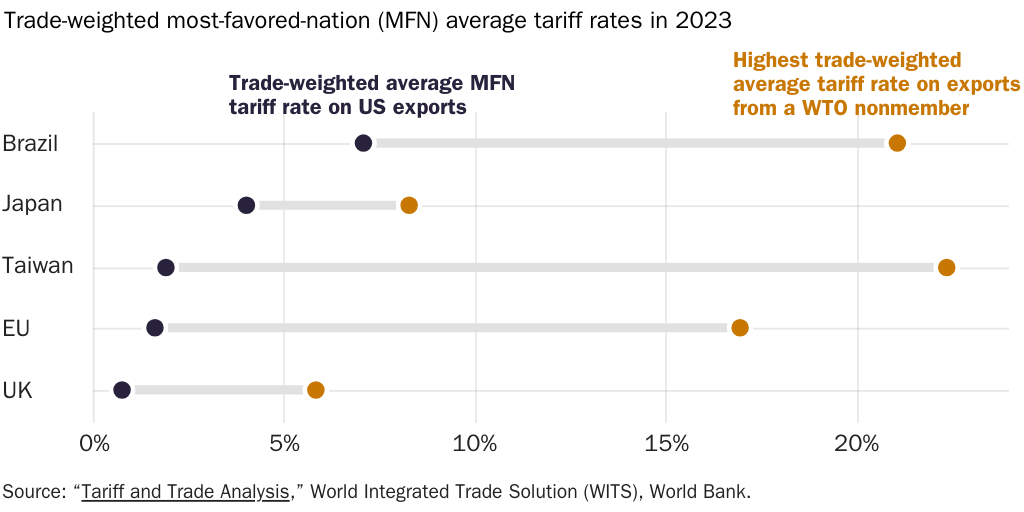
In addition to these two immediate economic costs of American withdrawal from the WTO, the US would also miss out on the benefits of any new trade concessions that might yet be agreed upon by other WTO members, including in areas vital to the future of the American economy such as digital trade and intellectual property. Senator Hawley has said that the United States should not just withdraw from the WTO but also abolish it.63 But the United States has neither the legal authority to abolish the WTO nor any power to do so, short of a military occupation of the WTO headquarters in Geneva—one act of coercion not yet threatened by Trump in his second term. Without the United States, the 165 other members of the WTO would persist in trying to find global trade solutions by negotiating and implementing new rules. American goods and services would not have the benefit of any of these new rules, and the US would not have a say in negotiating them. In the absence of the United States at the negotiating table, these new rules—which would nevertheless exist concurrently with US trade and affect it globally—might not be rules the United States would welcome.
One may ask, though: Isn’t the WTO increasingly irrelevant to world trade? Furthermore, if the United States reversed its reluctance to enter into new FTAs through negotiations—at any one time, with one or a few of its trading partners instead of 165 of them at the same time—wouldn’t the US still have the economic leverage it needed to make certain that it would be more likely to get more of its own way at the negotiating table? Wouldn’t this be a sufficient substitute for WTO membership?
No, it would not, partly because the WTO is still relevant. A WTO study done a few months before President Trump’s barrage of universal and other tariffs showed that, at that time, despite the proliferation of FTAs outside the WTO legal framework, and despite the consequent assumption in political and media circles of the increasing sidelining of the WTO in world trade, 83 percent of global trade in goods was still governed by the WTO principle of most-favored-nation treatment.64 For all the political focus on FTAs in the United States and elsewhere, and despite the trade discrimination inherent in FTAs, more than four-fifths of world trade in goods still flowed then consistently with this basic WTO rule. The latest Trump tariff hikes no doubt have diminished this percentage somewhat, but it holds true at least for now that, as the WTO explained these results, the most-favored-nation principle remains “a critical pillar of the global trading system.”65 Furthermore, although the United States could conceivably bully smaller countries into concluding bilateral trade agreements mostly on US terms, it simply does not have sufficient economic leverage to bully its larger trading partners such as China and the EU into economic acquiescence. Ultimately, most of the legitimate trade grievances of the United States can only be resolved multilaterally. Why, for example, would one country agree to cut its manufacturing or agricultural subsidies in a bilateral deal with the US if other countries that provided generous subsidies for such production were not part of that deal? Consequently, going around the WTO would not suffice as a substitute for staying in it.
Potential Geopolitical Costs of WTO Withdrawal
WTO withdrawal would also have high geopolitical costs for the United States. Coming on the heels of recent reckless and arbitrary global and other tariff increases, such a withdrawal would further erode the credibility of the United States as a world leader in trade. As the Wall Street Journal succinctly put it, it matters whether other countries—especially our firmest friends—are “able to trust America’s word as a reliable ally and trading partner.”66 In trade, as in much else, trust means being able to rely on someone else to keep their end of a bargain. A decline of trust is at the core of much that has gone wrong with America and the rest of the world lately. Geopolitically, the United States cannot benefit by becoming less trustworthy, in trade or otherwise.
One geopolitical cost of US withdrawal would be this: If the United States does not remain in the WTO, much of the organization’s leadership would fall by default to the second-leading trading country in the world, China. The EU, Japan, India, Canada, Brazil, and other WTO members would continue to help lead, and they would probably try to lead more. But without question, China would play a much larger role than it does now. The only question is whether, in the absence of the United States, China would end up playing a dominant role. Is this a goal of those in Congress who wish to remove the United States from the WTO?
Amid the bipartisan indifference to the governance and course of the WTO demonstrated by both the Trump and Biden administrations, China has gradually assumed a role of greater leadership within the institution, as might be expected of such a large trading country. While the United States has backed away from the WTO, China has increasingly embraced it while portraying itself—with some justification—as a defender of the multilateral trading system. Because it understands the benefits of WTO membership in a way the US appears to have forgotten, China, in a number of ways, has acted responsibly in participating in the multilateral leadership of the WTO.
But does the United States want to cede to China even more trade leadership worldwide than its overall share of world trade would justify? Would America be at even greater risk of forfeiting its current bountiful economic benefits from WTO membership if China stepped forward to lead more within the organization in the aftermath of a US withdrawal? As Sen. Charles Grassley, the senior Republican senator from Iowa and president pro tempore of the Senate, has said, “Withdrawing from the WTO would only leave a vacuum for China to fill and diminish America’s position of strength.”67
Historically, there has been a recurring illusion among Americans that the United States can somehow, economically and otherwise, go its own way in the world. Today’s fervent economic nationalism does not yet seem to be a commitment to a comprehensive economic isolationism, and at this point, President Trump seems more inclined toward politically motivated economic measures intended to force the rest of the world to bend to his will than he does toward ignoring the rest of the world. Indeed, this is a common thread in all his domestic and foreign policies, including his policies on trade: bend to his will.
Yet it is folly to abandon global rules the United States played a major role in writing—and got the other members of the WTO to agree to follow—for an arbitrary policy of continuing economic coercion. The uncertainty of a trade policy predicated on presidential whim is proving sufficient alone to undermine the steady growth of the American economy and the global economy. Sooner or later, the accumulation of arbitrary actions will produce a backlash among America’s friends and adversaries alike, with profound adverse economic and geopolitical consequences for the United States. In abandoning WTO rules and WTO treaty commitments by imposing discriminatory tariffs throughout the world, the United States is not only violating international law; it is also overplaying its economic hand. Abandoning the WTO altogether would only add to the ultimate economic and geopolitical losses for the United States.
Legal Benefits of WTO Membership (and Costs of Withdrawal)
A particularly large cost of WTO withdrawal for the United States would be the loss of the legal right to have recourse to WTO dispute settlement. Participation in the WTO dispute settlement system enables the United States to rely on the rule of law instead of the rule of power in international trade.68 This may not seem significant to those in the United States who have been busy unilaterally asserting and blithely overestimating the reach and resonance of American economic power in today’s world. But, as the accumulation of this overestimation gradually begins to demonstrate the limits to which the US can depend on getting its way on trade (and increasingly nontrade69) concerns through economic coercion, American leaders will be reminded of why the United States chose the rule of law when helping establish the WTO 30 years ago.
The debate over whether it’s in the United States’ national interest to go it alone without international legal hindrance or to work together within a legal framework of agreed rules in advancing international trade is not new. Despite the opposition of economic nationalists at the time, a substantial majority of Congress chose the rule of law over the rule of power in enacting the Uruguay Round Agreements Act in 1994. They chose to establish and participate in an international system of binding rules that could be upheld in international dispute settlement through the last resort of economic sanctions in the form of losing the benefits of trade concessions previously granted by other members of the WTO system. And they understood at the time that such a system can work for the United States and for the WTO’s other members only if the United States is subject to the same rules as every other member of the system. This is the necessary price for ensuring the “security and predictability” in conducting trade that is provided by the system and benefits the US enormously.70 Like all other WTO members, the United States cannot—within the rules—act arbitrarily; it must act consistently with the rules or forfeit some of the economic benefits of being in the WTO-based multilateral trading system.
Soon enough, the backlash against American trade bullying through arbitrary astronomical tariffs and other discriminatory trade actions will renew this domestic debate from the 1990s. When that happens, as the American economy begins to feel the negative consequences of the resulting backlash, American decisionmakers will be reminded of the virtues of WTO dispute settlement and the US national interest in making it a success. They will be reminded of why the United States, more than 30 years ago, chose to establish and support binding multilateral trade rules backed by a dispute settlement system through which those rules could be upheld and enforced. But if by that time the United States has withdrawn from its membership in the WTO, how much harder will it be to restore and strengthen the international rule of law in trade?
The American ability to renew this debate and reach the right decision is reduced by the prevailing and mistaken view of WTO dispute settlement as biased that is held by many US decisionmakers. This view is fed—as is so much of policymaking these days—by misinformation. Above all, there is the perception, expressed by President Trump, that “we lose … almost all the lawsuits in the WTO.”71 Moreover, other US decisionmakers often agree with him that WTO jurists in dispute settlement are biased against the United States. It follows logically from these premises that, opposed and discriminated against by a biased international organization, the United States should get out of it. Why prolong the apparent mistake of creating and joining it in the first place?
But these anti-WTO arguments are based on inaccurate premises. In reality, the United States has won or settled a solid majority of the cases it has brought as a complainant in WTO dispute settlement—including the overwhelming majority of the cases it has brought against China—and the United States has the best success record of any complainant.72 By contrast, the United States, like every other major trading country, including China, has lost most of the cases that have been brought against it in WTO dispute settlement, including a series of cases that were lost needlessly because the US has been recalcitrant in complying with previous adverse rulings on the same or similar legal issues (Figure 10).73 For example, on the use of a methodology called “zeroing” when making determinations about dumping (i.e., whether a foreign product is exported at a price that is lower than the domestic price in the exporting market) and calculating dumping margins, the United States decided not to comply with repeated WTO rulings that the use of this methodology is inconsistent with WTO rules on the use of trade remedies to which the United States has agreed—and played a major role in writing.74 Deciding not to comply with these rulings was within the sovereign rights of the United States, which are acknowledged in the WTO Agreement, but it nonetheless inflated the number of US losses at the WTO.
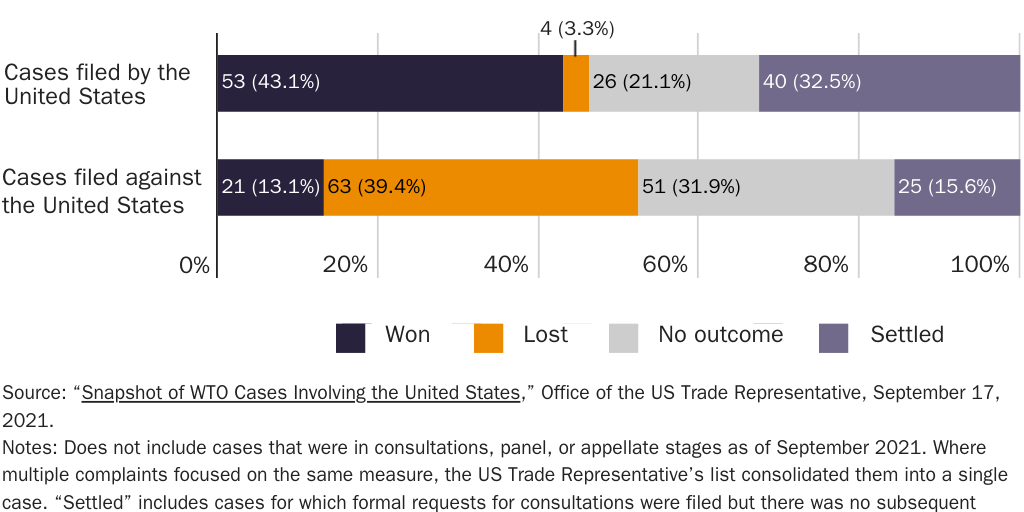
Thus, some of the United States’ loss record when complaints are brought against it in WTO dispute settlement is of its own choosing. As with the zeroing disputes, many of the cases the US has lost have involved the expansive American use of antidumping duties, countervailing duties to foreign governmental subsidies, and other kinds of trade retaliation against alleged unfair trade practices by US trading partners. In these cases, the United States acted outside the legal boundaries of the WTO rules that allow such trade restrictions and set out both the circumstances in which they can be applied and the procedures to be followed in applying them. When the United States lost these disputes, it was within its rights in choosing, in an exercise of its sovereignty, not to reform the laws and practices at fault. This choice, however, resulted in more disputes on the same legal issues and thus additional US losses in WTO trade disputes.
The US record on cases brought against it has also worsened recently because both the Trump and Biden administrations have simply ignored WTO legal obligations, especially the obligation of most-favored-nation treatment, in imposing and applying steel, aluminum, and other unilateral tariffs. Predictably, these actions have been judged in dispute settlement as violations by the United States of the WTO Agreement.75 The huge pile of tariffs that have been heaped onto international trade by President Trump since he returned to office will only add to the growing list of US losses in WTO dispute settlement.
Generally, the dispute settlement record of the United States is not unlike that of other WTO members. The main difference is that, as the largest trading country in the system, the United States is a party to the largest number of trade disputes. Generally, the US record of “wins” and “losses” reflects the institutional dynamics within the WTO: Out of more than 600 international trade disputes so far, complaining countries have won about 90 percent of the cases they have taken to the WTO dispute settlement system for resolution. Countries tend not to undertake the laborious task of filing a complaint against another country in WTO dispute settlement—with all the costs and domestic and geopolitical consequences that sometimes result—unless they believe they have a strong legal case that can be made.
In addition, as to supposed wins and losses, a victory may be said to have been achieved in a dispute when at least one legal claim is upheld; but not all legal claims are equal, and prevailing or not on some claims may be far more important than doing so on others. Indeed, a country may lose on a legal issue in one dispute but then employ that very ruling to prevail in a future dispute. For example, the United States has done this successfully in cases it has brought against China on Chinese violations of the WTO obligation to protect intellectual property rights—in which the US relied on WTO rulings that had been made against the United States in a previous unrelated dispute.76 Thus, the calculation of alleged wins and losses in WTO dispute settlement is at best an imperfect art.
Related Event
Isn’t it the case, though, that other WTO members routinely ignore WTO rulings? No. Far from it. Until recently, almost all WTO members have chosen, in an exercise of their sovereignty, to bring their trade measures into compliance with their WTO obligations within a reasonable period of time when it has been determined in dispute settlement proceedings that they have acted inconsistently with those obligations. This is partly because these countries want to avoid the last resort of lawful economic sanctions being imposed on their trade under WTO rules if they choose not to comply. It is also because WTO members, despite what they may say publicly, generally know they have lost in dispute settlement because they should have lost. Furthermore, these other members, especially the smaller countries, understand that their overall national interest is best served by maintaining the rule of law in trade that counters the threat of trade bullying by larger countries. Alone among all the WTO members, it is only the United States that in recent years has routinely ignored WTO rules and adverse WTO rulings.
In addition to disinformation about the US record in WTO dispute settlement, there also is no evidence that WTO jurists—some of whom are Americans—are biased against the United States. WTO jurists do not serve any one country; they serve the multilateral trading system. Toward this end, in effect, they shed their nationality when they become WTO jurists. According to the WTO Rules of Conduct, WTO jurists “shall be independent and impartial” and “shall avoid direct or indirect conflicts of interest,” among other requirements designed to safeguard “the integrity and impartiality” of the dispute settlement system.77 In the three decades since the WTO’s establishment and the adoption of these rules of conduct, the United States has not brought a single claim contending that a WTO jurist was not independent and impartial or had a direct or indirect conflict of interest. Nor has anyone else. Allegations of jurist bias—often after losing a dispute—are mere politics.
In rendering their rulings in appeals, WTO Appellate Body members are said by the United States to have frequently engaged in “overreaching” and in “gap filling” that have altered the obligations in the WTO Agreement. This criticism is widely taken as gospel by many in both major political parties—who perhaps have never read the WTO dispute settlement rules in the WTO Agreement or any of the detailed Appellate Body judgments in dispute settlement.78 The other members of the WTO—who know better, especially those that have lost WTO cases to the United States—generally dismiss such criticism as unwarranted political rhetoric.
Contrary to the common portrayal in the United States, the Appellate Body has done its job properly as mandated in the WTO Agreement. In particular, WTO members, including the United States, have instructed WTO jurists to “clarify the existing provisions” of the various trade agreements that comprise the WTO Agreement “in accordance with customary rules of interpretation of public international law.”79 Those customary rules require that a treaty shall be interpreted in good faith in accordance with the ordinary meaning of the terms of the treaty in their context and in light of its object and purpose as reflected in the treaty. This is not “overreaching” or “gap filling.” It is simply the Appellate Body doing what the members of the WTO have told it to do in the WTO Agreement. There is nothing the Appellate Body has done that justifies the dismantling of the tribunal through US refusal to join with other WTO members in appointing new appellate jurists.
Jurists, of course, are human and less than perfect, just like the rest of us. If, in fulfilling their mandate under the WTO Agreement by exercising their independent and impartial judgment, the members of the Appellate Body make a human mistake by reaching the wrong result while doing their job of clarifying WTO obligations, there is a ready remedy. WTO members can overrule the Appellate Body’s ruling by adopting their own legal interpretation, which will be binding on all WTO jurists as well as on all WTO members. This can be done by a favorable vote of a “three-fourths majority of the Members.”80 Members of the WTO have yet to invoke this opportunity, which has been part of the WTO Agreement since the outset but is available to all members if they can secure the support of three-fourths of the membership. So far, the United States has not sought to invoke this provision to overturn an Appellate Body legal ruling. (Neither, for that matter, has any other WTO member.) Could it be that the United States does not have the votes to support its claims? This inaction speaks volumes about the legitimacy of the US complaints about Appellate Body rulings and the folly of the United States in dismantling the Appellate Body by depriving it of any new judges.
The United States faces a choice today—as it did 30 years ago—between the rule of law and the rule of power. Withdrawing from the WTO would be a self-defeating embrace of the rule of power based on an errant notion of the extent of American economic power in the world. In contrast, remaining within the WTO would preserve the United States’ option of pursuing its true national interest by returning to, renewing, and further establishing and maintaining the international rule of law in global trade.
China Is Not a Rebuttal of the Case for Staying in the WTO
But what about China? Many critics of the multilateral trading system claim that China’s continued membership in the WTO necessitates US withdrawal from the organization. Member governments, they argue, rubber-stamped China’s WTO entry without requiring sufficient reforms to its state-led economic system. Thus, they contend, because the organization and its rules are intended for “pure” market economies like the United States, those rules cannot handle Chinese state capitalism and Beijing’s rampant use of protectionism and industrial policy, which, in their view, have caused so much economic damage to the US economy. Yet such claims reflect at best a misguided and incomplete understanding of China’s WTO membership and WTO disciplines.
First, under pressure especially from the United States during more than a decade of tough negotiations, China undertook a wide array of significant trade and economic policy reforms in advance of its 2001 accession to the WTO, well beyond those of most members (Figure 11). As Scott Lincicome detailed in a 2021 paper on the “China Shock”:
China first applied to join the WTO (under its predecessor, the General Agreement on Tariffs and Trade) in 1985, then reapplied in 1995 when the WTO came into being, and finally acceded to the body in 2001.… China’s accession over this time involved dozens of bilateral and multilateral (“working party”) meetings, negotiating texts, disclosures, and—as previously noted—internal reforms. China’s final accession package—a “Working Party Report” and “Protocol of Accession,” plus liberalization schedules for goods and services—contained hundreds of pages of commitments (by far the most of any acceding member to that point and considered still today to be some of the deepest ever). This included many “WTO-plus” commitments that the United States and other members dictated (via bilateral accession agreements) and have since been used, for example, to challenge Chinese laws through dispute settlement or to restrict Chinese imports.
Notably, the United States was the final holdout among large industrialized nations to approve China’s WTO accession via bilateral negotiations, demanding ever more concessions from the Chinese government over a contentious 13-year negotiation. Contrary to allegations from President Trump and others, the United States did not simply “rubber-stamp” China’s WTO accession or base it on Pollyannaish dreams of Chinese democratization.81
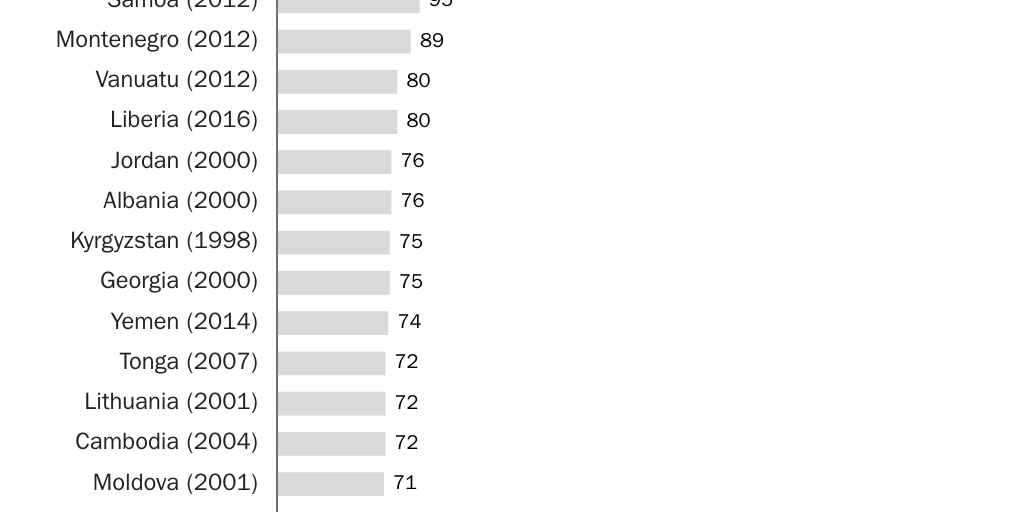
Lincicome added, citing several rigorous studies in this regard, that “the reforms that China undertook during its WTO accession—along with additional reforms made shortly after accession, often in direct response to WTO requirements (and member demands)—were so substantial as to drive China’s incredible export competitiveness” in the subsequent decades.82 It makes no sense for WTO critics to claim that US withdrawal is appropriate because the organization did not sufficiently push China to implement market-oriented policy reforms while also claiming that withdrawal is appropriate because of the economic effects of those very same WTO-driven and market-oriented policy reforms.
Second, it is also wrong to claim that WTO rules are intended for only “pure” or “real” market economies. The WTO is an open multilateral trade organization whose membership includes a wide variety of economic systems with varying levels of state intervention and control. For decades, it tolerated Eastern Bloc command-and-control economies. Today, the institution counts as members communist Cuba and Vietnam, several socialistic and autocratic countries, and democratic/capitalist ones with large state sectors or numerous state-owned industries. There is nothing in WTO rules that dictates the composition of a member’s economic system or prohibits any particular form of economic system. Furthermore, provisions in the WTO Agreement on subsidies, state-owned enterprises, price regulations, and other government economic interventions make clear that the organization’s rules contemplate a diverse membership that includes economies using such measures to varying degrees. In this respect, the Chinese economy differs from the economies of some other WTO members only in size and degree, not in kind.
Third, WTO mechanisms can discipline recent Chinese backsliding on some of its WTO commitments and on its broader market liberalization efforts—if the United States and other WTO members would make the effort to challenge them. China has not always complied with adverse WTO rulings as quickly as it should have. Moreover, there is much legitimate criticism about some Chinese measures affecting trade that have not yet been challenged in WTO dispute settlement.83 In addition, there are some Chinese measures affecting trade that do not yet fall within the legal scope of WTO rules and thus are not subject to WTO dispute settlement, and should be. However, especially now that the US has made it a practice under both the Trump and Biden administrations of simply ignoring a series of WTO rulings when they have gone against the United States, it can be fairly said that China’s record of complying with WTO rulings has been at least as good as that of the United States, if not better (especially lately).
As Tables A.1 and A.2 in the Appendix show, since China joined the WTO in 2001, 33 trade complaints against China have been completed in WTO dispute settlement. In 30 of these 33 completed cases, in response to the WTO ruling that it had acted inconsistently with its WTO treaty obligations, China took some action to move toward greater market access. In two of the three remaining matters where China did not act in response to the ruling to provide more market access, the complaining country in the case did not seek further WTO action. In the third, China appealed the panel report into the void created by the absence of a sitting Appellate Body—a void resulting from actions by the United States.84
Given these facts, there is cause for wonder at the wisdom of the US strategy of engaging in discriminatory unilateral trade actions against China in violation of WTO rules instead of seeking first to remedy US concerns with Chinese trade practices multilaterally through WTO dispute settlement, which is a legal obligation under the WTO Agreement.85 As my Cato colleagues and I have previously noted, there is a case to be made in WTO dispute settlement against an array of unfair Chinese trade practices. Yet for some reason the United States, through several successive administrations, has not done so—nor has it vigorously engaged in WTO proceedings meant to ensure Chinese compliance with past dispute settlement rulings. Particularly unexplored and therefore unenforced in dispute settlement are some of the numerous “WTO-plus” commitments made by China in 2001 as a condition of its entry into the organization. These include additional transparency obligations, commitments for independent domestic tribunals and rights of appeal in domestic Chinese courts, nullification of local rules inconsistent with WTO obligations, limitations on export taxes, prohibitions against technology-transfer requirements, guarantees of the right to trade, a commitment to let market forces determine prices, and more.86
WTO rules cannot address all the economic policies and actions of the Chinese government with which the United States disagrees. This is because not all of China’s economic actions that may affect the US economy fall within the scope of the WTO Agreement. But for many issue areas—human rights, democratic governance, monetary and foreign policy—this limitation is true not only for the United States but for all WTO members (and the US government probably prefers that the organization not involve itself in such matters). As for the rare trade policy issue unaddressed by both standard WTO rules and China’s WTO-plus commitments, there is always the option of negotiating new rules and disciplines to address them. One obvious area for the negotiation of new rules is governmental subsidies, especially in manufacturing, where China spends about four times as much of its GDP (and perhaps more) on money provided by the government to support manufacturing, as does the United States—even with the newfound interest under Trump, Biden, and now Trump again in financing a protectionist US industrial policy with taxpayer dollars.87
The United States and China can continue to damage their economic and other relations, as well as the health of their economies and the well-being of their citizens, by engaging in a tit-for-tat trade war in violation of international trade rules on which they both agreed by becoming members of the WTO. Or they can rely on those rules—far more than they have done thus far— in trying to resolve their trade disputes peacefully and without further economic disruption. The spillover effects of scofflaw actions by both countries are adding up in damage to themselves, damage to other countries, and damage to the rule-based multilateral trading system under the auspices of the WTO. At some point, the pursuit of a trade war with another country becomes not only self-destructive but also reckless by creating a situation in which the combative use of trade restrictions can have noncommercial repercussions. It is better to negotiate and litigate than to play recklessly with commercial matches that, if we are not careful, just might burn. The best way to prevent such a consequence is by continuing to work with China on resolving bilateral trade issues within the multilateral framework of the WTO.
Conclusion
To be sure, the WTO needs reform, but there is ample room for reform—in WTO rules and in WTO procedures for negotiation, litigation, and administration. Rather than withdrawing from the WTO, the United States should be leading the way in reforming it. Numerous books have been written about how the WTO can be improved. (I have written several.) There is no lack of specific proposals for reform that have been made in detailed reports by global commissions, governmental and nongovernmental groups, and research institutions (not least the Cato Institute). Even the WTO itself is negotiating a multitude of reforms, all designed to modernize the institution and make certain it is fit for purpose in the rapidly evolving global economy of the 21st century.
There is a long list of improvements and additions that have been suggested and are much needed in WTO rules.88 Creating free trade in medical goods. Eliminating tariffs on trade in environmental goods. Adding to the new disciplines on fisheries subsidies. Enforcing the existing but oft-ignored notification requirement for all grants of governmental subsidies. Enshrining the new rules on investment facilitation in the WTO legal framework. Agreeing for the first time on rules for digital trade. Agreeing on more and better rules to protect intellectual property while maintaining the right balance between innovation and access. Modernization is also much needed in some WTO processes. Opening more of what the WTO does to global public scrutiny through transparency. Speeding up the work of WTO panels. Improving the process of decisionmaking by WTO members. Finding better ways to make trade multilateralism more efficient, more effective, and more up to date in all respects. And yes, reconstituting the WTO Appellate Body as what it was before, an independent and impartial tribunal for hearing legal appeals in WTO dispute settlement.
But first, those who are responsible for leading the United States must forget about withdrawing from the WTO. They must act responsibly and not recklessly, constructively and not destructively. They must ignore misinformation, face the economic facts, and realize why it is overwhelmingly in the national interest of the United States to recommit to the centrality and to the success of the rule-based multilateral trading system overseen by the World Trade Organization (which the US, as much as any other country, if not more, had a role in creating). Those who lead America must safeguard the economic benefits resulting from WTO membership, and they must add to those benefits by working alongside other WTO members. The right task for Americans now is not to abandon the WTO. It is to help sustain and strengthen it for the mutual benefit of America and the rest of the world.
Appendix
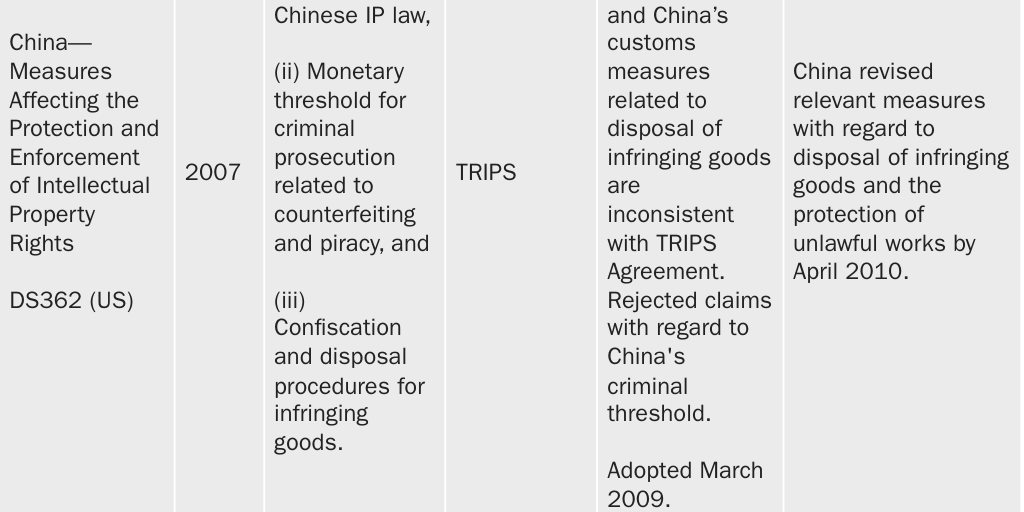
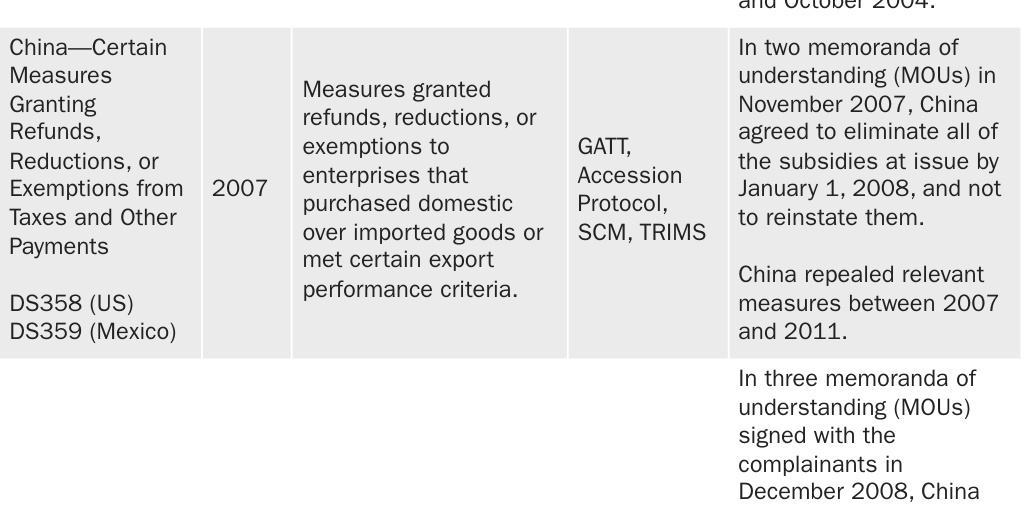
Citation
Bacchus, James. “What Happens If the United States Leaves the WTO?,” Policy Analysis no. 996, Cato Institute, Washington, DC, June 3, 2025.

About the Author


This work is licensed under a Creative Commons Attribution-NonCommercial-ShareAlike 4.0 International License.