
Fear in Washington over China’s expanding regional presence is quickly becoming a new rationale for an expansive US foreign policy in the Middle East. But China remains an opportunistic actor in the Middle East, driven by practical needs, not by aspirations to dominate the region. Beijing lacks the ability and desire to assume a dominant position in the Middle East, and its ability to jeopardize US regional interests is limited.
Centering US Middle East policy on competition with China is a recipe for disaster. It is an aimless rivalry divorced from concrete US interests. The United States has little to fear from China in the Middle East. By viewing every development in the Middle East through the framework of zero-sum competition with China, Washington is operating on faulty assumptions that will result in counterproductive policies. If navigated correctly, the return of multipolarity to the Middle East can be a net benefit for the United States, allowing Washington to disentangle itself from the region.
Introduction
Great power competition is rapidly becoming the new justification for US involvement in the Middle East. Citing efforts by Moscow and Beijing to “challenge American power, influence, and interests,” Washington formally placed competition with Russia and China at the center of the National Security Strategy in 2017.1 Washington views great power competition—particularly with China—in strictly zero-sum terms, extending to a broad swath of issue areas and regional theaters. This approach encourages an already counterproductive foreign policy driven by an indefinite—and expansive—struggle to maintain American global primacy.
Many in the defense and foreign policy establishment view the Middle East as a major theater for US–China competition.2 Washington has come to view Chinese encroachment in the Middle East as a serious national security threat to the United States. According to this logic, China is driven by grand ambitions in the region: If the United States were to lessen its regional involvement, Beijing stands ready to fill a US vacuum in the Middle East, to the detriment of US interests.3
According to such thinking, China filling this vacuum would jeopardize Washington’s freedom to maneuver throughout the Middle East or could result in Beijing weaponizing the region’s resources against the United States.4 Others have gone so far as to claim that China actively seeks to oust the United States from the Middle East because it desires regional supremacy.5 Fearing Chinese inroads in the Middle East, Washington has increasingly issued warnings to its regional partners cautioning against ties with Beijing, claiming this could jeopardize their relationships with the United States.6 Such concerns are some of the most commonly cited justifications for continued deep engagement in the Middle East.
Although China has considerably expanded its Middle East footprint for more than three decades—particularly over the past 15 years—these theories are misguided. This thinking misunderstands China’s interests and intentions in the region and fails to acknowledge the considerable limitations constraining Beijing’s ability to project power in the Middle East. China is a careful opportunist in the Middle East; Beijing is inherently averse to risk-taking in the Middle East and approaches the region cautiously. It lacks the ability and the will to assert itself as the chief powerbroker across the Middle East and remains far more concerned with domestic issues and political developments in its own neighborhood. Additionally, viewing China as inherently expansionist risks neglecting the ways in which regional actors manipulate great power rivalries to extract concessions from Washington. Ignoring these facts risk steering US Middle East policy in a harmful direction.
In this paper I challenge the notion that US–China competition should guide US foreign policy in the Middle East. In the first section I examine China’s growing presence in the region—particularly during the past three decades—and Beijing’s core regional interests and intentions. Next, I detail the limits of Chinese power projection in the Middle East. Then, I examine the often-neglected regional dimension of great power competition, namely how local actors—particularly US partners—hope to manipulate the US–China rivalry to advance their own interests. Finally, I argue that the return of global multipolarity can be an opportunity for the United States and allow for an overdue course-correction in the Middle East.
Assessing China’s Middle East Interests and Intentions
China’s presence in the Middle East dates back over 2,000 years to when the Silk Road linked Asia and Europe. Contemporary Chinese engagement in the Middle East began after the establishment of the People’s Republic of China (PRC), following a revolution by Mao Zedong (1893–1976) and the Chinese Communist Party (CCP) in 1949.
The Middle East was of marginal interest to China during Mao’s tenure. Beset by Cold War politics, the Middle East was consumed by competition between the United States and the Soviet Union, regional decolonialization, and state formation and development. China—not a party to this regional contest for influence and with no substantial presence in the Middle East—had little interest in the region. Beijing did support various anti-colonial and national liberation movements across the region during the Mao era, but this was largely symbolic and paled in comparison to the levels of American or Soviet involvement in the Middle East.7
At the time, Beijing was largely consumed by domestic issues—namely, a series of political, economic, and social initiatives under the Great Leap Forward (1958–1962) and the Chinese Cultural Revolution (1966–1976). Beijing’s chief international interest was gaining recognition of the PRC as the legitimate government of China, as opposed to Chiang Kai-Shek’s (1887–1975) nationalist regime in Taiwan.8 Under Mao, China established relations with a majority of the region’s states, except for the Gulf, which would come later in the 1980s and 1990s.9
Following the death of Mao Zedong in 1976 and Deng Xiaoping’s (1904–1997) rise to power, Beijing’s emphasis shifted heavily toward domestic economic development. A series of economic reforms initiated by Deng moved the PRC away from central planning toward a more market-oriented economy, which set the stage for China’s rapid economic growth.10 China’s domestic development relied heavily on oil, and China’s growing dependency on oil brought Beijing deeper into the Middle East. Under the leadership of Jiang Zemin (1926–2022), China became a net oil importer in 1993, and by 1996 the Middle East accounted for half of China’s petroleum imports.11
The PRC has considerably expanded its Middle East footprint over the past three decades. This expanded regional engagement is primarily driven by growing economic connections between Beijing and the Middle East, followed by diplomatic ventures and, to a much smaller extent, military and security ties. These three areas represent the three tiers of China’s Middle East engagement: economic interests, diplomatic ventures, and security linkages.
In all three domains, China’s Middle East engagement is driven by practical needs—not aspirations of regional domination. China is an opportunistic actor in the Middle East. Understanding Beijing’s core interests and intentions in the region—and the limits of China’s ability to project power in the Middle East—is necessary for greater strategic clarity in Washington.
Economic Engagement
For China, the Middle East is primarily a market. Economic interests are the principal driver of Beijing’s Middle East policy, and they set the parameters for China’s other forms of regional engagement.
Oil is at the center of China’s economic interests in the Middle East. China became the world’s largest net oil importer in 2012, and later, in 2017, it surpassed the United States as the Middle East’s largest oil importer.12 Beijing imports roughly half its oil from the region, and in 2023, it imported 5.2 million barrels per day.13 Beijing’s interest in Middle East oil—particularly from the Gulf—is likely to grow. The PRC is expected to import more than 80 percent of its oil and surpass the United States as the world’s largest oil market by 2030.14 The International Energy Agency estimates that China’s oil imports from the Middle East will double by 2035.15
Oil is not the only element of China’s expanding economic footprint in the Middle East. The region represents a lucrative export market for Chinese goods, and for bilateral trade more generally. China surpassed the United States as the region’s largest trade partner in 2014.16 The total bilateral trade between China and the Middle East and North Africa was roughly $470 billion in 2023.17 Beijing’s largest trade partners in the region—by a considerable margin—were Saudi Arabia and the United Arab Emirates (UAE), totaling roughly $107 billion and $95 billion, respectively.
China also surpassed the United States as the region’s largest investor in 2016.18 Chinese investment is primarily concentrated in energy, construction, and other infrastructure projects. Beijing is also increasingly investing in renewable and nuclear energy across the region.19 Technological cooperation between Beijing and Middle East states is also growing, with all Gulf Cooperation Council countries having signed 5G agreements with China’s Huawei.20 Moving forward, as Beijing continues to encounter economic problems at home, the massive sovereign-wealth funds of oil-rich Gulf states may prove appealing for an increasingly cash-strapped China.21
Chinese trade and investment in the Middle East are led by two broad-based initiatives that, despite the hype, warrant more skepticism than alarm.
First is China’s ambitious Belt and Road Initiative (BRI), designed to connect Asia and Europe through a network of land and sea routes traversing the Middle East. The BRI is central to Xi Jinping’s foreign policy agenda and is slated for completion in 2049 (the 100th anniversary of the PRC). All 22 members of the Arab League have signed BRI agreements with China, as have Turkey and Iran. Beijing has linked the BRI to several economic reform and development plans in the Middle East, particularly in the Gulf, as these oil-rich states seek to diversify their economies away from reliance on petroleum.22 The expansion of BRI projects throughout the Middle East has raised concerns in Washington that Beijing is using the enterprise to challenge the United States in the region. Yet the BRI is more rhetoric than substance. It is a brand representing a series of disparate, ad hoc projects tied together under the BRI label.23 These projects represent a mix of local and Chinese interests. The BRI’s progress has faltered considerably, with projects often plagued by corruption, financial implosions, delays, and cancellations.24 The geopolitical benefits Beijing extracts from the BRI are limited and declining.25
Second is the expansion of the BRICS economic partnership, consisting of Brazil, Russia, India, China, and South Africa, to include states from the Middle East.26 BRICS has expanded to include Egypt, Iran, and the UAE; an offer has been extended to Saudi Arabia, but Riyadh has yet to respond. Some analysts have depicted BRICS’ expansion to the Middle East as a threat to US regional interests—suggesting that China is using the group as a way to translate its economic engagement in the region into support for Beijing’s global ambitions.27 However, BRICS faces numerous limitations and does not represent a viable alternative to the current global financial system. BRICS does not have a clear objective—it is not a formal alliance and it suffers from ideological incoherence and considerable competing interests among member states.28
Given these limitations, Middle East countries joining the BRI or BRICS is hardly a sign of alignment with the PRC.
Still, there is growing concern in Washington that Beijing’s economic engagement in the Middle East is a springboard for China to challenge the United States.29 For example, Gen. Michael “Erik” Kurilla, head of US Central Command, described China’s economic footprint in the Middle East as a “strategic lever to supplant U.S. leadership in the region under the guise of benign economic initiatives and broadening security relationships.”30
Such alarmism is unwarranted. China’s economic interests in the Middle East do not directly conflict with those of the United States. America’s chief economic interest in the Middle East is the free flow of oil out of the region, particularly the Gulf. China—as the region’s largest oil consumer—shares this interest.
A significant disruption to the flow of petroleum from the Middle East—although highly unlikely—would adversely impact the global oil market. For this reason, Beijing desires stability—namely, the absence of armed conflict—in the Middle East to protect its economic interests. The United States shares this interest.
Some have argued that China aims to dominate the maritime chokepoints in the Middle East and could “hold the global economy hostage” by stopping the flow of oil out of the region to Western countries.31 Again, caution is needed here. First, China lacks the ability and the will to supplant the United States in the Middle East. Second, such arguments fundamentally misconstrue how the global oil market functions and the limitations of the so-called “oil weapon”—namely that embargoes against individual countries don’t work because consumers can simply purchase elsewhere.32 Oil is a global fungible commodity. For these reasons, China cannot weaponize oil against the United States.
China has not used its economic engagement in the Middle East as a springboard for regional dominance. American and Chinese economic interests in the region do not inherently conflict and should be viewed as an opportunity for cooperation with Beijing, not competition or conflict.
Diplomatic Engagement
Coupled with China’s increased economic engagement in the Middle East has been a growing Chinese diplomatic presence as well. Much of China’s diplomatic posturing in the Middle East is empty rhetoric and symbolism without a willingness—or ability—to shape outcomes or enforce agreements. Beijing has no desire to create or uphold a new political order in the Middle East. China is wary of being dragged into Middle East conflicts and actively tries to avoid getting entangled in the region’s politics. It has more to gain from avoiding these political entanglements and largely removes itself from the region’s power struggles.
China established a Middle East special envoy in 2002—the first-ever special envoy created by the PRC—to deal primarily with the Israel–Palestine conflict, which Beijing views as one of the core issues influencing Middle East stability.33 To facilitate greater cooperation between the PRC and the Middle East, China launched the China–Arab States Cooperation Forum in 2004, which holds ministerial meetings every two years. Beijing also launched a new forum in 2022, the China-Arab States Summit, which holds meetings every two years. Outside these forums, high-level visits by Xi Jinping to the Middle East and visits by Middle East heads of state to China are increasingly commonplace.
Lacking formal alliances, China maintains a series of multitiered partnerships with foreign countries. This includes a “comprehensive strategic partnership” with Algeria, Egypt, Saudi Arabia, the UAE, Bahrain, and Iran; a “strategic partnership” with Oman, Morocco, Qatar, Kuwait, Iraq, Jordan, and the Palestinian Authority; a “strategic cooperation” with Turkey; and an “innovative comprehensive partnership” with Israel.34
Beijing’s emphasis on diplomacy over military force was emphasized in China’s first Arab Policy Paper, drafted in 2016. Presented as a guiding framework for Beijing’s approach to the Middle East, it stresses respect for “sovereignty and territorial integrity” and the need to “combat external interference and aggression.” It centers China–Middle East relations on what it terms “win-win cooperation” and the creation of a “common, comprehensive, cooperative and sustainable security in the Middle East,” led by regional—not external—actors. The paper also emphasizes China’s economic interests in the Middle East, introducing the “‘1+2+3’ cooperation pattern,” which outlined Beijing’s priorities in the region: energy cooperation; infrastructure, investment, and trade; and nuclear energy, satellite technology, and renewable energy.35
Beijing engages with actors across geopolitical divides in the Middle East, including US partners and adversaries alike. Beijing compartmentalizes its regional policies and refrains from taking sides in the Middle East’s most intense geopolitical competitions.
Despite this, Washington often fixates on Beijing’s relationship with Iran, citing it as an affront to US dominance in the Middle East.36 Such concerns have grown following China and Iran signing a 25-year blueprint in 2021 to strengthen their economic and political relations.37 Under the agreement, China agreed to invest $400 billion in Iran over the next 25 years in exchange for a steady supply of oil.38 This deal builds on a 2016 agreement elevating Beijing’s relationship with Tehran to a comprehensive strategic partnership, in which China and Iran agreed to expand bilateral trade to $600 billion by 2026.39
These moves were met with alarm in Washington, with observers concerned it would provide Beijing with a strategic foothold in the Middle East.40 Some claimed the agreement heralded the emergence of a China–Iran axis in the region.41 However, progress on this plan has not materialized—far from it. Since the time of the agreement in 2021, Chinese investment in Iran has remained below an estimated $200 million.42 Bilateral trade between China and Iran was less than $4.6 billion in 2023.43 Floundering progress on China–Iran trade and investment was noted by former Iranian president Ebrahim Raisi before leaving for a trip to Beijing in 2023, claiming the two countries had “seriously fallen behind in these relations.”44
Beijing does not privilege its relationship with Tehran above its relationships with other countries in the region. For example, China’s relationships with Saudi Arabia and the UAE far outpace its relationship with Iran.45 China purchases cheap oil from Iran and balances its regional engagement by maintaining ties with all important regional actors. The same applies for Tehran: China provides an economic outlet to skirt US sanctions. Beijing has also not aligned with Tehran on critical issues, such as its nuclear program; in fact, China voted in favor of seven resolutions implementing sanctions targeting Iran’s nuclear program.46 China supported the Joint Comprehensive Plan of Action (JCPOA) agreement with Iran, and lobbied Tehran to negotiate with the United States.47 The idea of a China–Iran axis in the Middle East is a myth.
The PRC has also increasingly sought to portray itself as a neutral mediator and peacemaker in the region. Yet Beijing’s diplomatic initiatives in the Middle East are a form of performative politics: symbolic rhetoric and actions that lack substance. China opts for low-hanging diplomatic fruit in the region. Chinese diplomatic grandstanding in the Middle East lacks substance, let alone a willingness—or ability—to shape or enforce outcomes.
Consider Beijing’s actual assistance in brokering rapprochement between Saudi Arabia and Iran in 2023, as opposed to how it was portrayed.48 Official relations between Iran and Saudi Arabia had been suspended since 2016, following Riyadh’s execution of prominent Shi’a leader Sheikh Nimr al-Nimr and the torching of the Saudi embassy in Tehran in response.49 The agreement was hailed as a Chinese victory in the Middle East and a challenge to the United States.50 Some described the agreement as a diplomatic coup by Beijing, signaling a Chinese pivot to the Middle East.51 Although China aided in brokering this agreement, Iraq and Oman have led the efforts to deescalate Saudi–Iran tensions since 2021, allowing Beijing to capitalize on this existing process.52 Additionally, this agreement between Saudi Arabia and Iran was primarily rooted primarily in Saudi and Iranian interests, and both viewed de-escalation to be in their best respective interests.53 It is unlikely that China is capable or willing to expend the resources necessary to police Saudi–Iran relations or enforce an agreement if—or when—hostilities resume. Instead, China’s involvement was a low-cost way for Beijing to project an image of itself as a critical diplomatic broker in the Middle East.
Military/Security Engagement
Behind Beijing’s expanded economic and diplomatic engagement is a growing, but limited, Chinese security footprint in the region. The United States remains the dominant security actor in the Middle East, and Beijing’s security interests and ambitions in the region are minimal. China’s 2016 Arab Policy Paper details these limited interests, stating that Middle East security should be led by regional countries.54 It highlights areas of shared concern—such as counterterrorism, anti-piracy, and the respect for territorial integrity—but stops well short of proffering an alternative security architecture for the region.
China is inherently averse to becoming entangled in Middle East conflicts and has no desire to supplant the United States as the region’s predominant power. The PRC does not want to create or uphold a new regional security order. Attempting to do so would invite a level of risk that China is not willing to shoulder, and Beijing has not challenged the US-led security order in the region because it benefits from it. This security umbrella allows China to increase its regional involvement without assuming the costs of physically protecting its interests. China also undoubtedly enjoys seeing the Middle East keep the United States distracted while simultaneously bleeding American resources: Beijing does not want to see US military forces and assets dedicated to the Middle East repurposed to the Indo-Pacific.
The PRC participates in anti-piracy missions in the Gulf of Aden and in various UN peacekeeping missions across the region, often cooperating with other nations, including the United States. (China is notably absent from the US-led campaign to combat the Houthis’ targeting of shipping through the Red Sea after the war in Gaza, which China views as an American-instigated problem.) China’s military has also held joint drills with countries including Saudi Arabia, Iran, the UAE, and Oman, and has aided in the evacuation of Chinese citizens due to regional upheaval and conflict in places such as Lebanon, Egypt, Libya, Syria, and Yemen.
The Chinese military established its first-ever overseas naval facility on the region’s periphery in Djibouti in 2015, although the base is of limited function and capacity.55 Djibouti hosts bases from France, Japan, the United States, and many others. China’s military base in Djibouti is dwarfed by the US base in the country. There have been reports that Beijing is trying to establish military bases in the UAE and Oman. US intelligence agencies raised the alarm over construction taking place in Abu Dhabi on what they suspected was a Chinese military facility in 2021.56 Progress on the installation was halted due to US opposition. However, construction reportedly resumed in 2023, although this was denied by the Emirates.57 Similarly, reports of a Chinese plan to build a military facility in Oman surfaced in late 2023, but did not materialize.58 Little detail is available on the scope of these proposed facilities, but if they do materialize, they are likely to mirror China’s base in Djibouti and be limited in size and function. Moreover, China’s ability to use these installations to project power in the Middle East would remain constrained, due to the limitations discussed below.
China remains a marginal player when it comes to weapons sales in the Middle East, but its involvement in the regional arms market has grown.59 Chinese arms sales to the Middle East grew by 80 percent between 2013 and 2023, although this activity remains dwarfed by that of the United States.60 China has made inroads by selling weapons such as drones to countries including Saudi Arabia and the UAE, given the barriers that the United States faces due to export regulations on such technology.61 Similarly, Beijing has cooperated with Saudi Arabia on its ballistic missile program after Washington’s reluctance to do the same out of proliferation concerns.62
Still, Middle East states get less than 5 percent of their military hardware from China.63 Iran’s conventional weapons inventory has not been significantly influenced by China.64 Despite fears in Washington of states such as Saudi Arabia and the UAE turning to China for arms, Gulf countries get less than 2 percent of their weapons from Beijing.65 Moreover, the ability of US partners in the region to shift wholesale to alternative weapons systems would be difficult, given the incompatibility of Chinese arms with American defense systems in these countries.66 A decision by these states to transition either in part or entirely from these systems would come with considerable financial, political, and strategic costs.
Linkages between China’s sizeable domestic Muslim population—estimated to be between 20 and 30 million—and the Middle East present a particularly sensitive security concern for Beijing. Many Chinese Muslims—particularly the Uyghurs, who are concentrated in the region of Xinjiang—have historic ties with the Middle East, and many of these communities have been forcibly incorporated into the Chinese state. Beijing fears these linkages and the possible export of Islamism from the region, and the challenges this can pose to the authority of the CCP over these areas.67 Beijing views its Muslim population as a threat to its internal cohesion and fears that unrest in Xinjiang could inspire separatism elsewhere in China. The region of Xinjiang itself is of critical importance to the CCP: The region hosts 15 percent of China’s proven oil reserves and 22 percent of its gas reserves. It also shares more than 1,700 miles of land borders with Central Asian states and serves as Beijing’s gateway to Eurasia.68 As part of the effort to “Sinicize” Islam within China, Beijing has detained more than one million Muslims in internment camps, where they face torture, are forced to renounce Islam and pledge loyalty to the Communist Party, and are often executed for their noncompliance.69
Post‑9/11, China increasingly framed its struggle against its domestic Muslim minority as part of the broader global war on terror.70 The CCP has worked hard to keep Muslim-majority countries—especially those in the Middle East—silent regarding its repressive policies.71 Visits by Middle East heads of state and declarations of support from and praise from these governments for the CCP’s efforts to combat terrorism among its Muslim population are commonplace. In several cases, Middle East governments coordinate directly with Chinese authorities to arrest, detain, and deport Uyghurs and other Muslim minorities who have managed to escape from China.72 The UAE, for example, hosts a Chinese-run detention facility in Dubai, and has held joint air force training exercises with Beijing in Xinjiang.73
China’s fears of connections between its Uyghur population and the Middle East became particularly acute following Syria’s civil war. Beijing was concerned about militants connected to the Turkistan Islamic Party (TIP)—estimated to be a few thousand strong—and Uyghur separatists in Xinjiang.74 ISIS also issued several threats to Beijing during its reign in Iraq and Syria, with Uyghur fighters among its ranks threatening to return home and carry out terrorist attacks in China.75 Such fears were one of the core reasons why Beijing supported the government of Bashar al-Assad. These concerns are likely to remain, given the overthrow of the Assad regime and the rise to power of the Islamist group Hay’at Tahrir al-Sham (HTS), which has appointed foreign fighters—including Uyghurs—to prominent roles in the country’s armed forces.76
Despite China’s violent campaign against the Uyghurs in the Middle East, Beijing’s feud with the group is primarily rooted in local politics. China’s human rights violations against the Uyghurs at home, and their partnerships with various governments to hunt them abroad, are abhorrent and should be denounced, but this has little bearing on US Middle East policy. Such forms of transnational repression should not be equated with China being willing to assume a greater responsibility for Middle East security.
Beijing’s approach to the region can be considered a form of “strategic hedging,” whereby second-tier powers (in this case, China) seek to “develop a regional presence without disrupting a beneficial status quo.”77 Beijing does not desire hegemony in the Middle East. Why would it? It has been able to achieve its limited interests without assuming the costs of hegemony. Why would Beijing make itself vulnerable to the same types of entanglements and blowback that have proven disastrous for the United States? China, having learned from the mistakes of the United States, is unlikely to repeat those same mistakes.
Constraints on Chinese Power Projection in the Middle East
Combined with Beijing’s limited interests and intentions in the Middle East are several factors constraining China’s ability to protect power in the region.
First, China suffers from considerable domestic drag on its security resources.78 Beijing’s foremost priority is internal security, namely preserving the authority of the CCP and the territorial integrity of China. The authority of the CCP is regularly challenged inside China, with frequent protests over poor economic conditions, minority rights, and Beijing’s authoritarian policies.79 The authoritarian nature of China’s government requires vast resources for internal policing. Sizeable portions of Chinese territory—namely Xinjiang, Tibet, and Hong Kong—are contested, resulting in Beijing constantly policing these areas. Added to this is the CCP’s goal of reunification with Taiwan, which remains at the forefront of Chinese military strategy.
Second, China’s military is far more concerned with its immediate neighborhood than with global power projection. China is a regional power—the geographic reach of the Chinese military is largely limited to the Asia-Pacific. China’s military is primarily postured toward war over Taiwan or regional conflict with its neighbors, not power projection outside of the Asia-Pacific.80 China’s military is split into five theater commands, all of which are devoted to the PRC’s internal security and immediate periphery: four are focused on the country’s Pacific coast, and the other is dedicated to the country’s western border.81 The PRC’s global military footprint pales in comparison to other major powers, particularly the United States.82 Beijing’s ability to project power via blue-water operations is considerably constrained by a massive US military presence in the Pacific, and what is often referred to as the first and second island chains hindering Chinese maritime operations geographically (Figure 1).83
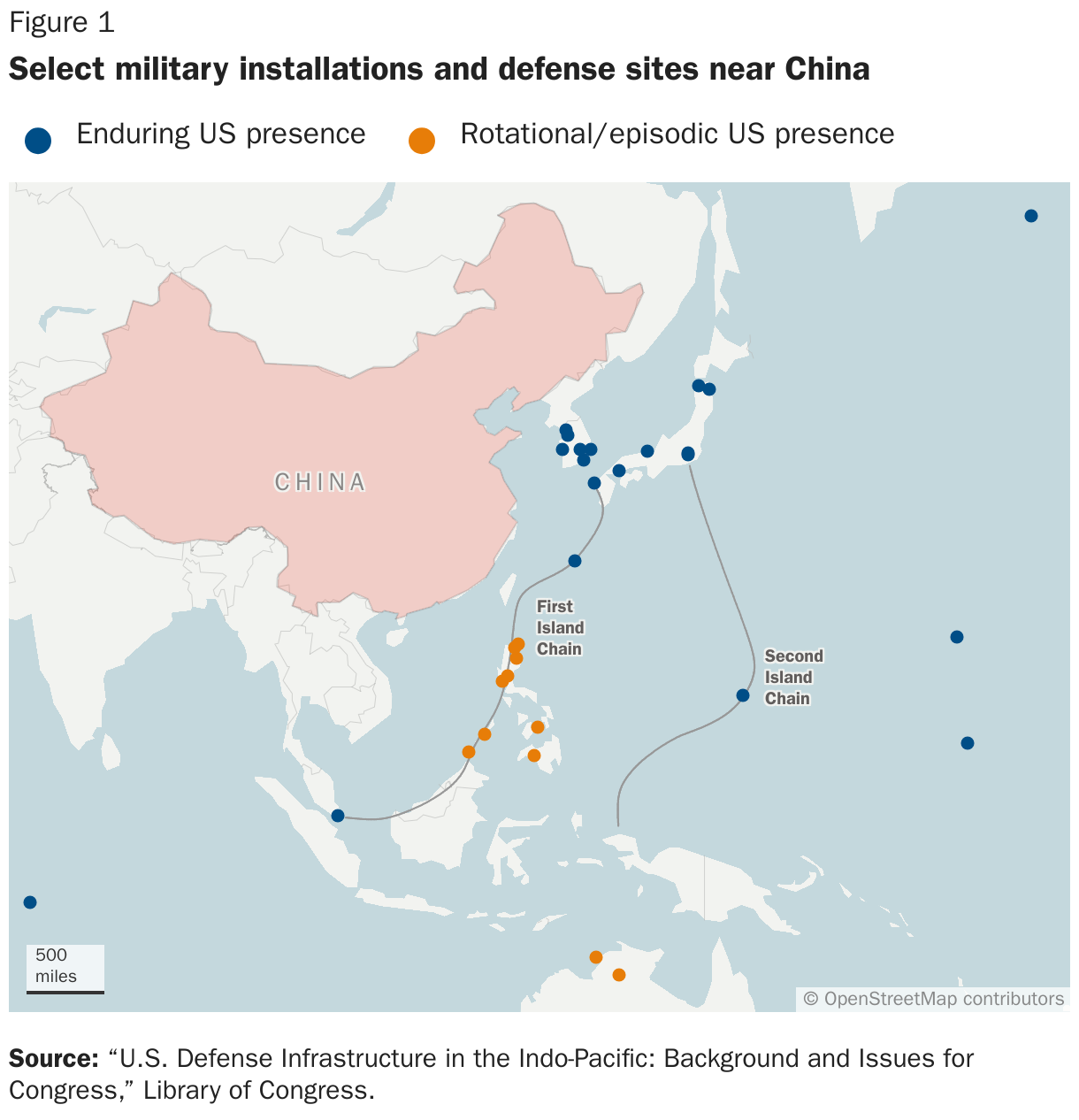
Third, China’s economy and military are not currently capable of devoting the attention or resources that would be required if Beijing were to get further entangled in Middle East geopolitics. China is facing serious economic trouble at home.84 Economic growth has slowed considerably as Xi Jinping has prioritized policies that are designed to solidify the power of the CCP over the health of the economy.85 China’s growth is projected to slow even further, with Beijing facing slowing productivity, high debt, a property market crisis, and a shrinking labor force.86 Amid these economic troubles, China’s military budget—calculated in terms of purchasing power parity and including off-budget items—stood at an estimated USD $471 billion in 2024.87 Greater military attention to the Middle East would constitute a considerable drain on China’s resources at a time when it is already strapped for resources.
The US case is instructive here: In the Middle East, Washington spends roughly $100 billion annually to maintain its expansive regional presence.88 That is equal to roughly 21 percent of China’s entire defense budget. Beijing would have to dramatically increase its military expenditure or divert resources away from other theaters to even come close to matching this level of commitment. Greater Chinese involvement in the Middle East would detract from Beijing’s core security interests while straining its economy and military, thus opening the door for the CCP’s adversaries to potentially squeeze China where it really matters—at home and in the Asia-Pacific.
The Middle East is peripheral to Beijing’s core security interests, and material limitations will continue to hinder China’s ability to project force in the region for the policy-relevant future.
Greatest Risks: Overreaction and “Reverse Leverage”
China’s interests and intentions in the Middle East are limited, and its ability to project force in the region is considerably constrained for the foreseeable future. Therefore, the direct threat to US interests is minimal. Instead, when it comes to China in the Middle East, the greatest risks to the United States don’t come from Beijing but from overreaction inside Washington and from America’s regional partners.
In Washington, viewing US Middle East policy through the lens of great power competition will lead to overreaction and self-defeating policies. Washington is increasingly falling into the so-called China trap, trying to counter Beijing’s every action around the globe without a clear vision of what specific US interests are being advanced.89 By pigeonholing itself through the logic of zero-sum competition with China, Washington limits its own strategic maneuverability.
This is the trap the United States is falling into in the Middle East. The tendency for overreaction in Washington is leading to policies that are counterproductive to US interests. Nowhere is this more apparent than in the attempts by America’s regional partners to pressure the United States into delivering costly and counterproductive concessions under the aegis of combating China. Washington’s obsession with US–China competition often results in policymakers neglecting the regional dimensions of great power politics in the Middle East.90 States in the region are aware of China’s limitations in the Middle East and are pursuing a two-tiered strategy to best advance their own interests.
In the short term, US partners in the Middle East hope to manipulate Washington’s anxiety about losing its position relative to China, resulting in a form of “reverse leverage” that is designed to keep the United States deeply enmeshed in the region as their security guarantor.91 In the process, US client states use their perceived strategic significance to pressure Washington for major policy concessions. In the long term, states across the Middle East recognize that the rise of non-Western powers and the return of global multipolarity is a reality, and they position themselves accordingly by expanding their relationships with countries such as China. The diversification of relationships—and the practice of sending multiple signals to multiple actors—is going to happen in a multipolar world.
The greatest risk to Washington is succumbing to this reverse leverage and acquiescing to the demands of its regional client states. The push by regional actors for more-concrete US security commitments is especially worrisome. This drive for more formalized commitments accelerated considerably following Russia’s invasion of Ukraine in 2022, after which states such as Saudi Arabia and the UAE bucked Washington’s requests on a number of issues, such as oil production, sanctions against Russian officials, and more. Riyadh and Abu Dhabi both pressed Washington for more formalized defense commitments in return for cooperating on these issues.92 This push by regional actors was coupled with a litany of calls inside Washington for the US to recommit to the Middle East.93 Former president Joe Biden centered his 2022 trip to Saudi Arabia on reaffirming America’s expansive regional presence, proclaiming the United States “will not walk away [from the Middle East] and leave a vacuum to be filled by China, Russia, or Iran.”94 Yet if the United States did walk away from the region, it wouldn’t create a vacuum—nor could any of these states fill it, if it existed.95
US–China competition was a central justification for making the so-called Abraham Accords the new lodestar of US foreign policy in the Middle East. Ratified under the first Trump administration in 2020, the Abraham Accords entailed the normalization of relations between Israel, Bahrain, the UAE, Morocco, and Sudan. Through the Accords, Washington promises it will be able to push back against China while drawing down its direct presence in the Middle East, allowing Washington to allocate more attention to other theaters.
Normalization between Israel and Gulf states in particular has been presented as a way for Washington to dominate the critically important maritime routes in the Middle East.96 At its core is the idea that the United States—either directly or through its regional partners—could, in the event of a war with China, block energy shipments to Beijing coming from the Middle East, thereby crippling China’s economic and military capabilities.97 Speaking before Congress, the commander of US Central Command, Gen. Michael “Erik” Kurilla, argued this point, claiming, “God forbid there’s ever a conflict with China, but we could end up holding a lot of their economy at risk in the CENTCOM region.”98
The idea that Gulf states would cooperate with Washington on cutting oil shipments to Beijing is magical thinking. Cutting off Middle East oil to China would be a Herculean task, eliciting global backlash. Regional states would never do it—their economies rely on Asian, particularly Chinese, markets. They have no interest in involving themselves in Washington’s zero-sum competition with Beijing. Should the United States attempt to block oil going to China in the event of a war, however, US naval vessels stationed at Diego Garcia in the Indian Ocean could be augmented to either block shipments from the Middle East, or coupled with existing forces in the Indo-Pacific to focus on the Malacca Strait, through which roughly 70 percent of China’s oil imports currently flow.99 (The prudence of trying to block China’s oil imports in the first place is beyond the scope of this paper.)
Regional states are using initiatives such as the Abraham Accords to preserve the prevailing status quo in the Middle East by keeping the United States deeply engaged in the region as the guarantor of their security.100 They have become a springboard for greater US security commitments to the Middle East.101 Regional actors do not view the Accords as an exit strategy for the United States in the Middle East, and they certainly do not view the Accords as a way of countering China.
This is evident in the current push by Washington to broker normalization between Israel and Saudi Arabia as an extension of the Abraham Accords. In return for normalization, Riyadh is demanding unprecedented concessions, specifically a formal US security guarantee and Washington’s assistance with developing a civilian nuclear program. Saudi–Israel normalization has been framed as a way to box China out of the Middle East.102 One analyst argues the deal will “draw Washington’s most capable friends in the Middle East deeper into efforts to address global challenges, including that posed by the rise of China.”103
The PRC does not represent a viable alternative patron to the United States for Saudi Arabia, and Riyadh is aware of this reality.104 Nor does the kingdom view China as a challenge like the United States does. Instead, it is trying to leverage cooperation with China to extract concessions from the United States. Saudi officials have themselves admitted this: According to the Wall Street Journal, “in private, Saudi officials said, the crown prince has said he expects that by playing major powers against each other, Saudi Arabia can eventually pressure Washington to concede to its demands for better access to U.S. weapons and nuclear technology.”105
Regional actors are not going to give up their relations with China, regardless of US concessions. They are heavily reliant on Chinese markets and do not view Beijing as a viable alternative patron to the United States. Instead, they will likely continue playing both sides by expanding their relationships with Beijing while pushing the United States for greater policy concessions. Washington would be wise not to take the bait.
Toward Opportunity, Not Tragedy
Competition with China should not guide US Middle East policy. For decades, the United States has relied on a series of grand narratives to justify its expansive presence in the Middle East, which are often detached from concrete and achievable US strategic interests. The current fixation on US–China competition is no different. Instead of centering its regional policies on lofty abstractions, Washington should view the return of multipolarity as an opportunity to pursue a desperately needed course correction in the Middle East.
The past four US administrations campaigned on promises to reduce America’s presence in the Middle East, yet US Middle East policy has remained remarkably consistent. There are currently between 50,000–60,000 US troops scattered across more than 63 bases in the Middle East.106 A strong commitment to upholding American primacy in the Middle East exists on both sides of the political aisle in Washington, buttressed by a plethora of special interests and decades of policy inertia that have pushed the United States deep into the region’s affairs. This relentless pursuit of American supremacy in the Middle East has been detrimental to US interests and regional stability.107 It has resulted in a perpetual war-footing in the region to maintain and expand the prevailing US-led order, the underlying foundations of which represent the most profound sources of instability in the Middle East.108
It does not have to be this way. American strategic interests in the Middle East are limited and easy to accomplish.109 The United States maintains three chief interests in the Middle East: maintaining the free flow of oil, preventing terror threats to the American homeland, and preventing the emergence of a regional hegemon. None of these interests justify current—or expanded—levels of US involvement in the Middle East. In fact, many of the problems the United States faces in the Middle East are a product of its own policies, namely the constant involvement in the region’s affairs.
These interests are not jeopardized by China’s involvement in the Middle East. As I have explained in this paper, China lacks the ability and the will to assume a dominant position in the Middle East akin to what the United States has held for decades. Even if Beijing did have such capacity or ambitions, why should we assume that China would be successful in trying to take over such a position? As the American experience in the Middle East has shown, an external hegemon attempting to maintain a regional order requires an enormous amount of political, economic, and military resources, and it still runs a high risk of failure. If high levels of aid, arms sales, and widespread military basing rarely translate into influence for Washington, why would they for Beijing?
Instead, China enjoys seeing the Middle East consume US foreign policy. It keeps Washington’s attention and resources away from Beijing and the Asia-Pacific. Additionally, it allows Beijing to operate in the Middle East under the US security umbrella at a low cost. But maintaining this order is not in America’s interest. Washington expends significant levels of attention and resources to upholding a security order in the Middle East, for which the main beneficiaries are regional actors and China. This is a bad deal for the United States.
When it comes to the Middle East, US interests are best served through disentanglement and deprioritization. Ending American political and military entanglements in the Middle East is of paramount importance. American efforts to politically engineer the Middle East have been an exercise in futility. They have repeatedly backfired, resulting in tremendous political, human, and economic costs, with virtually nothing to show for them. America’s expansive regional presence does not deter violence or stabilize the Middle East—instead, it incites violence and destabilizes the region while draining the United States of resources.110 Washington’s policies often compound the region’s problems while creating new ones. Its regional partners consistently undermine US interests and often bend American foreign policy in the Middle East toward their own objectives. America’s record in the Middle East is one of dysfunction and failure.
America also needs to prioritize. For far too long, the Middle East has assumed an outsized role in US foreign policy at the expense of more pressing policy issues facing the United States both at home and abroad. America’s entanglements in the Middle East risk overextending the United States as Washington remains waist-deep in assisting Ukraine against Russia’s invasion and attempting to deter China in the Asia-Pacific. Washington’s unwillingness to curb its adventurism abroad contributes to the country’s already unsustainable fiscal position, with national debt currently standing at more than $36 trillion and the United States running annual budget deficits of nearly $2 trillion.
Conventional thinking has repeatedly brought disaster to the Middle East while undermining US interests in the process. Centering US Middle East policy on competition with China risks repeating these same mistakes. Instead, Washington should acknowledge its limited interests in the Middle East and approach the region from arms-length.
Conclusion
Current US Middle East policy cannot be justified on the basis of great power competition with China. Beijing’s ability to threaten US strategic interests in the Middle East is minimal. China’s strong aversion to entangling itself in Middle East geopolitics means Beijing will continue to approach the region cautiously. The PRC lacks the ability and the will to assume a dominant position in the Middle East. Failing to recognize this reality risks overreactive and counterproductive US policy, particularly given that American interests in the region are limited and easily accomplished. There is nothing in the Middle East worth fighting China over.
Instead of doubling down on decades of failed policies and reaching for a new justification for America’s expansive presence in the Middle East, Washington should begin disentangling itself from the region. Centering US Middle East policy on competition with China will trap the United States in the region and lead to dramatic new levels of commitment at a time when the country is strapped for resources. Washington should prioritize. Given the limited US interests in the region, the Middle East should be near the bottom of America’s priority list. Washington should reduce its levels of regional involvement to a level concomitant with concrete and achievable US interests.
Citation
Hoffman, Jon. “Aimless Rivalry: The Futility of US–China Competition in the Middle East,” Policy Analysis no. 1000, Cato Institute, Washington, DC, July 10, 2025.

About the Author


This work is licensed under a Creative Commons Attribution-NonCommercial-ShareAlike 4.0 International License.