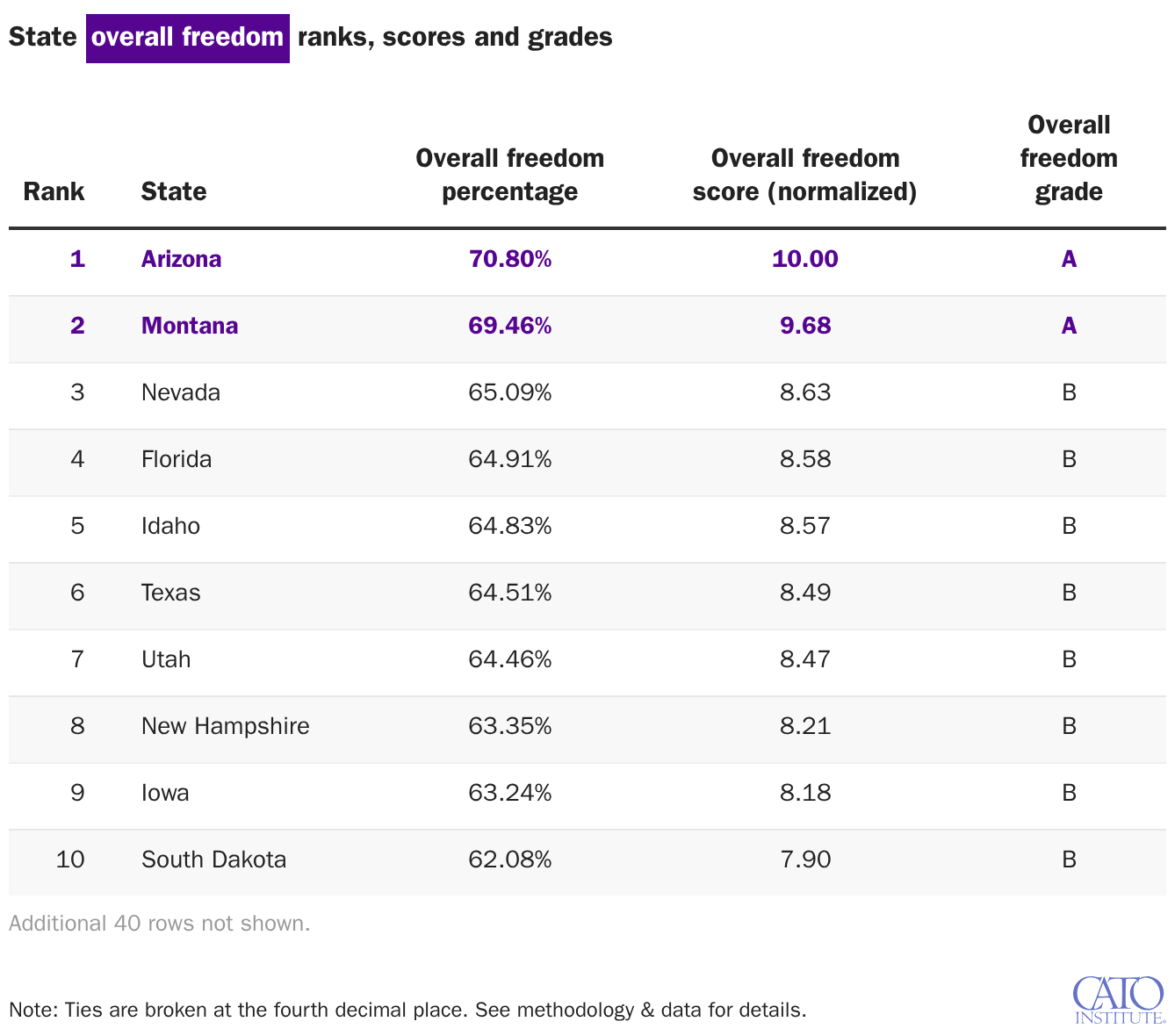
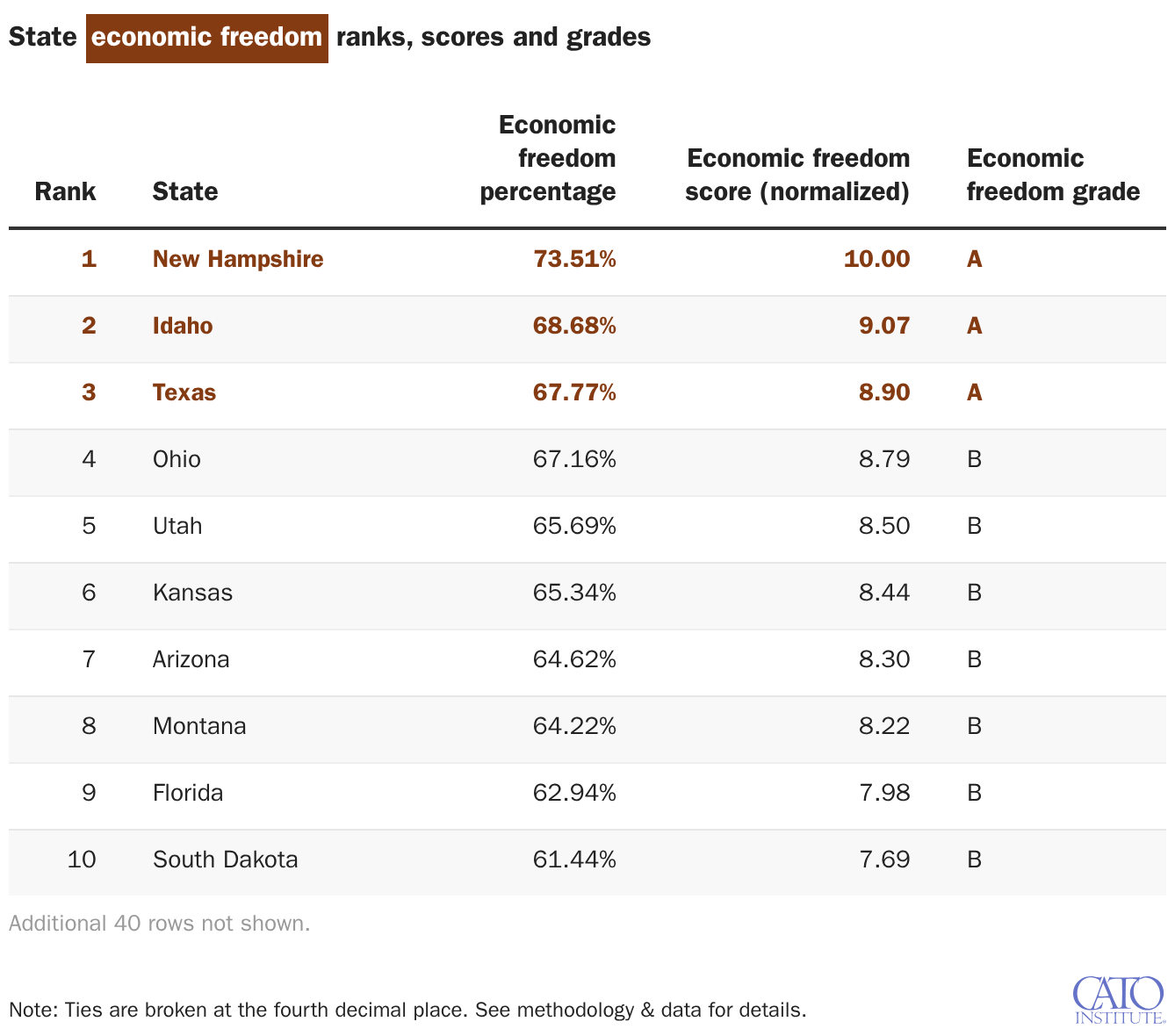
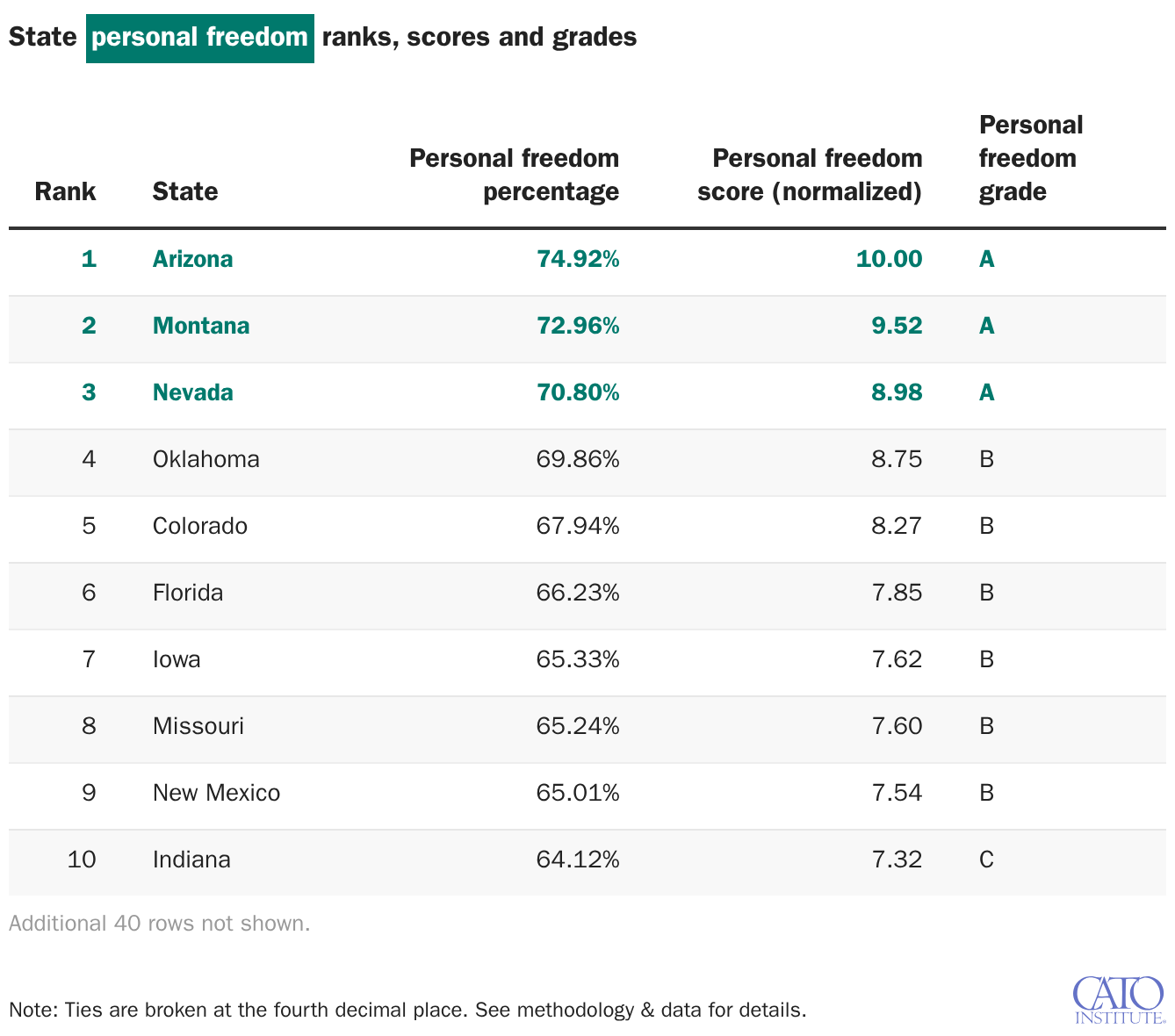
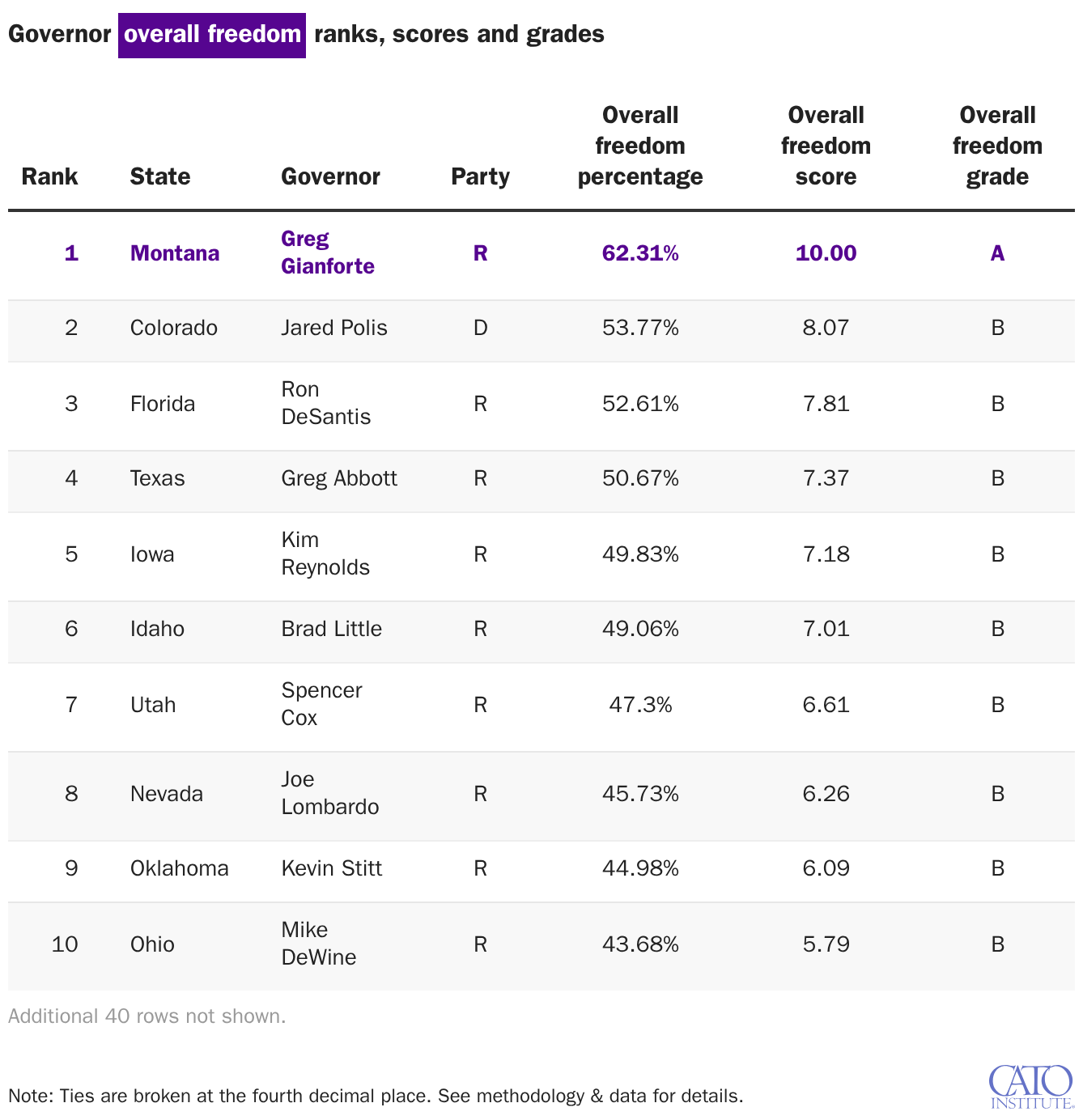
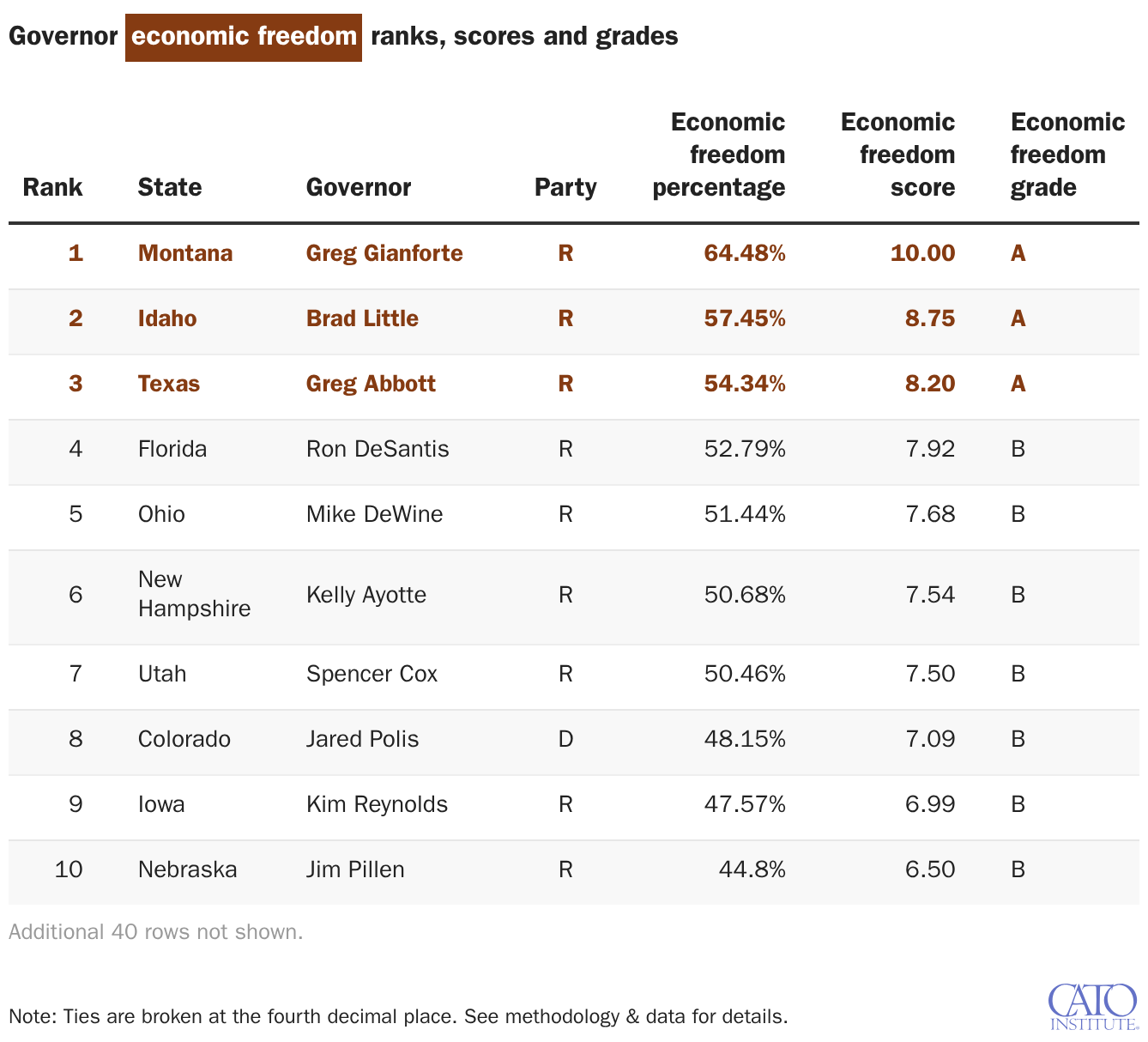
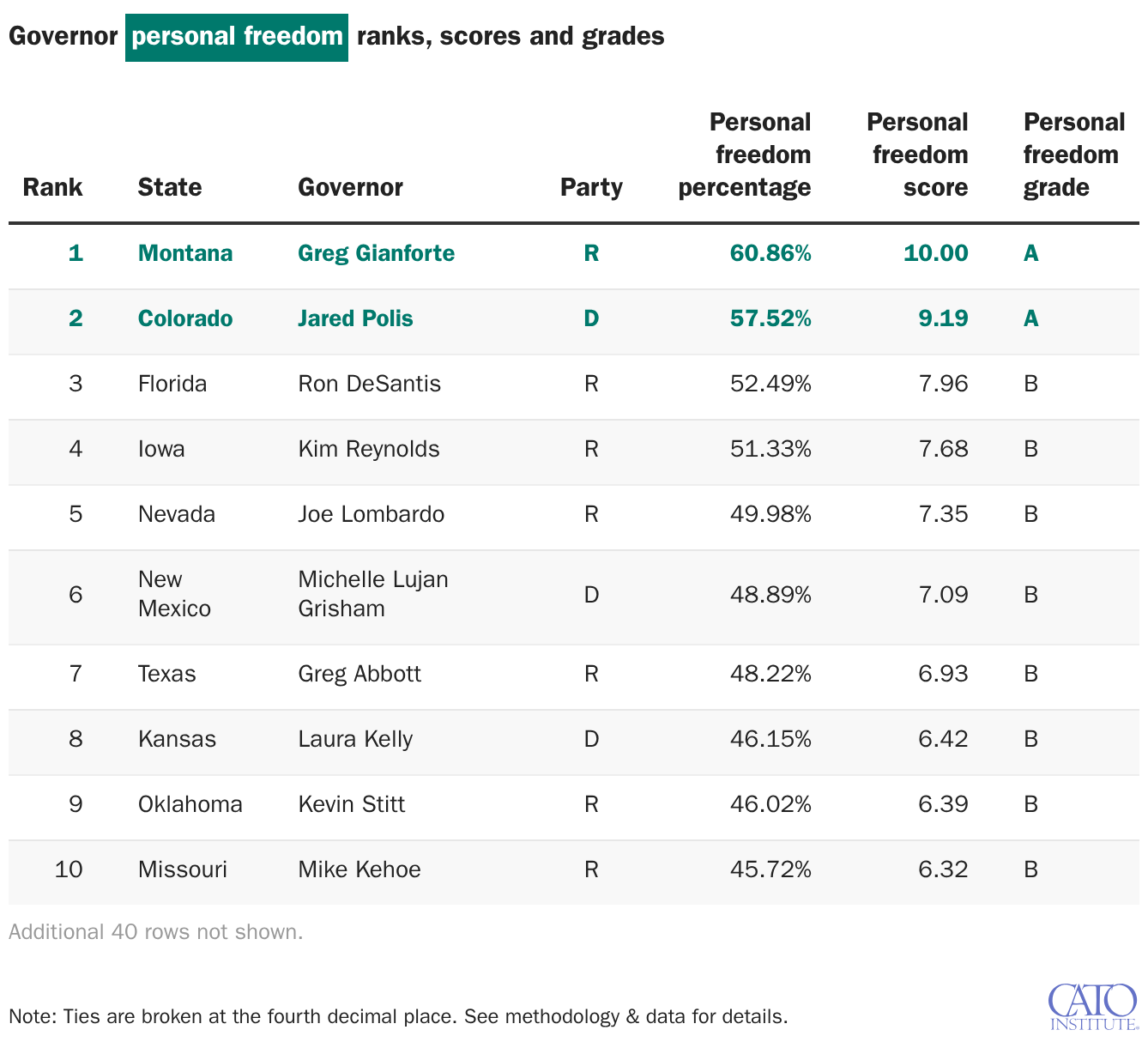
This year’s index is a modernized version of the report we have published periodically for the past decade. This new edition includes several variables not included in prior editions and removes some that are less relevant to today’s state policy debates. It pares down the number of categories and aligns them more closely with policy reforms being considered in the states. It also changes the way the scores are calculated. We believe these improvements will make the index more transparent and more valuable to policymakers, members of the public, and journalists covering public policy. Detailed descriptions of each category and variable analyzed are included in their respective sections.
In addition, while Cato has long published a separate report card grading governors only on tax and budget policies, it did so in ways that were often incompatible with the state rankings in “Freedom in the 50 States.” This redesigned “Freedom in the 50 States” merges the two reports into one, integrates both rankings, applies a consistent methodology, and assesses the record of all sitting US governors on a much broader range of freedoms.
Both the states and governors are graded on 97 policy variables spread across and grouped into 10 topic categories. (The scoring methodology is detailed in the Methodology.) For each of the 10 topic categories examined, each state and governor is first awarded a percentage score based on how well they did on the individual metrics, then a freedom score based on that percentage, and then a letter grade based on that freedom score:
- Percentage score. The average score of all the policy variables within a topic category yields a raw percentage score from 0 percent to 100 percent. If, for example, a category has 10 variables but a state has enacted a pro-freedom policy in only 5 of them, it receives a 50 percent raw score for that category.
- Freedom score. A state/governor raw score is then curved on a scale of 0–10 for its freedom score, with 10 being assigned to the highest percentage score in a particular category and 0 being the lowest. As such, a freedom score of 10 does not necessarily mean a state/governor scored 100 percent in a topic category; they simply had the best score among all participants.
- Letter grade. Letter grades are based on a state/governor’s freedom score for each category. Grades are assigned based on the freedom score achieved and are awarded on a curve. The highest score will always earn an A, as will scores above an 8.9, while a score of 2.5 or less earns an F, with other grades spread roughly equally between these thresholds. Letter grades are intended to improve readers’ understanding of freedom scores.
Once these scores are tabulated and grades assigned, the topic categories are grouped into a parent category, either Economic Freedom or Personal Freedom. Scores and grades are assigned in the same way as they are to these component topic categories, with all categories equally weighted. Finally, the overall grade for a state is assigned based on a weighted average of the Economic Freedom score and the Personal Freedom score.
Governors’ grades are a bit different. The state freedom grades are this index’s foundational element. Yet a governor of a high-scoring state receives the benefit of simply inheriting a freedom-oriented policy environment (or vice versa). To account for this reality, the governors are graded based on the direction they have personally moved the state—often in cooperation with the legislature but sometimes not (e.g., when the legislature overturns a governor’s veto). The bills a governor signed that increased the freedom score of the state above what it would have been otherwise give the governor extra credit, as these actions added to the state’s numeric freedom score. Conversely, a governor who vetoed a bill that would have increased a state’s freedom or who officially proposed something that would or did decrease the state’s freedom relative to the status quo (i.e., the policy as it existed before they were governor) has points deducted. The technical aspects of the scoring system and its overall methodology are also available in the Methodology.
Finally, the list of freedoms included in this index is not intended to be comprehensive. We will be updating the index every two years, and more policy measures will be added in future editions.