What Is Occupational Freedom?

Workers should be free to determine the conditions under which they enter into a lawful employment contract with an employer. Restrictions on how and whether one can be employed and at what wage one can be hired, along with state requirements for obtaining a government license before one can work (even for those already licensed in another state), are among the most pernicious and common limitations on the right to contract for both businesses and workers. This category scores states based on how well they protect—and how little they interfere with—this fundamental freedom.

State Ranks and Grades

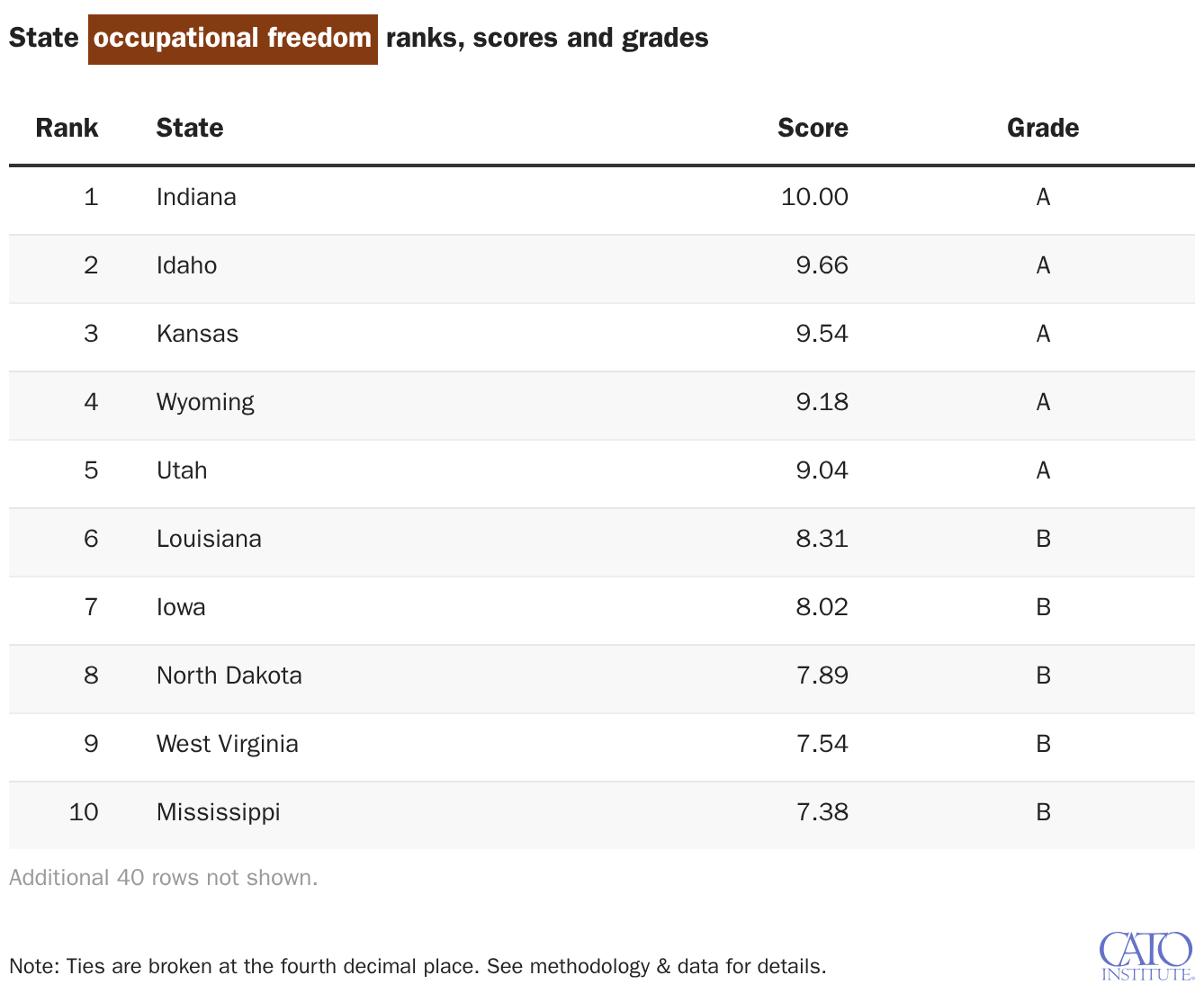
State occupational freedom ranks, scores and grades

Five states top the list with A grades (in rank order): Indiana, Idaho, Kansas, Wyoming, and Utah. These states score high because they all maintain right-to-work laws, don’t have an E‑Verify mandate for all private employers, don’t have a state minimum wage higher than the federal minimum, have a relatively low occupational licensing burden, have some form of universal occupational licensing recognition for those newly moving to the state, and allow the most flexibility for independent and freelance work.

Twelve states rank at the bottom and receive F grades (in rank order): Delaware, Minnesota, Rhode Island, Washington, Illinois, Oregon, Maryland, New York, New Jersey, Massachusetts, California, and Maine. None of these states has a right-to-work law, they maintain a high minimum wage, they have comparatively high occupational licensing burdens without universal recognition of licenses obtained in other states, and they have enacted policies that substantially restrict the options for workers who prefer to work as independent contractors.
Governor Ranks and Grades

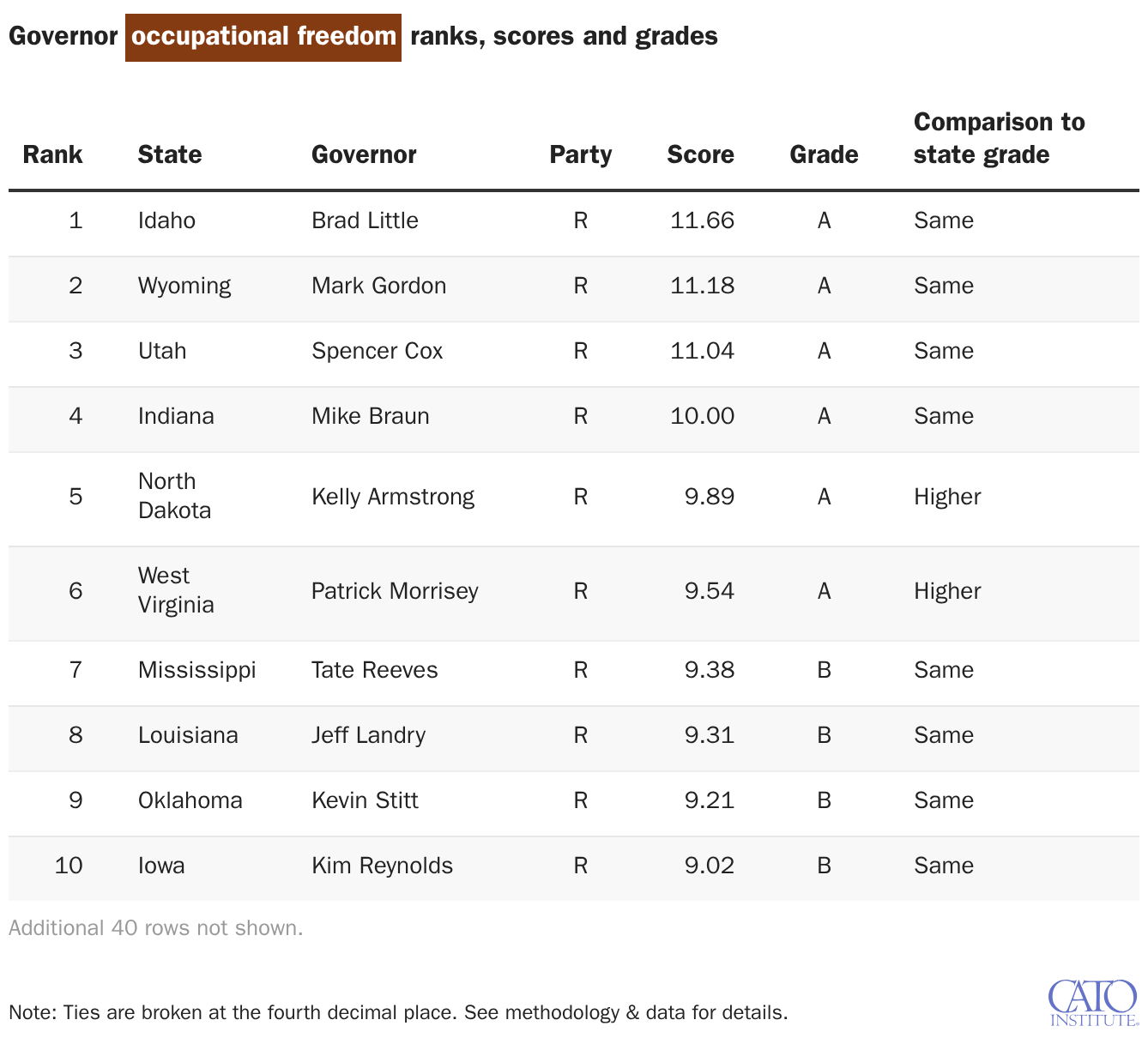
Governor occupational freedom ranks, scores and grades

Six governors receive A grades, all Republicans. While the top two highest scorers—Brad Little of Idaho and Mark Gordon of Wyoming—both assumed the governorship of a state that was already strong in terms of labor freedoms, they also signed into law some of the nation’s broadest universal-recognition provisions for occupational licenses issued in other states. Another high-scoring governor, particularly notable for having driven his state’s occupational licensing reforms in a state that has long been somewhat hostile to them, is West Virginia’s Patrick Morrisey.

Thirteen governors receive Fs, all Democrats. All but one of them govern states that also earn an F due to low levels of occupational freedom. These governors have not helped their states ascend from that low-reputation status. Of particular note is Gretchen Whitmer of Michigan, who worsened her state’s occupational freedom climate by signing into law a termination of the state’s 2012 right-to-work law.

How Is Occupational Freedom Measured?

This category consists of six variables organized into five groups:

  • Freedom of association in the workplace (two variables)
  • Minimum wage (one variable)
  • Occupational licensing (one variable)
  • Universal occupational licensing recognition (one variable)
  • Independent work freedom (one variable)

Freedom of Association in the Workplace

This group consists of two variables: whether a state has a right-to-work law and whether the state mandates that private-sector employers (not public-sector employers) verify workers’ status using the federal government’s E‑Verify system.

Right-to-work laws protect the rights of workers to refrain from joining or paying dues to a labor union. These laws also forbid the creation of union shops, in which joining a labor union is required for employment. Although some argue that these laws violate the contract rights of businesses that may want to operate as union shops, “Freedom in the 50 States” takes the perspective of the worker, who deserves the right to choose whether to associate with a labor union in their place of employment and who wants to avoid the coercive payment of union dues that compulsory membership requires. From that perspective, right-to-work laws protect workers’ right to associate, in light of the federal National Labor Relations Act, which tips the playing field in favor of compulsory unionization.

A state’s requirement that private-sector employers use the federal E‑Verify system to determine eligibility for employment is, as Cato Institute scholars have described it, an intrusive labor market regulation that is expensive and prone to errors that could falsely exclude Americans from employment. This is particularly burdensome since other less costly and equally accurate means—such as I‑9 forms—are available.

States that have a right-to-work law and no mandate to use E‑Verify receive a score of 10. A state that has only one of these receives a score of 5. A state that has both scores 0.

Minimum Wage

A mandated minimum wage precludes employment contracts that pay a wage rate lower than the mandated floor. Although a federal minimum wage already binds all states, some states have mandated an even higher minimum wage. This category measures the difference between a state’s higher minimum wage and the federal minimum wage. The calculation is based on the annual earnings of a minimum wage worker (2,080 work hours) as a share of per capita personal income. This allows us to roughly account for the existing level of income in a state. Although California’s nearly $17 minimum wage is high in absolute terms, it’s only the second highest in relative terms (40.5 percent of annual per capita personal income). Calculated this way, Missouri’s $15 minimum wage is actually the highest (40.6 percent).

States that abide only by the federal minimum wage receive the top score of 10 because there is no differential between the state minimum wage and the federal minimum wage. States that have their own higher minimum wage receive fewer points based on a curved scale.

Occupational Licensing

Occupational licensing laws are effectively mandates that require government permission before someone can legally work in many different occupations. Not all occupations are licensed, and not all states license the same occupations. The economic literature indicates that there are no real health or safety benefits to requiring these licenses. Yet the cost of obtaining many of them is quite burdensome and could keep many people out of the workforce for years, and the mere requirement to obtain one restricts a worker’s right to earn a living. This category, based on the Archbridge Institute’s State Occupational Licensing Index, measures the percentage of occupations (out of 254) that are licensed in a state. The states that license the least receive the highest scores.

Universal Licensing Recognition

Universal licensing recognition is a state policy that allows workers who hold an occupational license in one state to obtain authorization to practice in another state without needing to repeat education, testing, or training. Many states have passed some version of this, but some limit the recognition based on residency requirements or whether the issuing state’s training requirements are “substantially similar.” The gold standard of these laws requires automatic, nondiscretionary out-of-state license recognition regardless of how long an individual has been in a state or whether a licensing board decides that an issuing state’s requirements are sufficient (i.e., “substantially similar”). The states that have enacted this best-in-class recognition law, as measured by the Archbridge Institute, receive a score of 10. Those that have a recognition law but also a residency requirement without a “substantially similar” requirement receive a 7. States that have a “substantially similar” requirement in their recognition law receive a 5. States that have no recognition laws receive a 0.

Independent Work Freedom

Whether a worker can freely enter into freelance or other independent work arrangements with a business often depends on whether the government deems such arrangements “traditional” employment, which is typically subject to more stringent regulations governing wages, overtime, benefits, and other job aspects. In such cases, the government’s designation of a work arrangement as traditional will apply even where a worker is trying to avoid that designation for financial or personal reasons. To this end, some states deploy the strict ABC test—which many common independent work arrangements fail—to determine whether a worker should be legally considered an employee instead of a freelancer or contractor, with all the commensurate legal obligations and restrictions that entails. States are scored in this variable based on the strictness or absence of such a test. A state receives a 10 if there is no such test. A state receives a 5 if its test only applies to a few specific industry sectors. A state receives a 0 if it maintains a strict ABC test or similar classification test equally hostile to independent contract employment.