What Is Recreational Freedom?

Social activities revolving around wagering and alcohol are as old as the republic. So is the use of hemp and other substances. Yet perhaps even more common was the public discontent when these activities were taxed, regulated, and banned. This category measures the degree to which the state protects or infringes on the right of responsible adults to engage in recreational activities like gambling and the consumption of alcohol, nicotine, and marijuana.

State Ranks and Grades

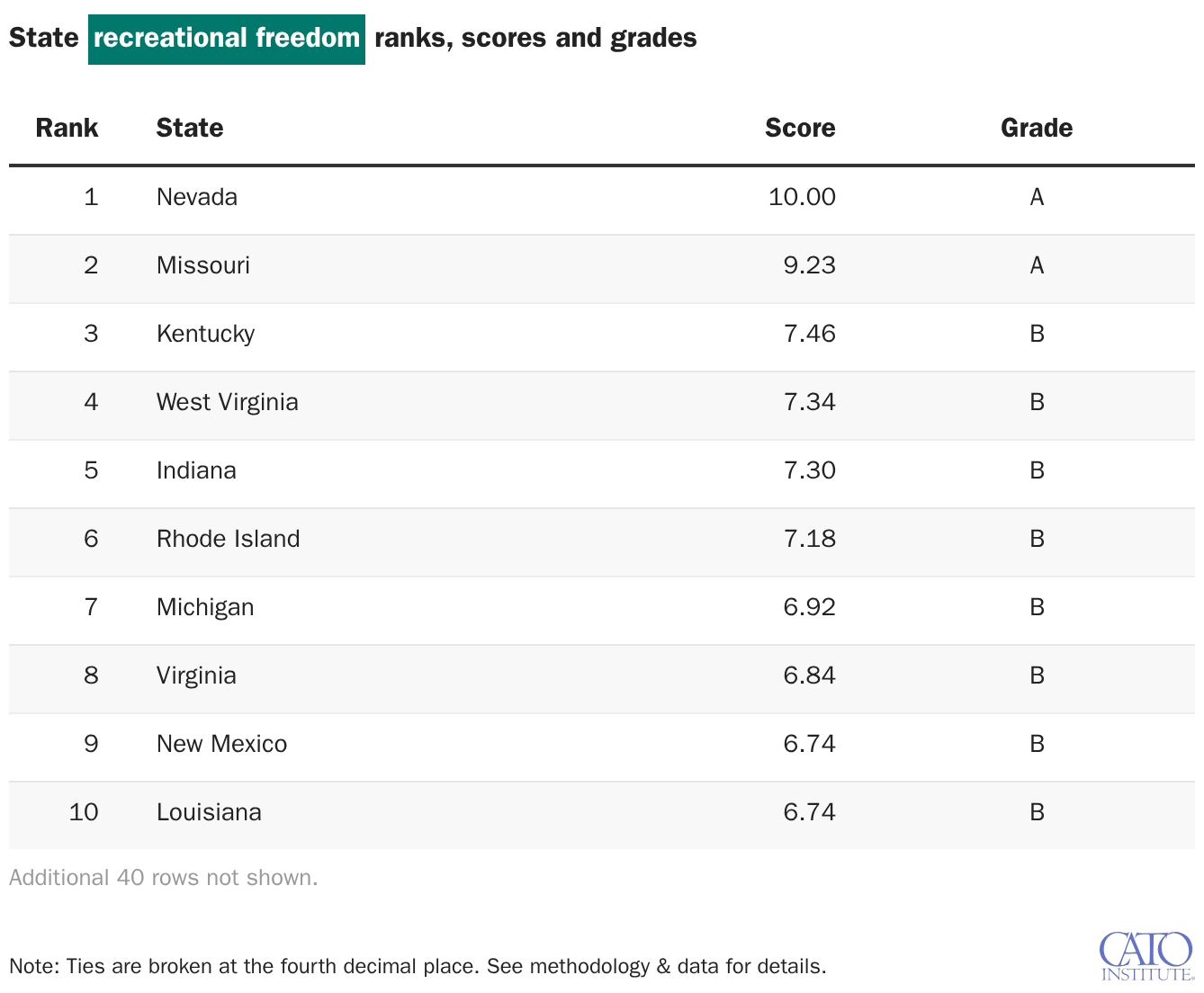
State recreational freedom ranks, scores and grades

Only two states share the top grade of A (in rank order): Nevada and Missouri. Each has legalized recreational marijuana, has low taxes on tobacco and alcohol, and has permissive allowances for hemp and CBD (cannabidiol). Nevada, not surprisingly, earns one of the highest marks for allowing the broadest array of gambling types.

Six states receive an F (in rank order): Alaska, Washington, Hawaii, Vermont, Utah, and Idaho. They are generally restrictive across most of the variables in this category, especially Idaho. For instance, that state classifies a consumer hemp product with any amount of THC (tetrahydrocannabinol) as marijuana (which is itself not available for recreational use in the state) and makes it a felony to possess more than three ounces of it (one of the lower thresholds among all the states).
Governor Ranks and Grades

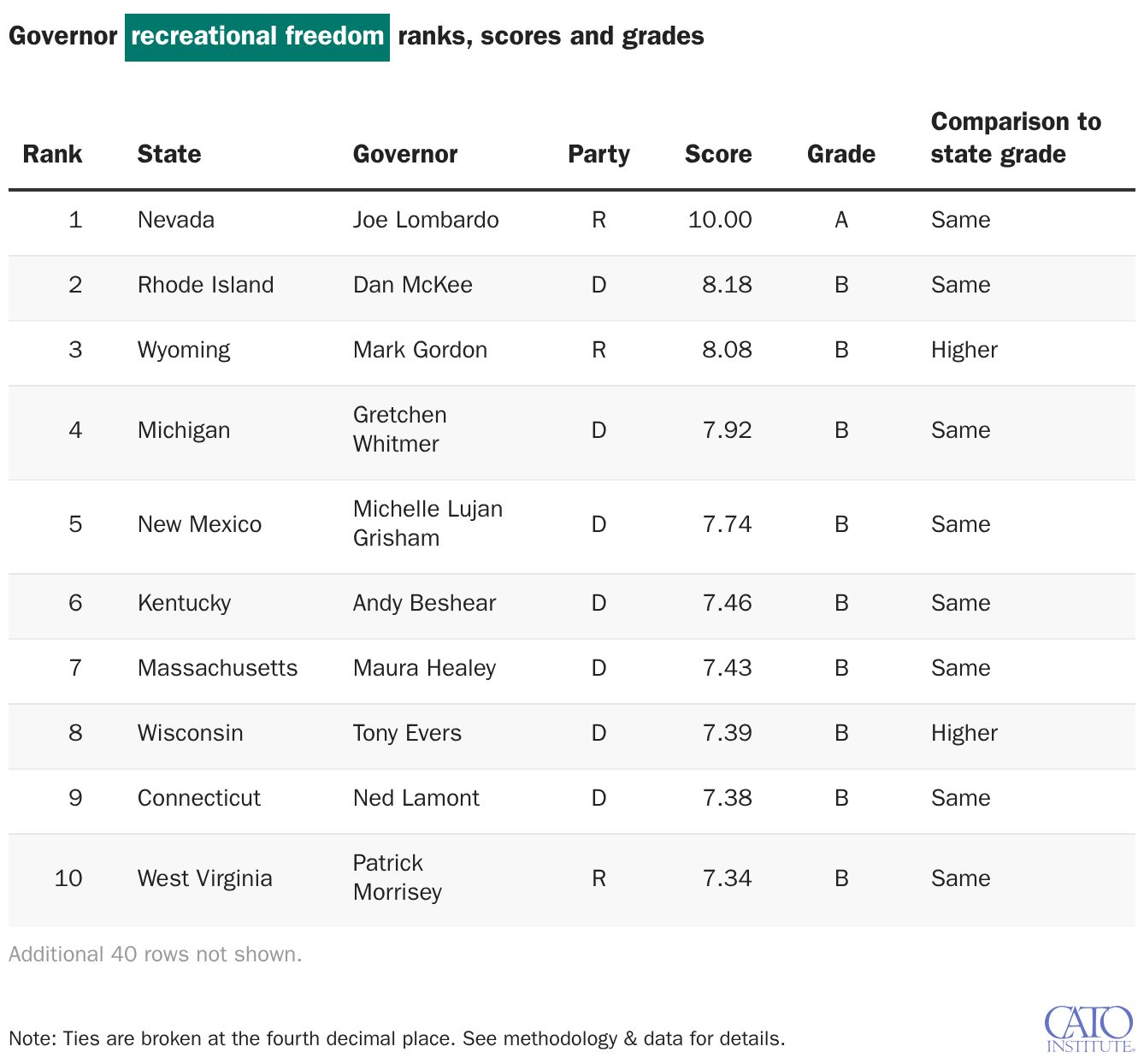
Governor recreational freedom ranks, scores and grades

One governor receives an A grade: Nevada’s Joe Lombardo (R). He benefits from his state’s top score. Lombardo maintained an A grade even though he encouraged the state’s litigation against Kalshi and other futures market platforms (a factor that was indeed considered in his grade). That impulse was offset by the overall positive policy positions; foremost among them, he signed a bill more than doubling the recreational marijuana possession threshold, from 1 ounce to 2.5 ounces.

There are 12 governors who receive an F, 8 of whom are Republican. The F‑grade governors are (in rank order): Oregon’s Tina Kotek (D), Iowa’s Kim Reynolds (R), Georgia’s Brian Kemp (R), South Dakota’s Larry Rhoden (R), Montana’s Greg Gianforte (R), Washington’s Bob Ferguson (D), Ohio’s Mike DeWine (R), Alabama’s Kay Ivey (R), California’s Gavin Newsom (D), Hawaii’s Josh Green (D), Utah’s Spencer Cox (R), and Idaho’s Brad Little (R). Most of them are governors of F‑grade states. Of these, the five governors with a lower grade than their state—Kotek, Kemp, Rhoden, DeWine, and Ivey—all receive subtractions from their state’s already low score for signing into law restrictions on the freedom of marijuana and hemp users.

What’s in the Recreational Freedom Category?

This category consists of 19 variables organized into five groups:

  • Gambling (six variables)
  • Alcohol (four variables)
  • Tobacco and vapes (three variables)
  • Marijuana (three variables)
  • Hemp and CBD (three variables)

Data in this category come from the Tax Foundation, the National Organization for the Reform of Marijuana Laws, the National Conference of State Legislatures, and our independent review of state statutes.

Gambling

This group measures the variety of wagering and casino types that are allowed by state law. They are grouped into three subtypes. Points are awarded for each type allowed in a state, and the score for each state is based on the percentage of the total number of types that are allowed. Only a state that allows all of them receives a perfect score of 100 percent.

Location-Based Gambling

This is predominantly traditional casinos—those located on Native American reservations as well as nontribal casinos—but it also includes electronic gambling terminals or slot machines found at clubs and bars outside typical casino venues and brick-and-mortar sportsbooks.

Online Gambling

Online gambling includes app-based mobile sports betting as well as web-based casino games.

Election Prediction Markets

Over 30 states restrict wagering on the outcome of any election. Some states ban election betting outright, while others ban it only for public officials or candidates for office. States that do allow it receive a point, those that lightly restrict it receive half a point, and those that forbid it for all consumers receive a zero.

Most of this wagering activity occurs online, but the laws and regulations concerning election betting predate the modern online betting economy. Some states, including Arizona, are beginning to use these laws as the basis for lawsuits to restrict the activities of event-prediction market platforms like Kalshi and Polymarket. (Other states use traditional gambling laws to regulate them, while the companies argue that what they do is effectively an event contract already regulated by the federal government. Most judicial decisions, for now, have favored of the platforms.) Although the legal landscape is still evolving, we have included election wagering laws in this index as a loose proxy for the freedom to engage in this specific form of betting. We assume that states currently forbidding it in their traditional gambling laws might be more likely to restrict it in the future or use it as a predicate for punitively taxing and licensing the platforms (as occurred recently in Illinois).

Alcohol

The alcohol group is composed of two halves. Half the points are awarded for how the state regulates the distribution and retail sales of alcohol, and the other half for the tax rates applied to various types of alcohol.

Distribution and Sales of Alcohol

All states administer some kind of licensing of alcohol sales, but some assume state government control over the wholesale distribution of certain types of alcohol or state ownership or control of retail locations. States that have full private control of both distribution and retail (subjecting these to licenses) receive 10 points. States that control only the wholesale distribution of alcohol but still allow private retail locations to sell alcohol score 5 points. States that control both wholesale distribution and retail sales receive 0 points.

State Excise Taxes

States are scored based on their tax rate per gallon for beer, wine, and distilled spirits. The states with the lowest tax rates receive higher scores.

In the states that monopolize both wine and spirits wholesaling, the effective tax burden on those beverages cannot be measured directly because in this case the state often generates revenue by applying a markup before retail sale. Published pricing data are insufficient to separate the revenue-raising portion of that markup from the ordinary wholesale margin. A zero excise rate in these states does not indicate a zero burden on drinkers. Rather than impute a figure, we left these variables out of the calculation and scored these states only on the beverage categories where a comparable consumer-facing rate is available.

Tobacco and Vapes

Like the alcohol group, the smoking and vaping variable group scores overall state intervention as well as taxes. It consists of three variables: statewide laws on smoking in restaurants and bars, cigarette taxes, and vape taxes. All three are equally weighted.

Prohibitions on Smoking in Restaurants and Bars

Private restaurant and bar owners should be able to decide whether to allow smoking in their establishments. Some state laws deprive those owners of that right. In this index, a state receives full credit if it allows private owners of both restaurants and bars to make this decision. If a state forbids smoking in only one of those types of establishments, it receives partial credit. States that prohibit smoking in both types of establishments earn a zero.

Cigarette Tax

This variable awards points based on the state tax rate for a pack of 20 cigarettes. Higher rates receive lower scores.

Vape Tax

This variable awards points based on the state tax rate on a four-pack of 1.8 mL vape cartridges. Higher rates receive lower scores.

Marijuana

The marijuana group has three variables covering statewide legalization of marijuana for adult recreational use, the legal limit for possession, and the severity of penalties for possession. The policies measured here strictly regard recreational marijuana—medical marijuana is included in the Medical Freedom category. Additionally, these all relate to adult use and possession of marijuana only. No state is penalized for banning sales in any form to minors.

Legalization of Recreational Use

This variable is a simple binary: Is the recreational (nonmedical) use of marijuana legal in the state? If yes, the state receives a score of 10. If no, a 0.

Possession Limit That Triggers Possible Incarceration

This variable records the legal state limits for personal possession, measured in ounces. States that set a high threshold before incarceration is either possible or mandatory—typically more than 15 ounces—are awarded maximum points; so are states that have no incarceration penalties for possession (for example, prison sentences are reserved for trafficking at very high volumes). At the other end of the range, states that are willing to incarcerate at comparatively much lower levels of possession receive a zero.

Felony Possession Limit

While many states may have a low-to-average possession limit, their penalties may be no more than a misdemeanor or perhaps a civil infraction. Some states, however, actively label possession of any amount or possession above a low threshold a felony. This variable measures the possession limit (in ounces) that triggers a felony sentence. The states where this threshold is high—such as 32 ounces in Minnesota—receive the maximum 10 points. States that do not make possession a felony at any amount also receive 10 points. States with the lowest felony thresholds in the nation—such as one ounce and below in Florida, Georgia, Mississippi, South Carolina—receive a zero.

Taken together, these variables (and the points awarded) work as a way to quantify what states have either legalized or “decriminalized”—meaning that although they have not legalized recreational marijuana, they have removed jail time as a penalty for possessing small amounts of marijuana for personal use. Those states still receive some credit for liberalizing their drug policy in this smaller way. In the aggregate, states that have legalized recreational marijuana tend to receive scores in the top half, and states that have decriminalized it never receive a zero and tend to place in the middle third. The states that have kept recreational marijuana illegal and have low felony or incarceration thresholds tend to be in the bottom third.

Hemp and CBD

Hemp is a form of cannabis used for fiber, food, and products containing CBD, a compound that does not itself produce a high. “Intoxicating hemp products” refers to hemp-derived products containing compounds such as delta‑8 or delta‑9 THC that can produce a high. Manufacturers often make delta‑8 by chemically converting CBD extracted from hemp.

Federal law currently defines hemp as cannabis containing no more than 0.3 percent delta‑9 THC by dry weight. States can choose to defer to the federal threshold and definitions while also adding their own restrictions on particular cannabinoids, age limits for purchasing, licenses for retail sale, and marketing restrictions. Meanwhile, other states can choose to be more restrictive by choosing to lower the threshold or by shrinking the list of allowed cannabinoids. (The federal government is currently scheduled to lower the effective federal threshold in December 2026. At that point, some states might end up with a comparatively higher threshold than the federal one. For this edition of “Freedom in the 50 States,” we use the federal standard as the baseline for the score.)

This category scores states on three variables related to these limits and classifications. Like the marijuana variables, these are strictly concerned with sales to and use by adults, not minors.

THC Levels

States that allow sales that conform to the federal definition receive 10 points. States that lower the allowable threshold (usually through capping total THC by serving) receive between 7.0 and 2.5 points based on their serving cap. States that ban all hemp with any discernible trace of THC are awarded a 0.

Allowed Cannabinoid Type

States that allow products with a broad spectrum of both naturally occurring THC (subject to the state’s limit) and the chemically extracted type from CBD receive the top score (10 points). The states that allow only the extracted or “converted” type get a 5. States with a narrower scope—either delta‑9 only or none at all—receive a 2.5 or 0, respectively.

Penalty for Possession or Use

Ingestion or possession of unapproved hemp or CBD is usually not a crime (which earns the state 10 points) or is no more than a misdemeanor or civil infraction (5 or 7.5 points, respectively). The handful of states that make it a felony—Idaho, Kansas, Nebraska, Pennsylvania, Texas, and Wyoming—get a 0.