What Is Education Freedom?

This category measures the degree to which a state expands or restricts the freedom of parents and students to choose the educational path—public, charter, private, or home-based—that best fits their needs. Education policy is primarily set at the state and local levels, resulting in a wide spectrum of parental choice across the nation. The education freedom category ranks all 50 states and their sitting governors based on how thoroughly their state’s current laws allow families to choose how and where their children are educated.

State Ranks and Grades

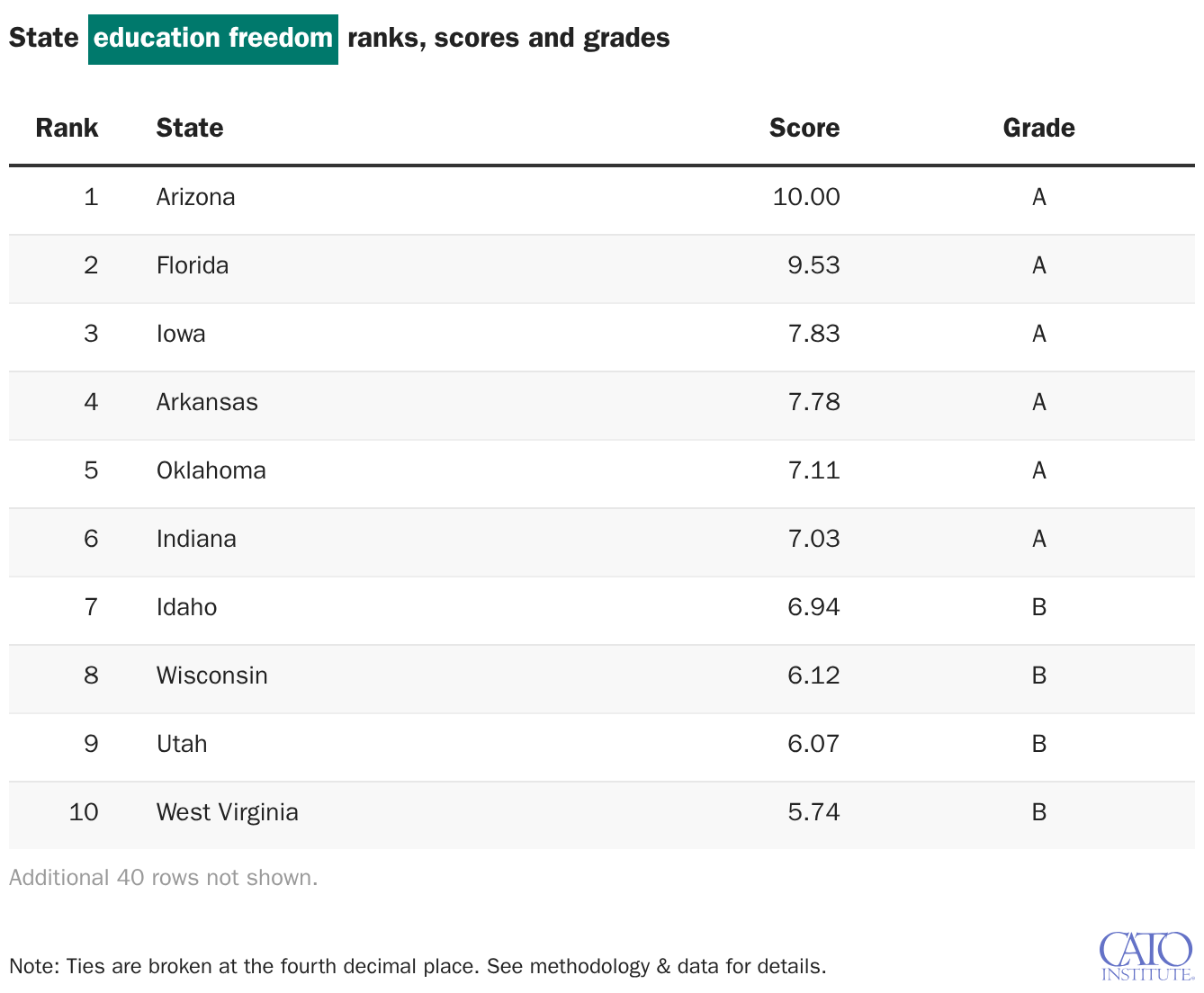
State education freedom ranks, scores and grades

Six states lead the rankings with an A grade (in rank order): Arizona, Florida, Iowa, Arkansas, Oklahoma, and Indiana. These states share several common characteristics: a universal school choice program, broad open-enrollment policies that allow students to transfer between or within districts, comparatively strong charter school laws, and lightly regulated homeschooling options.

States at the bottom of the rankings typically lack school choice programs, have weak or nonexistent charter school laws, and offer few or no open-enrollment options. Maine and Rhode Island are tied for last among all 50 states.
Governor Ranks and Grades

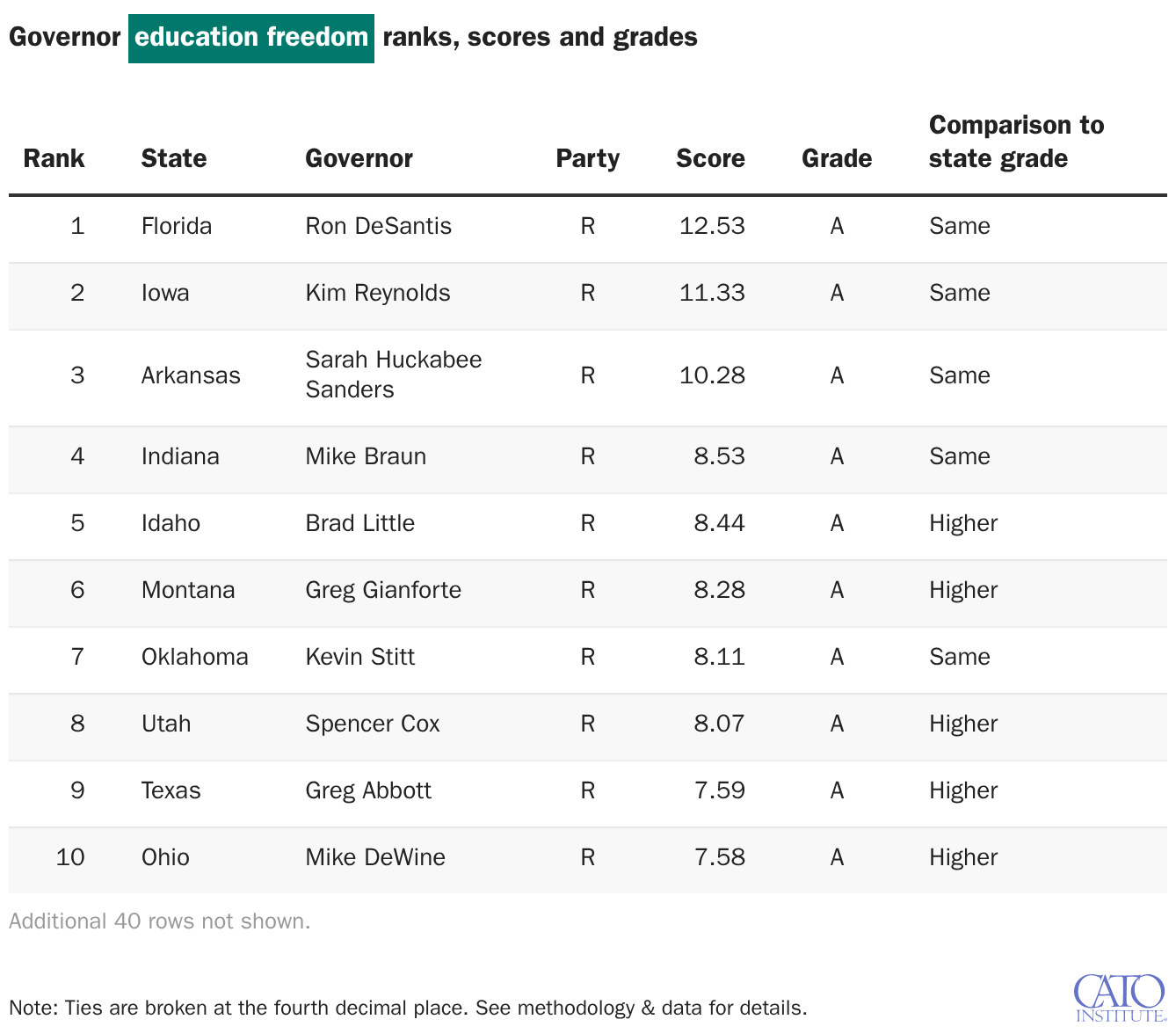
Governor education freedom ranks, scores and grades

Republican governors generally receive the highest grades in this category. Florida’s Ron DeSantis leads all 50 governors with an A grade, closely followed by Iowa’s Kim Reynolds. Both championed and signed landmark school choice programs into law in their states. Similarly, Arkansas’s Sarah Huckabee Sanders also earns an A for signing into law what school choice experts consider to be one of the top three programs in the nation.

The highest-scoring Democratic governor, Colorado’s Jared Polis, breaks from the usual pattern. He has actively expanded his state’s education freedom by signing charter school and open-enrollment expansions into law, earning the only B grade for a Democratic governor on education policy and the highest B among governors of any party.

The most notable divergence between a governor’s grade and their state’s grade is seen in Arizona. Although the Grand Canyon State earns an A grade for education freedom, Governor Katie Hobbs receives an F. This represents the largest gap between a governor’s grade and their state’s grade in this category, stemming from her first-year proposals to eliminate the state’s universal Empowerment Scholarship Account program and her subsequent proposals to cap it.

How Is Education Freedom Measured?

This category consists of five variables organized into four groups:

  • Private school choice programs (one variable)
  • Open-enrollment policies (two variables)
  • Charter school laws (one variable)
  • Homeschool regulations (one variable)

The primary sources for these variables are EdChoice’s Friedman Index, the Reason Foundation’s state-by-state open-enrollment survey, the Center for Education Reform’s (CER) charter school scorecard, and the Home School Legal Defense Association’s state-by-state survey of homeschool regulations.

Private School Choice Programs

This variable measures the scope, value, and reach of each state’s private school choice programs. States with more expansive school choice options score higher. It uses the Friedman Index score for each state, which is a percentage based on the number of students each school choice program covers, eligibility factors, and per-student funding levels relative to public school levels. Programs in this category include education savings accounts and tax credit programs designed to encourage donations to nonprofits (i.e., scholarship tuition organizations) that award scholarships for students to attend private schools. These percentages are then used to derive a curved 0–10 score. Any state with a private school choice program of any sort receives an automatic point, while those without one receive a zero. The remaining states receive a curved score between 1.5 and 10 for the quality of their private school choice law.

Open Enrollment Policies

This group measures whether students may transfer to a public school other than the one to which they are assigned based on their address. Both scores are taken from the Reason Foundation report on state open-enrollment laws, which assesses both between-district and within-district types. These two open-enrollment scores are combined, converted into a percentage of the total possible, and rescaled to a 0–10 total score for this group.

Charter School Laws

This variable is drawn from the annual charter school scorecard produced by the CER, which grades each state’s charter school system on the ease of starting and expanding a charter school and the operational autonomy the state government allows. The underlying CER score is rescaled to a 0–10 score, with the most permissive charter school laws receiving higher scores. States without any charter school law receive a 0.

Homeschool Regulations

This variable is based on the Home School Legal Defense Association’s categorization of each state’s homeschool regulations. States with no notice requirement and low regulation receive a 10; states with low regulation receive a 7.5; states with moderate regulation receive a 5; and states with high regulation—such as mandatory testing, curriculum approval, or licensing requirements for instructional personnel—receive a 0.