What Is Medical Freedom?

Free individuals should be allowed to make decisions about their own health care without government interference. This includes access to a range of services and providers operating in a relatively free market and the right to self-medicate. States that best protect these freedoms score the highest in this category.

State Ranks and Grades

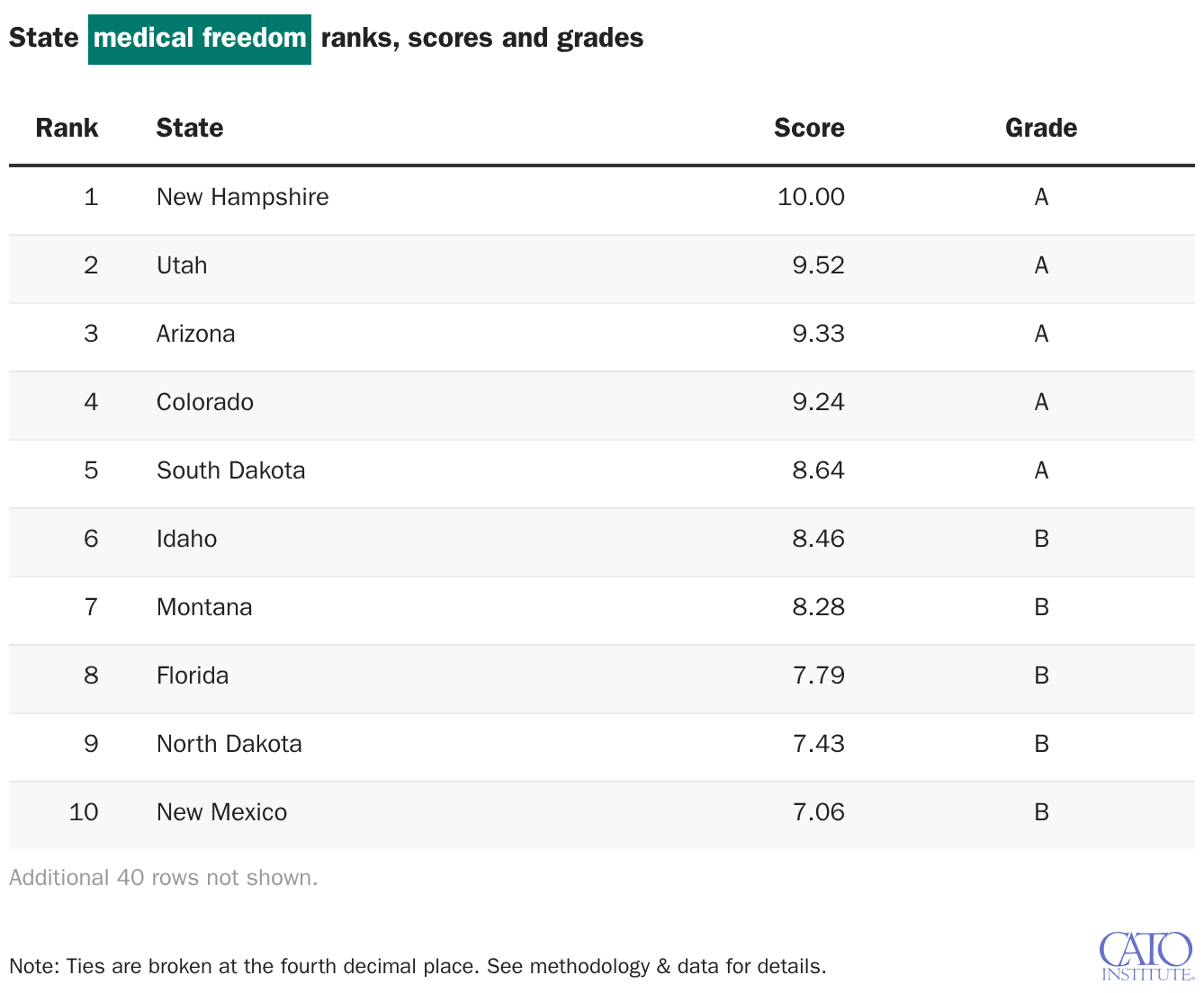
State medical freedom ranks, scores and grades

Five states earn an A grade (in rank order): New Hampshire, Utah, Arizona, Colorado, and South Dakota. All these states allow a relatively free statewide health marketplace due to the absence of certificate of need laws, which reduce health care competition. These states generally infringe the least on the right to self-medicate; allow the greatest number of nurse occupations to provide services independently without physician oversight, thereby increasing the affordability and variety of health care options for patients; and allow physicians and nurses to provide the widest and most comprehensive forms of telehealth to patients within and outside the state.

Tennessee ranks last among all 50 states due to its limited medical marijuana program, its exceptionally strict restrictions on the care that nurse practitioners can provide without a physician’s permission, and a lack of real freedom for health providers to serve patients remotely.
Governor Ranks and Grades

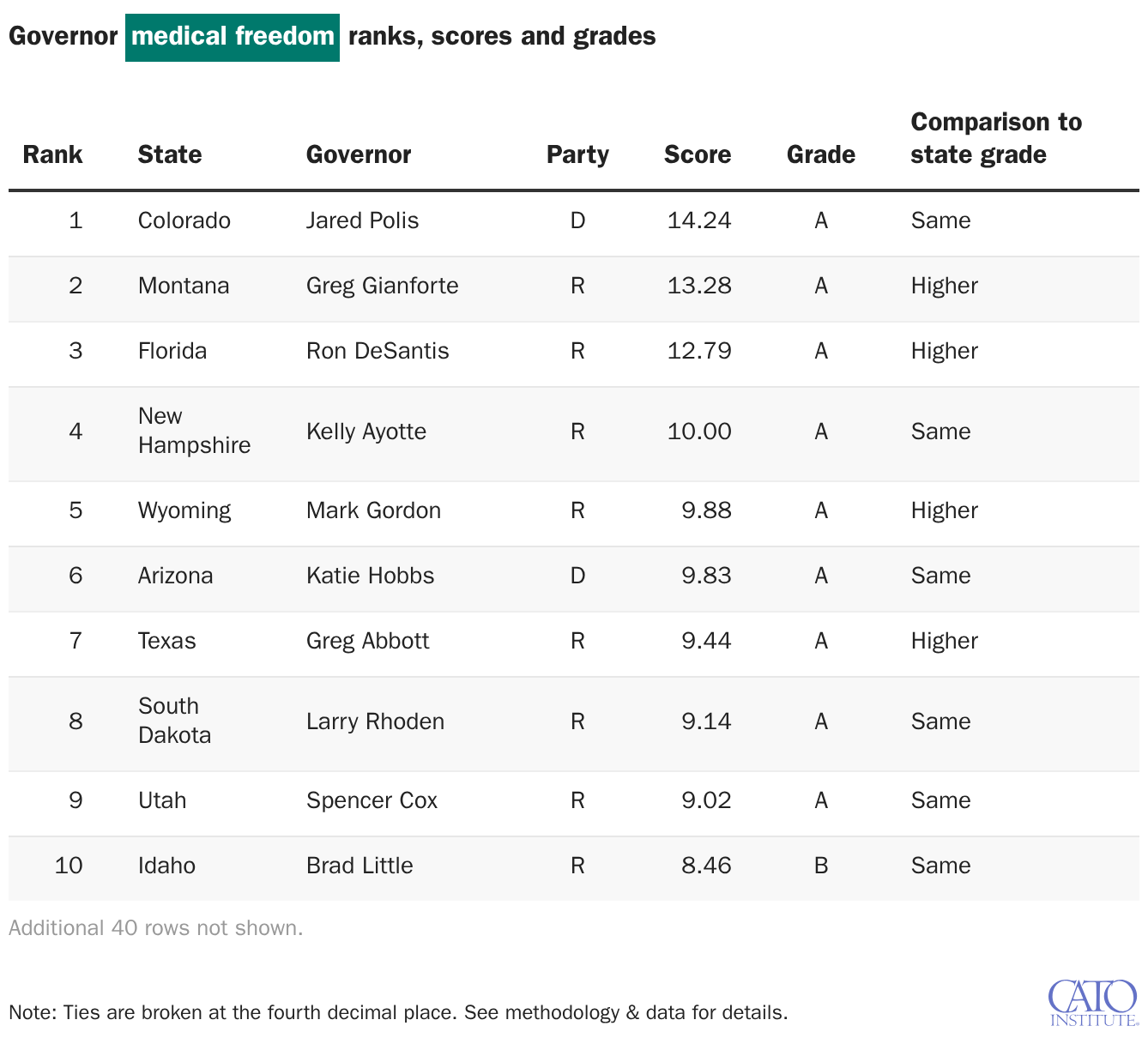
Governor medical freedom ranks, scores and grades

Among the governors, a few standouts drove or supported substantial reforms to expand medical freedom. The top-scoring governor is Colorado’s Jared Polis (D). He has maintained his state’s top-tier reputation in this category by expanding access to medical marijuana, actively supporting the state’s voter-approved medical psilocybin law, maximizing the scope of practice for nurse practitioners, and expanding telehealth options. Meanwhile, Florida’s Ron DeSantis and Montana’s Greg Gianforte, both the top-scoring Republican governors, spearheaded successful efforts to eliminate certificate of need laws and signed legislation to greatly expand telehealth options.

One notable discrepancy occurs between the state of California (which earns a B) and its Democratic governor, Gavin Newsom, who receives a C. Although he has supported expansions in the scope of practice for nurses, his crusade against all uses of kratom and 7‑hydroxymitragynine—including for medical purposes—helped drive his grade down. Existing state law does not actually ban either substance, yet he adopted an expansive reading of it as a pretext to order statewide confiscations of all types of products. This appears to be in stark contrast to the state’s mostly permissive medical treatment environment.

What’s in the Medical Freedom Category?

This category consists of 14 variables organized into four groups:

  • Certificate of need laws (two variables)
  • Scope of practice for nurses (four variables)
  • Telehealth regulations (three variables)
  • Experimental treatments and self-medication (five variables)

Sources for the data include the Mercatus Center, the Pioneer Institute, the Cicero Institute, the National Conference of State Legislatures, the Knee Regulatory Research Center, and our independent review of state statutes.

Certificate of Need

This group measures the extent to which states restrict the freedom of patients to obtain health care services from willing providers. A certificate of need (CON) is a legal permit required for health care providers to offer new services, expand facilities, or invest in technology. It combines the following equally weighted measures:

Percentage of Services That Require a CON

This variable measures what percentage of services (out of 33 total) require a permit before they may be offered by health care providers in the state (excluding hospitals—see below). Each state receives a score from 0 to 10 according to what percentage of its services require a CON: The greater the number of services covered by a CON law, the lower the state’s score will be.

Hospital CON Requirement

This binary variable measures whether building new hospitals or making hospital-sized investments requires a CON approval from the state: States either receive 0 points (“Yes”) or 10 points (“No”).

Scope of Practice

This group measures the extent to which patients have the freedom to access independent services from four specific nurse types (nurse practitioners, certified nurse-midwives, certified registered nurse anesthetists, and physician assistants) to the full extent of their training. Each nurse type is treated as a variable in this group. As with several other variables in this report, it could easily have fit within another category (in this case, the licensing group in the labor freedom category). However, because the licenses surveyed here are specifically medical in nature, and because the lack of available nurses and other medical professionals below the level of physician drives up costs and reduces choice for patients, this combination variable is included here. States that allow full practice authority (including prescription authority) receive a 10. States that allow full practice authority but only after a lengthy transition period, or restrict prescribing authority to physicians, only receive a 5. States that require all nurse types to only work under a licensed physician receive a 0.

Telehealth Regulations

This group combines three variables that measure the scope and availability of telehealth for patients and providers in each state. The definitions and categorizations come from the annual report on this topic published by the Pioneer Institute and the Cicero Institute. States are not graded on their Medicaid policies for telehealth.

Modality

Based on a definition developed by the American Telemedicine Association, this variable gauges whether a state allows all forms of telehealth, including video or audio consultations, and the synchronous or asynchronous transfer of medical records to a remote provider for review. A score of 10 is awarded to states that allow all forms. A score of 5 is awarded to states that restrict some forms. A score of 0 is given to states that forbid all or most forms.

Start Telehealth by Any Mode

Even states that allow telehealth consultations may require a specific mode (audio-only or video-only) when establishing the remote medical arrangement, even if doing so is not clinically appropriate or runs counter to the patient’s wishes. This variable scores states based on their regulatory indifference to how the medical relationship is initiated. A top score of 10 is awarded to states that allow all modes. A score of 5 is awarded to states that restrict some forms. A score of 0 is given to states that forbid all or most.

Barriers to Interstate Telehealth

This variable measures the barriers a state places in the way of patients seeking to access health care services remotely from providers licensed in other states. A state receives a perfect score of 10 if it assumes and allows recognition of out-of-state licenses for telehealth purposes. A state receives a 5 if it requires the provider to have a special-purpose telehealth license. A state earns a 0 if it forbids or severely restricts in-state patients from accessing out-of-state remote providers.

Experimental Treatments and Self-Medication

This group measures the restrictiveness of each state’s laws regarding the ability for patients to pursue experimental treatments (termed in law as the “right to try”) as well as a state’s willingness to allow adult medical use of psychoactive substances. Those substance variables specifically concern medical use by adults, and no state is penalized for forbidding these substances to anyone under age 21. This group is a composite of the following five equally weighted variables:

Right to Try Experimental Treatments

This variable measures the extent to which states allow terminally ill or those suffering severely debilitating illnesses to pursue investigative medical treatments to alleviate their conditions. The laws allow patients in extreme circumstances to enroll in treatments that have been through some stage of clinical testing but are otherwise not approved by medical regulators and are still considered experimental.

The federal government passed a “right to try” law in 2018 that allowed these treatments mainly for those with terminal illnesses. As a federal law, it covers each resident in every state, so this variable measures the extent to which state laws have been passed to broaden access to experimental treatments, particularly for those who don’t qualify as terminally ill, and to cover personalized genetic treatment. A state that simply conforms to the federal law does not receive any additional points here. For the rest, we follow the Knee Regulatory Research Center’s definition: States that provide safe harbor for physicians and drug companies but don’t otherwise expand on the federal law receive a 5, and the states that are maximally permissive and whose laws apply to patients with nonterminal conditions receive a full 10 points.

Medical Marijuana

This variable measures the obstacles a state places in the way of patients accessing medicinal marijuana and what forms they take. This is specifically a measure of medical marijuana laws, not recreational use (which is measured in the recreational freedom category). States receive 10 points for a more comprehensive adult medical marijuana program and 5 points for restricting medical marijuana to limited-THC variants or cannabis-derived products high in CBD and low in THC. States that do not allow any form of adult medical marijuana program receive a 0.

Kratom

Kratom is a popular plant product with psychoactive properties that is consumed across all 50 states. Kratom acts on some of the same endorphin receptors as opioids, but to a different degree. One of the primary medical uses of kratom is nonopioid pain relief. States that allow the use of kratom with little to no restrictions receive 10 points. States that treat kratom above a certain threshold as a controlled substance receive 5 points. States that schedule all kratom products as strictly controlled substances, effectively banning their possession, sale, and use, receive a 0.

7‑Hydroxymitragynine (7‑OH)

The kratom leaf contains 7‑hydroxymitragynine (7‑OH). This metabolite, along with mitragynine, gives kratom its pain- and anxiety-relieving effects. It is more potent than mitragynine, and many people purchase isolated 7‑OH in tablet, liquid, and gummy forms to self-medicate for pain, anxiety, and PTSD. Like kratom, its therapeutic uses are growing. States that allow the sale and use of 7‑OH with little to no restrictions for adults receive 10 points. States that restrict 7‑OH products concentrated above a certain threshold receive 5 points. States that schedule all 7‑OH products as strictly controlled substances, effectively banning their possession, sale, and use, receive a 0.

Psilocybin

This variable measures the treatment of psilocybin for therapeutic purposes in state law. Popularly known as magic mushrooms, psilocybin is a psychedelic compound found naturally in species of fungi. States with no restrictions on self-administered adult medical use of psilocybin receive a maximum of 10 points. States that allow its use only under the supervision of a specially trained clinician get 5 points. States that ban the substance for medical use receive 0 points.