This category measures the degree to which a state protects or restricts the exercise of Second Amendment rights, as outlined in the Constitution. Although the right to keep and bear arms is constitutionally guaranteed nationwide by the Second Amendment, it is in practice administered and shaped at the state and local levels. Consequently, states exhibit various restrictions or additional statutory protections of this right. The firearm freedom category ranks all 50 states and their sitting governors based on the extent to which both current state laws and the legislation each governor supported protect or restrict these constitutional rights.

State Ranks and Grades

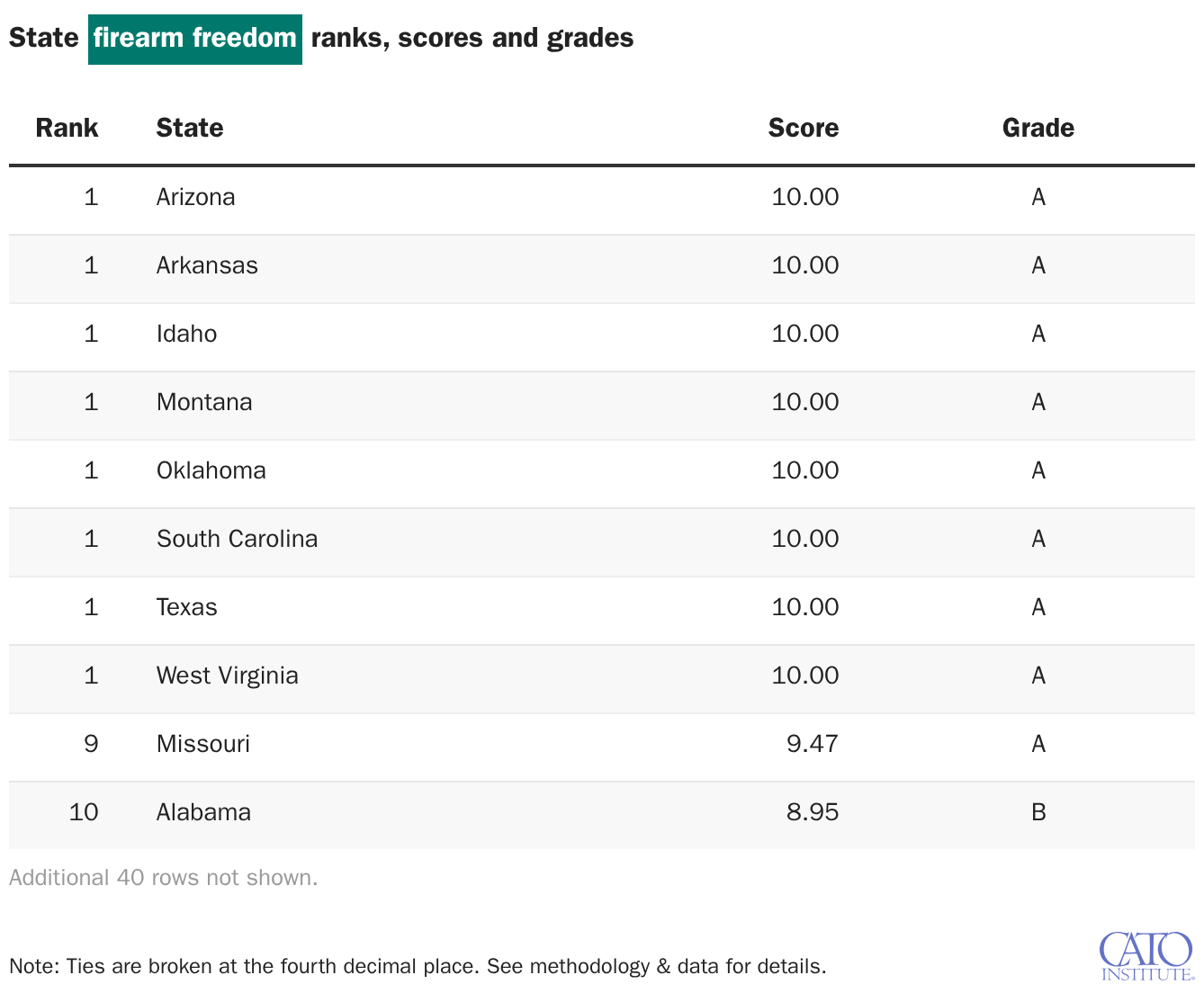
State firearm freedom ranks, scores and grades

Nine states earn an A grade (in rank order): Arizona, Arkansas, Idaho, Montana, Oklahoma, South Carolina, Texas, West Virginia, and Missouri. These states share several characteristics: They allow firearm purchases without a permit, allow permitless carry for both open and concealed weapons, have firearm protections codified in their state constitutions, and have not banned semiautomatic weapons.

California ranks last among all 50 states, with the lowest possible score of 0, having imposed permit-to-purchase requirements, firearm registration, bans on semiautomatic firearms and convertible pistols, and its permit requirement for concealed carry. These states also receive F grades (in reverse rank order): New York, Connecticut, New Jersey, Massachusetts, Maryland, Hawaii, and Illinois.
Governor Ranks and Grades

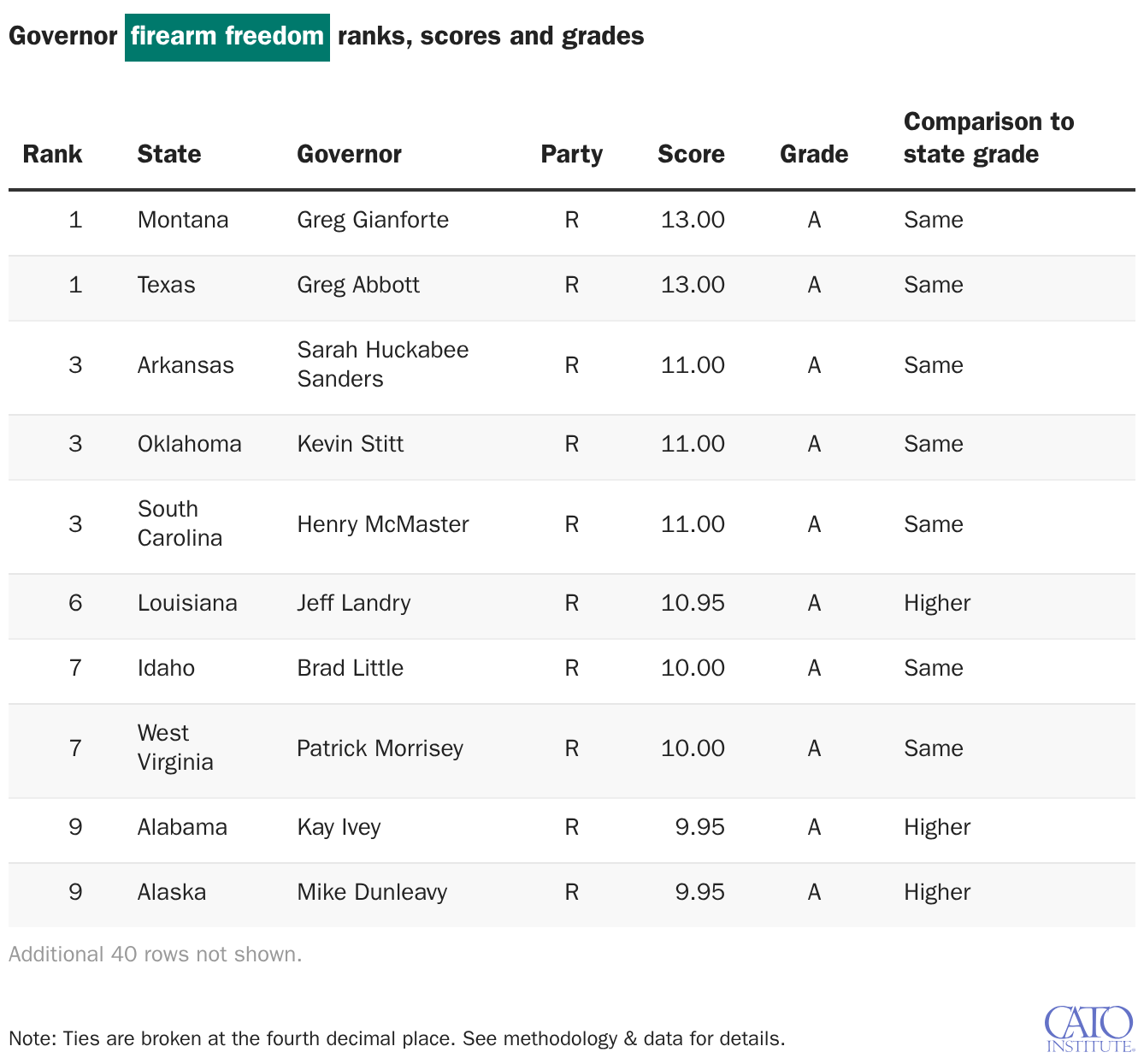
Governor firearm freedom ranks, scores and grades

Republican governors tend to earn the highest grades in this category. Montana Governor Greg Gianforte and Texas Governor Greg Abbott tie for first place among all governors, with grades only slightly higher than the average for Republican governors. Meanwhile, Vermont’s Phil Scott receives a C, the lowest grade among Republican governors, matching his state’s grade.

The top-scoring Democratic governors have been those in “red states” where the existing firearm freedom environment is already more permissive. For example, Kentucky’s Andy Beshear earns a B, the highest score among Democrats, primarily because he did not alter the state’s already better-than-average policy environment regarding firearms. California’s Gavin Newsom is the lowest-scoring Democrat, largely due to his state’s inhospitable policy climate toward firearms and his active efforts to expand his state’s restrictions.

The most notable divergence between a governor’s grade and their state’s grade is seen in Arizona. Although the Grand Canyon State earns an A for firearm freedom, Governor Katie Hobbs receives a C due to actively vetoing bills that would have expanded protections for firearm freedoms.

What’s in the Firearm Freedom Category?

This category consists of eleven variables, organized into four groups:

  • Purchase and registration rules (three variables)
  • Carry laws (three variables)
  • State constitutional and statutory protections of Second Amendment rights (two variables)
  • Bans or restrictions on weapon types (three variables)

The primary sources for these variables are the National Rifle Association’s state-by-state compilation of gun laws, the Giffords Law Center, and our independent review of each state’s statutes.

Purchase and Registration Rules

This group includes three types of impediments states may impose before a law-abiding person can legally acquire a firearm, as well as any requirements for owning a firearm.

Permit to Purchase
This variable measures whether a state requires a person to obtain a permit, license, or other government authorization before purchasing a firearm. States that do not require a permit receive a score of 1. States with a full permit law receive a 0. States with a partial permit law—usually applying to a specific type of firearm but not all—receive a 0.5.

Firearm Registration
This variable measures whether a state requires owners to register firearms with a government authority. Registration requirements obligate gun owners to record the existence and details of their firearms in a government database, often including serial numbers, make, model, and the owner’s identifying information. States with no registration requirement receive a 1; states with universal registration receive a 0; states with partial registration (for example, limited to handguns or specific categories of owners) receive a 0.5.

Firearm Owner Licensing
This variable measures whether a state requires gun owners to obtain a license simply to possess firearms. Unlike a permit to purchase, a licensing requirement is ongoing—it applies to continual possession, not solely the moment of acquisition. States that do not require a license to own a firearm receive a 1; states with a full licensing requirement receive a 0; states with a partial licensing scheme receive a 0.5.

Carry Laws

This group measures whether residents can carry firearms in public without obtaining government permission. Laws that require government permission to carry a firearm outside the home treat Second Amendment rights to self-defense as if they were government-granted privileges instead.

Permitless Open Carry
“Open carry” refers to the right to carry a firearm in plain view in public. This variable measures whether residents may openly carry a firearm without a permit or license. States that allow permitless open carry without restriction receive a 1. States that prohibit open carry or require a permit to open carry receive a 0. States with intermediate rules—for example, those that allow open carry in some jurisdictions but restrict it in others, or those that restrict it only in certain places—receive a 0.5.

Permitless Concealed Carry
“Concealed carry” refers to carrying a firearm hidden from public view, typically on one’s person or in a vehicle. States that allow permitless concealed carry receive a 1. States that require a permit to carry concealed receive a 0.5.

State Preemption
This variable measures whether state law requires localities to comply with the state standard for carry provisions. A state that forbids local governments from passing and enforcing their own provisions that reduce the scope of the state carry law receives a 1; a state that does not receives a 0.

Constitutional and Statutory Protections

This group measures whether states have gone beyond the federal constitutional floor to enshrine or reinforce Second Amendment protections in their laws. These protections reflect a state’s affirmative commitment to firearm freedom above and beyond what federal law requires.

State Constitutional Provision
Forty-four states include an explicit right to keep and bear arms in their constitution. These provisions vary in strength. Some closely mirror the federal Second Amendment, while others go further by applying “strict scrutiny” to any legislative restrictions, declaring the right “fundamental,” or prohibiting licensing and registration. States with a constitutional provision safeguarding the right to keep and bear arms receive a 1; states without one receive a 0.

Second Amendment Protection Act
A Second Amendment Protection Act—sometimes called a “firearm freedom act” or “Second Amendment sanctuary law”—is a state statute that prohibits state and local officials from enforcing or cooperating with federal firearm laws that infringe on the right to keep and bear arms. These laws assert an anti-commandeering principle: The federal government cannot conscript state resources or personnel in a federal law enforcement action that contravenes Second Amendment rights. States that have enacted a Second Amendment Protection Act or equivalent firearm freedom legislation receive a 1; states without such a law receive a 0.

Weapon-Specific Prohibitions

This category measures whether states have enacted bans on specific categories of commonly owned firearms. States without these prohibitions score higher.

Semiautomatic Weapon Ban
Some states ban certain semiautomatic firearms. These bans vary in their scope—some prohibit specific named models, others ban firearms with certain features (such as pistol grips, folding stocks, or detachable magazines), and some restrict magazine capacity as part of the same legislative framework. States with a semiautomatic weapon ban of any kind receive a 0; states without such a ban receive a 1.

Convertible Pistol Ban
Some states specifically restrict pistols that can be readily converted to fire automatically via so-called Glock switches or other devices enabling automatic fire from a semiautomatic platform. States with such a ban receive a 0; states without one receive a 1.

Magazine Capacity Restrictions
States that forbid the sale of firearm magazines exceeding 10 rounds receive a 0. Those that set the threshold between 11 and 17 rounds receive a partial score of 0.5. All other states receive a 1.