What Is Freedom of Speech and Association?

The freedom of speech and association is essential to a free society because it encompasses the ability of individuals to express political views, support causes and candidates, organize with others, share knowledge, and participate in public debate without undue government restriction or legal intimidation. This index measures several important protections of those freedoms at the state level. It considers the degree to which individuals are free to publicly express support for ideas and financially support political candidates and causes; the strength of protections from strategic lawsuits against public participation, which can be used to burden or silence critics; and the scope of statutory protections for students and faculty to express ideas on public college and university campuses. Indeed, in the context of the First Amendment, the government’s favoring one viewpoint over another is as bad as restricting any particular viewpoint. This index therefore focuses on whether individuals and organizations have broad and legally protected freedom to speak, associate, advocate, and participate in public life.

State Ranks and Grades

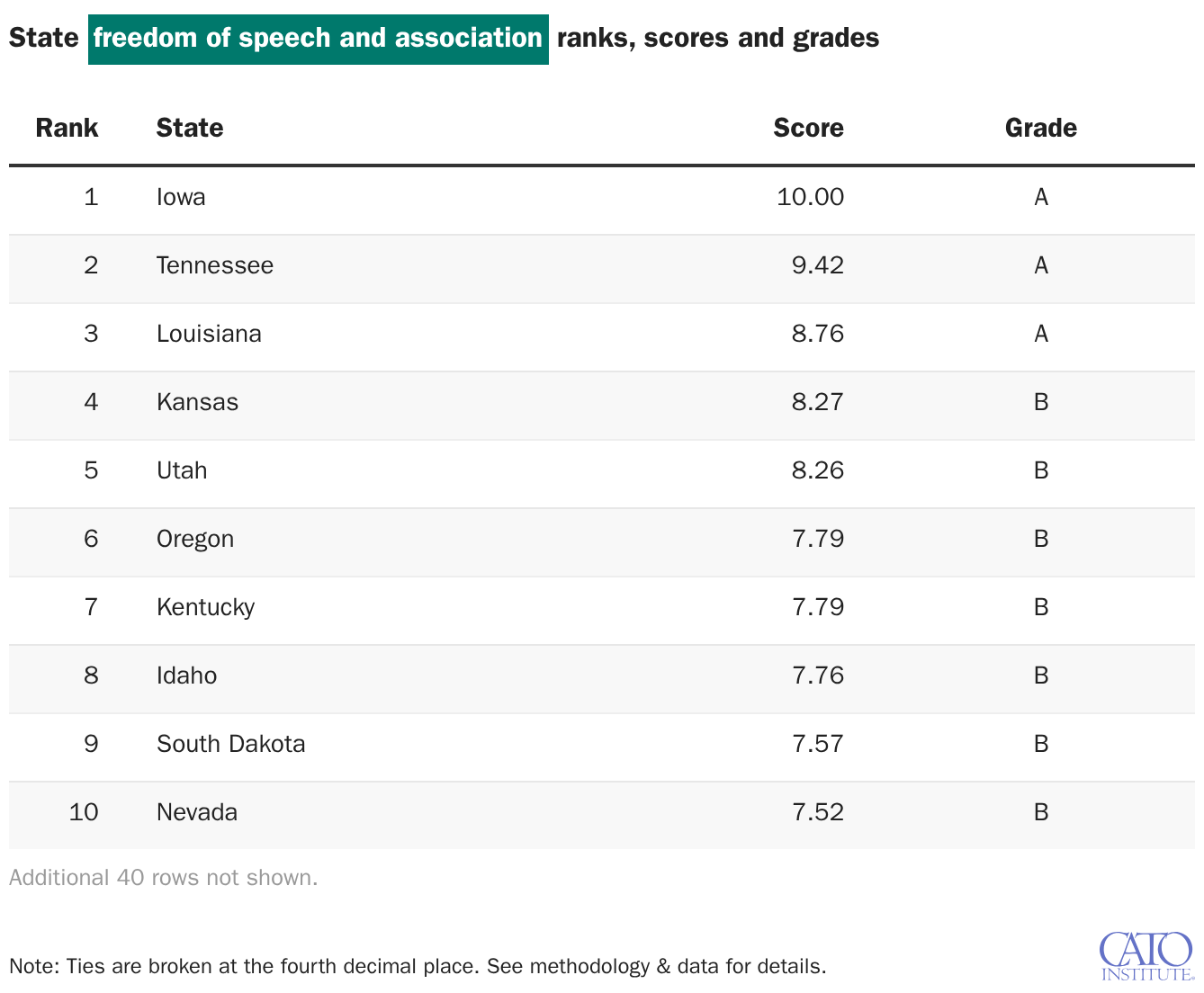
State freedom of speech ranks, scores and grades

Three states share the top grade of A (in rank order): Iowa, Tennessee, and Louisiana. All three have the highest scores for the protection of political speech, strong procedural safeguards on lawsuits intended to punish citizens for speaking or publishing, and the enactment of robust statewide laws to protect freedom of speech on college campuses.

The bottom of the ranking (in rank order) is populated by Maryland, Wisconsin, Mississippi, Massachusetts, New Hampshire, Wyoming, West Virginia, South Carolina, and Alaska. Each has lower-than-average political speech scores, weak or nonexistent protections against lawsuits for speaking or publishing, and college free speech scores that sit in the bottom third.
Governor Ranks and Grades

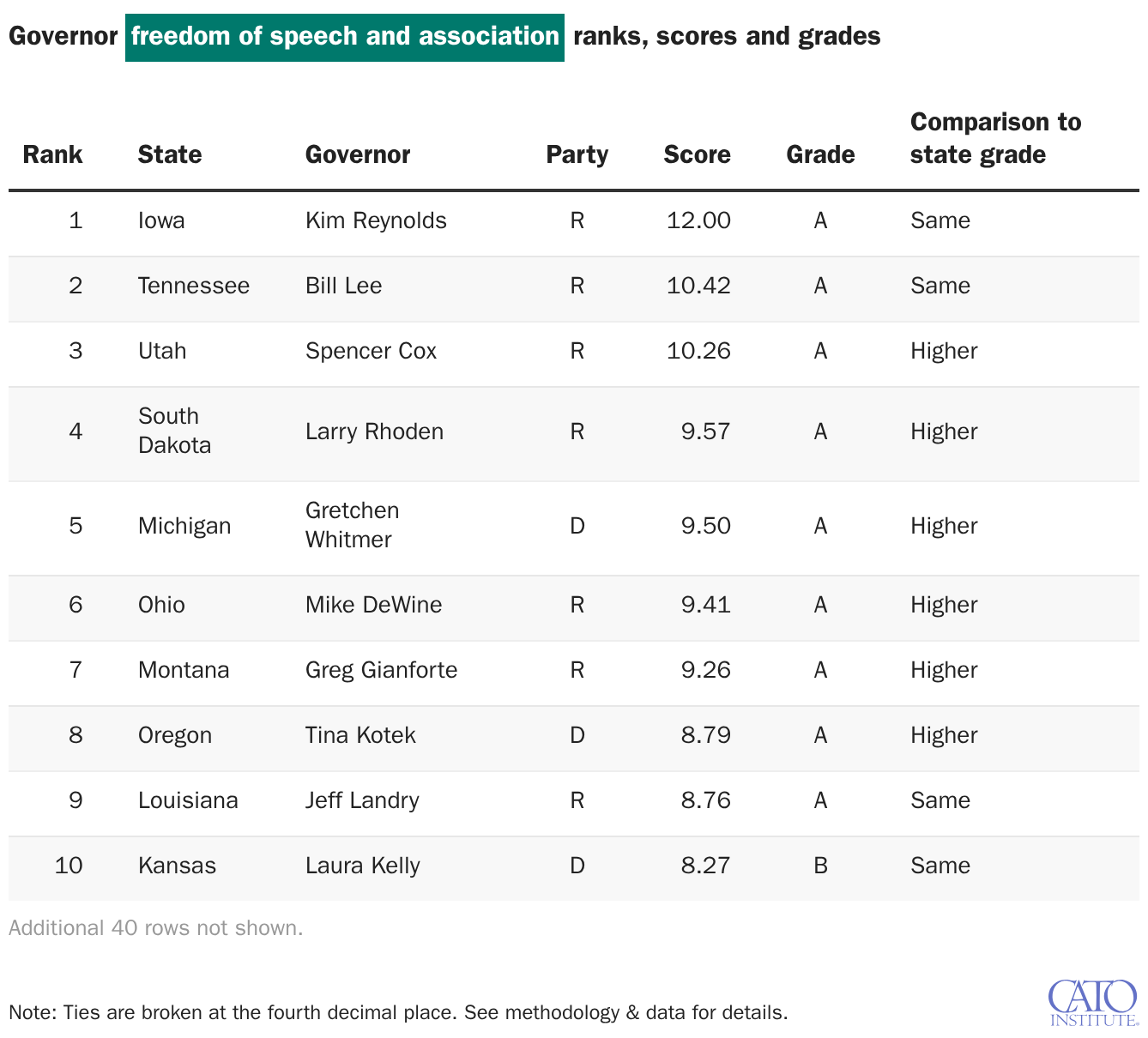
Governor freedom of speech ranks, scores and grades

There are nine governors who earn a top grade of A (in descending order by score): Kim Reynolds of Iowa (R), Bill Lee of Tennessee (R), Spencer Cox of Utah (R), Larry Rhoden of South Dakota (R), Gretchen Whitmer of Michigan (D), Mike DeWine of Ohio (R), Greg Gianforte of Montana (R), Tina Kotek of Oregon (D), and Jeff Landry of Louisiana (R). Each of these governors except Landry signed a broad strengthening of their state’s protections against lawsuits intended to silence public participation.

Ten governors receive a failing grade, seven of whom are Republicans. The governors with an F are (in descending order by score): Wes Moore of Maryland (D), Tony Evers of Wisconsin (D), Ron DeSantis of Florida (R), Maura Healey of Massachusetts (D), Kelly Ayotte of New Hampshire (R), Mark Gordon of Wyoming (R), Patrick Morrisey of West Virginia (R), Henry McMaster of South Carolina (R), Tate Reeves of Mississippi (R), and Mike Dunleavy of Alaska (R). Each of these governors except DeSantis receives a failing grade because their state also receives a failing grade.

In fact, DeSantis is the only failing governor of this group with a lower grade than his state (which is a D). His failing grade is due to his attempt to substantially weaken the state’s otherwise strong university campus free speech protections signed by his Republican predecessor. The legislation that DeSantis championed and signed effectively banned university professors from talking about certain subjects and, as a result, was recently blocked by a federal appeals court for violating the First Amendment.

What’s in the Freedom of Speech and Association Category?

This category consists of seven variables organized into three groups:

  • Protections of political speech (two variables)
  • Protection from lawsuits against public participation (one variable)
  • Campus speech protections (four variables)

Protections of Political Speech

Both variables in this group are based on two published rankings from the Institute for Free Speech (IFS). Our first variable uses the aggregate score from the IFS Free Speech Index (2022). That index measures the protections for citizens to speak freely in public about candidates, public policy, and government. Although there are dozens of subvariables in this IFS report, most of them are grouped into six major categories: (1) state laws on political action committee activity; (2) state regulations on grassroots advocacy; (3) the breadth of the state’s definition of campaign expenditures; (4) state laws regulating speech near election periods (i.e., “electioneering communications”); (5) how states define and regulate political speech by groups that are not typically political; and (6) laws regulating “coordinated” speech between candidates for office and political committees supportive of a candidate’s policy stances. The IFS score is converted for our purposes to a continuous scale of 0 to 10, with the highest IFS score corresponding to a 10 in our index.

The second variable in this group comes from the 2018 edition of the IFS Free Speech Index, which is IFS’s most recent comprehensive measure of limits on campaign contributions by private individuals, corporations, and political action committees. We updated the data where necessary. Campaign contributions of the type measured in the IFS index have been recognized by US courts as a form of protected speech, and these state contribution limits are graded alongside the above campaign activity and expenditure metrics. The highest scores are awarded to the states that allow large or unlimited political donations, while states with lower limits receive lower scores. Those scores are converted for our use here, with the highest-scoring state in the IFS ranking receiving a 10 in our index.

Protection from Lawsuits Against Public Participation

Journalists and other individuals are sometimes sued for defamation merely for publicly expressing an opinion. These lawsuits are called SLAPPs (strategic lawsuits against public participation) because they are meant to discourage and intimidate the speaker or writer. Laws intended to discourage such abuse are called anti-SLAPP laws and are designed to provide due process protections against such lawsuits. The strongest ones are based on the Uniform Law Commission’s (ULC) model statute.

For this variable, we use the IFS score, which is based on how close or distant the state’s anti-SLAPP law is to the gold standard of this model statute. States with no anti-SLAPP statute receive 0 points. States with an anti-SLAPP statute that is narrow, covering only certain speech, receive 5 points. (This can also include states that appear to provide broad coverage but leave the door open to a restrictive judicial interpretation. IFS awards these states grades of B through D.) The states that receive 10 points have the most comprehensive and unambiguous anti-SLAPP provisions and most closely approximate the ULC model statute (as indicated by the IFS grade of A).

Campus Speech Protections

This group measures the extent to which state law protects expressive rights at public colleges and universities for students and faculty. It is based on a cataloging of various campus speech protection statutes compiled by the Foundation for Individual Rights and Expression, which we independently verified.

This group is separated into four subgroups: (1) protections of student speech; (2) protections of faculty speech and classroom autonomy; (3) protections for public events; and (4) protections for student publications. A state receives credit if it has enacted protections for each subgroup. Those protections consist of the following five types: (1) private right of action that allows students or organizations to sue to enforce a campus free speech statute; (2) statewide application of policies consistent with the University of Chicago’s statement (2014) committing university institutions to unrestricted debate and barring community members from obstructing speech they oppose; (3) statewide application of the Davis standard, the threshold defined by court precedent that protects unpopular or offensive speech from being treated as harassment; (4) protections for belief-based student organizations so they cannot be penalized for requiring leaders or members to affirm the group’s beliefs; and (5) institutional neutrality requirements that bar institutions from compelling students, faculty, or staff to endorse or affirm the institution’s positions. The states with the highest percentage of these protections across the four subgroups receive a score of 10. The states with a lower share or none at all receive lower scores.