Last week in this space I criticized my friends at the Competitive Enterprise Institute for siccing the Federal Trade Commission on General Motors over its misleading “we repaid our bailout money” ads. Now CEI founder/president (and old friend) Fred Smith gives his side of the story in a lengthy response. And a new report from Fox News covers the whole controversy.
Cato at Liberty
Cato at Liberty
A Georgia jury has acquitted Tonya Craft of 22 criminal charges relating to child abuse and child molestation. A remarkable outcome given the awful rulings of the judge during the trial. Previous coverage here and here.
When so many charges are leveled, the pressure to enter into a plea bargain intensifies–even if the accused is innocent. The defense attorney will say something like, “Look, some kids are going to say you did something awful. That’s going to happen. We might persuade the jury to acquit on most of the charges, but there’s still a chance they will convict you on a few counts. That could mean several years in jail. Might be better to plead guilty to one charge, serve six months, and then get on with your life.” Some people breezily proclaim that they would never plead guilty to a crime they did not commit, but when your own freedom is really on the line, the decision is not so easy.
More on plea bargaining here (pdf).
Are Mexican authorities fighting an all out war against drug cartels or simply helping one drug organization win the battle against other criminal gangs for the most lucrative trafficking route to the United States? Street banners alongside Mexico’s highways—put up by rival drug gangs—have long suggested that the administration of Felipe Calderon is in bed with the Sinaloa cartel, that country’s most powerful drug organization. As The Economist reported earlier this year, the Mexican government’s efforts against drug trafficking have been fairly one-sided:
“The Sinaloa organisation (named after a north-western state) is responsible for around 45% of the drug trade in Mexico, reckons Edgardo Buscaglia, a lawyer and economist at ITAM, a Mexico City university. But using statistics from the security forces, he calculates that only 941 of the 53,174 people arrested for organised crime in the past six years were associated with Sinaloa.”
Leaked documents obtained and reported on Monday by Reforma newspaper suggest that drug corruption reaches the top levels of law-enforcement in that country, adding to the suspicion that the Mexican authorities have indeed sided with (some) drug lords. The documents apparently also show the police sharing DEA intelligence with its drug clients, a troubling development when Mexico is asking for more U.S. cooperation in its fight against some drug cartels.
Surveys indicate that the Mexican people still support the Calderon administration in its drug war. However, patience is running out, especially as the number of innocents killed in the violence soars. The tourism industry is also taking its toll, as shootings become commonplace in resorts such as Acapulco and Cancun, driving away visitors. If Mexicans perceive that all this blood and treasure have been paid just to help one criminal gang over the other ones, support for Calderon’s war will rapidly wane.
Also, these allegations present a conundrum for president Obama, who happens to host Felipe Calderon on Monday for a state dinner at the White House. The administration has been pressed by the Mexican government to substantially increase the level of assistance in the fight against cartels. However, if it becomes clear that high-ranking Mexican law enforcement officials are in bed with one or more criminal organizations (not the first time that something like this has happened) and that U.S. intelligence has ended up in the hands of drug lords, there will be growing resistance within the U.S. government to further aid Mexico. This in turn, will only exacerbate the tension between both governments.
“Plata o plomo” (which literally means “silver or lead” and refers to how officials are either corrupted or killed by drug lords) has long been a common feature of the drug war in Latin America. It is not surprising that multi-billion dollar cartels corrupt the officials who are supposed to fight them. What is surprising is some people in Washington still believe that this is a winnable war.
A bill introduced in the Senate yesterday would require Congress to bring earmarks out of the shadows, producing earmark data in a format that the public can easily use.
S. 3335 calls for a “unified and searchable database on a public website for congressional earmarks.” This is something President Obama called for in his 2010 State of the Union speech, though we haven’t heard much more from him about it since then.
Importantly the bill is not just about a web site. The bill would enable the public to “programmatically search and access all data in a serialized machine readable format via a web-services application programming interface.” That gobbledegook means that people could access the data for themselves, slicing and dicing it to learn whatever they want or to display it however they want.
I’ve noted here before the efforts of my government transparency web site WashingtonWatch.com to capture earmark data and the related effort to get earmark data directly from Congress at Earmarkdata.org.
The bill was introduced by Senator Tom Coburn (R‑OK), and is currently cosponsored by Sen. Michael Bennet (D‑CO), Sen. Barbara Boxer (D‑CA), Sen. Bob Corker (R‑TN), Sen. John Ensign (R‑NV), Sen. Russ Feingold (D‑WI), Sen. Kirsten Gillibrand (D‑NY), Sen. Johnny Isakson (R‑GA), Sen. John McCain (R‑AZ), and Sen. Mark Udall (D‑CO). Its House counterpart is H.R. 5258 (Cassidy R‑LA), which also has bipartisan support.
Support for these bills across parties and ideologies suggests good things may be in store for earmark transparency.
Related Tags
I see that my colleague Sallie James has already blogged on the inherent protectionism in the Senate’s long-awaited cap-and-tax bill. A summary was leaked last night by The Hill.
Well, we now have the real “discussion draft” of “The American Power Act” [APA], sponsored by John Kerry (D‑NH) and Joe Lieberman (I‑CT). Lindsay Graham (R‑SC) used to be on the earlier drafts, but excused himself to have a temper tantrum.
So, while Sallie talked about the trade aspects of the bill, I’d like to blather about the mechanics, costs, and climate effects. If you don’t want to read the excruciating details, stop here and note that it mandates the impossible, will not produce any meaningful reduction of planetary warming, and it will subsidize just about every form of power that is too inefficient to compete today.
APA reduces emissions to the same levels that were in the Waxman-Markey bill passed by the House last June 26. Remember that one — snuck through on a Friday evening, just so no one would notice? Well, people did, and it, not health care, started the angry townhall meetings last summer. No accident, either, that Obama’s approval ratings immediately tanked.
Just like Waxman-Markey, APA will allow the average American the carbon dioxide emissions of the average citizen back in 1867, a mere 39 years from today. Just like Waxman-Markey, the sponsors have absolutely no idea how to accomplish this. Instead they wave magic wands for noncompetitive technologies like “Carbon Capture and Sequestration” (“CCS”, aka “clean coal”), solar energy and windmills, and ethanol (“renewable energy”), among many others.
Just like Waxman-Markey, no one knows the (enormous) cost. How do you put a price on something that doesn’t exist? We simply don’t know how to reduce emissions by 83%. Consequently, APA is yet another scheme to make carbon-based energy so expensive that you won’t use it.
This will be popular! At $4.00 a gallon, Americans reduced their consumption of gasoline by a whopping 4%. Go figure out how high it has to get to drop by 83%.
Oh, I know. Plug-in hybrid cars will replace gasoline powered ones. Did I mention that the government-produced Chevrolet Volt is, at first, only going to be sold to governments and where it is warm because even the Obama Administration fears that the car will not be very popular where most of us live. Did I mention that the electric power that charges the battery most likely comes from the combustion of a carbon-based fuel? Getting to that 83% requires getting rid of carbon emissions from power production. Period. In 39 years. Got a replacement handy?
Don’t trot out natural gas. It burns to carbon dioxide and water, just like coal. True, it’s about 55% of the carbon dioxide that comes from coal per unit energy, but we’ll also use a lot more more electricity over the next forty years. In other words, switching to natural gas will keep adding emissions to the atmosphere.
Anyway, just for fun, I plugged the APA emissions reduction schedule into the Model for the Assessment of Greenhouse-gas Induced Climate Change (MAGICC — I am not making this up), which is what the United Nations uses to estimate the climatic effects of various greenhouse-gas scenarios.
I’ve included two charts with three scenarios. One is for 2050 and the other for 2100. They assume that the “sensitivity” of temperature to a doubling of atmospheric carbon dioxide is 2.5°C, a number that many scientists think is too high, given the pokey greenhouse-effect warming of the planet that has occurred as we have effectively gone half way to a doubling already. The charts show prospective warming given by MAGICC.
The first scenario is “business-as-usual”, the perhaps too-optimistic way of saying a nation without APA. The second assumes that only the US does APA, and the third assumes that each and every nation that has “obligations” under the UN’s Kyoto Protocol on global warming does the same.
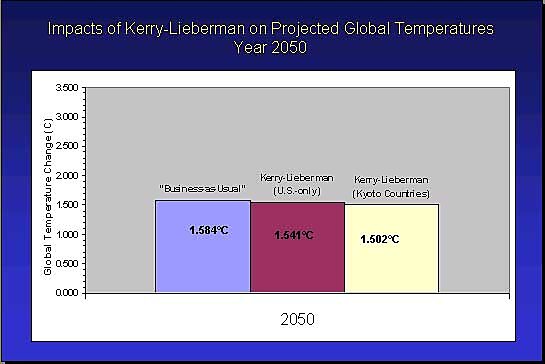

As you can plainly see, APA does nothing, even if all the Kyoto-signatories meet its impossible mandates. The amount of warming “saved” by 2100 is 7% of the total for Business-as-Usual, or two-tenths of a degree Celsius. That amount will be barely detectable above the year-to-year normal fluctuations. Put another way, if we believe in MAGICC, APA — if adopted by us, Europe, Canada, and the rest of the Kyotos — will reduce the prospective temperature in 2100 to what it would be in 2093.
That’s a big if. Of course, we could go it alone. In that case, the temperature reduction would in fact be too small to measure reliably.
I’m hoping these numbers surface in the “debate” over APA.
So there you have it, the new American Power Act, a bill that doesn’t know how to achieve its mandates, has a completely unknown but astronomical cost, and doesn’t do a darned thing about global warming. Such a deal!
Related Tags

Last month Cato On Campus announced a student essay contest for free tickets to the Friedman Prize for Advancing Liberty dinner, which will honor Iranian journalist Akbar Ganji this week.
In 500 words or less, responders answered the question, “In light of the selection of Akbar Ganji for the receipt of the 2010 Friedman Prize for Advancing Liberty, who would you nominate for a second prize this year and why?”
Students from around the world sent replies. Topics ranged from Russian labor camp dissidents to U.S. politician Ron Paul; from economics professors to space exploration; from free markets in charity to an individualist psychiatrist. A common thread that ran throughout all of the entries was entrepreneurial spirit and a unwavering value of individual liberty.
Cato on Campus chose three winners. Congratulations to:
Yasmin Green, an International Studies M.A. student at St. John Fisher College, who wrote about George Ayittey, an advocate of liberty through social entrepreneurship in Africa. “A man who believes that ‘Africa is poor because she is not free,’ Ayittey has worked to promote ideas and institutions that are consistent with the achievement of liberty, and individual rights,” wrote Green.
Joseph Hammond, a Middle East History M.A. student from California State University — Long Beach, who the Iranian protesters after the 2009 election. Hammond advocated that the many Iranians who demonstrated their dedication to becoming politcally recognized would be a “perfect compliment to Akbar Ganji.”
Liya Palagashvili, an Economics B.A. student at George Mason University, who identified economist Peter Boettke as an economist serving in the tradition of Milton Friedman. “In the classroom, Dr. Boettke advances his students in the ideas of liberty,” she wrote. “Outside of the classroom, Dr. Boettke inspires liberty through his writing,” which “is influential in providing a thorough understanding of liberty and the consequences of a nation that violates liberty.”
Congratulations to all the winners. If you’re a student and want to get more involved, check out Cato On Campus.
Related Tags

Editors Note: Christopher Preble has just returned from a 9‑day trip through Abu Dhabi, Dubai and Riyadh. Catch up on his trip here.
Well, it sure is nice to be home. I was fortunate to have traveled with an exceptional group of American academics. I learned a lot, but it was also nice to get to know them, and to share stories about how our respective institutions deal with different subjects. We were well-received by a number of senior Saudi government officials, a credit to the organizers of this trip. And as for the “people on the street” with whom I came into contact, the hotel staff and random merchants and restaurateurs were very friendly, and, almost without exception, spoke some English. (They also love American — that is to say Detroit — cars. I saw more Chevrolets, GMCs, and Fords on the road in Riyadh than I see every day in Northern Virginia.)
Having said all that, I can’t imagine any American ever really being comfortable in the Kingdom. For starters, we gave up on kings a long time ago, and with good reason. Americans might sometimes like the idea of royalty — they make such great copy for the tabloids, don’t you know — but we’d be genuinely horrified if a person’s right to rule over others were dictated solely by heredity.
Then there is the issue of women. One need not be an avowed feminist to be put off by the inequities in Saudi society. Perhaps I’d grow accustomed to seeing 50 percent of the population covered from head to toe in black, but I sincerely doubt it. Meanwhile, dress codes are merely the tip of the iceberg when it comes to women’s rights. Many years ago, the U.S. Supreme Court helped us to understand that “separate but equal” is inherently unequal. And the Saudis don’t even aspire to “separate but equal”. The “family” section of the Starbucks next door to our hotel received less attention from the wait staff than the main dining area (women patrons essentially came in through a back door, and were served through the kitchen). The “women only” lines at the food court at the nearby mall were longer than the “men only” ones. Our hotel in Riyadh had a nice workout room…for men only. My female traveling companions were reduced to calisthenics and stretching exercises in their respective (small) hotel rooms.
We heard a number of people trying to explain the rationales for keeping men and women separate. None were convincing.
The best educated there, including especially those who attended schools in the U.S. or U.K., understand that their country cannot progress if the percentage of women in the labor force remains at its current low level (about 15 percent). But public policy isn’t made by the best educated. Meanwhile, there are strong economic incentives at an individual or family level to allow women greater freedom, but these alone will not force a change in policy.
Over dinner one night with several Saudi academics, an IR professor explained how change actually occurs in the Kingdom. There is a lot of debate about different social conventions, especially about the rights of women, he said. The most conservative within the religious hierarchy oppose extending certain rights — say, for example, to obtain an education — and then one day the king will say “Women shall be educated.” End of debate. The clerics and imams, after all, derive a paycheck from the government (as does about 80 percent of the total Saudi workforce). This professor predicted that that is how women in the Kingdom will someday be allowed to drive: by decree.
The actual process behind the scenes is a little more complicated, as the king rules by consensus and must bring along enough of the other senior leaders and the religious conservatives. When the government feels very strong, they are inclined to give in less, but when they are weak they are more constrained.
A far-sighted leader might push his society to embrace some aspect of modernity against its will — in other words, actually lead — but he is not immortal. He will inevitably be replaced by a son or brother, perhaps one who would choose simply to undo these reforms, especially if the prior ruler’s policies have never been embraced by the public at large. In short, the 18th century liberals were onto something when they railed against the divine right of kings.
Our forefathers also had the right idea when they articulated other liberties that we now take for granted, from freedom of speech and worship, to the right to own firearms. Others came along after the founding generation extending rights to women, and to religious and ethnic minorities. Today, most Americans take for granted that these rights cannot be denied to anyone on the basis of gender, race, religion, or sexual orientation.
Other countries do not presuppose that their citizens have such rights; rights are something parceled out by the government, or not at all. As a libertarian, I can’t imagine ever wanting to live in any such place, but I’m doubtful that talented, entrepreneurial non-libertarian women, for example, will ever want to invest or work in Saudi Arabia. I’m equally skeptical that large numbers of Western men — the fathers of women and husbands of women — will want to do so, either. Some Westerners do live and work in the Kingdom. They are insulated from many of these regulations when at home, but subject to them when they venture out of their compounds. That means they can drink a glass of Chardonnay with dinner in their kitchen, but not at a restaurant.
Wine with dinner isn’t a big deal. The other stuff is: The knock on the door in the middle of the night. The visits to journalists who get a little too interested in particular stories. The intrusive police state and draconian punishments for relatively minor crimes. “Due process” in the Kingdom has a meaning all its own.
I predict that countries (not just Saudi Arabia) that do not afford full legal rights to all citizens will inevitably bump up against a glass ceiling. Unable to attract the best and brightest, and unwilling to allow their own people to advance to the full extent of their ability, the society will stagnate. And when the oil money dries up, they will be left with what they had before oil: namely, not much.
Many of the Saudis with whom we met seemed genuinely interested in improving the lives of Saudi citizens, and in moving beyond an economy based on oil extraction. I hope, for the sake of the people of Saudi Arabia, that they succeed. In the coming years, I’ll be watching the statistics about Saudi competitiveness (28th according to the World Economic Forum, pdf). I’ll check the World Bank’s annual “ease of doing business” reports (SA ranked 13th in 2009). And, as always, I’ll read the indices of economic liberty (The latest Heritage-Wall Street Journal index ranked the Kingdom 65th). Notably, the Economic Freedom of the World Index doesn’t include Saudi Arabia given the lack of reliable statistics that can be easily compared with other countries.
But even reliable data can only tell so much. Another indicator of whether Saudi Arabia has truly changed will be the percentage of American students wishing to study in Saudi Arabia, and of Americans who want to work there. Today, those numbers are very small, while the number of Saudis wishing to come here is very large. I think that says a lot.