This week’s bipartisan deal to raise the debt limit will do little in the way of actual spending cuts, it defers all the tough decisions on spending and debt to a “SuperCongress” committee and the deal will do little to protect the United States credit rating. Cato’s Dan Mitchell, Jagadeesh Gokhale and Chris Edwards comment on the debt deal.
Cato at Liberty
Cato at Liberty

(A few years ago I was hired to contribute some articles on free banking and related subjects to an online forum called the Free Market News Network. I wrote several before the checks stopped coming, and then insisted that those already published be taken off the site, which has since ceased to exist.
For a long time I thought the articles were lost for good. But I recently uncovered them on a UGA backup drive, and so have decided to make some of them available again here.)
______________________________________
Some self-styled friends of the free market think the world would be better off without fractional-reserve banks. They believe, among other things, that fractional reserves are inherently fraudulent and that they promote business cycles. Lawrence White and I have addressed these and related criticisms of fractional reserves both in this forum and elsewhere. Here I wish not to refute claims concerning supposed disadvantages of fractional-reserve banking, but to point to one of its crucial advantages—an advantage its opponents studiously ignore.
This advantage has to do with economic development, and industrial development especially. To state the matter baldly: the most tangible achievements of the free market—the vast improvements in technology and productivity, the industrial plant and infrastructure from which these derive, and the extensive retailing networks that deliver industry’s fruits to consumers—would be far more meager were it not for past and present lending financed by fractionally-backed bank liabilities. To condemn fractional-reserve banking in any form is, in other words, to strike a blow, albeit unwittingly, at one of the supporting pillars modern capitalism.
This claim is hardly unique to modern-day champions of free banking. It has, on the contrary, been widely subscribed to by economists since the very beginnings of industrialization. Although The Wealth of Nations (1776) appeared when Great Britain’s Industrial Revolution was just getting started, that didn’t keep Adam Smith from noticing the substantial contribution fractional reserves had made to British, and especially Scottish, industrial development. Smith’s homage to fractional reserves occurs as part of his refutation of Mercantilism, with its naive identification of a nation’s wealth with its stock of coin and bullion. That stock, Smith says,
makes no part of the revenue of the society to which it belongs; and though the metal pieces of which it is composed, in the course of their annual circulation, distribute to every man the revenue which properly belongs to him, they make themselves no part of that revenue.
Indeed, Smith goes on to say, the real resources devoted to producing a nation’s money—to that “great wheel of commerce” that makes efficient exchange possible—are necessarily diverted from the production of other goods and services. Fractional reserves promote real economic growth by reducing the cost of money—what today’s economists might term money’s “opportunity cost”:
The substitution of paper in the room of gold and silver money, replaces a very expensive instrument of commerce with one much less costly, and sometimes equally convenient. Circulation comes to be carried on by a new wheel, which it costs less both to erect and to maintain than the old one….[T]he circulating notes of banks and bankers are … best adapted for this purpose.
Public confidence in Scottish banknotes was already such in Smith’s time as to allow exchanges in that country to be conducted with only a fifth as much gold and silver as would have been needed had coins alone been used. The savings on metallic money translated into a corresponding increase in Scotland’s working capital. “The operation,” Smith says, “resembles that of the undertaker of some great work, who, in consequence of some improvement in mechanics, takes down his old machinery, and adds the difference between its price and that of the new to his circulating capital, to the fund from which he furnishes materials and wages to his workmen.” Scotland, a relatively backward and poverty-stricken country at the onset of the 18th century, was by Smith’s day rapidly catching up with England, the world’s wealthiest country. That Scotland’s fractional-reserve banks had “contributed a good deal to the increase” in Scotland’s wealth was, according to Smith, a matter that “cannot be doubted.” No wonder Smith favored free banking, or something very close to it. He approved of only two special banking regulations—and approved of them, I should add, on rather faulty grounds. The regulations, which dated from 1765, were the outlawing of notes for less than one pound and of “optional clause” notes giving banks the contractual right temporarily to suspend specie payments. That Smith had nothing good to say about permanently irredeemable, “fiat” money should go without saying.
Economic research since Adam Smith’s day has mainly tended to bolster his favorable views on fractional-reserve banking, both by amassing evidence of its beneficial effects and by delving more deeply into the basis for fractional-reserve banks’ unique ability to harness scarce savings and put them to good use. In the second part of this essay, I will briefly review some of these “post-Smithian” findings.
Related Tags
The following chart looks at total projected federal spending according to the Congressional Budget Office’s adjusted March baseline and its score of the debt deal. The chart only considers the reduction in outlays resulting from the deal’s cap on discretionary spending, which the CBO says will save $917 billion over the next ten years. It does not consider the $1.2-$1.5 trillion in future “deficit reduction” that Dan Mitchell discusses here.
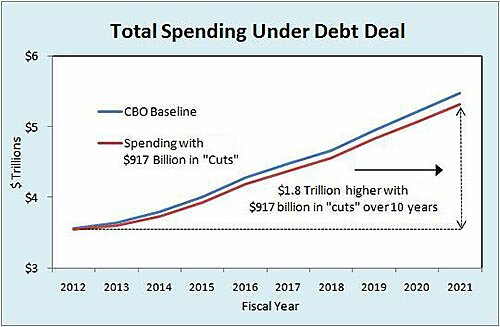
Excluding outlays for the wars in Afghanistan and Iraq, which are unlikely to materialize, total spending over the next ten years would be about $43 trillion under the discretionary spending caps instead of $44 trillion. In other words, even if Congress holds to the caps — and even if the “deficit reduction” targets established in the bill are achieved — the federal government’s spending binge will continue. If this is a “win” for the limited government crowd, I’d hate to see what the Beltway establishment would consider a “loss.”
Related Tags
Want to know a major reason Washington won’t make the cuts we need? Because winning elections is largely about getting “middle-class” votes, and just about any program can be spun as a savior for that big — but rarely defined by politicians — chunk of Americans.
Case in point, an animosity-stoking assertion uttered last week by House education committee Ranking Member George Miller. As reported by CNN, the subject was the possibility of a cut being made to the federal Pell Grant program:
Rep. George Miller, a California Democrat, defended Pell Grant funding on Friday, calling it the “great equalizer” for millions of students.
“Pell is the reason they are able to go to college and get ahead,” Miller said. “It’s a shameful excuse and an attack on middle class families.”
Now, what’s wrong with this assertion (other than its obnoxiousness and assumption that Pell doesn’t mainly enable colleges to raise their prices)? According to the U.S. Department of Education’s description of Pell – and the long understood intent of the program — it isn’t for the middle class. It is for “low-income” Americans:
The Federal Pell Grant Program provides need-based grants to low-income undergraduate and certain postbaccalaureate students to promote access to postsecondary education.
So much for Pell-trimming proposals assaulting the middle class. Buy maybe Rep. Miller was doing more than just inaccurate, uncivil political posturing with his comments. Maybe he was revealing a dirty little secret: While Pell is better focused on low-income students than many federal aid programs, over time politicians increasingly aim all education efforts at the big mass called the middle class. Maybe Miller was accidentally acknowledging that aid for the poor morphs into aid for the not-poor because, well, that’s where the votes are.
Look at Pell, which, again, is relatively well targeted. In the 1975–76 school year, 1.2 million students received grants (table 1). By 2009-10, 8.1 million did — almost seven times more! Meanwhile, overall enrollment in degree-granting institutions grew from about 11.2 million in 1975 to 20.4 million in 2009, less than doubling. Almost certainly, there has been less precise targeting to truly low-income students. Indeed, about 6 percent of Pell recipients (table 3‑A) in 2009-10 came from families making at least $50,000 a year, or about the median household income in 2009.
Such expansion has been seen in K‑12 education, too, though one wonders if Pell is singled out for big bucks in the debt-ceiling deal because people get Pell personally, unlike elemetary and secondary aid which goes to states and districts. Regardless, federal K‑12 funding has spread farther and wider over the decades as politicians have sought to keep money coming even as their districts have lost people, and as allocations have become less and less focused on individual students.
When waging class war, a powerful weapon is to portray your political enemy as intentionally hurting the most vulnerable people: the poor, children, etc. But the winning strategy? Sending money to the middle class, and capturing their precious votes.
Related Tags
The budget deal announced last night offers two sets of potential cuts in military spending.
The first set of potential cuts, created by the budget caps, target “security” spending. That includes the Pentagon, State, foreign aid, the Department of Homeland Security and Veterans (the discretionary portion of Veterans spending, to be precise). The deal caps “security” spending at $684 billion for this fiscal year and $686 for the next. That requires little pain; the 2012 security cap is only $5 billion below what we’ll spend on those categories in fiscal 2011. The White House claims that the caps will generate $350 billion in savings from base defense spending for ten years. They get there, dubiously, by projecting security spending at the capped level across the decade, even after the caps expire, and counting as savings the difference between that spending trajectory and what CBO now projects. They are also assuming that all the savings go to defense, even though Republicans will try to make the other security categories absorb the pain.
The second set of potential cuts, which occur automatically if the Joint Committee fails to reach its spending cut goals, target defense spending directly. This could add $500 billion in defense cuts over ten years, the White House says.
Assuming that is true, the maximum amount of defense cuts possible here is $850 billion. That is a cut of roughly 15 percent compared to planned spending based on the president’s February 2011 budget submission — not including the wars. It is roughly on par with the cuts proposed by the Bowles-Simpson Commission. The total savings are much lower, roughly half, if you compare the cuts to what we actually spend now, rather than the increases we were planning on in past planning documents.
And remember, that $850 billion is a maximum; it may not materialize. It will be lower, if, as hawks hope, the cuts fall on the non-defense elements of the security category. It will be lower if the Joint Committee finds other accounts to cut, avoiding the triggers.
Still, that possible amount is enough to make hawks apoplectic. We are sure to hear more complaints about “gutting or “hollowing out” the force. But let’s keep some facts about military spending in mind:
The Pentagon’s budget has more than doubled over the past decade, and current projections call for the Pentagon to receive more than $6 trillion from U.S. taxpayers through 2021. If its budget got cut by 15 percent, that would return us to roughly 2007 levels. That hardly seems like “gutting”. After such cuts, we would still account for more than 40 percent of global military spending, and our margin of military superiority over any combination of rivals would remain unrivaled.
The focus should now shift to strategy. The White House says the Pentagon’s ongoing roles and missions review will guide the first round of security cuts. The aim is to eliminate military capabilities that are unnecessary or provided by multiple services. We should go deeper, looking to what missions, allies, and possible wars, we can jettison. The recommendations should guide not only the first set of cuts, but also the second. That means making recommendations for the Joint Committee on additional defense cuts and preparing for automatic cuts should they occur. There is nothing preventing those cuts from being achieved by retiring force structure required by needless missions—such as defending rich allies that can defend themselves.
We should also keep in mind that this deal hardly solves our deficit problem and does not exhaust the possible savings we should seek. Deeper military cuts are possible and could even enhance security given the right strategy.
Related Tags
Here’s a point that ought to seem obvious: “Security”—whether physical or electronic—is always a function of the thing you’re trying to secure. If I were to tell you that my Washington apartment has barred windows, an outer front gate, a deadbolt on the inner door, and an alarm system to boot, you’d probably say my home sounds highly secure. If I told you that the precise same measures were the complete security system for a bank, you’d laugh. The reason is obvious: Unless I finally push the NSA over the line, my apartment only needs to withstand attacks from local thugs. A bank’s security must be able to withstand assaults from seasoned teams of professional criminals who — with millions as a potential jackpot — may be willing to spend weeks in planning, take extraordinary personal risks, and “invest” thousands of dollars in burglary equipment or bribes to insiders. My Apple gadgets and comic book art — though precious to me — are unlikely to inspire such extraordinary expenditures of time, effort, and money. Put another way: My apartment is “secure” when my security system makes the risk-adjusted cost of a break-in attempt higher than the value of my stuff to a prospective burglar.
Many people don’t find this as obvious, however, in the context of data security—a point I allude to glancingly in a New York Post op-ed this morning that takes aim at a data retention mandate wending its way through Congress. If I started storing big piles of gold bullion and precious gems in my home, my previously highly secure apartment would suddenly become laughably insecure, without my changing my security measures at all. If a company significantly increases the amount of sensitive or valuable information stored in its systems — because, for example, a government mandate requires them to keep more extensive logs — then the returns to a single successful intrusion (as measured by the amount of data that can be exfiltrated before the breach is detected and sealed) increase as well. The costs of data retention need to be measured not just in terms of terabytes, or man hours spend reconfiguring routers. The cost of detecting and repelling a higher volume of more sophisticated attacks has to be counted as well.
One very simple security measure a company can practice, then, is to simply avoid retaining enough data to attract the interest of the most skilled professionals (or, alternatively, those willing to hire out botnets to aid their attacks). Because the adequacy of a security system is always a function of the payoff of breach to the attacker, then, privacy is an important component of security, as well as a value worth respecting for its own sake.
Attorney/blogger Daniel Schwartz notes that even as the state of Connecticut continues to enact new labor laws at a hectic pace — from obligatory employer-paid sick leave, a first-of-its-kind law, to new curbs on consideration of workers’ credit records in hiring — it seldom gets around to repealing any of the obsolete old ones, such as its laws regulating the working conditions of telegraph messengers and elevator operators and saying disabled persons need a doctor’s note to accept night-time work in stores and restaurants. Because more law equals better law, right?
Not at all by coincidence, the New Haven Register noted ruefully in February that Connecticut has had zero job growth since 1990 and that the state “is projected to have the lowest national job growth rate — less than 1 percent — through 2016, according to IHS Global Insight, a New York economic analysis company.” At this rate, Connecticut is going to need every telegraph messenger and elevator operator job it can get. Is it any wonder the country is looking elsewhere — and in particular to states like Texas — for policy leadership?