This interview is another indication of the changing climate on the marijuana laws.
Cato at Liberty
Cato at Liberty
Yesterday, the Institute for Justice, which has long been a leader in the fight against the abusive practice of civil asset forfeiture, released a new edition of its important 2010 study Policing for Profit.
Civil asset forfeiture has been with us for centuries, but the Drug War has kicked the government’s incentives to seize property without charge or trial into high gear. Federal seizures alone have gone from tens of millions to billions of dollars a year over the last generation, while the vast majority of states still use a deficient and abusive process to take private property from citizens who haven’t been charged with any wrongdoing.
Thanks to the work of organizations like IJ, journalist exposés of numerous egregious abuses, and legislators committed to the rule of law, several states have reformed their forfeiture laws. But as the new report shows, the work is far from finished, and, despite a pledge to reform, the federal government continues to undermine state reforms while seizing billions of dollars on its own.
The key findings of the report include:
- a massive increase in civil forfeiture actions in the 21st century
- a continued burden on property owners who have to prove themselves innocent rather than being proven guilty by the state
- an abject lack of transparency about how much the government seizes and how the agencies are spending the proceeds of those seizures
- the perverse incentives provided by laws that allow executive agencies to add to their own budgets by taking property and cash from individuals
The report also includes updates to IJ’s state-by-state assessments of forfeiture laws, with 35 states and the federal government earning grades of D+ or worse.
IJ also released an excellent video to summarize their findings:
The full report can be found here. How does your state stack up?
For Cato’s explainer on the issues and abuses inherent in civil asset forfeiture, click here.


Were she still alive, Anna Schwartz, one of the last centuries’ greatest monetary economists, would have celebrated her 100th birthday today.
Alas, we must commemorate the date without her. To do so, I repost here remarks I made upon her death in 2012. In what has become a prolonged era of unconventional monetary policy, the loss of her expertise and wisdom is even more sorely felt than it might have been otherwise. Still all of us, and the economics profession especially, are much better off thanks to her straightforward and uncompromising scholarship.
Happy Birthday, Anna.
***
She was one of my intellectual heroes, Anna was — together with Milton and Leland, David Laidler, Sir Alan Walters, and Dick Timberlake. Old monetarists all, come to think of it. Now only three are left; and, no, they do not make them like that any more.
I met Anna at NYU. Back then the NBER occupied the 8th floor of 269 Mercer Street. NYU’s economics department was on the 7th floor. Of course I went to meet her. She turned out to be very nice, so I got the bright idea to ask her to serve as an external member of my dissertation committee. I had the impression that I was one of very few NYU Ph.D. candidates to think of doing that, which struck me as odd. But then a lot of things about NYU, and about the economics business generally, struck me (and still strike me) as odd.
Anna gave me some good advice; indeed, apart from Larry White (who was my supervisor, and who I talked to almost daily) she was my most helpful adviser at NYU. Naturally I don’t remember much about the particular advice she gave me. But I do distinctly remember her telling me that, once I got into the business, I had better write about stuff besides free banking if wanted to survive. I took Anna’s advice, and still found it rough going. Had I not listened to her I’m sure I would have had to give up.
I’m also pretty sure that it was only thanks to Anna that some of the the free banking stuff that did make it into the better journals got through: she was one of the few persons who was both greatly respected by the editors of those journals and willing to give the free bankers a hearing. Indeed, Anna was more than sympathetic: she was, or she became, one of us. I am reasonably certain that she played a very large, if not crucial, part in encouraging Milton to revise his thinking on the topic, as he did when he and Anna published their 1986 JME paper “Has Government Any Role in Money?”. That Anna’s views on the proper scope of government interference in banking became progressively more radical I have no doubt. For example, while in a 1995 Cato Journal article she and Mike Bordo took the conventional line that you couldn’t have a stable banking system without some sort of deposit insurance, when I questioned her about this stand a few years ago Anna claimed that she had since rejected that view, having come to believe instead that the moral hazard arising from deposit guarantees ultimately caused such guarantees to do more harm than good.
I was lucky to be able to talk to Anna at length on several occasions during the last few years, thanks to Walker Todd, who arranged for her to visit the American Institute for Economic Research while I was there as a summer fellow. What I remember most about those conversations was how very candid and uncompromising they were: Anna never held a punch, and when she threw one, it landed square on target. Not that Anna wasn’t generous with praise: it’s just that, whatever she thought, she always came right out with it. She’d lived long enough, I suppose, to earn that. In any event it meant that talking to her was really a blast. (If only I could repeat all that I heard!)
Now, with all the dominoes lined-up from Greece to Brussels and beyond, and ready to start toppling at any moment, how I wish that this tough and uncompromising monetarist was still among us! No one can say just what she’d have made of it all; but whatever she made you can bet she would have served it up straight.
Related Tags
Police body cameras can only be as good as the policies which govern them allow. Regrettably, despite widespread calls for more police officers to wear body cameras in order to improve accountability and transparency, many police departments across the United States are governed by poor policies and practices.
The Leadership Conference on Civil and Human Rights and Upturn recently released a body camera scorecard, which grades body camera policies in 25 cities, including the 15 largest departments which currently or will soon outfit officers with body cameras.
Each department was judged on a range of issues including public access to body camera policies, restrictions on biometric technology, allowing officers to view body camera footage before making a statement, and officer discretion. The results (shown below) are not encouraging.

Of the 25 departments, only one–Baltimore–limits facial recognition technology being used in body cameras. None of the 25 departments explicitly prohibit officers from reviewing body camera footage before making an initial statement or report for any incident. The majority of the departments do not have body camera policies publicly available on their websites. Only two of the departments (Parker, Colorado and Washington, D.C.) allows people filing a police misconduct complaint to view at least some of the relevant body camera footage.
Some of the departments with disappointing policies have received funding from the Department of Justice (DOJ). The Los Angeles Police Department, for example, was awarded $1 million for body cameras despite requiring officers involved in a fatal use-of-force incident to view body camera footage before making a statement.
Body cameras are a relatively new technology with great potential, but this potential could go unrealized if lawmakers are not careful. Amid ongoing discussions on criminal justice and police misconduct, it is not surprising that body cameras are often cited as tools which can play a role in reforms. However, as the Leadership Conference on Civil and Human Rights and Upturn scorecard demonstrates, many body camera policies do not help provide the much-needed increase in law enforcement transparency and accountability.
In my latest Cato Institute policy analysis, I propose a number of policies which would, if implemented, provide increased transparency and accountability in law enforcement. It is understandable that law enforcement agencies and lawmakers across the country are keen to deploy body cameras. But body camera policy shouldn’t be rushed. Without the right policies in place, body cameras could come to be seen not as a valuable part of criminal justice reform, but rather a secretive and confusing law enforcement tool with worrying privacy implications.
There is nothing easier or seemingly more popular in higher education than bashing openly for-profit colleges. (I use “openly,” by the way, for a reason.) If you burrow into the demographic and funding weeds, however, you’ll see that proprietary schools are likely no worse, as a whole, than any other sector of uber-subsidized higher ed. And now Gallup has produced a little more good news for these beleaguered schools, to the extent that any news from our bloated Ivory Tower is good: For-profits seem to do a better job of serving veterans – at least from the vets’ perspective – than public colleges and, depending on how you slice the data, nonprofit private colleges as well.
As the table below shows, when veterans rank how well they feel their schools understood their needs, the percentage giving a 4 or 5 – the top scores – to for-profit schools beats any other sector, and at just the 5 level only nonprofit private institutions surpass them. Comparing for-profit and public schools, for-profits get more 4s and 5s by a 15 percentage point margin.

It’s probably not a mystery why this is. For-profits are more nimble than public colleges, and their desire for profits may actually – get ready – make them more responsive to the needs of the students who buy their services. Yes, there are bad for-profit actors – though the extent to which that is the case is unclear – but maybe on the whole they work better for students than lumbering, impersonal public institutions that get big taxpayer subsidies upfront. At the very least, that’s what this evidence suggests. Not that evidence has mattered much in this debate so far.
Related Tags
In last night’s Republican Presidential debate, Donald Trump argued that President Eisenhower immigration enforcement plan called Operation Wetback (Trump didn’t use that horrendous name) drastically reduced unlawful immigration in the early 1950s. He said:
“Let me just tell you that Dwight Eisenhower. Good president. Great president. People liked him. I liked him. I Like Ike, right? The expression, ‘I like Ike.’ Moved 1.5 million illegal immigrants out of this country. Moved them just beyond the border, they came back. Moved them again beyond the border, they came back. Didn’t like it. Moved ‘em waaaay south, they never came back. Dwight Eisenhower. You don’t get nicer, you don’t get friendlier. They moved 1.5 million people out. We have no choice. We. Have. No. Choice.”
The evidence and statements by border patrol and INS officials in the 1950s and afterward disagree with Mr. Trump’s analysis. Increased immigration enforcement did not reduced unauthorized immigration in the 1950s, legal migration did.
Background
In 1942, the United States government created Bracero guest worker visa program to allow Mexican farm workers to temporarily work for American farmers during World War II.[i] The government entered into a bilateral labor agreement with Mexico that regulated the migrant’s wages, duration of employment, age of workers, health care, and transportation from Mexico to U.S. farms.[ii] Transportation to the farm, housing, and meals were sold by the employers for a low price.[iii] Ten percent of the migrant’s wages were deducted from their paychecks and deposited in an account that would be turned over to them once they returned to Mexico.[iv]
The Bracero program did not limit the number of migratory workers as long as the government’s conditions were met, making the system flexible to surges in demand. As a result, nearly five million Mexican workers used the Bracero program from its beginnings in 1942, when the first group of 500 braceros arrived at a farm in California, until the program’s cancellation in 1964.[v] The program’s flexibility increased over time as the Border Patrol and INS realized that the Bracero program was an indispensable component of reducing unlawful immigration by providing a lawful means of migration. During the early phase of the program, the United States government acted as the arbiter and distributor of the Mexican workers to American farms – heavily subsidizing the movement and not requiring total reimbursement for government expenses on medical and security screenings.[vi] Later, as the number of unauthorized immigrants began to rise, the government reformed the program to allow for workers and employers to deal more directly with fewer regulations and government subsidies.[vii]
Unauthorized Immigration in the 1950s
During the early, more regulated, and thus restricted phase of the Bracero program, unauthorized immigrants continued to cross the border which resulted in almost two million of them living in the United States by the early 1950s.[viii] The immigration enforcement apparatus performed well when few unauthorized immigrants were trying to enter the United States during the Great Depression and World War II, but it suddenly broke down in the face of sustained postwar unlawful migration.
In 1946, the year after the war ended, an INS report recorded a massive increase in unauthorized entries that was “riddling the country of aliens illegally in the United States” with more illegal entries than any previous year.[ix] Reports in subsequent years reported the same steady increase in the number of illegal immigrants and enforcement actions (table 1).[x] In 1950–51, the volume of unauthorized Mexican immigrants was so high that the INS institutionalized a voluntary departure procedure that was quicker and cheaper.[xi] Government reports described the large increase in unauthorized immigration after World War II as “virtually an invasion.”[xii]
Table 1
Aliens Deported and Voluntary Departures, 1946–1952
|
Year |
Aliens Deported |
Voluntary Departures |
|
1946 |
14,375 |
101,945 |
|
1947 |
18,663 |
195,880 |
|
1948 |
20,371 |
197,184 |
|
1949 |
20,040 |
276,297 |
|
1950 |
6,628 |
572,477 |
|
1951 |
13,544 |
673,169 |
|
1952 |
20,181 |
703,778 |
Source: Congressional Research Service, 1980.
Government Responses – Expanding Visas & Enforcement
The government responded to the increased illegal immigration with two interrelated and coordinated actions. The first and more important action (to say nothing of its humanity), was a legal reform and expansion of the Bracero guest worker visa program in 1951.[xiii] The second was called Operation Wetback, a nasty immigration enforcement operation begun in 1954 (it expanded on earlier program) that altogether removed almost two million unauthorized Mexicans in 1953–1954.[xiv]
What Mr. Trump and other supporters of harsh enforcement actions like Operation Wetback won’t tell you is that increased enforcement was combined with an increase in legal migration opportunities. Many of the migrants rounded up in the enforcement buildup to Operation Wetback were legalized on the spot, a long-standing process derogatively referred to as “drying out” illegal migrant workers,[xv] and given a bracero work visa.[xvi] “Drying out” was not invented during Operation Wetback; it had been common practice beginning in 1947 and was made law in 1951.[xvii] Although data is sparse on the number of unlawful migrants who underwent “drying out,” in 1950, 96,239 migrant workers were legalized in that process and the Department of Labor actually gave preference to legalizing unlawful migrants over admitting new braceros.[xviii]
Other unlawful migrants were driven down the border and made to take one step across the border and come back in as a legal bracero worker, a process referred to as “a walk-around statute.”[xix] The combination of a legal migration pathway with consequences for breaking immigration laws incentivized Mexican migrants to come legally. As a result, the number of removals in 1955 was barely three percent of the previous year’s numbers. Those who previously would have entered unlawfully instead signed up to become braceros, which was the intended purpose of the reforms.[xx]
The government did not tolerate unlawful entry but the INS made it very easy for migrants to get a guest worker visa and used the Border Patrol to funnel unauthorized migrants and potential unauthorized migrants into the legal system – sometimes simplifying the system beyond what Congress intended.[xxi] Increased lawful migration, flexibility, and enforcement funneled migrant workers into the bracero Program and reduced unauthorized immigration by an estimated 90 percent.[xxii] The existence of a legal visa for lower skilled Mexican migrants was essential to the decrease in unlawful immigration.
Bracero Deserved Credit for Halting Unauthorized Immigration, According to Border Patrol and INS
The Bracero program was effective at stopping unlawful immigration for two reasons. First, it created a large and easy to use visa for farmers in the United States. If the cost of employing bracero workers was too high, farmers would just hire unauthorized immigrants as they threatened to do numerous times – and Border Patrol and INS listened.[xxiii] Prior to the expansion and partial deregulation of the Bracero program in 1951, employers in the Rio Grande Valley referred to the Border Patrol as a “Gestapo outfit” that wrenched their willing unlawful workers away from employment.[xxiv] Along with increased enforcement, INS Commissioner Joseph Swing realized that he would have to enlist the cooperation of the employers of unlawful migrant workers if the INS was to have any hope of shrinking the number of unauthorized workers.[xxv] He knew he would have to affect both the supply and demand for unauthorized workers.
Before launching Operation Wetback, Swing travelled and spoke to numerous audiences and farmers assuring them that their unauthorized workers would be replaced with legal workers from Mexico on a bracero work visa.[xxvi] In Swing’s words, the purpose of a ten-day trip to visit farmers along the border prior to the launch of Operation Wetback, was to tell them: “If there is any employer who cannot get legal labor all he has to do is let either the Department of Labor or Immigration know and we will see that he gets it … I am quite emphatic about this because I know I am going to run into some opposition in Southern Texas.”[xxvii]
Swing characterized the success as an “exchange” of illegal workers for legal guest workers.[xxviii] For example, the 1953 harvest in the Rio Grande Valley only employed 700 legal guest workers while in 1954 the number had grown to 50,326.[xxix] At every opportunity, Swing praised farmers and gave them credit for the substitution of illegal workers for legal bracero workers, saying the “accomplishment of this task would have been impossible without the generous cooperation extended to the effort by ranchers, farmers, and growers.”[xxx]
Beginning in 1954, Commissioner Swing also issued I‑100 cards to law-abiding bracero workers who were favored by particular American growers, further simplifying the bureaucratic process for them to re-enter and work in the future.[xxxi] The INS eventually came to believe that the I‑100 cards were an integral part of their efforts to keep unlawful immigration low.[xxxii] The INS also made it easy for braceros to move among farms to work regardless of the original labor contract.[xxxiii] As historian Ernesto Galarza wrote, “[t]he most skeptical of farm employers could see that the private black market was no longer vital, now that a public one could be created at will.”[xxxiv] The Bracero program made it economically advantageous for American employers of unlawful immigrants to cooperate with the Border Patrol and INS to ensure that their workforces were legal.
Second, the visa was also very easy for Mexican migrants to access and guaranteed that they would not have to work illegally and face the possibility of deportation. Over the course of the Bracero program, the INS and Border Patrol progressively removed the Mexican government from selecting the bracero migrants and moved toward a model where U.S. growers selected their workers – often based on previous experience with the individual migrant. Removing the Mexican government from the process decreased opportunities for corruption and abuse of the workers. When the Mexican government was actively involved in selecting the Mexicans who could work in the United States prior to the reforms in 1951, the migrant often had to pay a mordida– a bribe – to Mexican officials. The migrant was then sent to a central processing center where he would have to pay yet anotherbribe to be considered.[xxxv] The Mexican government was frustrated when the U.S. government allowed American growers to unilaterally recruit braceros, but cutting out the Mexican government middleman likely saved braceros a lot of money and headaches.
From 1955 to 1960, annual bracero migration fluctuated between 400,000 and 450,000[xxxvi] and replaced the roughly two million unauthorized immigrants who moved to the United States after World War II. During this time, the government allowed braceros to work in virtually every sector of agriculture[xxxvii] The Bracero guest worker visa program, more so than any immigration enforcement system, practically eliminated unauthorized immigration.
A Border Patrol official warned that if the Bracero program was ever “repealed or a restriction placed on the number of braceros allowed to enter the United States, we can look forward to a large increase in the number of illegal alien entrants into the United States.”[xxxviii] That official’s prediction came true. When the Bracero program was ended in 1965 and not replaced by another effective lower skilled guest worker visa program, unlawful immigration as measured by the number of removals and returns skyrocketed (see Figure 1).
Figure 1
Removals and Returns of Unlawful Immigrants and Numbers of Guest Worker Visas, 1942–2011
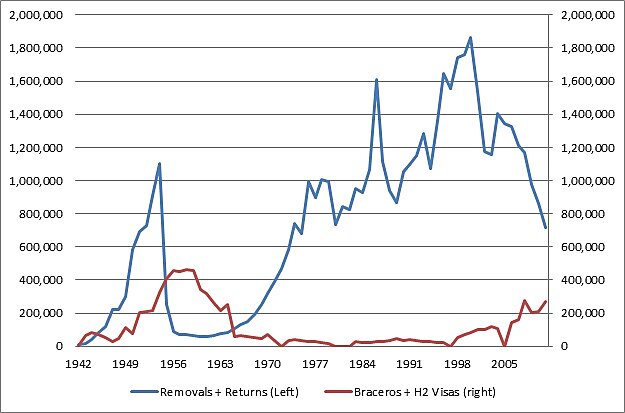
Source: Department of Homeland Security and Immigration and Naturalization Service annual reports.
One legal worker on a visa seems to be worth more than one unauthorized immigrant worker – meaning a favorable trade off for those concerned about the number of guest workers who could migrate if a large guest worker program was implemented. In 1954, one guest worker visa replaced 3.4 unauthorized immigrants, meaning that one legal worker seemed to be equal to more than three illegal workers (see Figure 1). That far fewer “physically able, adult male” braceros could do the same quantity of work as several illegal workers was even noted at the time.[xxxix] If an important goal of a lower skilled guest worker visa is to eliminate the American economic demand for unauthorized immigrants, relatively fewer guest worker visas can replace a much larger unauthorized immigrant population.
Figure 2 indicates that increased numbers of Border Patrol and border enforcement were unnecessary to get this result. When the government launched Operation Wetback and expanded the Bracero program, the number of border patrol agents did increase but only to a previous high.
Figure 2
All Illegal Immigrants Removed and Returned and Number of Border Patrol Agents, 1942–1960

Sources: Department of Homeland Security, Immigration and Naturalization Service annual reports, and National Foundation for American Policy.
By allowing unauthorized immigrants to get work visas, by not punishing them or employers for coming forward, and by making work visas available to future migrants, almost all future and current unauthorized immigrants can be funneled into the legal market without a large increase in enforcement. This was the policy followed in the 1950s and it worked.
Clearly Operation Wetback should not be a guide for future enforcement policy because its racially discriminatory and harsh enforcement policies were unethical and legally unsound. However, a new guest worker visa program combined with a refocused immigration enforcement system that seeks to channel unlawful and new migrants onto the guest worker visa could be effective.
End of Bracero and Re-Ignition of Unlawful Immigration
By the time of Bracero’s cancellation in 1964, increasing regulations promulgated by the Department of Labor (DOL) and restrictions whittled the number of Bracero guest worker visas down to just 200,000 that year.[xl] New DOL wage regulations and labor certification raised costs for farmers and migrants, incentivizing them to move into the informal, underground economy.[xli] By making lawful employment of migrants so expensive, the government created unauthorized immigration. Since 1964, very few lower skilled workers have been allowed in and the unauthorized immigrant population has skyrocketed. Ending Bracero did not end temporary worker migration to the United States; it merely made such migration illegal.[xlii]
After cancellation of the Bracero program, the H‑2 guest worker visa became the source of legal foreign agricultural workers. The H‑2 was underused relative to the Bracero program because of complex rules, numerical restrictions, and the cost of sponsoring migratory workers.[xliii] The H‑2 visa was initially created through the Immigration and Nationality Act of 1952 for “other temporary workers” not covered by the Bracero program.[xliv] From 1964 until 1986, mostly temporary unauthorized Mexican migration filled the gap left by the repeal of the Bracero program, which was unfilled by the H‑2 visa.[xlv] After the end of Bracero, the modern age of unlawful immigration began as Figure 1 shows. The rest is history.
Conclusion
Mr. Trump is correct that unauthorized immigration decreased markedly in the 1950s, but he is wrong to attribute all or even most of that to increased enforcement under the utterly inhumane Operation Wetback. That operation would have been a complete failure if there was not a Bracero guest worker visa available to provide a legal avenue for lower skilled migration. The Bracero program had a lot of problems, and any modern visa program would have to be very different, but it was better than the black market alternative. Border Patrol and INS agents at the time credited Bracero with ending unlawful immigration and predicted, correctly, that ending Bracero would reignite it. Despite what Mr. Trump says, the lesson from the 1950s is not that harsh and inhumane immigration enforcement is effective, it is that a legal migration pathway can halt unlawful immigration.
div[ii] See Wayne D. Rasmussen, The Emergency Farm Labor Supply Program 1943–47, U.S. Department of Agriculture Bureau of Agricultural Economics, Monograph no. 13, Washington, September, 1951.
div[iii] Ibid.
div[iv] Ernesto Galarza, Merchants of Labor: The Mexican Bracero Story, McNally and Loftin Publishers, Charlotte NC, 1964, p. 47.
div[v] Douglas S. Massey, Jorge Durand, and Nolan J. Malone, Beyond Smoke and Mirrors: Mexican Immigration in an Era of Economic Integration (New York: Russell Sage Foundation, 2002), pp. 35–39.
div[vi] Kitty Calavita, Inside the State: The Bracero Program, Immigration, and the INS, Quid Pro Books, New Orleans, Louisiana, 2010, pp. 20–24 and Ernesto Galarza, Merchants of Labor: The Mexican Bracero Story, McNally and Loftin Publishers, Charlotte NC, 1964, pp. 44, 84–85.
div[vii] Kitty Calavita, Inside the State: The Bracero Program, Immigration, and the INS, Quid Pro Books, New Orleans, Louisiana, 2010, pp. 70–71, 93.
div[viii] Deborah Cohen, Braceros: Migrant Citizens and Transnational Subject in the Postwar United States and Mexico, University of North Carolina Press, 2011, pp. 213–14.
div[ix] “History of the Immigration and Naturalization Service,” Congressional Research Service, December 1980, p. 54.
div[x] “History of the Immigration and Naturalization Service,” Congressional Research Service, December 1980, p. 54.
div[xi] “History of the Immigration and Naturalization Service,” Congressional Research Service, December 1980, p. 54.
div[xii] Kitty Calavita, Inside the State: The Bracero Program, Immigration, and the INS, Quid Pro Books, New Orleans, Louisiana, 2010, p. 50.
div[xiii] Deborah Cohen, Braceros: Migrant Citizens and Transnational Subject in the Postwar United States and Mexico, University of North Carolina Press, 2011, pp. 213–14 and Vernon M. Briggs Jr., Immigration Policy and the American Labor Force, The Johns Hopkins University Press, Baltimore, 1984, p. 99, 103.
div[xiv] Kitty Calavita, Inside the State: The Bracero Program, Immigration, and the INS, Quid Pro Books, New Orleans, Louisiana, 2010, pp. 50–61.
div[xv] Kitty Calavita, Inside the State: The Bracero Program, Immigration, and the INS, Quid Pro Books, New Orleans, Louisiana, 2010, p. 34.
div[xvi] Deborah Cohen, Braceros: Migrant Citizens and Transnational Subject in the Postwar United States and Mexico, University of North Carolina Press, 2011, p. 209, Kitty Calavita, Inside the State: The Bracero Program, Immigration, and the INS, Quid Pro Books, New Orleans, Louisiana, 2010, pp. 25–26, and Ernesto Galarza, Merchants of Labor: The Mexican Bracero Story, McNally and Loftin Publishers, Charlotte NC, 1964, p. 63.
div[xvii] Ernesto Galarza, Merchants of Labor: The Mexican Bracero Story, McNally and Loftin Publishers, Charlotte NC, 1964, p. 64.
div[xviii] Ernesto Galarza, Merchants of Labor: The Mexican Bracero Story, McNally and Loftin Publishers, Charlotte NC, 1964, p. 63.
div[xix] Kitty Calavita, Inside the State: The Bracero Program, Immigration, and the INS, Quid Pro Books, New Orleans, Louisiana, 2010, p. 43 and Ernesto Galarza, Merchants of Labor: The Mexican Bracero Story, McNally and Loftin Publishers, Charlotte NC, 1964, pp. 66–67.
div[xx] Deborah Cohen, Braceros: Migrant Citizens and Transnational Subject in the Postwar United States and Mexico, University of North Carolina Press, 2011, pp. 213–14.
div[xxi] Kitty Calavita, Inside the State: The Bracero Program, Immigration, and the INS, Quid Pro Books, New Orleans, Louisiana, 2010, p. 3.
div[xxii] Daniel Griswold, “Comprehensive Immigration Reform: What Congress and the President Need to Do to Make It Work,” Albany Government Law Review 3, no. 1 (2010): p. x.
div[xxiii] Kitty Calavita, Inside the State: The Bracero Program, Immigration, and the INS, Quid Pro Books, New Orleans, Louisiana, 2010, p. 90.
div[xxiv] Kitty Calavita, Inside the State: The Bracero Program, Immigration, and the INS, Quid Pro Books, New Orleans, Louisiana, 2010, p. 37.
div[xxv] Kitty Calavita, Inside the State: The Bracero Program, Immigration, and the INS, Quid Pro Books, New Orleans, Louisiana, 2010, p. 57.
div[xxvi] Kitty Calavita, Inside the State: The Bracero Program, Immigration, and the INS, Quid Pro Books, New Orleans, Louisiana, 2010, p. 57.
div[xxvii] Kitty Calavita, Inside the State: The Bracero Program, Immigration, and the INS, Quid Pro Books, New Orleans, Louisiana, 2010, p. 57.
div[xxviii] Kitty Calavita, Inside the State: The Bracero Program, Immigration, and the INS, Quid Pro Books, New Orleans, Louisiana, 2010, p. 59.
div[xxix] Kitty Calavita, Inside the State: The Bracero Program, Immigration, and the INS, Quid Pro Books, New Orleans, Louisiana, 2010, p. 59.
div[xxx] Kitty Calavita, Inside the State: The Bracero Program, Immigration, and the INS, Quid Pro Books, New Orleans, Louisiana, 2010, p. 63.
div[xxxi] Kitty Calavita, Inside the State: The Bracero Program, Immigration, and the INS, Quid Pro Books, New Orleans, Louisiana, 2010, pp. 94–95, 104–105.
div[xxxii] Kitty Calavita, Inside the State: The Bracero Program, Immigration, and the INS, Quid Pro Books, New Orleans, Louisiana, 2010, p. 104.
div[xxxiii] Kitty Calavita, Inside the State: The Bracero Program, Immigration, and the INS, Quid Pro Books, New Orleans, Louisiana, 2010, p. 107.
div[xxxiv] Ernesto Galarza, Merchants of Labor: The Mexican Bracero Story, McNally and Loftin Publishers, Charlotte NC, 1964, p. 69.
div[xxxv] Kitty Calavita, Inside the State: The Bracero Program, Immigration, and the INS, Quid Pro Books, New Orleans, Louisiana, 2010, p. 66.
div[xxxvi] Daniel Griswold, “Comprehensive Immigration Reform: What Congress and the President Need to Do to Make It Work,” Albany Government Law Review 3, no. 1 (2010): p. 37.
div[xxxvii] Ernesto Galarza, Merchants of Labor: The Mexican Bracero Story, McNally and Loftin Publishers, Charlotte NC, 1964, pp. 74–75.
div[xxxviii] Kitty Calavita, Inside the State: The Bracero Program, Immigration, and the INS, Quid Pro Books, New Orleans, Louisiana, 2010, pp. 89–90.
div[xxxix] Kitty Calavita, Inside the State: The Bracero Program, Immigration, and the INS, Quid Pro Books, New Orleans, Louisiana, 2010, p. 63.
div[xl] Douglas S. Massey, Jorge Durand, and Nolan J. Malone, Beyond Smoke and Mirrors: Mexican Immigration in an Era of Economic Integration (New York: Russell Sage Foundation, 2002), pp. 35–39. p. 41 and Kitty Calavita, Inside the State: The Bracero Program, Immigration, and the INS, Quid Pro Books, New Orleans, Louisiana, 2010, pp. 130–132, 138–140.
div[xli] Douglas S. Massey, Jorge Durand, and Nolan J. Malone, Beyond Smoke and Mirrors: Mexican Immigration in an Era of Economic Integration (New York: Russell Sage Foundation, 2002), pp. 35–39. p. 41 Kitty Calavita, Inside the State: The Bracero Program, Immigration, and the INS, Quid Pro Books, New Orleans, Louisiana, 2010, pp. 142–143.
div[xlii] Joyce Vialet, Barbara McClure, and Marsha Cerny, “Temporary Worker Programs: Background and Issues,” Congressional Research Service, February 1980, p. 55, Vernon M. Briggs Jr., Immigration Policy and the American Labor Force, The Johns Hopkins University Press, Baltimore, 1984, p. 151, 156, Vernon M. Briggs Jr., Immigration and American Unionism, Cornell University Press, Ithaca, NY, 2001, p. 143.
div[xliii] Massey, Durand, and Malone, pp. 43–47.
div[xliv] See Lindsay M. Pickral, “Close to Crucial: The H‑2B Visa Program Must Evolve, but Must Endure,” University of Richmond Law Review 42, no. 4, (March 2008).
div[xlv] See Douglas S. Massey and Audrey Singer, “New Estimates of Undocumented Mexican Migration and the Probability of Apprehensions,” Demography, 32 (1995): 203–13.
Jonathan Chait comments on the University of Missouri failure:
The upsurge of political correctness is not just greasy-kid stuff, and it’s not just a bunch of weird, unfortunate events that somehow keep happening over and over. It’s the expression of a political culture with consistent norms, and philosophical premises that happen to be incompatible with liberalism. The reason every Marxist government in the history of the world turned massively repressive is not because they all had the misfortune of being hijacked by murderous thugs. It’s that the ideology itself prioritizes class justice over individual rights and makes no allowance for legitimate disagreement.
Chait deserves praise. I had thought the time was past – long past – when a committed Social Democrat could hold liberal views on the freedom of speech. Time to jettison my prior beliefs about Jonathan Chait. But he is pretty much alone, no?
I see political correctness in this instance as an outgrowth of egalitarianism, a worldview that sees everywhere only oppressors and the oppressed. The former can have no rights that the latter are bound to respect, and thus it makes perfect sense, as the law professor Owen Fiss once proposed, to “restrict the speech of some elements of our society in order to enhance the relative voice of others.”
Free speech needs support from the political left. It is hard to see how such support might be revived.