At the National Sheriffs’ Association Conference in Washington last week, Homeland Security Secretary Janet Napolitano noted that riders on the DC Metro system can hear her voice repeatedly promoting her department’s “If You See Something, Say Something” terrorism hotline campaign. “That’s a scary thought,” she suggested.
Even scarier to me is the campaign itself.
It was begun in New York City where it generated 8,999 calls in 2006 and more than 13,473 in 2007. Although the usual approach of the media is to report about such measures uncritically, one New York Times reporter at the time did have the temerity to ask how many of these tips had actually led to a terrorism arrest. The answer, it turned out, was zero.
That continues to be the case, it appears: none of the much-publicized terrorism arrests in New York since that time has been impelled by a “If You See Something, Say Something” tip.
This experience could be taken to suggest that the tipster campaign has been something of a failure. Or perhaps it suggests there isn’t all that much out there to be found. Undeterred by such dark possibilities, however, the campaign continues, and the number of calls in New York skyrocketed to 27,127 in 2008 before settling down a bit to a mere 16,191 in 2009.
For its part, the FBI celebrated the receipt of its 2 millionth tip from the public, up to a third of them concerning terrorism, in August 2008. There seems to be no public information on whether the terrorism tips proved more useful than those supplied to the New York City police. However, an examination of all known terrorism cases since 9/11 that have targeted the United States suggests that the “If You See Something, Say Something” campaign has never been relevant.
It turns out that New York has received a trademark on its snappy slogan, something Napolitano’s DHS dutifully acknowledges on its relevant website when it refers to its public awareness campaign as: “If You See Something, Say Something&™.” (Nowhere on the website, by the way, does the Department bother to tally either the number of calls it receives or the number of terrorism arrests the hotline has led to.)
New York has been willing to grant permission for the slogan to be used by organizations like DHS, but sometimes it has refused permission because, according to a spokesman, “The intent of the slogan is to focus on terrorism activity, not crime, and we felt that use in other spheres would water down its effectiveness.” Since it appears that the slogan has been completely ineffective at dealing with its supposed focus—terrorism—any watering down would appear, not to put too fine a point on it, to be impossible.
Meanwhile, in New York alone $2 million to $3 million each year (much of it coming from grants from the federal government) continues to be paid out to promote and publicize the hotline.
But that’s hardly the full price of the program. As Mark Stewart and I have noted in our Terror, Security, and Money, processing the tips can be costly because, as the FBI’s special counsel puts it, “Any terrorism lead has to be followed up. That means, on a practical level, that things that 10 years ago might just have been ignored now have to be followed up.” Says the assistant section chief for the FBI’s National Threat Center portentously, “It’s the one that you don’t take seriously that becomes the 9/11.”
It might seem obvious that any value of the “If You See Something, Say Something™” campaign needs to be weighted against the rather significant attendant costs of sorting through the haystack of tips it generates. Of course, the campaign might fail a cost-benefit analysis because it is expensive and seems to have generated no benefit (except perhaps for bolstering support for homeland security spending by continually reminding an edgy public that terrorism might still be out there).
This grim possibility may be why, as far as I can see, no one has ever carried out such a study and that the prospect of doing one has probably never crossed the minds of sloganeer Napolitano or of the rapt sheriffs in her audience.
Now that’s a scary thought.
Cross-posted from the Skeptics at the National Interest.
Cato at Liberty
Cato at Liberty
No, legal academics don’t usually come right out and say this, but Hazel Weiser, executive director of the Society of American Law Teachers (SALT), did say it as part of a discussion of the woes of new law graduates in a slow hiring market:
Rather than deregulate the legal profession, which is notoriously bad at self-policing, the best way to get more jobs for these unemployed recent graduates is to up regulation, not do away with it. Another op ed piece, “It’s Consumer Spending, Stupid” dated October 25, 2011, by James Livingston, a professor of history at Rutgers, puts it perfectly: “…private investment — that is, using business profits to increase productivity and output — doesn’t actually drive economic growth. Consumer debt and government spending do. Private investment isn’t even necessary to promote growth.” Government spending means regulation as well as bridges and tunnels. Let’s hire these young attorneys to enforce the laws of the land!
In a similar vein, note this blog post by University of Michigan law professor Sam Bagenstos, a leading disabled-rights expert who served in the Obama administration until last year as Principal Deputy Assistant Attorney General for Civil Rights, the number two official in the Civil Rights Division. Commenting on a report that the city of Mobile, Alabama, was preparing to spend $146,000 to comply with new federal rules governing its public swimming pools, Prof. Bagenstos ran the item under the headline “New ADA Regs: Job Creators.” (Update: It was a joke, he says.)
Next time you read about some daffy new idea out of Washington, keep in mind that there’s a whole school of thought out there that, faced with a choice between a mild and a stringent regulatory option, imagines that by going with the more stringent Washington can create more jobs. It explains a lot.
Related Tags
The release of Mitt Romney’s tax returns is generating debate about the federal tax rates on capital gains and dividends of 15 percent. Great, let’s have a debate about why it’s both fair and good policy that these rates were cut in 2003.
Romney’s effective income tax rate in 2010 was 14 percent because most of his income was in the form of capital gains and dividends. Let’s focus on dividends, which were $4.9 million of his 2010 income of $21.7 million.
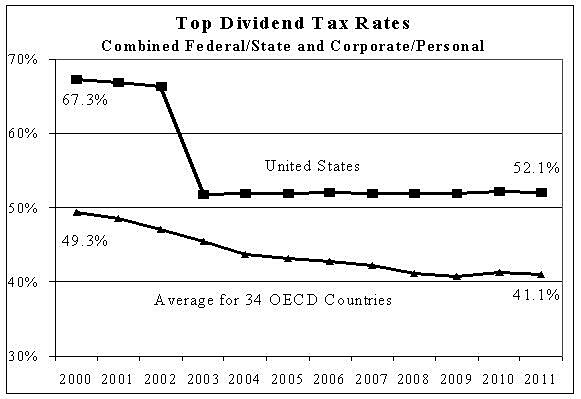
While Romney paid a 15 percent federal personal rate on his dividend income, the total tax rate on the stream of corporate profits that ended up in Mitt’s pocket was a huge 52 percent. That figure is from the OECD, and it includes the corporate-level burden on the underlying profits and the state-level corporate and personal taxes on dividends. So the total tax burden on Romney’s dividends is high not low, despite the dividend tax cut in 2003.
Just about every industrial country provides relief for the double taxation of corporate equity, either by having a lower personal rate on dividends, a personal tax credit for dividends, or a lower corporate-level tax. Despite the 2003 dividend tax cut, the overall U.S. rate on dividends at 52 percent is still the fourth-highest among the 34 high-income nations of the OECD.
Many people don’t seem to understand is that globalization has vastly changed the reality for capital income. Every major nation has cut tax rates on capital income in recent decades. The chart shows the average top dividend tax rate in the 34 OECD countries since 2000. The U.S. cut its rate, but so did other countries. Liberals say they want to bring back Clinton’s higher tax rates, but the world has changed since then. And we’ve got more cutting to do: Our dividend rate is still 11 points higher than the average of the 34 high-income nations.
Related Tags
Last night, Newt Gingrich praised the Chilean Social Security system, which allows workers to save for their retirements in personal accounts, rather than contribute to the government pension scheme. Several of my Cato colleagues are far more qualified than I am to comment on that system, including Mike Tanner, Jagadeesh Gokhale, and Jose Pinera–who designed and implemented it. But personal accounts are as important for reforming compulsory health insurance schemes like Medicare as they are for reforming compulsory pension schemes.
In 2010, I traveled to Chile to deliver an address to the International Federation of Pension Fund Administrators (FIAP). I detailed the harms caused by compulsory health insurance schemes and explained how personal medical accounts would improve health care and generate wealth even for the poor:
In designing health care markets, perfection is not an option. Under any system, whether state-run or the free market, some patients will inevitably fall through the cracks.
Personal medical accounts can help fill in those cracks by enabling innovations that improve medical care and bring it within reach of the poor. Yes, some will not earn enough to provide for themselves. And when we are free to make our own decisions, a small number of people will make poor decisions. I believe we have a moral duty to care for patients who could not or would not provide for themselves. Personal medical accounts will make it easier for us to meet that moral duty.
Under compulsory health insurance schemes, those cracks widen, and more people fall through. Price and exchange controls block innovation. Governments waste resources on low-value medical care. Some would describe these as the unavoidable costs of creating an equitable society. But those wasted resources do not purchase solidarity. They purchase sickness and poverty.
FIAP turned my address into this book chapter, which also explains how to craft a system of personal medical accounts.
For current enrollees, who have not built up savings in a personal medical account, Congress should make Medicare look more like Social Security. That is, the government should subsidize Medicare enrollees by giving them cash, rather than creating a complex health-insurance scheme that effectively lets government officials shape the entire health care sector.
Related Tags
Back in 1993, when Whitney Houston hit #1 with “I will always love you”, there was something that California-based state schooling advocates didn’t love at all: a school voucher ballot initiative. Much was written on the subject, and in 1994 a booklet was published summarizing the arguments for and against (Voices on Choice, K. L. Billingsley, ed.). In today’s School Choice Week installment, we’ll hear from those who were agin’ it.
Maxine Waters, United States Congress (D, Los Angeles):
“Contrary to claims, school choice will be devastating for urban, minority, and poor students who desperately need quality education.”
Delaine Eastin, California State Representative (D, Fremont):
“Having schools without [government] standards won’t improve learning.” Private school choice “won’t teach more kids how to read and write.”
Well, actually… U.S. private school choice programs usually do improve student achievement significantly in one or more subjects, and they have never been shown to have a negative impact on student achievement. The domestic scientific evidence to that effect was collected and summarized last March by Greg Forster, for the Foundation for Educational Choice. I do have one quibble with the report (it doesn’t count the insignificant findings in studies that have at least one significant finding, as is standard practice in literature reviews) but even after addressing it the aforementioned statements would still hold true.
Heck, even the few choice programs that don’t currently seem to be raising test scores are substantially raising students’ graduation rates–and doing it at substantially less cost to taxpayers than the state schools.
What’s more, when we cast a wider net and look at scientific studies comparing government and independent schools within countries all over the world, the results are even more dramatic. In fact, it is the least regulated, most market-like schools that most consistently outperform state-run monopoly school systems such was we have in the U.S.
Delaine Eastin:
“[T]his initiative allows schools to fail. But it does nothing to protect taxpayers when they do. When public school systems go belly up as a result of the voucher initiative, the courts are likely to rule that taxpayers will be stuck with the tab—and it won’t be cheap.”
Modern private school choice programs have been operating around the country for as long as twenty years, and I know of no case in which they have been found to increase the total burden on taxpayers. In fact, the only systematic studies of the issue find that these programs save taxpayers money—sometimes quite a bit of it. Florida’s legislature has studied the fiscal impact of that state’s k‑12 scholarship donation tax credit program, and found it to save $1.49 for every $1 it reduces revenues. That’s a nearly 50% return.
What’s more, the program has been found in two separate studies to both improve achievement of students who remain in public schools and to improve achievement of students who receive scholarships to attend private schools. It’s not hard to fathom why: on average, private schools spend thousands less per pupil than does the public school monopoly.
Warren Furutani, past president, Los Angeles City Board of Education:
“It is no coincidence that dollars are being pulled from our underfunded, overburdened school system at the same time our governor and the president of this nation are pushing vouchers and choice.”
Um… Yeah… About that claim that “dollars were being pulled” from “underfunded” public schools in California. I just happen to have the actual spending trend handy:
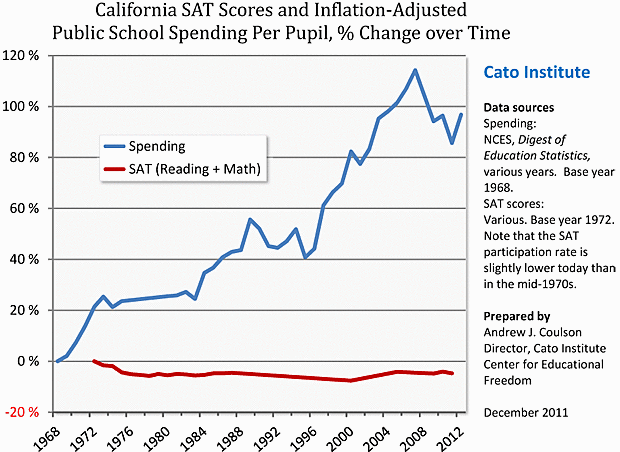
So, not only were these Status Quo Stalwarts unable to correctly predict the future, they had some difficulty accurately describing the present. Oh, and while thrifty school choice programs around the country have been improving student achievement and attainment, it’s hard to say the same for the California’s state education monopoly.
Related Tags
Does a more careful reading of the Supreme Court’s decision in U.S. v. Jones turn up a lurking victory for the government?
Modern media moves so fast that the second-day story happens in the afternoon of the first. The Supreme Court ruled unanimously Monday morning that government agents conduct a Fourth Amendment search when they place a GPS device on a private vehicle and use it to monitor a suspect’s whereabouts for weeks at a time. Monday afternoon, a couple of commentators suggested that the case is less a win than many thought because it didn’t explicitly rule that a warrant is required to attach a GPS device to a vehicle.
Writing on the Volokh Conspiracy blog, George Washington University law professor Orin Kerr noted “What Jones Does Not Hold.”
The Court declined to reach when the installation of the device is reasonable or unreasonable. … So we actually don’t yet know if a warrant is required to install a GPS device; we just know that the installation of the device is a Fourth Amendment “search.”
And over on Scotusblog, Tom Goldstein found that “The Government Fared Much Better Than Everyone Realizes”:
[D]oes the “search” caused by installing a GPS device require a warrant? The answer may be no, given that no member of the Court squarely concludes it does and four members of the Court (those who join the Alito concurrence) do not believe it constitutes a search at all.
So there is a constitutional search when the government attaches a GPS device to a vehicle, but the Court conspicuously declined to say that such a search requires a warrant. Do we have an “a‑ha” moment?
When the Supreme Court granted certiorari in the case, it took the unusual step of adding to the questions it wanted addressed. In addition to “[w]hether the warrantless use of a tracking device on respondent’s vehicle to monitor its movements on public streets violated the Fourth Amendment,” the Court wanted to know “whether the government violated respondent’s Fourth Amendment rights by installing the GPS tracking device on his vehicle without a valid warrant and without his consent.” These are both compound questions, but the dimension added by the second is the Fourth Amendment meaning of attaching a device to a vehicle. The case was about attaching a device to a vehicle, and if the Court didn’t walk through every clause in each of the questions presented, that’s why.
On that central question in the case, the government argued the following: “Attaching the GPS tracking device to respondent’s vehicle was not a search or seizure under the Fourth Amendment.” The government lost, full stop.
Now, it’s true that the Court’s majority opinion didn’t explictly find that the “search” that occurs when attaching and using a GPS device requires a warrant, but look at its characterization of the opinion it affirmed: “The United States Court of Appeals for the District of Columbia Circuit reversed [Jones’s] conviction because of admission of the evidence obtained by warrantless use of the GPS device which, it said, violated the Fourth Amendment.”
The Court did decline to consider the argument that the government might be able to attach a device based on reasonable suspicion or probable cause—that argument was “forfeited” by the government’s failure to raise it in the lower courts—but if the Supreme Court were limiting its holding to the attachment-as-search issue, it would have remanded the case back to the lower courts for further proceedings consistent with the opinion. It did not, and the sensible inference to draw from that is that the general rule applies: a warrant is required in the absence of one of the customary exceptions. Failing to make that explicit was not “opening a door” to a latent government victory. U.S. v. Jones was a unanimous decision rejecting the government’s warrantless use of outré technology to defeat the natural privacy protections provided by law and physics.
At least one serious lawyer I know has raised the point that I address here, and it is a real one, but some in the commentariat are a little too showy with their analysis and far too willing to go looking for a government victory in what is nothing other than a government defeat.
As I noted on Friday, the seizure of popular cyberlocker Megaupload demonstrates that, even without controversial new legislation, our government already has extraordinarily broad powers to take down U.S.-registered websites (including any site in the .com and .org domains) before anyone has been tried for illegal conduct, let alone convicted. While the evidence presented in the indictment charging Megaupload’s executives with criminal racketeering and copyright infringement certainly seems damning, I also worried about the broader chilling effect such seizures could have on cloud storage services generally.
It didn’t take long for those effects to become apparent. The cyberlocker Filesonic has now disabled file sharing functionality: Users can still upload files for personal storage, but can’t create public links to enable others to access those files. (Though I’m not sure what prevents someone from simply creating a dummy account, uploading files, and then publicly posting the login information.) Another cyberlocker, Uploaded.to, is just blocking all traffic from U.S. Internet addresses, though it’s not at all clear how much legal protection that’s likely to afford them. You can hardly blame them for being skittish: The Megaupload indictment suggests that the U.S. government considers a wide array of cyberlocker business practices to be ipso facto evidence of criminal intentions, even though there are arguably legitimate reasons for many of them. Yet the government doesn’t think it has to wait for a trial, or give the folks who run a site an opportunity to explain their practices, before seizing an entire domain—which would be an effective death sentence for many startups.
If you think all cyberlockers are nothing more than piracy tools, and there’s no legitimate reason to make use of cloud storage for anything but personal backups, this might sound like an entirely healthy development. It’s a little more worrying to those of us who see many valid reasons that law abiding individuals—even those who lack contracts with major record labels and movie studios, or the funds and tech savvy to run their own servers—might want to share large files with friends and colleagues, or distribute them to the general public.
To be sure, such services aren’t going to vanish entirely. Established corporations like Google have sophisticated filter algorithms that can help identify copyrighted content—though those are trivially defeated by file compression and encryption—and large, well paid legal teams to handle copyright compliance and fend off lawsuits, like the one Google’s own YouTube continues to fight with content behemoth Viacom. The question is whether these are the only companies we want offering such services. Is the market for cloud-based platforms that enable sharing (which is one of the big selling points of cloud computing) a market we’re prepared to see effectively closed off to startups that can’t preemptively police every user-uploaded file to Hollywood’s satisfaction? Because that is the predictable effect of a regulatory environment where investors know a nascent site can be summarily yanked offline by a district judge who thinks a Tumblr is some sort of gymnastics aficionado.
If you’re only thinking about current, known uses of the Internet, this might not seem like that big a deal: Why do we need lots of different platforms for sharing large files? But then, just a few years ago it was hard to envision why we might want a platform for sharing streams of 140-character messages (“Just a bunch of people gabbing about what they had for lunch, ho-ho-ho!”) or a platform where anyone, not just Professional Content Creators, could upload short videos (“Amateur videos? Sounds like an excuse to steal movies!”) or half the other technologies that are so profoundly shaping 21st century life.
The last innovation is always safe. That’s why it’s easy to claim concrete examples of the harm regulation might do are hyperbolic fearmongering: Nobody’s going to shut down YouTube or Twitter now, because we’ve already seen the incredible value creation they enable, even if they also make it a bit easier to infringe copyrights. And anyway, the success stories eventually get big enough to afford their own fancy lawyers. It’s the next platform that we risk strangling in the cradle, because every new medium starts out recapitulating old media content before it becomes truly generative. Early radio is full of people reading newspapers and books out loud. Early TV and film looks like what you get when someone points a camera at a stage play.
File lockers still look like nothing but piracy tools to a lot of people, because most of us aren’t yet generating and sharing gigabytes worth of content on a daily basis. But it doesn’t take a whole lot of imagination to imagine a world where that’s not at all the case, a world where cheap, ubiquitous, powerful computing and rising bandwidth and falling storage costs make collaborative creation of high definition sound, video, and—who knows—maybe entire 3D environments a nigh universal recreational activity. (Like TV has been for the last couple generations, only with fewer dead brain cells.)
That world can be run by Google and Sony and a few other behemoths capable of negotiating byzantine licensing deals (and filtering protocols), with incumbents ill-disposed to see the value in anything that isn’t easily shoehorned into their existing business models. Or we can have a more dynamic, open world where someone with a cool idea for a platform can give it a try without spending more money on lawyers than servers first. The interesting, important question isn’t—as regulatory advocates want to make it—whether Megaupload should go out of business. Odds are it will and should, after a proper trial. It isn’t even whether sites like Rapidshare or Hotfile ought to follow suit. The interesting, important question is whether we’re going to have a legal climate that’s capable of giving rise to the second kind of cultural ecosystem, or one that’s only hospitable to the first kind.