My French is rusty, but I’m pretty sure the Fresh Prince just flipped out at the idea of a 75-percent marginal tax rate like that advocated by France’s new socialist president.
Cato at Liberty
Cato at Liberty
Tax and Budget Policy
Since 2009 Greece has been at the epicenter of the euro crisis, and after last week’s parliamentary election, it looks like its departure from the common currency is a matter of weeks. Everyone agrees that Greece didn’t get into trouble because it spent too little, just the opposite. When George Papandreou became prime minister in October 2009, he found that his conservative predecessor had cooked the books and left him with a staggering fiscal deficit of 12.7% of GDP. The socialist Papandreou was then forced to shelve his promises of more handouts and implement a program of fiscal austerity in exchange for multi-billion bailouts from the European Union.
Two and a half years on, things look as bleak as ever for Greece, with an economy that is still shrinking and unemployment on the rise. Today, many people claim that, even though profligacy was the source of Greece’s problems, austerity is now making things worse by cutting spending too fast too soon. Time magazine’s Fareed Zakaria explained the dynamics yesterday in his CNN show GPS:
“The problem is that as these governments cut spending in very depressed economies, it has caused growth to slow even further – you see government workers who have been fired tend to buy fewer goods and services, for example – and all this means falling tax receipts and thus even bigger deficits.”
Zakaria is not the only one describing austerity as mostly spending cuts, and some pundits even dramatize the term by adding adjectives such as “deep,” “brutal,” “savage,” or “self-defeating.” Let’s look at how brutal these spending cuts have been in Greece:
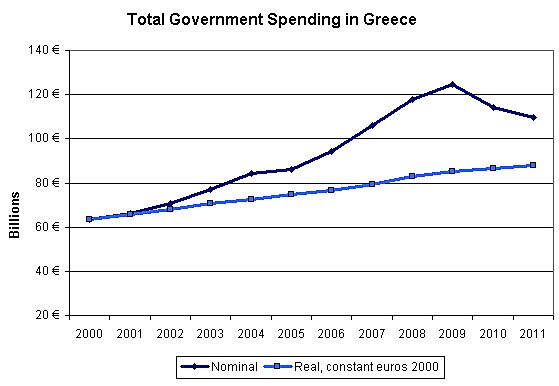
Source: Source: European Commission, Economic and Financial Affairs.
Spending has declined to approximately its 2007 level in nominal terms, while in real terms it actually continues to go up. (I look at spending in real terms because that’s what Ryan Avent at The Economist said we should look at in a reply to Veronique de Rugy’s initial graph on austerity in Europe. Note that, as in my previous posts on Britain and France, I’m using the GDP deflator to calculate spending in real terms). If we look at spending in real terms, there haven’t been any spending cuts in Greece. On the other hand, Tyler Cowen observes that “in the short run it is supposedly nominal which matters (that said, gdp and population [and inflation] are not skyrocketing in these countries for the most part).” Let’s look at nominal then. Since 2000, public spending rose in Greece at an annual rate of 7.8% until 2009. Then it declined by 8.3% in 2010 and a further 4.1% in 2011. This is certainly a cut in spending, but far from brutal.
Some argue that we shouldn’t look at spending levels when talking about austerity, but rather at spending as a share of the economy. In that sense, government spending in Greece went up from 47.1% of GDP in 2000 to 53.8% in 2009 and it has come down to 50.3% in 2011—approximately its 2008 level. However, I don’t buy the argument. Does it mean that the government has to spend an ever increasing share of the GDP in order to keep the economy afloat? Is half of the economy not enough when it comes to government spending?
What about Zakaria’s argument of the crippling effect of firing government workers on growth? Last January, The Economist looked at the situation in Greece and noted that “Of the 470,000 who have lost their jobs since 2008, not one came from the public sector. The civil service has had a 13.5% pay cut and some reductions in benefits, but no net job losses.” As for what “austerity” means for most Greeks, the magazine added, “Since Greece’s first bail-out in May 2010, the government has imposed austerity, increasing taxes so much that people can barely manage.”
The Economist is not alone in pointing out the extent to which taxes have gone up. Even the IMF has done so. Back in November, Poul Thomsen, the IMF mission chief in Greece, said that the country “has relied too much on taxes and I think one of the things we have seen in 2011 is that we have reached the limit of what can be achieved through increasing taxes.” Since then Greece agreed to eliminate 15,000 government jobs (2% of its public sector workforce) in exchange for a second bailout. Once again, that figure pales when compared to the number of people who have lost their jobs in the private sector.
The evidence shows that in Greece austerity has meant significant tax increases and timid spending cuts.
Related Tags
Some politicians say that banks need more regulation because JPMorgan Chase lost $2 billion, about 2 percent of its annual revenue.
Meanwhile, the federal government will have a deficit of about $1.3 trillion this year, more than half its annual revenue (and about a third of its annual spending).
Is there some sort of regulation that might remedy that?
Related Tags
Californians may be forgiven for expectorating coffee over their morning newspapers today, as they learn that their state deficit is not $9 billion, as Governor Brown’s administration had predicted, but rather $16 billion. Oops.
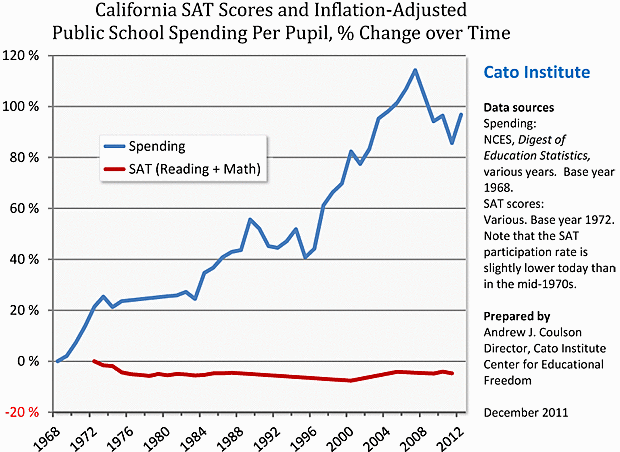
Further increasing the breakfast table choking hazard is the Governor’s “solution”: raise taxes. Gov. Brown is pushing a fall ballot initiative that would raise both sales and income taxes. He argues that this is preferable to cutting spending on things like public schooling on the grounds that schools have already been slashed to the bone. But have they? Actually, no. California’s per pupil spending has nearly doubled over the past forty odd years, in real inflation-adjusted dollars, and remains near its all-time high.
What did California get for that massive spending increase? Not a great deal if the SAT performance of its college-bound high school students is any guide. And, as I pointed out in this op-ed, it’s a pretty reasonable guide.
But while raising taxes has consistently failed to improve educational performance, cutting them actually works—via tax-credit school choice programs that give families an easier choice between public and private schools. Florida’s education tax credit program, for instance, has been shown to improve the achievement of students who stay in public schools, to improve the achievement of students who accept scholarships and attend private schools, and to save taxpayers millions of dollars a year. If expanded on a mass scale in a large state like California, it would save billions of dollars a year.
So what’ll it be, Californians? Fiscal and education policy sobriety, or the Governor’s hair-of-the-dog continued big government partying?
Related Tags
The Washington Times today discusses whether Mitt Romney’s political and policy team is looking too much like George W. Bush’s team. The reporter quotes me in his article:
Chris Edwards, director of tax policy studies at the Cato Institute, a libertarian-leaning think tank, offered glowing reviews of Mr. Romney’s troika of advisers—Mr. Hubbard, Mr. Mankiw and Kevin Hassett, another former member of the Bush team—on issues of taxation and economic policy.
“These are brilliant economists,” Mr. Edwards said before cautioning that Mr. Romney shouldn’t look to Mr. Bush’s team on the spending side.
“A key failing of Bush was that he spent far too much money. Bush’s Office of Management and Budget chiefs, like Joshua Bolten, were not spending cutters. Indeed, they were believers in big government like Bush was,” he said.
“So,” he said, “Romney needs spending-cutting experts to complement these tax experts. Our giant $1 trillion deficits and huge Obama spending increases will be the key thing Romney needs to tackle if he is elected.”
“So he needs experts on how to cut, privatize and downsize federal departments like Housing and Urban Development, Energy and Education. If elected, he needs a hard-line spending-cutting OMB chief. He needs Cabinet secretaries who believe in cutting their own departments.”
Related Tags
It is very sad that America’s tax system is so onerous that some rich people feel they have no choice but to give up U.S. citizenship in order to protect their family finances.
I’ve written about this issue before, particularly in the context of Obama’s class-warfare policies leading to an increase in the number of Americans “voting with their feet” for places with less punitive tax regimes.
We now have a very high-profile tax expatriate. One of the founders of Facebook is escaping to Singapore. Here are some relevant passages from a Bloomberg article.

Eduardo Saverin, the billionaire co-founder of Facebook Inc. (FB), renounced his U.S. citizenship before an initial public offering that values the social network at as much as $96 billion, a move that may reduce his tax bill. …Saverin’s stake is about 4 percent, according to the website Who Owns Facebook. At the high end of the IPO valuation, that would be worth about $3.84 billion. …Saverin, 30, joins a growing number of people giving up U.S. citizenship, a move that can trim their tax liabilities in that country. …“Eduardo recently found it more practical to become a resident of Singapore since he plans to live there for an indefinite period of time,” said Tom Goodman, a spokesman for Saverin, in an e‑mailed statement. …Singapore doesn’t have a capital gains tax. It does tax income earned in that nation, as well as “certain foreign-sourced income,” according to a government website on tax policies there. …Renouncing your citizenship well in advance of an IPO is “a very smart idea” from a tax standpoint, said Avi-Yonah. “Once it’s public you can’t fool around with the value.” …Renouncing citizenship is an option chosen by increasing numbers of Americans. A record 1,780 gave up their U.S. passports last year compared with 235 in 2008, according to government records. …“It’s a loss for the U.S. to have many well-educated people who actually have a great deal of affection for America make that choice,” said Richard Weisman, an attorney at Baker & McKenzie in Hong Kong. “The tax cost, complexity and the traps for the unwary are among the considerations.”

What makes this story amusing, from a personal perspective, is that Saverin’s expatriation takes place just a couple of days after my wayward friend Bruce Bartlett wrote a piece for the New York Times in which he said that people like me are exaggerating the impact of taxes on migration. Here are some key excerpts from Bruce’s column:
In recent years, the number of Americans renouncing their citizenship has increased. …This led William McGurn of The Wall Street Journal to warn that the tax code is turning American citizens living abroad into “economic lepers.” The sharply rising numbers of Americans renouncing their citizenship “are canaries in the coal mine,” he wrote. The economist Dan Mitchell of the libertarian Cato Institute was more explicit in a 2010 column in Forbes, “Rich Americans Voting With Their Feet to Escape Obama Tax Oppression.” …[T]he sharp rise in Americans renouncing their citizenship since 2008 is less pronounced than it appears if one looks at the full range of data available since 1997, when it first was collected. As one can see in the chart, the highest number of Americans renouncing their citizenship came in 1997. …The reality is that taxes are just one factor among many that determine where people choose to live. Factors including climate, proximity to those in similar businesses and the availability of amenities like the arts and cuisine play a much larger role. That’s why places like New York and California are still magnets for the wealthy despite high taxes. And although a few Americans may renounce their citizenship to avoid American taxes, it is obvious that many, many more people continually seek American residency and citizenship.
I actually agree with Bruce. Taxes are just one factor when people make decisions on where to live, work, save, and invest.
But I also think Bruce is drinking too much of the Kool-Aid being served by his new friends on the left. There is a wealth of data on successful people leaving jurisdictions such as California and New York that have confiscatory tax systems.
And there’s also a lot of evidence of taxpayers escaping countries controlled by politicians who get too greedy. Mr. Saverin is just the latest example. And I suspect, based on the overseas Americans I meet, that there are several people who quietly go “off the grid” for every person who officially expatriates.
The statists say these people are “tax traitors” and “economic Benedict Arnolds,” but those views are based on a quasi-totalitarian ideology that assumes government has some sort of permanent claim on people’s economic output.
If people are leaving America because our tax law is onerous, that’s a signal we should reform the tax code. Attacking those who expatriate is the fiscal version of blaming the victim.
Related Tags
Thumbtack.com is a young web start-up that people can use to find service professionals in their area. The company recently utilized its nationwide network to survey small businesses on their state’s business climate (select cities were included too).
The survey, which can be found here, contained a couple of interesting findings. First, although taxes are an important consideration, licensing and regulatory concerns were even more important:
Although taxes are a dominant topic in many discussions of a location’s attractiveness to business, our analysis indicates that small businesses tend to care more deeply about the friendliness of a region’s licensing regime by a factor of nearly two. Similarly, being subject to special regulatory requirements had a negative effect on overall small business friendliness, and among those small businesses subject to special regulations, the ease of complying with these requirements was by far the most important factor.
Second, I was initially disturbed to read that “An important predictor of small business friendliness was whether the respondent was aware of the state or local government offering training programs for small businesses.” Yikes. As a former state budget official, one of the more worthless agencies I encountered was the one that was supposed to assist small businesses. So I was relieved when I then read this:
Interestingly, while those aware of training programs gave overall small business friendliness scores approximately 10% higher than those who were not, respondents who had actually attended one of the trainings rated their states less than one-percent higher than those who were aware of the trainings but had never attended.
For a state by state break-down, see here. Texas, Oklahoma, Idaho, and Utah received the best marks from small businesses, while California, Vermont, and Rhode Island received the worst.