The ACLU has issued a related report here.
Cato at Liberty
Cato at Liberty
Tax and Budget Policy
Farmer-friendly members of Congress are such a target-rich environment for ridicule when it comes to poor agriculture policy that it would be a full-time job just blogging about their utterances. So I try to spare you, most of the time. (You’re welcome.) But occasionally a quote passes my desk that is so ridiculous that I just have to share.
Senator Debbie Stabenow, chairwoman of the Senate Agriculture Committee and a Democrat (not that that matters) from Michican, yesterday made a statement that contains a pretty obvious logical fallacy:
“American agriculture represents a bright spot in our economy,” Chairwoman Stabenow said. “Agricultural exports are reaching record highs and American farmers and ranchers are continuing to outpace the rest of the world in productivity and efficiency. Sixteen million American jobs are supported by American agriculture, so it’s critical we pass the Farm Bill this year. We must provide farmers and small businesses the certainty they need to continue growing and helping the country’s economy recover.” [emphasis mine]
Which of course raises the question: If U.S. agriculture is doing so well, why do we need to subsidize it? To maintain those sixteen million jobs the Senator claims are supported by U.S. agriculture? Please. Research has shown a negative link between farm subsidies and rural development, including jobs creation (more here, including on rural subsidies more broadly). And the money for farm programs is extracted from the productive sector of the economy, at ensuing cost.
In the meantime, a non-subsidized sector of the U.S. farm sector is faring very well indeed. The popcorn industry is booming thanks to sales to Colombia following the U.S.-Colombia Free Trade Agreement, which came into effect last month. That hasn’t stopped Nebraska’s senators from asking for hand-outs on behalf of the industry, of course, but the lesson to me seems clear: freer trade, fewer subsidies. [HT: Andy Roth at the Club for Growth]
For more on Cato’s work on agriculture subsidies see here, here, here, here and here. And a whole lot more here.
The Bipartisan Policy Center (BPC) has come out against bipartisan spending restraint. The BPC has issued a report highly critical of the sequestration spending cuts that were agreed to in the bipartisan Budget Control Act of 2011.
The BPC is a center-left thinktank in Washington that houses some very good policy scholars. The goal of the group is to celebrate “times in American political history when two sides have come together in the interest of the country and the people.”
Surely that describes the Budget Control Act. The Act made some modest progress at trimming the giant federal budget deficit, which is an important concern of BPC scholars. The Budget Control Act passed the House 269 to 161 with 174 Republicans and 95 Democrats in favor. It passed the Senate 74 to 26. President Obama signed it. What could be more bipartisan than that?
However, the BPC complains that the sequester will cause “immense pain, disruption, and uncertainty,” and it could “cost the economy more than one million jobs” from the supposedly negative “multiplier effects.” But that’s not what happened the last time we had bipartisan spending restraint in Washington, which was in the 1990s. Federal spending fell from 22 percent of GDP to 18 percent during that decade, and the economy boomed.
Government shrinkage creates a positive multiplier, not a negative one, because the government releases resources—such as skilled workers from the defense industry in the 1990s—that are put to more productive uses in the private sector. You take an engineer from the Department of Defense or Energy and put her in the private sector producing goods for the market, and GDP will go up not down.
I don’t want to pick on BPC in particular, and their new report has lots of useful data and analysis. But how is America going to avoid a Greek-style fiscal disaster if even the supposed deficit-hawk groups start chickening out of spending restraint after just the first small reform steps?
Rather than reversing course, we should be build on the BCA with the reforms at www.DownsizingGovernment.org.
Related Tags
Rep. Tom McClintock (R‑CA) introduced three amendments to the recently passed Energy & Water appropriations bill that would have eliminated a slew of business subsidies at the Department of Energy. Unfortunately, House Republicans once again teamed up with their Democratic colleagues to keep the corporate welfare spigot flowing.
From The Hill:
The largest spending cut proposal came from Rep. Tom McClintock (R‑Calif.), which would have eliminated the Energy Efficiency and Renewable Energy account at the Department of Energy and used the $1.45 billion in savings toward deficit reduction. Like other Republicans, McClintock argued that this account needlessly spends money on questionable private investments that have not led to any measurable returns. But the House rejected McClintock’s amendment in a 113–275 vote, in which 113 Republicans voted for it but 107 Republicans joined every Democrat in opposition.
From a second article from The Hill:
Rep. Tom McClintock (R‑Calif.) proposed ending all nuclear energy research subsidies to private companies, which would have saved $514 million and used that money to lower the deficit. But the House rejected that amendment in a 106–281 vote that divided Republicans 91–134. McClintock also proposed language cutting fossil energy research subsidies, which would have saved $554 million. But the House killed that amendment 138–249, as Republicans split again 102–123.
A few comments:
First, Democrats voted overwhelmingly to continue to subsidize commercial interests. And here I thought Democrats were concerned about the have and have-nots.
Second, Rep. McClintock deserves a round of applause for his efforts. These votes speak volumes about a member’s beliefs about the proper role of the federal government. A lot of members—especially Republicans—talk a good game when it comes to spending, limited government, free markets, etc. However, when the time comes to put their money where their mouths are, many choose to instead put other people’s money in the mouths of special interests.
For those taxpayers who are interested in seeing how their member voted, the following are the roll call tallies for McClintock’s amendments:
- Reduce the energy efficiency and renewable energy account by $1.45 billion: http://clerk.house.gov/evs/2012/roll311.xml.
- Reduce the construction and expansion account of nuclear energy by $514 million: http://clerk.house.gov/evs/2012/roll315.xml.
- Reduce the fossil energy research and development account by $554 million: http://clerk.house.gov/evs/2012/roll317.xml.
[See here for more on why energy subsidies should be eliminated.]
Update: Steve Ellis from Taxpayers for Common Sense alerted me to an amendment introduced by Dennis Kucinich (D‑OH) and McClintock that would have shut down the Department of Energy’s Title 17 loan guarantee program. That’s the program that gave us Solyndra. The amendment failed 136–282 with 127 Republicans joining 155 Democrats to defeat the amendment. That the Republican-led House couldn’t get rid of the program that begot Solyndra is about as low as it gets.
Liberals love to complain about Republican support for supposedly “reverse Robin Hood” fiscal policies. Here’s Alan Blinder and Rachel Maddow, for example, pointing the finger at Paul Ryan and Mitt Romney, respectively.
However, I don’t see much liberal concern about big government spending programs that really do redistribute income upwards. What do Blinder and Maddow think about Democrats and Republicans in the Senate who are eager to extend billions of dollars worth of unaffordable payments to farm businesses and landowners? Robert Samuelson recently described these corporate welfare recipients as “immensely profitable” because of high crop prices.
Tad DeHaven and I looked at data on farm household incomes for testimony to the House last week. Here is what we found:
Farm subsidies redistribute wealth from taxpayers to often well-off farm businesses and landowners. Farm income stabilization payments have recently fluctuated between about $13 billion and $33 billion annually. This is a welfare hand-out like food stamps, yet it goes to higher-income households. In 2010, the average income of farm households was $84,400, or 25 percent above the $67,530 average of all U.S. households. Moreover, the great bulk of farm subsidies go to the largest farms.
I’m not in favor of Robin Hood or reverse Robin Hood programs, but it would be nice to see more liberals focusing on spending programs that are unfair to the nation’s taxpayers.
Related Tags
I have great fondness for Estonia, in part because it was the first post-communist nation to adopt the flat tax, but also because of the country’s remarkable scenery.
Most recently, though, I’ve been bragging about Estonia (along with Latvia and Lithuania, the other two Baltic nations) for implementing genuine spending cuts. I’ve argued that Estonia is showing how a government can reignite growth by reducing the burden of government.
Not surprisingly, some people disagree with my analysis. Paul Krugman of the New York Times criticized Estonia yesterday, writing that the Baltic nation suffered a “Depression-level slump” in 2008 and has only managed an “incomplete recovery” over the past few years.
He blames this supposedly weak performance on “austerity.”
I have a positive and negative reaction to Krugman’s post. My positive reaction is that he’s talking about a nation that actually has cut spending, so there’s real public-sector austerity (see Veronique de Rugy’s L.A. Times column to understand the critical difference between public-sector and private-sector austerity).
This is a sign of progress. In the past, he launched a silly attack on the U.K. for a “government pullback” that never happened, so what he wrote about Estonia at least is based on real events.
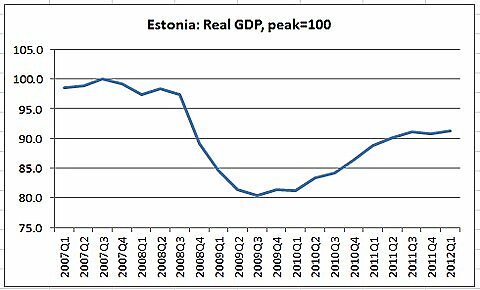
My negative reaction is that Krugman is very guilty of cherry-picking data. If you look at the chart that accompanies his post, Estonia’s economic performance isn’t very impressive, but that’s because he’s only showing us the data from 2007-present.
The numbers are accurate, but they’re designed to mislead rather than inform (sort of as if I did a chart showing 2009-present).
But before exposing that bit of trickery, there’s another mistake worth noting. Krugman presumably wants us to think that the downturn coincided with spending cuts. But his own chart shows that the economy hit the skids in 2008 — a year in which government spending in Estonia soared by nearly 18 percent according to EU fiscal data!
It wasn’t until 2009 that Estonian lawmakers began to reduce the burden of spending. So I guess Professor Krugman wants us to believe that the economy tanked in 2008 because of expectations of 2009 austerity. Or something like that.
Returning now to my complaint about cherry picking data, Krugman makes Estonia seem stagnant by looking only at data starting in 2007. But as you can see from this second chart, Estonia’s long-run economic performance is quite exemplary. It has doubled its economic output in just 15 years according to the International Monetary Fund. Over that entire period — including the recent downturn, it has enjoyed one of the fastest growth rates in Europe.

This doesn’t mean Estonia is perfect. It did experience a credit/real estate bubble, and there was a deep recession when the bubble burst. And the politicians let government spending explode during the bubble years, almost doubling the budget between 2004 and 2008.
But Estonia reacted to the overspending and the downturn in a very responsible fashion. Instead of using the weak economy as an excuse to further expand the burden of government spending in hopes that Keynesian economics would magically work (after failing for Hoover and Roosevelt in the 1930s, Japan in the 1990s, Bush in 2008, and Obama in 2009), the Estonians realized that they needed to cut spending.
And now that spending has been curtailed, it’s worth noting that growth has resumed.
What makes Krugman’s rant especially amusing is that he wrote it just as the rest of the world is beginning to notice that Estonia is a role model. Here’s some of what CNBC just posted.
Sixteen months after it joined the struggling currency bloc, Estonia is booming. The economy grew 7.6 percent last year, five times the euro-zone average. Estonia is the only euro-zone country with a budget surplus. National debt is just 6 percent of GDP, compared to 81 percent in virtuous Germany, or 165 percent in Greece. Shoppers throng Nordic design shops and cool new restaurants in Tallinn, the medieval capital, and cutting-edge tech firms complain they can’t find people to fill their job vacancies. It all seems a long way from the gloom elsewhere in Europe. Estonia’s achievement is all the more remarkable when you consider that it was one of the countries hardest hit by the global financial crisis. …How did they bounce back? “I can answer in one word: austerity. Austerity, austerity, austerity,” says Peeter Koppel, investment strategist at the SEB Bank. …that’s not exactly the message that Europeans further south want to hear. …Estonia has also paid close attention to the fundamentals of establishing a favorable business environment: reducing and simplifying taxes, and making it easy and cheap to build companies.
Good policy makes a difference. But it also helps to have rational citizens (unlike France, where people vote for economic illiterates and protest against reality).
While spending cuts have triggered strikes, social unrest and the toppling of governments in countries from Ireland to Greece, Estonians have endured some of the harshest austerity measures with barely a murmur. They even re-elected the politicians that imposed them. “It was very difficult, but we managed it,” explains Economy Minister Juhan Parts. “Everybody had to give a little bit. Salaries paid out of the budget were all cut, but we cut ministers’ salaries by 20 percent and the average civil servants’ by 10 percent,” Parts told GlobalPost. …As well as slashing public sector wages, the government responded to the 2008 crisis by raising the pension age, making it harder to claim health benefits and reducing job protection — all measures that have been met with anger when proposed in Western Europe.
It’s worth noting, by the way, that government is still far too big in Estonia. The public sector consumes about 39 percent of economic output, almost double the burden of government spending in Hong Kong and Singapore.
But, unlike certain American politicians, at least the Estonians understand the problem and are taking steps to move in the right direction. I hope they continue.
P.S. The President of Estonia, a Social Democrat named Toomas Hendrik Ilves, used his twitter account to kick the you-know-what out of Krugman yesterday. For amusement value, check out this HuffingtonPost article.
P.P.S. A few other nations, such as Canada and New Zealand, also imposed genuine spending restraint in recent decades and they also got good results.
Related Tags
Two of Washington’s top tax scholars have authored an excellent new book on overhauling the federal tax code. Alan Viard and Robert Carroll’s new book, Progressive Consumption Taxation, is a great introduction to tax reform for young policy wonks who want to understand the economics of savings, investment, tax base neutrality, efficiency, and other factors that are important in tax design.
I discussed the book at an AEI forum on Capitol Hill on Monday. The video is available here.
The X‑Tax is a compromise version of the Hall-Rabushka Flat Tax created by the brilliant former tax economist David Bradford. The Flat Tax itself is a “progressive” or graduated tax system because it has a large basic exemption, but the X‑Tax would be even more graduated. I’m a fan of more proportional tax systems, so I like the Flat Tax. But the X‑Tax would represent a huge simplification of the tax code and remove the income tax bias against savings and investment, which harms economic growth.
The X‑Tax and Flat Tax are consumption-based tax systems, which Viard and Carroll favor. In their book, they wisely reject a VAT, which is an often-discussed consumption-tax option. In my view, a VAT would be a money machine for the federal government, simply throwing fuel on the fire of overspending in Washington.
Viard and Carroll seem particularly interested in the Flat Tax/X‑Tax idea of cash-flow business taxation. If we are going to impose a tax on business entities at all, cash-flow taxation seems to be the way to go, as I explored in this Cato paper.
Anyway, great book. My tip for readers, however, would be to substitute the word “proportional” whenever the authors talk about “progressive” consumption taxation.