The Cato Institute’s Roger Pilon, Ilya Shapiro, Michael F. Cannon, Michael D. Tanner and Trevor Burrus evaluate today’s Supreme Court ruling on the Affordable Care Act.
Cato at Liberty
Cato at Liberty
Thanks to today’s Supreme Court ruling, the federal government has gained broad new powers to control the nation’s health care system. This, we are told by the President and his fellow travelers, will save money, expand access, and improve quality. One way to gauge the chances of that is to see what benefits federal oversight has brought to education in the one district in the nation over which Congress has ultimate authority: the District of Columbia public schools.
As I wrote earlier this week, the Census Bureau has now confirmed my finding that DC public schools spend about $30,000 / pupil annually. That is more than double the national average of public schools. Access to schooling may be universal in the District, but access to a quality education is not. As Economist Mark Perry writes, despite its stratospheric spending, DC’s graduation rate of 58.6% is far lower than the national average of 75.5%. The academic performance of its students is also significantly below the national average, and also below the average for other big city districts–in both reading and mathematics. Its achievement gaps by race and socio-economic status are also larger than in other public school districts.
That is how the only public school district in the nation under the control of Congress performs. Nor have nationwide federal education programs shown promise, as the chart below illustrates.
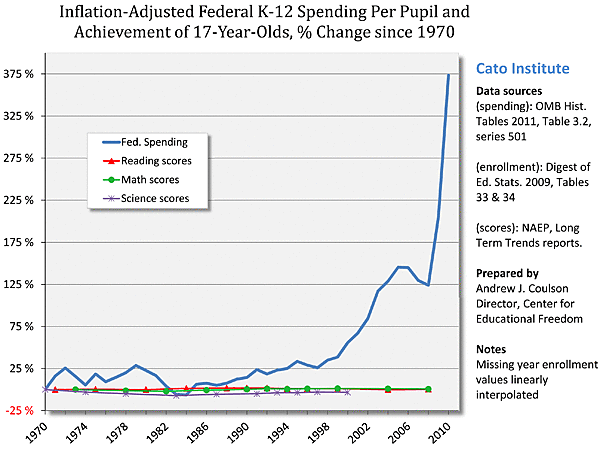
If our experience with education is any guide, a bigger federal role in health care does not bode well.
Related Tags
As you digest Chief Justice Roberts’ opinion, it is worth re-reading the opening part of my DePaul colleague David Franklin’s Slate piece from a while back. In it, he notes the current Chief Justice’s admiration for Chief Justice John Marshall, and then speculates that Roberts’ “Obamacare” opinion may try to ape Marshall’s strategy in Marbury v. Madison. David writes:
Everyone knows Marbury v. Madison as the case in which the court first asserted the power to declare acts of Congress and the president unconstitutional. What’s less well known is that the defendants in Marbury (Secretary of State James Madison and, by extension, President Thomas Jefferson) got off on a technicality.… Marbury promised sizzle and ended with fizzle.
But all of this was by design. John Marshall, the brilliant but unassuming chief justice, always intended to use Marbury to hand his cousin and arch-foe Jefferson a narrow legal victory while dealing him a long-lasting political blow. By lecturing Jefferson about his legal duties, Marshall put the president in his place. (Ours is ‘a government of laws, and not of men.’) And by laying the foundation for judicial review, Marshall carved out a prominent new place for the court. Most important, Marshall did all of this without ordering Madison or Jefferson to actually do anything. No wonder historian Robert McCloskey called Marbury ‘a masterwork of indirection.’ ”
Was Roberts trying to ape his hero Marshall’s “masterwork of indirection” when he crafted his opinion? The idea isn’t totally implausible, especially if you credit libertarian lawprof Jon Adler’s and Slate pundit Tom Scocca’s takes on the decision. Both note that while the decision hands President Obama a legal victory, the opinion may contain a considerable silver lining for advocates of limited government over the longer term. Whether or not you think this is true, it at least opens a plausible window on the mind of Chief Justice Roberts.
Update: David Franklin has posted a sequel to the article quoted above in a new Slate piece that expands on the connection between Roberts’ “Obamacare” opinion and Roberts’ Marshall-philia. David may be too sanguine about the long term potential for Roberts’ opinion to help libertarians. David has also altered me to a piece by Daniel Epps at the Atlantic, which also explores the link between Roberts’ thinking and Marbury. Epps takes the long-term potential of Roberts’ decision to help advocates of limited government more seriously than David does. For those looking for insights into Roberts’ motivations, both are well worth reading.
Today’s Supreme Court decision upholding the individual mandate rests on a purely fictional distinction between taxes and regulations that does not exist in other areas of law that restrain the power of Congress. While the Constitution is a document that, when properly read, grants limited power to the national government, the United States has signed international documents promising not to exercise some of those powers. The agreements that form the obligations of membership in the World Trade Organization contain direct disciplines on the exercise of government power relating to the regulation of international trade. The reason this is particularly relevant today is that the drafters of these texts were acutely aware that a tax, by any other name, would impede trade just as effectively. Consider paragraph 1 of Article III of the General Agreement on Tariffs and Trade:
The contracting parties recognize that internal taxes and other internal charges, and laws, regulations and requirements affecting the internal sale, offering for sale, purchase, transportation, distribution or use of products, and internal quantitative regulations requiring the mixture, processing or use of products in specified amounts or proportions, should not be applied to imported or domestic products so as to afford protection to domestic production. (emphasis added)
This coupling of taxes and regulations is found throughout international trade law for the simple and obvious reason that if the disciplines addressed only taxation, national governments would just alter the form of their protectionist measures and apply equivalently restrictive internal regulations. These disciplines harness the power of international law to prevent (or at least hinder) the U.S. government from coercively directing the commercial choices of Americans for the benefit of special interests.
In a post earlier today on Cato@Liberty, my colleague Chris Edwards offered some hypothetical laws of the future that would be justified under the reasoning embodied in the Supreme Court’s decision. One of them especially caught my attention:
Federal Domestic Jobs Act of 2016: Don’t exceed 25 percent foreign content on family consumer purchases, else pay the IRS $4,000.
While the Supreme Court’s constitutional analysis could now be affected by the fact that the word “IRS” is mentioned in the law, the WTO doesn’t care because it treats taxes and laws the same. What matters for WTO purposes is the effect of the measure, regardless of its form. The words “Don’t exceed 25 percent foreign content” are sufficient to make this law WTO-inconsistent regardless of who you have to pay when you do.
Although the Supreme Court may fail to recognize constitutional restraints on power that should prevent the federal government from forcing us to buy insurance, eat broccoli, or recycle, there remains one institutional impediment (albeit one of narrow scope and power) that is not hoodwinked by a fictional distinction between laws and taxes.
NATO fulfilled its Cold War role by deterring rather than sparking conflict. Yet if Turkey and Syria come to blows, the transatlantic alliance could turn into a transmission belt of war for America.
Syria’s developing civil war has spilled over into Turkey. Moreover, Ankara has begun to meddle in the conflict next door. Despite Turkey’s denials, the Erdogan government appears to be channeling arms shipments to rebels and sheltering Syrian opposition activists.
Thus, tension between the two governments was rising even before the Syrian military destroyed a Turkish RF-4E reconnaissance plane. Damascus claimed the aircraft was in Syrian airspace; Ankara said the jet had strayed over Syrian territory but was over international waters when downed. The plane may have been on a surveillance mission: the Erdogan government has been pressing for NATO military action against Syria.
After the shoot-down, Prime Minister Recep Tayyip Erdogan said “any military approach to the Turkish border from the Syrian side will be perceived as a threat and will be dealt with accordingly.” Ankara also sought backing from NATO’s members: “We consider this act to be unacceptable and condemn it in the strongest terms,” explained Alliance chief Anders Fogh Rasmussen.
Rasmussen said that Article 5, regarding use of military force in defense, had not been discussed. And he stated “It is my clear expectation that the situation won’t continue to escalate.” Wars have a way of happening unexpectedly, however. If Turkey attacks Syrian military units in their own territory, sparking retaliation by Damascus followed by a call from Ankara to NATO for support, the United States could find itself, however reluctantly, at war.
Alliances make sense when directed against an overwhelming outside threat. The Soviet Union constituted one. Syria does not. NATO has turned into an association which drags members into everyone else’s wars, actually reducing collective security.
The United States pulls Europe into Afghanistan, a mission widely opposed by the European people. Europe pulls America into Libya, a mission widely opposed by the American people. Turkey could pull both America and Europe into Syria, a mission generally opposed by both the American and European people.
The security argument for Washington’s defense of Europe disappeared years ago. The worsening confrontation between Turkey and Syria offers a sharp reminder that NATO is not only unnecessary but dangerous. The U.S. should drop this outmoded security commitment before it draws America into yet another war in the Middle East.
Related Tags
I’m not a lawyer, or an expert on the Constitution, though I sometimes play one on TV.
But I can read, and I’ll agree with my friends on the left that the federal government has a broad power to tax. I wish the 16th Amendment had never been ratified, but its language gives the federal government a green light to rape and pillage.
The Congress shall have power to lay and collect taxes on incomes, from whatever source derived, without apportionment among the several States, and without regard to any census or enumeration.
That being said, the power to tax is not the same as the power to spend. And at the risk of sounding old fashioned, my big objection to the Obamacare decision is that health care is not listed as one of the federal government’s enumerated powers in Article I, Section VIII of the Constitution.
Sadly, that horse got out of the barn many decades ago, culminating in a horrible 1942 Supreme Court decision that said a man couldn’t grow crops on his own land to feed his own animals for consumption by his own family.
But let’s look at the bright side. Even though the Obamacare case was decided incorrectly, at least the judiciary is beginning to reconsider these issues, thanks in large part to the work of the Cato Institute’s legal scholars and adjunct legal scholars.
P.S. While the federal government has a broad power to tax, I should add that this doesn’t — or at least shouldn’t — vitiate other provisions of the Constitution. This is why it is so disappointing that we’ve seen the erosion of key civil liberties such as the presumption of innocence and the 4th Amendment’s protection against unreasonable searches and seizures.
P.P.S. This Michael Ramirez cartoon about Obamacare and the Constitution is amusing, though that’s not much solace given what happened. And here’s another one of his cartoons, this one on the broader theme of Obama vs. the Founding Fathers.
P.P.S. Speaking of cartoons, this one seems especially appropriate today.
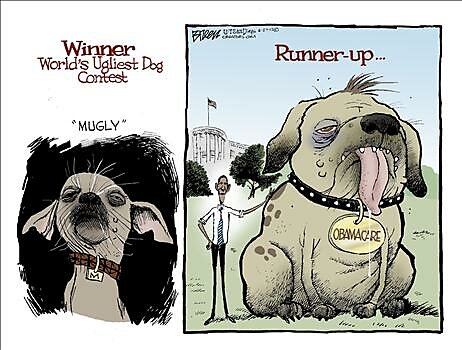
If you like that one, you can see another Breen cartoon here.
While the nation’s political reporters were waiting for this morning’s Supreme Court ruling on the Affordable Care Act, the House Intelligence Committee reportedly voted unanimously, in a closed session, to approve a five-year extension of the controversial FISA Amendments Act. As I noted earlier this week, this is moving forward despite the National Security Agency’s refusal to provide some extraordinarily basic information about the law’s implementation—such as the number of Americans whose communications have been intercepted pursuant to this sweeping authority.
One odd thing about the NSA’s claim that they are simply unable to provide such information is that it would seem to be impossible to comply with several of the FAA’s safeguard provisions without some way of tracking this information. And indeed, as I reviewed the most recent publicly available report on the intelligence community’s compliance with these procedures, I noted the following passage:
During the onsite visits to NSA, the team reviews NSA’s [REDACTED] of Section 702-acquired data to verify compliance with minimization procedures. The team reviews all serialized reports based on Section 702-acquired data that NSA identifies as containing United States person information. The results of these reviews have been documented and included as attachments to the Section 707 Report. During this review period, the team also began to take a random sample of reports not identified by NSA to ensure that NSA was accurately identifying all reports containing United States person information.
Now, to be sure, what they’re talking about here is reports and not acquisitions: From what we understand about how FISA surveillance generally works, NSA vacuums up an enormous amount of communications data, only a fraction of which ultimately is (or in practice ever could be) reviewed by human analysts to be written up, summarized, and disseminated to other agencies. But that figure is at least something, and would at least give us an inkling of how many Americans’ communications have been reviewed by NSA personnel. Moreover, the same random sampling method could surely be used to determine, at least approximately, what proportion of the not-yet-reviewed intercepts concern Americans. Again, it’s almost impossible to believe that an estimate is impossible to produce—as opposed to merely inconvenient for those who’d rather not risk rousing the public from a state of apathy about the scale of spying underway.
More generally, these reports contain a good deal of redacted statistical information that there is simply no plausible excuse for keeping secret. A table of “statistical data relating to compliance incidents,” for example, is included—but entirely blacked out. Are we to believe that the national security of the United States would be imperiled if the public knew the number of times the NSA had difficulty following the law? The reviewers conclude that the “number of compliance incidents remains small, particularly when compared with the total amount of activity”—but is there any legitimate reason for barring the public from knowing what counts as a “small” number, or just how massive the “total amount of activity” truly is? For traditional, individually targeted FISA surveillance, this kind of aggregate information must be reported by law, and is made public as a matter of course—providing citizens with one of their only warning flags when secret surveillance increases dramatically. Aren’t such numbers—whose publication clearly hasn’t done anything to injure national security—even more important when the spying is no longer constrained by any obligation to seek individualized warrants?