Today Cato Senior Fellow Nat Hentoff is 89! Happy Birthday Nat!
Check out the documentary film on his civil liberties work and writings on jazz, The Pleasures of Being Out of Step.
Here is the trailer:
Today Cato Senior Fellow Nat Hentoff is 89! Happy Birthday Nat!
Check out the documentary film on his civil liberties work and writings on jazz, The Pleasures of Being Out of Step.
Here is the trailer:

Today must be student loan day in President Obama’s “year of action” – also “year of midterm elections” – as the President announced he will expand eligibility for student loan repayment capping and forgiveness. In addition, this week the Senate is set to take up Elizabeth Warren’s (D‑MA) bill to federally refinance student loans at lower interest rates, including truly private loans.
Let’s review the folly of such seemingly well-intentioned efforts:
Someday, I hope somebody’s “year of action” will finally deal with the crippling reality of federal student aid “help.” But that will only happen if the public gets tired of sweet-sounding “solutions,” especially in years of elections.
The American citizenry is already used to our progressive friends taxing the hell out of everything they don’t like: smoking, drinking, fatty foods, etc. But now, apparently, the hyper-progressive and very cash-strapped D.C. Council is seriously considering slapping a 5.75 percent tax on health club memberships. That is riveting stuff, considering how many progressives out there are urging the unwashed masses rest of us to eat our broccoli and get on that treadmill.
The nation’s capital is, of course, a temporary home to that most progressive and fittest of couples: POTUS and FLOTUS. There is a government website with a catchy name “Let’s move.” It features many a picture of our First Lady in a variety of physical activities. What fun!
Not to be outdone, the Exerciser in Chief can take pride in “The President’s Challenge,” which is “the premier program of the President’s Council on Fitness, Sports, and Nutrition.” The President’s Challenge, its website tells us, “helps people of all ages and abilities increase their physical activity and improve their fitness through research-based information, easy-to-use tools, and friendly motivation.”
The former British Prime Minister Margaret Thatcher used to say that “the problem with socialism is that eventually you run out of other people’s money.” And so it is with the D.C. council, which in its perpetual quest for more revenue might very well end up discouraging behavior that progressives claim to want to encourage.
Welcome to Absurdistan on the Potomac!
According to the New York Times Morris Adelman, professor emeritus of economics at M.I.T. died on May 8 at the age of 96. His work, including Genie Out of the Bottle (M.I.T. Press 1995), informed the papers and articles on energy policy published by the Cato Institute over the last 30 years. A good summary of his views can be found in this article in Regulation from 2004.
His writing was refreshingly honest and is worth quoting at some length.
…conventional wisdom (there is that term again) is that Middle Eastern nations wield an “oil weapon” that they can use to punish the United States or any other nation. In support of this belief, many people point to the 1973 “oil embargo” against the United States by Arab members of OPEC (except Iraq — Saddam Hussein profited by it). Secretary of State Henry Kissinger cruised around the Middle East many times to negotiate an “end” to it. Ten years later, he explained that the significance of the “embargo” was psychological, not economic. Recently, the London Economist quoted approvingly what I said in July 1973: If an embargo was declared, it would have no effect because diversion would nullify it. And so it was.
The embargo against the United States never happened, and could not happen. The miserable, mile-long lines outside of U.S. gasoline stations resulted from domestic price controls and allocations, not from any embargo. We ought not blame the Arabs for what we did to ourselves.”
“The real moral is this: It does not matter how much oil is produced domestically and how much is imported. Presidents may declare that there is an “urgent need” to cut imports and boost “energy independence” — no one ever lost political support by seeing evil and blaming foreigners. The facts are less dramatic.
There’s an old saying that there’s no such thing as bad publicity.
That may be true if you’re in Hollywood and visibility is a key to long-run earnings.
But in the world of public policy, you don’t want to be a punching bag. And that describes my role in a book excerpt just published by Salon.
Jordan Ellenberg, a mathematics professor at the University of Wisconsin, has decided that I’m a “linear” thinker.
Here are some excerpts from the article, starting with his perception of my view on the appropriate size of government, presumably culled from this blog post.
Daniel J. Mitchell of the libertarian Cato Institute posted a blog entry with the provocative title: “Why Is Obama Trying to Make America More Like Sweden when Swedes Are Trying to Be Less Like Sweden?”

Good question! When you put it that way, it does seem pretty perverse. …Here’s what the world looks like to the Cato Institute… Don’t worry about exactly how we’re quantifying these things. The point is just this: according to the chart, the more Swedish you are, the worse off your country is. The Swedes, no fools, have figured this out and are launching their northwestward climb toward free-market prosperity.
I confess that he presents a clever and amusing caricature of my views.
My ideal world of small government and free markets would be a Libertopia, whereas total statism could be characterized as the Black Pit of Socialism.
But Ellenberg’s goal isn’t to merely describe my philosophical yearnings and policy positions. He wants to discredit my viewpoint.
So he suggests an alternative way of looking at the world.
Let me draw the same picture from the point of view of people whose economic views are closer to President Obama’s…
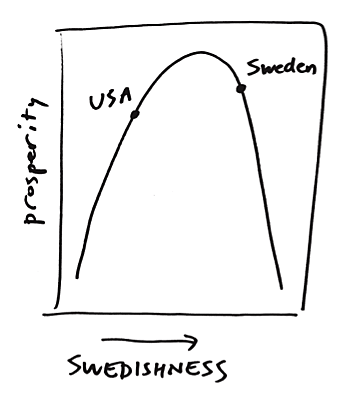
This picture gives very different advice about how Swedish we should be. Where do we find peak prosperity? At a point more Swedish than America, but less Swedish than Sweden. If this picture is right, it makes perfect sense for Obama to beef up our welfare state while the Swedes trim theirs down.
He elaborates, emphasizing the importance of nonlinear thinking.
The difference between the two pictures is the difference between linearity and nonlinearity… The Cato curve is a line; the non-Cato curve, the one with the hump in the middle, is not. …thinking nonlinearly is crucial, because not all curves are lines. A moment of reflection will tell you that the real curves of economics look like the second picture, not the first. They’re nonlinear. Mitchell’s reasoning is an example of false linearity—he’s assuming, without coming right out and saying so, that the course of prosperity is described by the line segment in the first picture, in which case Sweden stripping down its social infrastructure means we should do the same. …you know the linear picture is wrong. Some principle more complicated than “More government bad, less government good” is in effect. …Nonlinear thinking means which way you should go depends on where you already are.
Ellenberg then points out, citing the Laffer Curve, that “the folks at Cato used to understand” the importance of nonlinear analysis.
The irony is that economic conservatives like the folks at Cato used to understand this better than anybody. That second picture I drew up there? …I am not the first person to draw it. It’s called the Laffer curve, and it’s played a central role in Republican economics for almost forty years… if the government vacuums up every cent of the wage you’re paid to show up and teach school, or sell hardware, or middle-manage, why bother doing it? Over on the right edge of the graph, people don’t work at all. Or, if they work, they do so in informal economic niches where the tax collector’s hand can’t reach. The government’s revenue is zero… the curve recording the relationship between tax rate and government revenue cannot be a straight line.
So what’s the bottom line? Am I a linear buffoon, as Ellenberg suggests?
Well, it’s possible I’m a buffoon in some regards, but it’s not correct to pigeonhole me as a simple-minded linear thinker. At least not if the debate is about the proper size of government.
I make this self-serving claim for the simple reason that I’m a big proponents of the Rahn Curve, which is …drum roll please…

a nonlinear way of looking at the relationship between the size of government and economic performance. And just in case you think I’m prevaricating, here’s a depiction of the Rahn Curve that was excerpted from my video on that specific topic.
Moreover, if you click on Rahn Curve category of my blog, you’ll find about 20 posts on the topic. And if you type “Rahn Curve” in the search box, you’ll find about twice as many mentions.
So why didn’t Ellenberg notice any of this research?
Beats the heck out of me. Perhaps he made a linear assumption about a supposed lack of nonlinear thinking among libertarians.
In any event, here’s my video on the Rahn Curve so you can judge for yourself.
And if you want information on the topic, here’s a video from Canada and here’s a video from the United Kingdom.
P.S. I would argue that both the United States and Sweden are on the downward-sloping portion of the Rahn Curve, which is sort of what Ellenberg displays on his first graph. Had he been more thorough in his research, though, he would have discovered that I think growth is maximized when the public sector consumes about 10 percent of GDP.
P.P.S. Ellenberg’s second chart puts the U.S. and Sweden at the same level of prosperity. Indeed, it looks like Sweden is a bit higher. That’s certainly not what we see in the international data on living standards. Moreover, Ellenberg may want to apply some nonlinear thinking to the data showing that Swedes in America earn a lot more than Swedes still living in Sweden.
Last Friday it was reported that Uber, the transport technology company that links passengers to drivers with its smartphone app, had raised $1.2 billion in a funding round valuing it at $18.2 billion.
The valuation means that Uber is worth roughly the same as Hertz Global Holdings Inc. and Avis Budget Group Inc. combined. As The Wall Street Journalnoted, “Only Facebook Inc. in 2011 raised capital at a higher valuation from private investors — an investment from Goldman Sachs valued the social network at $50 billion—according to VentureSource data.”
The reaction to the news has been mixed. In The Guardian, James Bell, who described the valuation as a “fantasy,” wrote the following in the wake of the news of Uber’s valuation:
… when you buy a tech stock at a huge multiple – and Uber’s revenues have been (generously) estimated at around $200m a year, which makes $18bn a borderline-insane 90x valuation – you’re making a bet that its profits down the line will be vastly larger than they are today. In fact, you’re betting that they will be almost unimaginably larger.
There is absolutely no reason to believe this is true. Uber has rivals in every market it’s in – both established players fighting off the insurgents, and Uber-like rivals with similar software products. Uber and all its rivals are dueling one another for taxis – lowering fares and their percentage takes, even offering lunch or $500 bonuses to drivers.
The Wall Street Journal’s Christopher Mims has described the valuation as “nuts,” and wrote that the “moat” protecting Uber from competition is “incredibly shallow,” arguing that drivers are driven by price rather than loyalty to Uber. Mims went on to say that the market Uber works in will remain easy to enter despite any of its attempts to deal with competition:
I say ride-sharing is “frictionless” because in its price war with Lyft, both companies are forced to constantly lower prices, and riders — especially those whom the company presumes will give up their cars — are naturally price sensitive. Even if Uber uses its funds to try to crush competition such as Lyft, the Lyft model is simpler than Uber’s and built on recruiting everyday folks, not professional drivers. It isn’t hard to enter this market.
Mims also argued that even if Uber captures 50 percent of the global taxi market in five years it would still be worth less than $18.2 billion.
However, over at Vox, Matthew Yglesias correctly points out that Uber and its competitors could greatly increase the size of the market for paid rides, which seems to be what Uber CEO Travis Kalanick has in mind. In a recent interview with The Wall Street Journal Kalanick said that Uber’s vision is, “Basically make car ownership a thing of the past.”
In Forbes, Mark Rogowsky writes that Mims is wrong to treat Uber as a replacement for taxis:
So long as you look at Uber as a taxi replacement, you’ll see it as something less than it’s already becoming in its early markets: A transportation app. In San Francisco, for years the taxi commission didn’t want to issue more medallions for additional cabs because there was ostensibly no real demand for them (As of last year, the city had 1,600 taxi medallions). Yet just 4 years after Uber’s launch, there are often well over 1,000 rideshare vehicles on the road during peak times.
Rogowsky’s article highlights two important points to consider when thinking about Uber and its competitors: 1) Unsurprisingly, bodies like San Francisco’s taxi commission are evidently not very good at estimating the demand for rides, and 2) while Uber is competing with traditional taxis it would be a mistake to think of it as a taxi replacement rather than a technology company that makes it easier for passengers to find drivers, be they professional chauffeurs or car owners trying to make some extra money on the side.
What makes the huge valuation especially remarkable is that Uber and its competitors are facing numerous regulatory challenges, some of which I wrote about last week. Yet despite these challenges, investors see an opportunity in Uber. Speaking to Reuters a spokeswoman for Summit Partners, one of the investors in the funding round, said, “Uber is one of the most rapidly growing companies ever, and we believe there are opportunities for continued tremendous growth.”
I recently had the pleasure of visiting northwest Arkansas. If you have the chance, go—not only to experience the beauty of the Ozarks, but to see the world’s only Walmart convenience store. This store offers groceries, a gas station, and a counter for a local business, Bentonville Butcher & Deli. The difference between Walmart convenience stores and other convenience stores: Walmart prices (read: excitingly low). Those low prices mean that the more these stores spread, the more lives will improve.
I realize that there are ongoing arguments about whether Walmart improves or reduces people’s welfare. For instance, some argue that Walmart reduces the number of jobs in locations where they open, while others find that Walmart creates more jobs overall. Some believe that when Walmart enters a town, competitors are forced to lower worker income or close. Others claim that the benefits of lower prices may result in higher real wages, even in the retail sector. Some write that Walmart costs taxpayers huge sums as their employees receive federal support. Others insist that these programs are operating as intended: boosting employment among low income families who would otherwise be jobless.
While those issues are still debated, one thing is clear: When we have access to cheaper goods, our quality of life improves because we can buy more with the same amount of money. This is especially true for the poor who spend a higher percentage of income on household goods and food. For them, daily savings on these items are necessary for survival. Shopping at Walmart leaves them with more money, which they can use to feed their families, pay for additional tutoring for their children, or work less as they can afford more leisure time. In that way, few forces have improved the lives of Americans, particularly poor Americans, as much as Walmart.
