My review essay, forthcoming in International Finance, on Charles Calomiris and Stephen Haber’s very important book.
Cato at Liberty
Cato at Liberty

Both Jeb Bush and Rand Paul are talking about broadening the appeal of the Republican Party as they move toward presidential candidacies. Both say Republicans must be able to compete with younger voters and people of all racial backgrounds. Both have talked about the failure of welfare-state programs to eliminate urban poverty. But they don’t always agree. Bush sticks with the aggressive foreign policy that came to be associated with his brother’s presidency, while Paul wants a less interventionist approach. Bush calls for “smarter, effective government” rather than smaller government, while Paul believes that smaller government would be smarter. Perhaps most notoriously, Bush strongly endorses the Common Core educational standards, building on George W. Bush’s policy of greater federal control of schooling.
Meanwhile, Paul promises to bring in new audiences by talking about foreign policy and civil liberties. As Robert Costa reported from an Iowa rally this weekend:
Turning to civil liberties, where he has quarreled with hawkish Republicans, Paul chastised the National Security Agency for its surveillance tactics. “It’s none of their damn business what you do on your phone,” he said.
“Got to love it,” said Joey Gallagher, 22, a community organizer with stud earrings, as he nursed a honey-pilsner beer. “It’s a breath of fresh air.”
But the rest of Paul’s nascent stump speech signaled that as much as he wants to target his father’s lingering network, he is eager to be more than a long-shot ideologue.
Paul cited two liberals, Sen. Bernard Sanders (I‑Vt.) and Rep. Alan Grayson (D‑Fla.), during his Friday remarks and said he agrees with outgoing Attorney General Eric H. Holder Jr. on curbing federal property seizures and softening sentencing laws for nonviolent drug offenders — all a nod to his efforts to cast himself as a viable national candidate who can build bipartisan relationships and expand his party’s political reach.
“Putting a kid in jail for 55 years for selling marijuana is obscene,” Paul said.
Alan Grayson and Eric Holder? That’s pushing the Republican comfort zone. And what was the reception?
“Just look at who’s here,” said David Fischer, a former Iowa GOP official, as he surveyed the crowd at Paul’s gathering Friday at a Des Moines winery. “He is actually bringing women, college students and people who are not white into the Republican Party.”
That’s his plan. It’s a real departure from the unsuccessful candidacies of old, hawkish John McCain and old, stuffy Mitt Romney. It just might create the kind of excitement that Kennedy, Reagan, and Obama once brought to presidential politics. The question is whether those new audiences will show up for Republican caucuses and primaries to join the small-government Republicans likely to be Paul’s base.
Related Tags
You Ought to Have a Look is a feature from the Center for the Study of Science posted by Patrick J. Michaels and Paul C. (“Chip”) Knappenberger. While this section will feature all of the areas of interest that we are emphasizing, the prominence of the climate issue is driving a tremendous amount of web traffic. Here we post a few of the best in recent days, along with our color commentary.
—
Some folks are just slow to get it.
There is no way on God’s greening earth that international negotiators are going to achieve the emissions reductions that climate models tell them are necessary to keep the rise in the planet’s average surface temperature to less than 2°C above the pre-industrial value.
At the United Nations climate meeting held in Cancun back in 2012, after kicking around the idea for several years, negotiators foolishly adopted 2°C as the level associated with a “dangerous interference” with the climate system—what everyone agreed to try to avoid way back in 1992 under the Rio Treaty.
Bad idea—it won’t happen. Even the folks at the U.N. are starting to realize it.
According to an article in this week’s The Guardian titled “Paris Climate Summit: Missing Global Warming Target ‘Would Not Be Aailure’”:
EU climate chief and UN’s top climate official both play down expectations that international climate talk pledges will help hit 2C target… “2C is an objective,” Miguel Arias Canete, the EU climate chief, said. “If we have an ongoing process you can not say it is a failure if the mitigation commitments do not reach 2C.”
…In Brussels, meanwhile, the UN top climate official, Christiana Figueres, was similarly downplaying expectations, telling reporters the pledges made in the run-up to the Paris meeting later this year will “not get us onto the 2°C pathway”.
There’s so much backpeddling and spinning going on, that you’re motion sick reading the article. While we certainly did see this coming, we didn’t expect the admissions were going to start at this early date.
There is actually one way in which the global temperature rise may stay beneath 2°C, at least for the next century or so, even under the U.N.’s mid-range greenhouse gas emissions scenarios—that is, if the earth’s climate sensitivity is a lot lower than that currently adopted by the U.N. and characteristic of their ensemble of climate models.
Most climate negotiators and climate activists are loathe to admit this might be the case, as that would be the end of first-class travel to various hot spots to (yet again) euchre our monies.
But scientific evidence continues to mount, maybe even enough to send them to the back of the plane. Instead of the earth’s equilibrium climate sensitivity—how much the earth’s average surface temperature will ultimately rise given a doubling of the atmospheric concentration of carbon dioxide—being somewhere around 3°C (as the U.N. has determined), the latest scientific research is starting to center around a value of 2°C, with strong arguments for an even lower value (closer to 1.6°C).
If the earth’s response to greenhouse gas emissions is to warm at only one-half to two-thirds the rate negotiators currently assume, it means it is going to take longer (and require more emissions) to ultimately reach a temperature rise of 2.0°C. This buys the negotiators more time—something about which negotiators, conference organizers, and associated service industries should be ecstatic!
As an example of how much time would be bought by a lower climate sensitivity, researchers Joeri Rogelj, Malte Meinshousen, Jan Sedlacek, and Reto Knutti—whose work has been telling us all along that 2°C was basically impossible—ran their models incorporating some recent estimates of low sensitivity in place of the IPCC preferred sensitivity assessment.
What they found is available via the open access literature and worth taking a look at. Figure 1 sums it up. Using a lower climate sensitivity (pink) reduces the end-of-the-century temperature rise (left) and increases the quantity of carbon dioxide emissions before reaching various temperature thresholds (right).
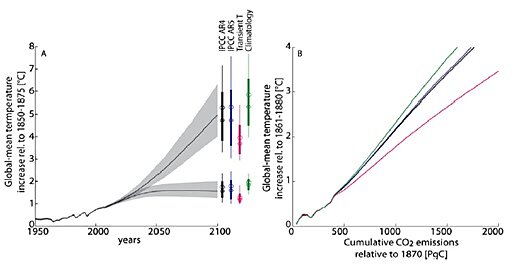
Figure 1. Temperature evolution over time (left) and in association with cumulative carbon dioxide emissions (right) from models run under different assumptions for the equilibrium climate sensitivity. The black and dark blue colors use the U.N. values; green represents a higher climate sensitivity; and pink a lower one (from Rogelj et al., 2014). Of note is a massive gaffe—which is to implicitly attribute all warming since 1861 to greenhouse gases. The fact is that the sharp warming of the early 20th century occurred before significant emissions.
This information will surely be useful in Paris this December for those countries who seek less stringent emissions reduction timetables.
And finally, it was announced this week that the homework that the U.N. handed down to each country at the end of the last year’s climate meeting in Lima is due in draft form on February 13th, which was for every nation to publish a target and timetable for reducing carbon dioxide emissions and a plan as to how that is to be achieved.
It ought to be interesting to see what grades everyone receives on their assignments.
No doubt the U.N. officials have already seen some that were handed in early, which is why they announced that they are going to be grading on a curve. What should have been “F”s (for failure to meet the 2° target) will now surely be given “A”s (for effort). As everyone knows, grade inflation is a worldwide phenomenon.
Related Tags
The Current Wisdom is a series of monthly articles in which Patrick J. Michaels and Paul C. “Chip” Knappenberger, from Cato’s Center for the Study of Science, review interesting items on global warming in the scientific literature or of a more technical nature. These items may not have received the media attention that they deserved or have been misinterpreted in the popular press.
—
Posted Wednesday in the Washington Post’s new online “Energy and Environment” section is a piece titled “No, Climate Models Aren’t Exaggerating Global Warming.” That’s a pretty “out there” headline considering all the evidence to the contrary.
We summed up much of the contrary evidence in a presentation at the annual meeting of the American Geophysical Union last December. The take-home message—that climate models were on the verge of failure (basically the opposite of the Post headline)—is self-evident in Figure 1, adapted from our presentation.

Figure 1. Comparison of observed trends (colored circles according to legend) with the climate model trends (black circles) for periods from 10 to 64 years in length. All trends end with data from the year 2014 (adapted from Michaels and Knappenberger, 2014).
The figure shows (with colored circles) the value of the trend in observed global average surface temperatures in lengths ranging from 10 to 64 years and in all cases ending in 2014 (the so-called “warmest year on record”). Also included in the figure (black circles) is the average trend in surface temperatures produced by a collection of climate models for the same intervals. For example, for the period 1951–2014 (the leftmost points in the chart, representing a trend length of 64 years) the trend in the observations is 0.11°C per decade and the average model projected trend is 0.15°C per decade. During the most recent 10-year period (2005–2014, rightmost points in the chart), the observed trend is 0.01°C per decade while the model trend is 0.21°C per decade.
Clearly, over the period during which human-caused greenhouse gases have risen the fastest (basically any period ending in 2014), climate models consistently predict that the earth’s surface temperature should have warmed much faster than it did.
Given our results (and plenty like them), we were left scratching our heads over the headline of the Post article. The article was reporting on the results of a paper that was published last week in the British journal Nature by researchers Jochem Marotzke and Piers Forster, and pretty much accepted uncritically what Marotzke and Forster concluded.
The “accepted uncritically” is critical to the article’s credibility.
Figure 2 shows the results that Marotzke and Forster got when comparing observed trends to model-predicted trends of lengths of 15 years for all periods beginning from 1900 (i.e., 1900–1914) to 1998 (1998–2012). Marotzke and Forster report that overall, the model trends only depart “randomly” from the observed trends—in other words, the model results aren’t biased.
But this claim doesn’t appear to hold water.
During the first half of the record, when greenhouse gas emissions were relatively small and had little effect on the climate, the differences between the modeled and observed temperatures seem pretty well distributed between positive and negative—a sign that natural variability was the driving force between the differences. However, starting in about 1960, the model trends show few negative departures from the observations (i.e., they rarely predict less warming than was observed). This was partially due to the model mishandling of two large volcanic eruptions (Mt. Agung in 1963 and Mt. Pinatubo in 1992), but also it is quite possibly a result of the models producing too much warming as a result of increasing greenhouse gas emissions. It seems that the models work better, over the short term (say 15 years), when they are not being forced by a changing composition of the atmosphere.

Figure 2. Comparison of observed trends (black) with the climate model average trend (red) for periods of 15 years in length during the period 1900–2012 (adapted from Marotzke and Forster, 2015).
But the models appear to do worse over long periods.
Figure 3 is also from the Marotzke and Forster paper. It shows the same thing as Figure 2, but this time for 62-year-long trends. In this case, the models show a clear and persistent inability to capture the observed warming that took place during the first half of the 20th century (the models predict less warming than was observed over all 62-year periods beginning from 1900 through 1930). Then, after closely matching the observed trend for a while, the models began to overpredict the warming beginning in about 1940 and progressively do worse up through the present. In fact, the worst model performance, in terms to predicting too much warming, occurs during the period 1951–2012 (the last period examined).

Figure 3. Comparison of observed trends (black) with the climate model average trend (red) for periods of 62 years in length during the period 1900–2012 (adapted from Marotzke and Forster, 2015).
This behavior indicates that over longer periods (say, 62 years), the models exhibit systematic errors and do not adequately explain the observed evolution of the earth’s surface temperature since the beginning of the 20th century.
At least that is how we see it.
But perhaps we are seeing it wrong.
Over at the website ClimateAudit.org, Nic Lewis (of low climate sensitivity fame) has taken a very detailed (and complicated) look at the statistical methodology used by Marotzke and Forster to arrive at their results. He does not speak in glowing terms of what he found:
“I was slightly taken aback by the paper, as I would have expected either one of the authors or a peer reviewer to have spotted the major flaws in its methodology.”
“Some statistical flaws are self evident. Marotzke’s analysis treats the 75 model runs as being independent, but they are not.”
“However, there is an even more fundamental problem with Marotzke’s methodology: its logic is circular.”
Lewis ultimately concluded:
“The paper is methodologically unsound and provides spurious results. No useful, valid inferences can be drawn from it. I believe that the authors should withdraw the paper.”
Not good.
So basically no matter how* you look at the Marotzke and Forster results—taking the results at face value or throwing them out altogether—their conclusion are not well-supported. And certainly, they are no savior for poorly performing climate models.
*No matter how, that is, except if you are looking to try to make it appear that the growing difference between climate model projections and real world-temperature change poses no threat to aggressive measures attempting to mitigate climate change.
References:
Marotzke, J., and P. Forster, 2015. “Forcing, Feedback and Internal Variability in Global Temperature Trends.” Nature, 517, 565–570, doi:10.1038/nature14117.
Michaels, P.J., and P.C. Knappenberger, 2014. “Quantifying the Lack of Consistency Between Climate Model Projections and Observations of the Evolution of the Earth’s Average Surface Temperature since the Mid-20th Century.” American Geophysical Union Fall Meeting, San Francisco, CA, Dec. 15–19, Paper A41A-3008.
Related Tags
The latest issue of The Economist has a good article about allowing American states to set their own migration policies.
Last spring, Cato published a policy analysis on this very topic by Brandon Fuller and Sean Rust, entitled “State-Based Visas: A Federalist Approach to Reforming U.S. Immigration Policy.” Cato’s policy analysis explores the legalities, economics, and practical hurdles of implementing a state-based visa system in addition to the existing federal system. Cato even had an event in March 2014 (video available) where critic Reihan Salam and supporter Shikha Dalmia explored the idea.
The Economist article lays out the case well. Canada and Australia have state- and provincial-based visa systems that complement their federal immigration policies. The results have been positive for those local jurisdictions because they have more information and incentive to produce a better visa policy than a distant federal government does. American states could similarly experiment with less restrictive migration policies, attracting workers of any or all skill types.
The economic impact of immigration is positive, so the downsides of decentralized immigration policy would be small. Most importantly, The Economist echoes a point that Fuller and Rust made in their policy analysis: these migrant workers should eventually be able to move around the country for work. An unrestricted internal labor market is positive for the American economy; a freer international labor market would be too.
Please read The Economist piece, Cato’s policy analysis, and watch Cato’s event on this topic.
At TIME I write about the rise of libertarianism, Rand Paul, and my forthcoming book (Tuesday!) The Libertarian Mind:
Tens of millions of Americans are fiscally conservative, socially tolerant, and skeptical of American military intervention.…
Whether or not Rand Paul wins the presidency, one result of his campaign will be to help those tens of millions of libertarian-leaning Americans to discover that their political attitudes have a name, which will make for a stronger and more influential political faction.
In my book The Libertarian Mind I argue that the simple, timeless principles of the American Revolution—individual liberty, limited government, and free markets—are even more important in this world of instant communication, global markets, and unprecedented access to information than Jefferson or Madison could have imagined. Libertarianism is the framework for a future of freedom, growth, and progress, and it may be on the verge of a political breakout.
Related Tags
Proponents of network neutrality regulation are cheering the announcement this week that the Federal Communications Commission will seek to reclassify Internet Service Providers as “common carriers” under Title II of the Telecommunications Act. The move would trigger broad regulatory powers over Internet providers—some of which, such as authority to impose price controls, the FCC has said it will “forbear” from asserting—in the name of “preserving the open internet.”
Two initial thoughts:
First, the scope of the move reminds us that “net neutrality” has always been somewhat nebulously defined and therefore open to mission creep. To the extent there was any consensus definition, net neutrality was originally understood as being fundamentally about how ISPs like Comcast or Verizon treat data packets being sent to users, and whether the companies deliberately configured their routers to speed up or slow down certain traffic. Other factors that might affect the speed or quality of service—such as peering and interconnection agreements between ISPs and large content providers or backbone intermediaries—were understood to be a separate issue. In other words, net neutrality was satisfied so long as Comcast was treating packets equally once they’d reached Comcast’s network. Disputes over who should bear the cost of upgrading the connections between networks—though obviously relevant to the broader question of how quickly end-users could reach different services—were another matter.
Now the FCC will also concern itself with these contracts between corporations, giving content providers a fairly large cudgel to brandish against ISPs if they’re not happy with the peering terms on offer. In practice, even a “treat all packets equally” rule was going to be more complicated than it sounds on face, because the FCC would still have to distinguish between permitted “reasonable network management practices” and impermissible “packet discrimination.” But that’s simplicity itself next to the problem of determining, on a case by case basis, when the terms of a complex interconnection contract between two large corporations are “unfair” or “unreasonable.”
Second, it remains pretty incredible to me that we’re moving toward a broad preemptive regulatory intervention before we’ve even seen what deviations from neutrality look like in practice. Nobody, myself included, wants to see the “nightmare scenario” where ISPs attempt to turn the Internet into a “walled garden” whose users can only access the sites of their ISP’s corporate partners at usable speeds, or where ISPs act to throttle businesses that might interfere with their revenue streams from (say) cable television or voice services. There are certainly hypothetical scenarios that could play out where I’d agree intervention was justified—though I’d also expect targeted interventions by agencies like the Federal Trade Commission to be the most sensible first resort in those cases.
Instead, the FCC is preparing to impose a blanket regulatory structure—including open-ended authority to police unspecified “future conduct” of which it disapproves—in the absence of any sense of what deviations from neutrality might look like in practice. Are there models that might allow broadband to be cheaper or more fairly priced for users—where, let’s say, you buy a medium-speed package for most traffic, but Netflix pays to have high-definition movies streamed to their subscribers at a higher speed? I don’t know, but it would be interesting to find out. Instead, users who want any of their traffic delivered at the highest speed will have to continue paying for all their traffic to be delivered at that speed, whether they need it or not. The extreme version of this is the controversy over “zero-rating” in the developing world, where the Orthodox Neutralite position is that it’s better for those who can’t afford mobile Internet access to go without rather than let companies like Facebook and Wikipedia provide poor people with subsidized free access to their sites.
The deep irony here is that “permissionless innovation” has been one of the clarion calls of proponents of neutrality regulation. The idea is that companies at the “edge” of the network introducing new services should be able to launch them without having to negotiate with every ISP in order to get their traffic carried at an acceptable speed. Users like that principle too; it’s why services like CompuServe and AOL ultimately had to abandon a “walled garden” model that gave customers access only to a select set of curated services.
But there’s another kind of permissionless innovation that the FCC’s decision is designed to preclude: innovation in business models and routing policies. As Neutralites love to point out, the neutral or “end-to-end” model has served the Internet pretty well over the past two decades. But is the model that worked for moving static, text-heavy webpages over phone lines also the optimal model for streaming video wirelessly to mobile devices? Are we sure it’s the best possible model, not just now but for all time? Are there different ways of routing traffic, or of dividing up the cost of moving packets from content providers, that might lower costs or improve quality of service? Again, I’m not certain—but I am certain we’re unlikely to find out if providers don’t get to run the experiment. It seems to me that the only reason not to want to find out is the fear that some consumers will like the results of at least some of these experiments, making it politically more difficult to entrench the sacred principle of neutrality in law. After all, you’d think that if provider deviations from neutrality in the future prove uniformly and manifestly bad for consumers or for innovation, it will only be easier to make the case for regulation.
As I argued a few years back, common carrier regimes might make sense when you’re fairly certain there’s more inertia in your infrastructure than in your regulatory structure. Networks of highways and water pipes change slowly, and it’s a good bet that a sound rule today will be a sound rule in a few years. The costs imposed by lag in the regulatory regime aren’t outrageously high, because even if someone came up with a better or cheaper way to get water to people’s homes, reengineering physical networks of pipes is going to be a pretty slow process. But wireless broadband is not a network of pipes, or even a series of tubes. Unless we’re absolutely certain we already know the best way to price and route data packets—both through fiber and over the air—there is something perverse about a regulatory approach that precludes experimentation in the name of “innovation.”