So says the Kaiser Family Foundation.
Support dropped among independents too (not as much, but still more than the margin of error).
So says the Kaiser Family Foundation.
Support dropped among independents too (not as much, but still more than the margin of error).
When I first read this story in the Washington Post about supposedly under-appreciated federal bureaucrats, I was tempted to focus on the sentence referring to “the sledgehammer of budget cuts scheduled to hit today.” Below is the Congressional Budget Office’s depiction of this “sledgehammer.” Does the Washington Post really think that a 1.2 percent reduction in overall spending for the current fiscal year (which means the federal budget would still be larger than it was last year) represents a “sledgehammer of budget cuts”?
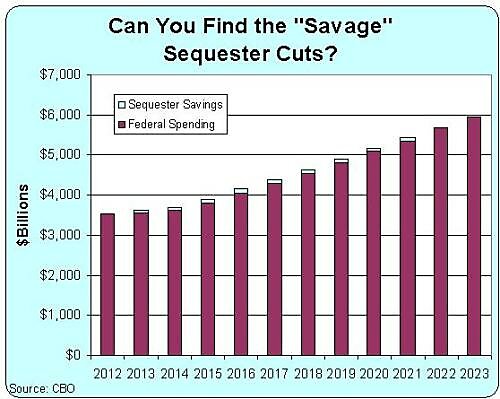
But I just mocked the New York Times last week for its reporting about supposed “deep spending cuts” and I also nailed the Washington Post back in 2011 for using the term “slash” for a budget plan that would have shaved a miniscule $6 billion from a budget of $3,800 billion. So instead I want to focus on the part of the story featuring self-pitying remarks of federal bureaucrats.
Here’s a good sampling:
[F]ederal workers in [the government-employee-heavy Fairfax County neighborhood of] Mantua say … having “United States Treasury” atop their paycheck [now] means having to defend yourself against arguments, from strangers and even from your own relatives, that you’re an overpaid and underworked leech.
…[M]any federal workers are … bothered by the growing sense that the careers they chose may now seem unattractive, even unworthy. …[O]n a recent visit to Missouri, [one worker] got fed up with ritual denunciations of federal workers…
[Another worker named Raymond] Won, a federal worker for 31 years, resents the notion, now commonplace on talk radio and Web sites devoted to bashing the government, that federal workers carry a lighter load than their for-profit counterparts.
…[O]lder government workers … are concerned about their pensions but even more anxious about why politicians are so willing to make federal employees the target of popular rage.
Excuse me while I wipe away the tears and compose myself. There are so many stories of unbearable hardship:
Perhaps we can create a new congressional medal to give to the bureaucrat who suffers the most because of the “sledgehammer” cuts and those mean people on “web sites.”
Indeed, I think we have our first recipient. But brace yourself before you read this passage—the anguish and suffering may haunt you for the rest of your life. This bureaucrat, who is enduring unimaginable hardship
has already cut back in anticipation of the forthcoming budget slashing: He told a carpenter who was going to build bookshelves in the living room that the $5,000 job will have to be put off, and he told his doggie day care provider that he’ll have to go without that service when the furloughs kick in.
Oh my God! Not only are we failing to appreciate government bureaucrats, but the “budget slashing” will lead to neglected pets as well. What sort of cruel and heartless society have we become?!?
And imagine the Keynesian death spiral that will occur when the carpenter and dog walker then have to cut back on their purchases? Maybe we need to take Bastiat’s advice and go break some windows!
To make matters worse, there are mean-spirited people such as Chris Edwards at places like the Cato Institute who have the nerve to point out that federal bureaucrats get about twice the overall level of compensation as workers in the productive sector of the economy.
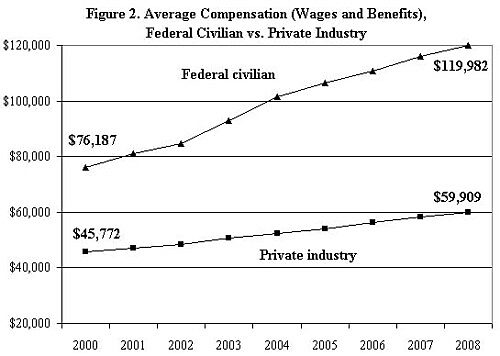
How can Edwards sleep at night after making such an invidious comparison?
But there’s another cad at the Cato Institute who actually had the nerve to narrate the video below, which unfairly uses facts and data to show that the federal workforce is over-compensated. Worst of all, he actually suggests at the end of the video that the real problem is that the federal government is far too large. What sort of place would employ such unreasonable folks?
Four years ago, I wrote in the Wall Street Journal about a courageous United Nations whistleblower named Georges Tadonki. In 2008, Tadonki correctly predicted an outbreak of cholera in Zimbabwe. The epidemic, which killed 4,000 people, and an annual hyperinflation of 90 sextillion percent, were the results of Robert Mugabe’s drive to nationalize Zimbabwe’s commercial farms. Unfortunately, the UN bureaucracy, which was much more interested in appeasing Mugabe than helping his long-suffering people, threatened to fire Tadonki because of the revelation.
Congratulations to Bob Amsterdam, a friend of Cato and a human rights lawyer who defended, among others, Mikhail Khodorkovsky in Russia, for his recent win of Tadonki’s case before a UN tribunal.
Enshrined in the U.S. Constitution and an integral element of democratic self-governance generally is the fundamental right of all people to be treated equally by their government—to receive “equality under the law” in both procedure and substance. Yet at least one important federal law, with cascading effects on many others, denies that equal protection on the basis of sexual orientation: The Defense of Marriage Act, signed into law by President Clinton in 1996, contains a provision, Section 3, that defines “marriage” in all federal statutes as a legal union between one man and one woman.
This definitional detail affects more than 1000 federal provisions, from tax returns and veterans’ benefits, to Social Security and health care, to housing and immigration. That is, federal law views lawfully married same-sex couples (who were married in one of the states or countries that recognizes these unions) differently from lawfully married opposite-sex couples.
Aside from treating individuals adversely on the basis of their sexual orientation, Section 3 also imposes discriminatory costs on all sorts of private employers and contractors, due to the complex operation of federal employee benefits law—to give just one example of DOMA’s reach.
Another example comes in tax law: Edith Windsor, the plaintiff in a case against DOMA that will soon be heard by the U.S. Supreme Court, had been in a loving, committed relationship with Thea Spyer for 42 years when they legally married in Canada in 2007. When Spyer passed away in 2009, Windsor not only had to deal with the grief of losing her partner, but was forced to pay federal estate taxes totaling $363,053 because Section 3 prevents the IRS from recognizing Windsor as a surviving spouse. When Windsor sued to get her money back, two lower federal courts found Section 3 unconstitutional and ordered the requested tax refund.
The Second Circuit Court of Appeals (based in New York) held that a law targeting gays and lesbians is subject to heightened scrutiny as wrongful discrimination, which Section 3 cannot survive. The case is now before the Supreme Court—through a complicated procedural maneuver because the federal government stopped defending DOMA in the courts—and Cato has joined the Constitutional Accountability Center on a brief that focuses on the Fifth Amendment’s equal protection guarantee (part of the liberty protected by that amendment’s Due Process Clause).
The principle of “equal protection” requires the federal government to treat all similarly situated persons alike and prohibits it from drawing distinctions between individuals based solely on differences that are irrelevant to legitimate governmental objectives. Under any standard of review, DOMA’s sweeping discrimination contravenes this constitutional guarantee, which the Supreme Court has consistently ruled to secure equality under the law and forbid invidious discrimination.
The Fifth Amendment forbids the federal government from enacting laws arbitrarily singling out a class of individuals for disfavored legal status. The government thus cannot discriminate among individuals who are lawfully married on the basis of their sexual orientation.
DOMA was born out of animosity toward homosexuals and does nothing to further the supposed objectives regarding marriage put forward by the government. We urge the Supreme Court to invalidate Section 3 as an affront to the Constitution’s guarantee of equality under the law and inconsistent with the rights and freedoms extending to all who live in the United States.
The Court will hear argument in United States v. Windsor on March 27, the day after it hears Hollingsworth v. Perry, about which I wrote yesterday.
Yesterday, WaPo’s Valerie Strauss accused scholarship tax credit (STC) programs of operating as Reverse Robin Hoods, robbing from the poor to give to the rich.
Call it welfare for the rich. Why? Wealthy businesses and individuals are the folks who get the tax credits for putting up the cash to pay the tuition. Furthermore, the amount of money for tuition made available for tuition by private scholarship organizations often does not actually cover the full cost of attending a private school. Poor families can’t make up the difference. Guess who can.
The reality is almost exactly the opposite. Donors are not benefitting financially at the expense of the poor or anyone. And while it is true that tax-credit scholarships do not always cover the full cost of tuition at private schools, thanks to low-cost options and needs-based tuition breaks, low-income families are the primary beneficiaries of STC programs.
STC Donors Do Not Benefit Financially
It is odd to claim that “wealthy businesses” are financially benefitting by receiving a tax credit for their donations. Even a 100% tax credit means that they are simply no worse off than before. A corporation with a $10,000 tax liability that made a $10,000 donation to a scholarship organization would then owe no state taxes but it would still have $10,000 less than it did before. Whether the $10,000 went to the government or a nonprofit is irrelevant to its bottom line.
Moreover, Strauss fails to mention that most state STC programs do not grant 100% credits. In fact, only four of the fourteen STC programs do. The other credits range from 50% to 90%. In these states, corporations would be better off financially if they merely paid their taxes.
STC Programs Benefit Low-Income Students
It is telling that Strauss provides only one example to support her claim that rich people benefit from the scholarships instead of the poor: “[Pennsylvania families] eligible to receive money to pay private tuition can earn more than $72,000…”
The key words in that sentence are “can earn.” The relevant question is how much do the families of scholarship recipients actually earn. The nonpartisan Pennsylvania Legislative Budget and Finance Committee reported in 2010 that the average scholarship recipient’s family earned only $29,000 annually, less than half of what the program allowed at the time.
The available evidence shows that Pennsylvania is not unique. Scholarship recipients in Florida must earn less than 185% of the federal poverty line, which is the income threshold for the federal government’s free and reduced lunch program. Nevertheless, the average annual household income of Floridian scholarship recipients is only $24,250, just 12.3% above the federal poverty line. And though Arizona’s corporate STC program has no means-testing requirement, a 2011 study found that more than two-thirds of scholarship recipients earned less than 185% of the federal poverty line.
There is clear evidence that students benefit by participating in educational choice programs. Numerous randomized-controlled studies have demonstrated that students in choice programs exhibit higher academic performance while additional studies have found higher graduation rates, increased college enrollment, and increased civic-mindedness.
Conclusion
It should be noted that in addition to Strauss’ central arguments, her broadside contained numerous significant inaccuracies. Contrary to Strauss’ assertions, scholarship tax credit programs are not the same as vouchers. They differ greatly in terms of their funding mechanisms and administration. Moreover, the U.S. Supreme Court has ruled that STC programs use private money not public money. Every state supreme court to address the matter has agreed. Finally, well-designed STC programs such as those in Arizona, Florida, and Pennsylvania actually save states money by decreasing state expenditures more than they decrease state tax revenue.
Under the status quo, wealthy families already have school choice while low-income families do not. Wealthy families can afford to live in districts with high-performing government schools or send their children to private schools. By contrast, low-income families generally only have one choice: the local assigned government school.
The good news is that scholarship tax credit programs work as intended. As the Washington Post editorial board understands, STC programs expand educational opportunities for low-income families, empowering them to meet the individual needs of their children.
This week, the Supreme Court considered whether collecting DNA from an arrestee was an unreasonable Fourth Amendment search.
Or at least that would have been a good way for the Court to frame the question.
Instead, much of the oral argument in Maryland v. King dealt with the question whether swabbing the cheek of an arrestee to take a DNA sample upsets one’s reasonable expectations of privacy. The “reasonable expectation of privacy” test is doctrine that arose from Justice Harlan’s concurrence in Katz v. United States. The test asks whether a person claiming the Fourth Amendment’s protections had a subjective expectation of privacy and whether it is “one that society is prepared to recognize as ‘reasonable.’ ”
The government’s case rests on that framing, which is why Deputy Solicitor General Michael Dreeben began his argument by saying that arrestees are “on the gateway into the criminal justice system. They are no longer like free citizens who are wandering around on the streets retaining full impact Fourth Amendment rights. The arrest itself substantially reduces the individual’s expectation of privacy.”
It’s true that an arrestee has his privacy and other liberties invaded various ways. What problem is it if a bit of DNA is collected at the same time? It’s pretty much like finger printing, the argument goes…
The “reasonable expectation” test is almost never faithfully followed by courts. My guess is that the Court will not assess whether King himself actually expected “privacy.” That would encompass everything from believing that none of his mucus membranes would be collected by a government agent, to believing that his genetic material would neither be analyzed nor preserved in a Maryland lab for further analysis somewhere in an uncertain future.
When it applies the objective part of the test, there is a chance, but I’ll be surprised if any justice actually examines the difference in experience between fingerprinting and DNA collection, such as by comparing the slim privacy invasion when one person touches another’s hands to the real invasion that occurs when a person puts something in another person’s mouth. Doing so in its exercise of free-form interest balancing could, but probably wouldn’t, overcome the government’s interest in using “the fingerprinting of the 21st Century” to catch crooks.
Rather than using doctrine and making policy judgments, the Court should assess the government’s actions as the Fourth Amendment commands. The law does not invite the Court to examinine what people may or may not think about “privacy.” It bars the government from committing unreasonable searches and seizures.
If one examines the case guided by the words of the Fourth Amendment, what happened is far more clear. Taking a bodily specimen from Alonzo King was, in natural language, a seizure. Processing that specimen to create an identity profile was a further examination, bringing otherwise concealed information into law enforcement’s view. And comparing King’s identity profile to cold-case profiles was incontrovertibly looking for something. This is all searching using that seized bodily material.
Now, was the search reasonable?
Having been picked up on a variety of assault charges, King’s mouth was swabbed and his DNA taken, processed, and used to investigate whether genetic material matching his was associated with any other cases. It’s the equivalent of taking keys on the person of an arrestee and looking through his house for evidence of other crimes. There was no relationship between King’s alleged wrongdoing and the investigation conducted using his DNA.
Perhaps it is reasonable to conduct a free-form search into the biography of a person who has been arrested–that is, a person about which a law enforcement officer says he has probable cause to arrest–but it is unlikely. The Fourth Amendment’s particularity requirement suggests that it is unreasonable to investigate a person arrested for one crime to see what other, unrelated crimes he may have committed.
Counsel for the State of Maryland rested her argument heavily on the use of information about other crimes in bail decisions. This falls apart under the same logic, unless the Court is going to produce a rule that the Fourth Amendment allows the government carte blanche to search and seize when a bail hearing is pending. And the DNA results came back months after Alonzo King’s arraignment.
Global Science Report is a weekly feature from the Center for the Study of Science, where we highlight one or two important new items in the scientific literature or the popular media. For broader and more technical perspectives, consult our monthly “Current Wisdom.”
Today’s global media are ablaze with coverage of newly reported scientific findings purporting to show that anthropogenic global warming is leading to more extreme weather events such as heat waves, forest fires, and floods.
The findings are being made available in the early releases section of the Proceedings of the National Academy of Sciences (PNAS) and represent the work of a group of researchers from the Potsdam Institute for Climate Impact Research (PIK)—an institute which can be routinely counted on to produce rather alarming climate change studies. The new analysis, led by Vladimir Petoukhov, is no exception.
The researchers examined the trends in the daily patterns of air flow in the lower atmosphere and found that some patterns had become more persistent with time—a characteristic that leads to a slowdown in the forward motion of weather systems. Or as the researchers put it in their press release, “What we found is that during several recent extreme weather events these planetary waves almost freeze in their tracks for weeks.” To make sure you understand the implications, they added “Since many ecosystems and cities are not adapted to this, prolonged hot periods can result in a high death toll, forest fires, and dramatic harvest losses.”
While climate alarm plays well in the media, what doesn’t play so well is climate-as-normal.
Case and point: there are zero media stories about a similarly timed study purporting to show that any anthropogenic global warming influence on extreme weather events is too small to be reliably detected.
This study, available in the early-release section of the journal Geophysical Research Letters, was performed by the research team of James Screen and Ian Simmonds of the University of Melbourne. Screen and Simmons examined the trends in the daily patterns of air flow in the lower atmosphere and found little significant change. They note that “the changes in meridional amplitude over recent decades are relatively small compared to the year-to-year variability” and “that possible connections between [anthropogenic global warming] and planetary waves, and the implications of these, are sensitive to how waves are conceptualized.” They cautiously conclude that “[t]he contrasting meridional and zonal amplitude trends have different and complex possible implications for midlatitude weather, and we encourage further work to better understand these.”
[Layman’s translation: There are few significant changes in north-to-south extent of jet stream troughs or their forward speed. The data are so noisy that results are highly dependent upon what analytical method is chosen. The contrasting north-south and east-west changes in jet stream troughs have multiple influences that we haven’t sorted out yet, but it would be foolish to tie them to global warming at this time.]
So there are two different research teams studying the same issue; one screams that global warming is killing us, while the notes that the situation is complicated and requires additional study, and that it is difficult to relate any observed changes to global warming.
Such an example provides a perfect picture of how the media influences public opinion about science.
A large number of people will be exposed to the news that scientists are reporting that global warming is leading to more severe weather. This will be the majority opinion, as few folks are inclined to dig deeper than a sound byte or a single paragraph.
Virtually no one will be exposed to the scientific finding that the influence of global warming on severe weather is largely lost in the noise of the complex influences of a number of other factors.
And so the story of global warming science in the public eye grows asymmetrically, with alarming evidence receiving far more exposure than evidence for more modest changes and impacts, or, situation-as-normal findings.
We’re not blaming the media. While they have a clearly demonstrable bias, that’s just a convenient assist to their prime motivation: selling more ad space. The end-of-the-world-as-we-know-it always sells better than business-as-usual.
Where the science really needs to gets sorted out and fairly considered is in the summary “science assessment” reports that form the basis for policy (or lack thereof). Consider the document “Global Climate Change Impacts in the United States,” published by the U.S. Global Change Research Program (you can find it here).
As our work at the Cato Institute’s Center for the Study of Science plainly reveals, the representativeness of the science included in many government assessment reports is no better than it is in the popular media (you can find our companion report to the above-mentioned government report here).
Alarm not only sells papers, but also amps up the regulatory state.
References:
Petoukhov, V., et al., 2013. Quasi-resonant amplification of planetary waves and recent Northern Hemisphere weather extremes. Proceedings of the National Academy of Sciences (Early Edition), doi:10.1073/pnas.1222000110
Screen, J.A., and I. Simmonds, 2013. Exploring the links between Arctic amplification and mid-latitude weather. Geophysical Research Letters, in press, doi: 10.1002/GRL.50174