Cato scholars pose a few suggested questions ahead of tonight’s final debate between Hillary Clinton and Donald Trump. Enjoy.
Cato at Liberty
Cato at Liberty
Government and Politics
(This post is an ad for the upcoming debate: Should Libertarians Vote? It’s sure to rock the world of liberty. Sign up at the link.)
The first and second parts of my “Economics Will Be Our Ruination” series highlighted how putatively neutral economic analysis often subtly embeds non-neutral values. Economists tend to prefer human activity that’s measurable using dollars over non-monetary trade or leisure, for example. An economic model of the Fourth Amendment can easily place group interests ahead of individual rights. In this installment I’ll highlight weaknesses in the practice of economic modeling, using the example of voting.
Creating a theoretical construct to depict common transactions or interactions, then assessing such activity as abstracted, is essential to economics. But it is also a profound weakness of that form of analysis, because failing to model accurately will send one’s economic assessment off the rails.
An example of this is economic assessment of voting. Many economists, both professional and amateur, are ineluctably drawn to modeling voting as a process solely for selecting the officials that will serve in a representative government. Given the exceedingly low likelihood that one person’s vote will sway the outcome, the time and effort spent on voting is pure waste. So economists conclude that voting is irrational.
That model of voting is hugely over-simplified, omitting even down-ballot electoral and initiative races, which somewhat increase the still-small odds of casting a decisive vote. But what the model really fails to account for is the effect that margins of victory have on the many, many political and social actors that will consume vote information after election day. As I wrote a few months ago in a piece called Don’t Not Vote, “Votes are a dazzling roman candle of information supplied to elected officials, their staffs, political parties, journalists, opinion leaders, and future candidates, to name a few. All these witnesses to elections incorporate vote information—not just outcome, but win/loss margins—into their actions and assessments well beyond election and inauguration day.”
Michael Cannon agrees, adding that the custom of voting signals solidarity and commonality of purpose with your neighbors. If you want to have influence with them, “you obey the local customs.”
The upshot of over-simplified economic modeling of the vote is that it causes libertarian economists and economic thinkers to undercut the adoption of libertarian ideas. If libertarians don’t vote their preferences, their relevance is underweighted by all the election observers noted above, and on top of that they alienate themselves from nearby persuadable audiences, remaining odd political and social separatists instead. Thinking different is fun, but if you want to live in a more libertarian society, you might want to go out and vote.
It’s not economists that will be arguing the wrong side of the voting question at our upcoming debate on the topic. It will be philosophers Aaron Ross Powell and Trevor Burrus concocting delightfully amusing but still wrong, ivory-tower reasons why voting is a waste or even a harmful practice. And if present practice is any indication, some debaters are going to be throwing some shade! It should be a good time, followed by adult beverages to “pre-mourn the outcomes of the forthcoming election.” Register now!
Related Tags
When the Framers designed our federalist system, they assumed that the federal government would be limited to those powers actually enumerated in the Constitution and that it would exercise those powers only when authorized by statute. Further, to give the states some say in the drafting of these statutes, one half of the federal Congress—the Senate—was elected by the state legislatures themselves and designed to reflect the interests of the state governments.
Today, none of these elements of our original design remain. The Supreme Court has allowed the federal government to control nearly limitless activities, supposedly as an exercise of its power to regulate interstate commerce. The executive branch acts as its own de facto legislative branch, “interpreting” statutes through executive actions and agency rulemaking to unilaterally give itself the powers it wishes to exercise. And after the passage of the Seventeenth Amendment, senators are now elected by popular vote, meaning there is no longer any direct link between the state and federal governments. The result of these three changes is that states have less power than ever — and there’s not much they can do about it.
To solve that problem, Representatives Rob Bishop (R‑UT) and Cathy McMorris Rodgers (R‑WA) recently introduced the “Re-Empowerment of the States Amendment,” a proposal that would allow two thirds of the state legislatures to repeal any “Presidential Executive order, rule, regulation, other regulatory action, or administrative ruling issued by a department, agency, or instrumentality of the United States.”
Importantly, this amendment would not allow states to repeal the text of statutes that have duly passed both houses of Congress. This isn’t an amendment to change the system of bicameralism that the Framers designed; instead, it’s an amendment to restore the checks on the executive branch that existed before the massive expansion of the administrative state. As the amendment’s creator David Hemingway has explained, “The practical result would be to enhance the power of Congress since it would encourage the president to work with Congress rather than govern by issuing executive orders.”
Why are the states in the best position to check executive power? First, state legislators don’t have the same conflict of interest as members of the federal Congress. The House and Senate could—in theory—overrule any executive order by passing a statute with a veto-proof two-thirds majority. But in practice, they almost never do so. Members of Congress know that overruling an executive order will anger the same president they need to sign the bills that they want to pass, and so even the orders they privately oppose will usually go unchallenged.
Second, the states have the most to gain by limiting the federal government to its constitutionally designed role, and will thus be more active in policing it. As the Tenth Amendment made explicit, those powers not given to the federal government “are reserved to the States.” The Framers knew that most issues are best handled at the state level, and executive orders are often the worst culprits in usurping that original delegation. Giving the states a veto power over these agency rules simply allows them to say: “Either pass this law through Congress, or let the states handle the issue ourselves, as we did for most of our nation’s history.”
Creative amendment proposals like this one should be encouraged. (Another intriguing amendment, conceived by Mr. Hemingway’s colleague Gary Hansen, would aid this creative process by allowing states to draft and propose their own constitutional amendments without waiting for Congress to call an Article V convention). These days, it’s not that common for 34 states to agree on much of anything. But when 34 states can agree that the executive branch has gone too far, they should be able to do something about it.
Back in 2003 the psychiatrist and columnist Charles Krauthammer declared a new psychiatric syndrome, “Bush Derangement Syndrome: the acute onset of paranoia in otherwise normal people in reaction to the policies, the presidency — nay — the very existence of George W. Bush.” He had a point. But derangement can be generated by support as well as opposition for a political figure.
What do we say about conservatives — people who believe, variously, in limited government, free markets, Judeo-Christian values, and the importance of character in public life — who have been forced to utter absurdities in defense of Donald Trump? It’s one thing to say that Hillary Clinton and her Supreme Court justices and her 4,000 bureaucrats are on net worse than Trump and whatever menagerie he brings to the White House. But when free-market conservatives find themselves enthusiastically defending the most protectionist presidential candidate since Pat Buchanan, or Christian conservatives are forced to say that personal character isn’t really a big issue for them, I fear that derangement has set in. Take just a few examples in the past few days.
In Thursday’s Wall Street Journal Karl Rove writes that Trump needs “a Republican House to pass his agenda.” But his agenda is trade war, deportation, and banning adherents of the Muslim faith from entering the United States. Is that an agenda a Republican House would pass? Say it ain’t so, Karl (or Paul).
Also in Thursday’s Journal the Christian author Eric Metaxas writes that “God will not hold us guiltless” if we fail to vote for Trump. Metaxas oddly cites Dietrich Bonhoeffer as a Christian who also had to make a difficult moral choice: He joined a plot to kill Hitler. Is that really something Metaxas thinks God would consider wrong? As for voting for Trump despite his moral flaws, Metaxas tells us that God will ask “What did you do to the least of these?” I wonder where that leads: Perhaps “the least of these” are the Mexican and Chinese workers whose jobs Trump wants to destroy, the Hispanic immigrants he wants to deport, separating them from their U.S.-born children, the low-income Americans who will find it harder to afford T‑shirts, sneakers, and smartphones, or the refugees fleeing war and devastation whom he would bar from the United States on the basis of their faith.
And then there’s Ben Carson, who delivered himself of these thoughts at a college in Missouri:
Ben Carson urged a conservative audience to be strong in their faith and stand by their beliefs in the face of “ever-growing government.”
Tyranny will reign otherwise, “and there will be mass killings once again,” Carson told a crowd Friday. “The peace that we experience now will be a memory only. This is the nation that stands between peace and utter chaos.”
Asked at a press conference how he thought such a grim future might come about, Carson referenced “the whole gay marriage issue.”
“Why must they change it?” Carson said, referring to efforts to recognize civil unions as equal to traditional marriage. “I believe the reason is, if you can change the word of God in one area, then you can change it in every area. It’s the camel’s nose under the tent, and it will just be an avalanche of one thing after the other.”
Maybe that’s not exactly Trump Derangement, just general derangement. But Carson was the second former opponent to endorse Trump, and he’s become an enthusiastic surrogate.
Finally, I note the comments of Rush Limbaugh this week. Limbaugh is often funny and sometimes has real insights lurking in his monologues. But the attempt to defend both conservatism and Trump for three hours a day seems to be getting to him. In particular, a guy who soared to the top of the talk radio business by attacking Bill Clinton and his “bimbo eruptions” now finds himself compelled to defend confessions of sexual assault. He fell into the abyss Wednesday with this meditation:
You know what the magic word, the only thing that matters in American sexual mores today is? One thing. You can do anything, the left will promote and understand and tolerate anything, as long as there is one element. Do you know what it is? Consent. If there is consent on both or all three or all four, however many are involved in the sex act, it’s perfectly fine. Whatever it is. But if the left ever senses and smells that there’s no consent in part of the equation then here come the rape police. But consent is the magic key to the left.
This is just sad. A conservative, a defender of traditional moral values, denouncing the idea that consent is required for sexual activity. This is what rank partisanship, red team/blue team mentality, and a failure to recognize when your party has taken a wrong turn leads to.
None of this should be construed as an endorsement of Hillary Clinton. I’ve been denouncing her statism since the 1990s. But I hope, for the sake of my conservative friends, that the Wall Street Journal was wrong when it wrote early in the Clinton years, “the personal virtue known as self-restraint was devalued. In the process, certain rules that for a long time had governed behavior also became devalued,” and thus there were going to be a lot of casualties. Because a lot of conservatives seem to be hurtling over the guardrails and defining deviancy down in their determination to justify anything — anything — the Republican nominee for president says or does.
Related Tags
Donald Trump always sounded just like a Bernie Sanders Democrat when talking about international trade. “We have one issue that’s very similar,” he said, “and that’s trade.” That Trump-Sanders hostility to trade liberalization, in turn, is identical to that of the AFL-CIO and the Economic Policy Institute, a leftist think tank created and largely financed by labor unions.
It should be no surprise that Donald Trump’s most influential adviser and spokesman on international trade, Peter Navarro, is a former unsuccessful Democrat politician who seems closer to an old-style Bernie Sanders leftist Democrat than to a Bill Clinton “New Democrat.”
The only academic among Trump 13 economic advisers, Navarro returned to being an economics professor at U.C. Irvine, after losing San Diego mayoral election to Republican Susan Golding. In 1993 Navarro wrote the book, Bill Clinton’s Agenda for America.
With one caveat, the book was full of glowing praise for everything Clinton promised to do – notably lots more federal spending (which, ironically, fell substantially).
Navarro’s doubts about Clinton concerned NAFTA, which Bush created but Clinton promised to change. “I thought the NAFTA agreement ought to have been more properly called ‘SHAFTA,’” says Navarro. But he notes that “candidate Clinton later acknowledged the problems of the environment and lost jobs raised by NAFTA, and called for wage safeguards and stricter environmental regulations. It remains to be seen whether this was merely rhetoric, or a serious concern that will have policy follow-through.”
Putting NAFTA aside, giving Clinton the benefit of doubt, Navarro concluded, “if Clinton and Gore carry through with their agenda … we will become more globally competitive, our educational system will improve, better protection will emerge for our environment, our cities will be rebuilt, and, most important of all, hundreds of thousands of jobs will be created.”
Navarro dismissed Reagan’s seven years of 4.4% annual GDP growth as “The Failure of Reaganomics” and the “Trickle Down Rip-Off.” He thought Reagan spent far too much on Defense. Maybe so, but that helped dissolve the USSR which later made it easy for President Clinton to spend much less.
Navarro was almost as fearful of Japanese industrial dominance in 1993 as he now is of China. For some reason (perhaps the United Auto Workers), he even worried Japan would “locate many of their plants within U.S. borders to avoid the certain protectionism they saw coming.”
The way to beat such winners, he argued, was for the U.S. to become more protectionist and dirigiste. “Countries like Japan, Germany, France and Taiwan have very sophisticated industrial policies,” wrote Navarro, while “Reagan and Bush Administrations… [were] clinging to a free-trade philosophy.” Without a protectionist industrial policy and generous grants and subsidies the U.S. couldn’t possibly compete, since “Japan and Germany were devoting over 10 times what the U.S. was spending on public infrastructure and new technologies.”
“The essence of a national industrial policy,” Navarro explained, “is a full partnership between government and business… [T]he role of government is to help a nation’s businesses compete by providing technological assistance, subsidies and protectionist measure such as tariffs and quotas.” In other words, Crony Capitalism — an open invitation to mass corruption.
Industrial policy advocate Peter Navarro may now seem a peculiar choice to advise a Republican presidential contender, but such peculiarity is not unprecedented.
John McCain’s adviser was the loyal Democrat, Mark Zandi. He’s the so-called “independent expert” mentioned by Hillary Clinton in the first debate, and he’s the loyal hyper-Keynesian Democrat who predicted wondrous results from Obama’s “stimulus” scheme. Zandi is also the nameless “leading private forecasting firm” who’s most responsible for the Obama team’s infamously wrong Romer-Bernstein forecast of January 2009.
McCain didn’t do so well by turning to a Democrat ideologue for economic advice. That lesson was apparently lost on Mr. Trump.
One of the most remarkable developments in the world of fiscal policy is that even left-leaning international bureaucracies are beginning to embrace spending caps as the only effective and successful rule for fiscal policy.
The International Monetary Fund is infamous because senior officials relentlessly advocate for tax hikes,

but the professional economists at the organization have concluded in two separate studies (see here and here) that expenditure limits produce good results.
Likewise, the political appointees at the Organization for Economic Cooperation and Development generally push a pro-tax increase agenda, but professional economists at the Paris-based bureaucracy also have produced studies (see here and here) showing that spending caps are the only approach that leads to good results.
Heck, even the European Central Bank has jumped into the issue with a study that reaches the same conclusion.
This doesn’t mean balanced budget requirements are bad, by the way, but the evidence shows that they aren’t very effective since they allow lots of spending when the economy is expanding (and thus generating tax revenue). But when the economy goes into recession (causing a drop in tax revenue), politicians impose tax hikes in hopes of propping up their previous spending commitments.
With a spending cap, by contrast, fiscal policy is very stable. Politicians know from one year to the next that they can increase spending by some modest amount. They don’t like the fact that they can’t approve big spending increases in the years when the economy is expanding, but that’s offset by the fact that they don’t have to cut spending when there’s a recession and revenues are falling.
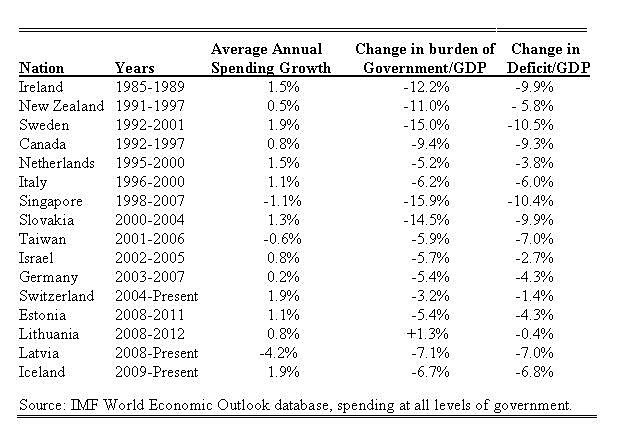
From the perspective of taxpayers and the economy, the benefit of a spending cap (assuming it is well designed so that it satisfies Mitchell’s Golden Rule) is that
annual budgetary increases are lower than the long-run average growth of the private sector.
And nations that have followed such a policy have achieved very good results. The burden of government spending shrinks as a share of economic output, which naturally also leads to less red ink relative to the size of the private economy.
But it’s difficult to maintain spending discipline for multi-year periods. In most cases, governments that adopt good policy eventually capitulate to pressure from interest groups and start allowing the budget to expand too quickly.
That’s why the ideal policy is to make a spending cap part of a nation’s constitution.
That’s what happened in Switzerland early last decade thanks to a voter referendum. And that’s what has been part of Hong Kong’s Basic Law since it was approved back in 1990.
And while many nations struggle with ever-growing government, both Switzerland and Hong Kong have enjoyed good outcomes and considerable fiscal stability.
Now a Latin American nation may enact a similar reform. Brazil, which is suffering a recession in part because of bad government policies, is trying to boost its economy with market-based reforms. Given my interests, I’m especially excited that it has taken the first step in a much-needed effort to impose a spending cap.
The Brazil Chamber of Deputies on Monday voted in favor of a constitutional amendment that would limit government spending to counteract the country’s alarming economic downturn. …The amendment proposal must pass two rounds of voting in the lower House and Senate. Should it be passed, the government would limit spending increases to the rate of inflation… Following approval, the amendment would take effect in 2017.
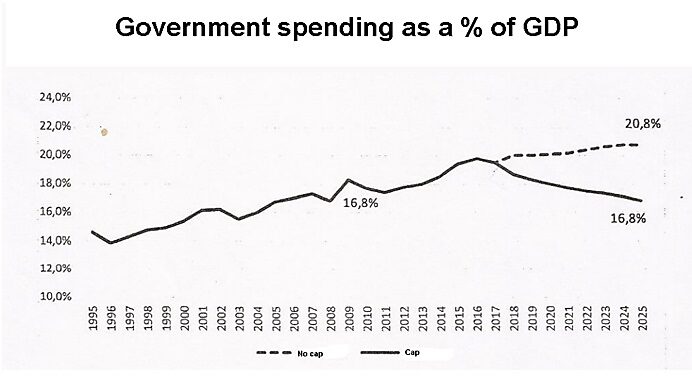
The specific reform in Brazil would limit spending so it doesn’t grow faster than inflation. And it would apply only to the central government, so the provinces would be unaffected.
Capping central government outlays would be a significant step in the right direction. The central government would consume 16.8 percent of economic output in 2025 with the cap, compared to 20.8 percent of GDP if fiscal policy is left on autopilot.
Of course, there’s no guarantee this reform will become part of the Constitution. It needs to be approved a second time by the Chamber of Deputies (akin to our House of Representatives) and then be approved twice by the Senate.
But the good news is that more than 71 percent of Deputies voted for the measure. And there’s every reason to expect a sufficient number of votes when it come up for a second vote.
Brazil’s Senate, however, may be more of a challenge. Especially since various interest groups are now mobilizing against the proposal.
Advocates of the reform should go over the heads of the interest groups and other pro-spending lobbies and educate the Brazilian people. They should make two arguments that hopefully will be appealing even to those who don’t understand economic policy.
First, a spending cap doesn’t require spending cuts in a downturn. Outlays can continue to grow according to the formula. This should be a compelling argument for Keynesians who think government spending somehow stimulates growth (and also may appease those who simply think it is “harsh” to reduce spending when the economy is in recession).
Second, by preventing big spending increases during the boom years, a spending cap is a self-imposed constraint to protect against “Goldfish Government,” which should be an effective argument for those who are familiar with the underlying fiscal and demographic trends that already have caused so much chaos and misery in nations such as Greece.
P.S. While I haven’t been a fan of Brazilian economic policy in past years, I actually defended that nation when Hillary Clinton applauded Brazil for being more statist than it actually is.
P.P.S. Being less statist than Hillary is not exactly something to brag about, so I will note that Brazil deserves credit for moving in the right direction on gun rights and also having some semi-honest left-wing politicians.
Related Tags
An upcoming Cato event examines whether or not you should vote in the election. If you decide to go ahead with it, National Taxpayers Union (NTU) has resources to you help assess the fiscal issues at stake.
Regarding your choice for president, NTU has tallied the spending promises of Hillary Clinton, Donald Trump, and Gary Johnson. Clinton has proposed dozens of spending increases and a few cuts, which add up to a net $203 billion a year in higher spending. Trump’s promises add up to a net $20 billion a year in higher spending.
By contrast, Johnson is promising to save us money. NTU calculates that his net spending cuts would be $143 billion a year. Such reforms would be a good start, but less than my proposed cuts of $1.2 trillion a year.
If you don’t plan on voting for president, or any politician this year, another useful NTU guide describes other important issues at stake on state ballots. Here are a few highlights:
- Marijuana legalization (and taxation) for recreational use is on the ballot in five states: Arizona, California, Maine, Massachusetts, and Nevada.
- Tobacco tax increases are on the ballot in four states. My governor’s report noted that a dozen states have enacted tobacco tax hikes just since 2014. In the minds of some politicians, smokers are “deplorables,” so it is easy to target them.
- New taxes on sugary drinks are on the ballot in a number of local jurisdictions. Cola drinkers are becoming a new class of deplorables.
- Voters will decide on bond issues in many places. One statewide California proposition would authorize $9 billion in debt to fund schools and colleges. My governors report explains why state and local debt issuance is bad policy, even for capital improvements. State and local capital projects should be funded pay-as-you-go. It is cheaper, more transparent, and less conducive to corruption.
- Coloradans will vote on Amendment 69, “which would create a government-run health care scheme (ColoradoCare) aiming to cover all residents. The amendment includes a $25 billion tax increase … This would nearly double the state’s budget.” Wow, that’s big.
- Corporate welfare choices are on the ballot in a few places. Voters in Arlington, Texas, will decide on new taxes to fund a $1 billion stadium for MLB’s Texas Rangers. Voters in San Diego will decide on new taxes to fund a football stadium for the NFL’s Chargers.
I don’t know whether or not you should vote for president. But you should check out the NTU guide and www.ballotpedia.org to see what state and local issues you will be able to weigh in on.