Cato Quarterly
Events


Milton Friedman Prize for Advancing Liberty Presented to Charles Koch
Lawmakers, business leaders, journalists, policy professionals, and Cato Partners gathered on May 1 to celebrate the biennial Milton Friedman Prize for Advancing Liberty, which was presented to Charles Koch (top right) for his tireless efforts to advance human freedom. As chairman of Koch Inc. and founder of the Stand Together philanthropic community, Koch has spent decades championing the principles that characterize a free and prosperous society. Other speakers included Charles’s son, Chase Koch (middle left), executive vice president of Koch Inc.; Peter Goettler (top left), president and CEO of the Cato Institute; and Patrick Collison (middle right), cofounder and CEO of Stripe Inc., who was interviewed by Ryan Bourne (middle), R. Evan Scharf Chair for the Public Understanding of Economics at Cato.


Cato Hosts Biennial Benefactor Summit
The Cato Institute’s gratitude for its individual donors (whom we now call Partners) is immense. To thank, update, and inspire them, Cato hosted the biennial Benefactor Summit the weekend following the 2025 Milton Friedman Prize dinner. Cato brought together many of its most dedicated supporters, its scholars, and thought leaders to engage in conversations about current events, Cato’s vision for the future, and its role in the country, and to take part in some fun activities. Amid threats to liberty coming from both the left and the right, this cornerstone event is a reminder that the flame of liberty is still bright, and Cato will continue to be one of its proudest bearers.
Top: Peter Goettler, Cato President and CEO joking with John Mackey, cofounder of Whole Foods, before discussing Mackey’s new book The Whole Story: Adventures in Love, Life, and Capitalism. Bottom left: Annie Duke, champion poker player and thought leader in strategic decision-making, addressing the audience. Bottom right: Columbia University linguistics professor and New York Times columnist John McWhorter discusses his new book Pronoun Trouble with John Samples, director of Cato’s Center for Representative Government.

A Fork in the Road: The Stark Choices on US-Iran Policy
The prospects of American or Israeli military action against Tehran are growing, and the window for diplomacy is closing. The Trump administration favors diplomacy but is split on what a deal should look like. Jon Hoffman (right), research fellow at the Cato Institute, invited three guests to discuss the administration’s options to avoid a disastrous war: Gregory Brew (left), senior analyst at the Eurasia Group; Negar Mortazavi (center-left), senior fellow at the Center for International Policy; and Danny Citrinowicz (center-right), research fellow at the Institute for National Security Studies, Tel Aviv University.

Ending the US Department of Education as It Turns 45: A Fireside Chat with Secretary Linda McMahon
Linda McMahon (left), secretary of the Department of Education (DOE), joined Neal McCluskey (right), head of Cato’s Center for Educational Freedom, to explain how and why she is trying to shut down the unconstitutional department that she currently leads. The event, which was broadcast on C‑SPAN, was attended by journalists, DOE staffers, and policymakers. McMahon made the case for eliminating federal interference in education policy and returning control to the states, and, ultimately, parents. But to accomplish this task, “Congress will have to vote to close it,” McMahon told McCluskey.
Publications

Crushing Capitalism: How Populist Policies Are Threatening the American Dream
Supposedly, free trade, immigration, and unabated technology have resulted in an economy that no longer works for Americans. The problem with this bleak story is that it is completely wrong. Norbert Michel’s latest book shows that the American dream is alive—unless we kill it with more government intervention.
“Emotion-driven populists who want to take on Norbert Michel’s arguments … are bringing rhetorical knives (and dull ones at that) to an empirical gunfight.… Crushing Capitalism is essential reading for anybody who wants to follow the facts rather than be led around by politicians.”
—Kevin D. Williamson, national correspondent, The Dispatch
“Michel persuasively refutes the narrative of pessimism and decline that is so dominant in discussions of economic outcomes and prospects. He argues that populist policies are solutions in search of problems—Americans simply have not been victimized and impoverished by free markets.”
—Michael R. Strain, Arthur F. Burns Scholar in Political Economy, American Enterprise Institute

Beyond the Fourteenth Amendment
Courts do very little to protect the right to earn a living. By all accounts, that precious right was intended to be a centerpiece of the Fourteenth Amendment. Yet federal courts have all but written it out of the Constitution. Editor Anastasia Boden compiled this volume while she was director of Cato’s Robert A. Levy Center for Constitutional Studies.
Contributors—including Timothy Sandefur, Cato adjunct scholar, and Stephen Slivinski, Cato senior fellow—consider new strategies to protect the freedom to contract, innovate, and earn a living. Practical yet innovative, their essays serve as a blueprint for scholars, researchers, and litigants who seek to restore the Constitution’s promise of opportunity through economic freedom.

A Beginner’s Guide to Superabundance: The New Economics of Time Prices
Marian L. Tupy and Gale L. Pooley’s 2022 Superabundance was one of the most popular books the Cato Institute has ever released, with excellent reviews from figures such as Balaji Srinivasan, Jason Furman, Steven Pinker, George F. Will, and many more. Its compelling and optimistic explanation of how population growth, combined with freedom, drives prosperity is now in a smaller but no less explosive package: A Beginner’s Guide to Superabundance: The New Economics of Time Prices.
This new book by Pooley is an accessible introduction to the concepts in Superabundance for younger readers, including middle and high school students, with Marvel villain Thanos used to hook readers into a case against degrowth economics, pessimism, and big government. It will also be a joy to read for educators, journalists, and passionate layfolk.

False Dawn: The New Deal and the Promise of Recovery, 1933 — 1947
A definitive history of the United States’ recovery from the Great Depression— and the New Deal’s true part in it. By distinguishing the New Deal’s successes from its failures and explaining how the United States finally managed to lay the specter of mass unemployment to rest, Senior fellow George Selgin draws salient lessons for dealing with future recessions.
“False Dawn is perhaps one of the greatest books ever written about the Great Depression. It is … comprehensive in its coverage, balanced in its treatment, and a lively and engaging read. A great achievement.”
—Charles Calomiris, Columbia Business School
Featured Cato Studies
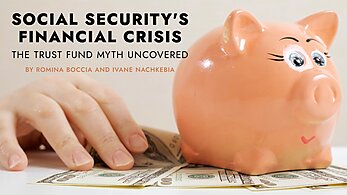
Social Security’s Financial Crisis: The Trust Fund Myth Uncovered
Most people incorrectly think of Social Security as a giant piggy bank. To shatter their misconceptions, Romina Boccia, director of budget and entitlement policy, and Ivane Nachkebia, research consultant, conceptualized this visual feature about the demographic problems that make the current program unsustainable. To maintain benefits for an aging population, the Treasury has borrowed more than $1 trillion since 2010. Over the next decade, Social Security’s cash-flow deficits will contribute more than $4 trillion to the federal debt. Boccia and Nachkebia propose policy changes that would lower future program costs while upholding its original goal of keeping seniors out of poverty

Poll: 63% of Americans Want to Increase Trade with Other Nations, 75% Worry Tariffs Are Raising Consumer Prices
When President Trump announced his “Liberation Day” tariffs, all eyes were on who could best explain the chaos. Emily Ekins’s 2024 Trade and Globalization National Survey provided unique insights into how Americans think about trade and protectionism. Pollster Frank Luntz, entrepreneur Scott Galloway, and other public figures discussed the survey’s results on social media, CNN, The View, and other outlets. “We want to wear Nikes, not make them,” Galloway said on NewsNation’s Cuomo. “The Cato Institute did a study, 80 percent of Americans think we need more manufacturing, but only 1 in 5 have any interest in working in a plant.”

The Simon Abundance Index 2025
Elon Musk, Kimberly Strassel of the Wall Street Journal, and others highlighted the results of the 2025 Simon Abundance Index, an annual report from HumanProgress.org that measures the relationship between resource abundance and population. Authors Marian L. Tupy and Gale L. Pooley found that 50 basic commodities have become 518.4 percent more abundant over the past 44 years. This phenomenon, which Tupy and Pooley term “superabundance,” has persisted despite natural disasters, wars, and political turmoil in recent decades. HumanProgress.org tells the stories of innovation that made this possible with a growing population.