Photography by Richie Downs
Capitol Connections: Changing Congress from the Staff Up
Trace Mitchell participated in the Cato Institute’s Congressional Fellowship Program. The experience helped him and hundreds of other staffers reach across the aisle.

ongress is infamously dysfunctional and more polarized now than at any point in the last 50 years. As Democrats have moved further to the left and Republicans to the right, the middle has hollowed out. This trend is readily apparent on cable news and social media, where lawmakers are rewarded for cheap barbs and scorned for principled stands. It’s no surprise, then, that Americans’ confidence in Congress has hovered around historic lows for the past decade.
But beneath the gridlock and grandstanding of elected officials, there are ranks of talented, ambitious staffers still hopeful that the legislative branch can work as it should. Many of them are hungry for fresh ideas in an environment where party loyalty takes precedence over principle.
Filling that void is Cato’s Congressional Fellowship Program—a unique, off-the-record forum for Capitol Hill staffers to wrestle with today’s toughest policy issues in candid conversations with Cato scholars and their peers.
“That’s something that this type of forum allows for in a way that very few other public policy–oriented forums allow—this kind of iterative discussion, ebb and flow, back and forth, where you get to not just have these thinkers giving you their thoughts firsthand, but build upon their thoughts, follow up, push back, and challenge some of the assumptions you have,” said Trace Mitchell, a recent alumnus of the program who currently works as deputy chief counsel for the House Subcommittee on the Administrative State, Regulatory Reform, and Antitrust.
By briefly muting partisanship and setting aside agendas, the program is creating an opportunity for staffers to engage with the more fundamental principles that inform our scholars’ work: individual liberty, limited government, free markets, and peace.
“Not only did I think that was very valuable, but I would look around the room and week after week, I would see people’s perspectives evolving over time.”
Since 2021, more than 225 staffers have gone through the program, diving deep into constitutional law, economic studies, foreign policy, and more with our experts. The fellowship’s value is clear in its popularity—wait-lists are growing and so is its reach, thanks to the generosity behind Cato’s Vision for Liberty Campaign.
That success is largely because of Cato’s nonpartisan reputation, which makes it an ideal convener. The Institute’s long track record of mainstreaming bold ideas gives fellows the confidence to think beyond partisan lines or short-term politics.
“You could work in a Democratic House office for a decade, and in all likelihood, you would never have a substantive conversation with a Senate Republican committee staffer working on the same issues during the same time period,” said Lawrence Montreuil, Cato’s senior director of government affairs.
The goal, of course, is not just to be a central node in a network. Libertarians and others frustrated with runaway government spending know all too well that bipartisanship is a means rather than an inherent value, especially when the left and right only come together to quash liberty. But by briefly muting partisanship and setting aside agendas, the program is creating an opportunity for staffers to engage with the more fundamental principles that inform our scholars’ work: individual liberty, limited government, free markets, and peace.
“I think you get much better outcomes when you can step back and say, ‘What’s the framework in which we’re operating? What are the underlying principles that we’re really discussing here?’” Mitchell said. “Cato is one of the very few—it may be the only institution providing that sort of forum for people to really engage with these ideas at a high level, while bringing together such a diverse range of different staffers.”

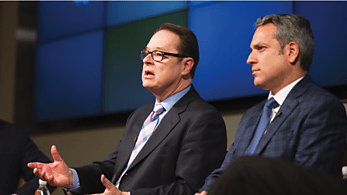
Trace Mitchell, deputy chief counsel for the House Judiciary Subcommittee on the Administrative State, Regulatory Reform, and Antitrust, addresses other members of the Congressional Fellowship Program at a dinner last year.
The Congressional Fellowship Program is also making Cato scholars top of mind for the people who hold the procedural levers in Congress and run the day-to-day. It’s one reason we delivered 30 testimonies to Congress in 2024. Jennifer Huddleston, senior fellow in technology policy at Cato, submitted testimony for a hearing before Mitchell’s subcommittee about AI and antitrust—helping staffers and lawmakers alike navigate one of the most complex challenges facing Congress today.
In post-fellowship surveys, nearly all participants report a deeper understanding of both policy and their peers. One Democratic fellow put it plainly: “[Cato’s] speakers changed my perspective on issues. As a Democrat, I appreciated the balance of fellows. I’ll be your voice on the Hill.”
One conversation won’t fix Congress. But hundreds of conversations—with people willing to think differently, engage sincerely, and challenge old assumptions—just might.
Cato’s Congressional Fellowship Program is planting the seeds of a better Congress: one that is more thoughtful, principled, and capable of securing liberty for the next generation.
This program runs year-round with four fellowships per year: constitutional law, economic studies, international studies, and a rotating topic. To learn more about the program, each fellowship, and the growing alumni network visit the Cato Institute’s Congressional Fellowship Program page.