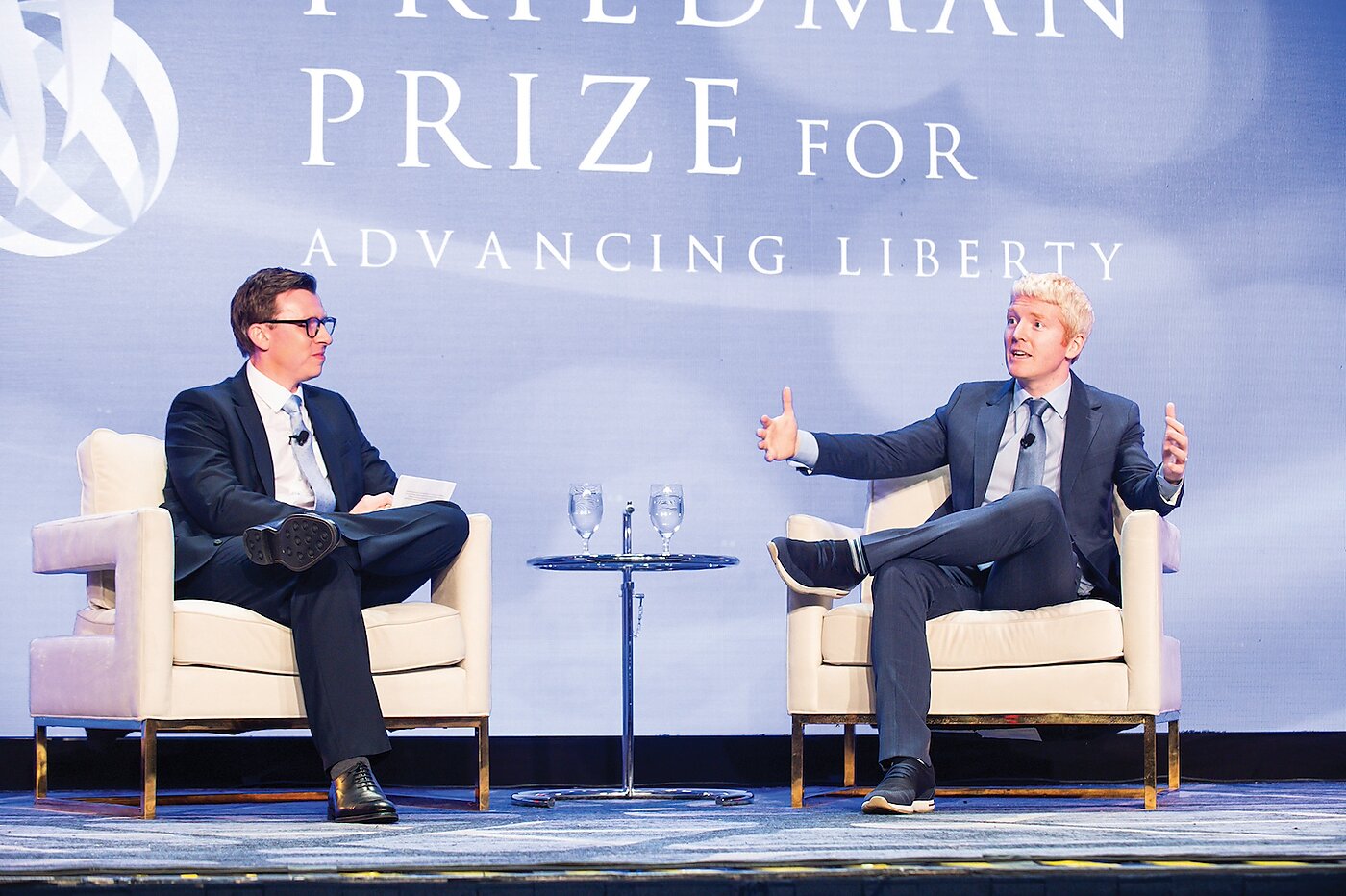
Bourne: Let’s shift gears a bit. I’m British. You’re Irish. We’re both here in the United States. For all of the regulatory problems you just highlighted, this country has amazing strengths, and it’s fair to say it’s motoring ahead of Europe in many respects. You operate across many countries. How do you explain this? Is it to do with public policy? Is it entrepreneurial culture? Is there something just unique about Silicon Valley? What explains this big divergence we see?
Collison: Well, first, America is so good. I don’t know if you guys always appreciate that enough. I’ve noticed in my almost 20 years here that you guys are not always uniformly positive on the place. America is the best country in the world, and I mean that seriously. There are lots of other countries with lots of great attributes, but the confluence of circumstances that has been painstakingly created here in America in a hair’s breadth under a quarter of a millennium is just astonishing, and a beacon for people like me growing up in rural Ireland.
I think the world’s most ambitious people want to come here. I think the world’s innovators want to come here. The world’s scientists want to come here. And while yes, in many domains, the United States is overregulated, it’s typically much worse elsewhere. AI is happening here. The energy revolution is happening here. And the provision of credit outside the banking sector is actually an underappreciated contributor. Here in the United States, 80 percent of commercial lending happens outside of the banking sector. In most of the rest of the OECD [Organisation for Economic Co-operation and Development] that’s closer to 20 percent, so there’s a huge divergence. And it takes money to do new things. Stripe would not exist without the US’s dynamic venture capital sector, so I just have a lot of appreciation and admiration for those who risk their capital by funding these ventures.
Bourne: I want to bring us back full circle to the social role of business. Later in Milton Friedman’s life, he gave a speech at Cato in which he described what he saw as the suicidal impulse of the business community. He said that too often, businesses are willing to go along to get along by endorsing or not speaking out against public policies that are against their interests. He referenced public education and protectionism, but he also talked about Silicon Valley firms in the 1990s that were jumping in on the Microsoft case and urging the Federal Trade Commission to take action. In the past few years, I think it’s fair to say we’ve seen Silicon Valley types more willing to get involved in politics and more willing to defend their interests, in many respects. Why do you think that phenomenon is occurring now?
Collison: I think wokeism was a big contributor. Politics largely exists outside the home, but problems arise once it encroaches inside the home. There’s the Pericles line, “You might not be interested in politics, but politics is interested in you.” And I think as politics and DC became interested in a lot of what was happening in Silicon Valley, it started to have kind of larger societal import—or at least it was perceived to.
I think there’s something to the fracturing of the neoliberal consensus that prevailed in the ’90s, and obviously we’re seeing a lot more ideological heterogeneity than prevailed back then. But again, in that Friedman piece, at least as I interpret it, I think he was arguing against businesses being active in the political domain in a shortsightedly self-serving fashion, but not against their participation in the public domain at all.
And actually, the Pericles line about government being interested in you—I was curious about that line so I looked into it, and as far as I can tell, he didn’t say it. It’s just one of those things that takes off on Reddit or Goodreads or something. But he did say in one of his funeral orations, and this is from memory, so I apologize if I butcher it: “Though we love the beautiful, we’re not extravagant. And even though we love things of the mind, we’re not soft. And here [in Athens] individuals are not only concerned with their private affairs, but also concerned with affairs of the state.”
That’s one of the peculiarities about Athens. The person who does not participate in politics is not somebody who minds his own business, but someone who has no business being here. Pericles really judged people who did not participate in the larger policy around them. He thought this was very important for sustaining the liberties and the freedoms and the culture that he saw himself and his citizens benefiting from. That seems right to me.