Cato at Liberty
Cato at Liberty

Global Science Report is a feature from the Center for the Study of Science, where we highlight one or two important new items in the scientific literature or the popular media. For broader and more technical perspectives, consult our monthly “Current Wisdom.”
The United Nations’ Intergovernmental Panel on Climate Change (IPCC) released its Fifth Assessment Report (AR5) last week to fanfare and stinging criticism.
Most of the criticism was aimed at the IPCC’s defense of climate models—models that the latest observations of the earth’s climate evolution show to be inaccurate, or at least are strongly indicative that is the case.
There are two prominent and undeniable examples of the models’ insufficiencies: 1) climate models overwhelmingly expected much more warming to have taken place over the past several decades than actually occurred; and 2) the sensitivity of the earth’s average temperature to increases in atmospheric greenhouse gas concentrations (such as carbon dioxide) averages some 60 percent greater in the IPCC’s climate models than it does in reality (according to a large and growing collection of evidence published in the scientific literature).
Had the IPCC addressed these model shortcomings head on, the flavor of their entire report would have been different. Instead of including projections for extreme climate changes as a result of continued human emissions of greenhouse gases resulting from our production of energy, the high-end projections would have featured relatively modest changes and the low-end projections would have been completely unremarkable.
Since changes in the earth’s temperature scale approximately linearly with a property known as the earth’s equilibrium climate sensitivity (how much the earth’s average surface temperature rises as a result of a doubling of the atmosphere’s carbon dioxide concentration), it is pretty straightforward to adjust the IPCC’s projections of future temperature change to bring them closer to what the latest science says the climate sensitivity is. That science suggests the equilibrium climate sensitivity probably lies between 1.5°C and 2.5°C (with an average value of 2.0°C), while the climate models used by the IPCC have climate sensitivities which range from 2.1°C to 4.7°C with an average value of 3.2°C.
To make the IPCC projections of the evolution of the earth’s average temperature better reflect the latest scientific estimates of the climate sensitivity, it is necessary to adjust them downward by about 30% at the low end, about 50% at the high end, and about 40% in the middle.
The figure below the jump shows what happens when we apply such a correction (note: we maintain some internal weather noise). The top panel shows the projections as portrayed by the IPCC in their just-released Fifth Assessment Report, and the lower panel shows what they pretty much would have looked like had the climate models better reflected the latest science. In other words, the lower panel is what the IPCC temperature projections should have looked like.
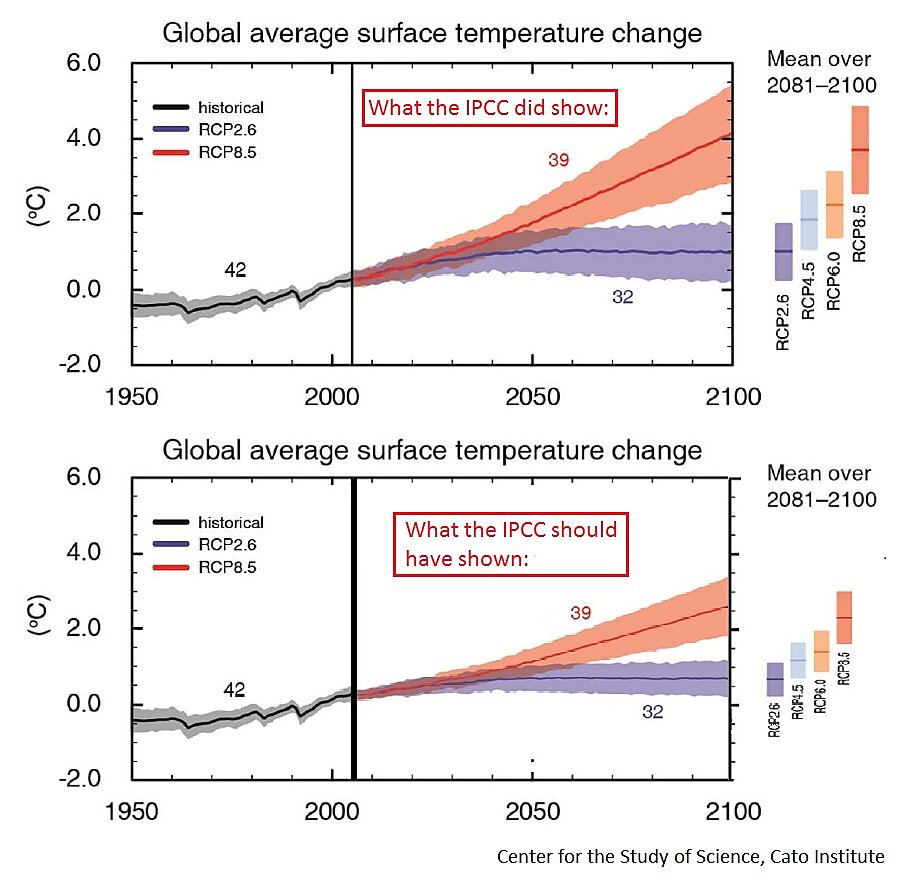
Figure 1. (Top) Temperature evolution from 1950 to 2100 as portrayed by the IPCC in its Fifth Assessment Reportaccording to its worst case (red) and best case (blue) emissions scenarios (RCP8.5 and RC2.6, respectively). (Bottom) Temperature evolution from 1950 to 2100 from the same emission scenarios adjusted such that the equilibrium climate sensitivity values better matched the latest science.
The result of such adjustments is that the IPCC’s worst-case emissions scenario produces a global average temperature rise (from the 1986–2005 average) by the end of the century that has a centralized value of about 2.6°C, compared with a rise of 4.1°C given in the IPCC AR5. The more moderate emissions scenarios (the more likely course as the natural gas revolution will see lower carbon dioxide-emitting natural gas replace higher-emitting coal in energy production), once properly adjusted, produce a temperature rise by century’s end of only about 1.25°C (of which, about 0.15°C has already happened).
Since virtually all climate impacts are related to the change in the earth’s temperature, the smaller the future temperature increase, the smaller the resulting impacts. Another degree of so of temperature rise during the next 87 years is not going to lead to climate catastrophe.
Had the IPCC been more interested in reflecting the actual science rather than in preserving a quickly crumbling consensus (that human greenhouse gas emissions are leading to dangerous climate change that requires urgent action), its Fifth Assessment Report would have been a much kindler and gentler document—as it well should have been.
Related Tags
The Wall Street Journal’s James Taranto:

Meet Brendan Mahoney, the young man who is saving ObamaCare. He’s 30 years old, a third-year law student at the University of Connecticut. He’s actually been insured for the past three years–in 2011 and 2012 through a $2,400-a-year school-sponsored health plan, and this year through “a high-deductible, low-premium plan that cost about $39 a month through a UnitedHealthcare subsidiary.” But he wanted to see what ObamaCare had to offer.
He tried logging in to the exchange’s website at 8:45 a.m. yesterday…” He said the system could not verify his identity.” So he called the toll-free help line, whose operator also encountered computer trouble. “But then he logged on a second time, he said, and the system worked.”
“Once it got running, it was fast,” Mahoney tells the Courant. “It really made my day. It’s a lot like TurboTax.” He obtained insurance through ObamaCare. Now, he says, “if I get sick, I’ll definitely go to the doctor.” Even better, if he stays healthy, he won’t need to go to a doctor, and his premiums will support chronically ill policyholders on the wrong side of 40.
So, how much of a premium is strapping young Brendan Mahoney paying to help make ObamaCare work? Oops. The Courant reports that Mahoney “said that by filling out the application online, he discovered he was eligible for Medicaid. So, beginning next year, he won’t pay any premium at all.”
So the great success story of ObamaCare’s first day is the transformation of a future lawyer who was already paying for insurance into a welfare case.
Remember that the next time someone says that people on Medicaid have no other options. HT: Jack McHugh
Related Tags
Reason’s Peter Suderman:
Chad Henderson is the media’s poster boy for Obamacare. Reporters struggled this week to find individuals who said they had been able to enroll in one of the law’s 36 federally run health-insurance exchanges.
That changed yesterday, when they found Henderson, a 21-year-old student and part-time child-care worker who lives in Georgia and says that he successfully enrolled himself and his father Bill in insurance plans via the online exchange administered at healthcare.gov.
But in an exclusive phone interview this morning with Reason, Chad father’s Bill contradicted virtually every major detail of the story the media can’t get enough of. What’s more, some of the details that Chad has released are also at odds with published rate schedules and how Obamacare officials say the enrollment system works.
Related Tags
Syria: On September 27th, the United Nations Security Council unanimously adopted a resolution outlining the details of the turn over and dismantlement of Syria’s chemical weapons. Syria’s president, Bashar al-Assad, has stated that his government will abide by last week’s UN resolution calling for the country’s chemical weapons to be destroyed.
It appears that this news was well received by the people of Syria. The black-market exchange rate for the Syrian pound (SYP) has dropped from 206 per U.S. dollar on September 25th to 168 on September 30th. That’s a whopping 22.6% appreciation in the pound against the dollar. Currently, the implied annual inflation rate in Syria sits at 133 percent, down from a rate of 185 percent on September 25th.
Iran: Since President Rouhani took office, Iranian expectations about the nation’s economy have turned positive. Over the past month we have seen a significant decrease in the volatility of the Iranian rial on the black market. This trend of stability has continued into this week, as President Rouhani’s trip to the UN has raised hopes of constructive cooperation with the West. In consequence, the rial has remained virtually unchanged on the black market, moving from 30,500 per U.S. dollar on September 25th to 30,200 on September 30th. The implied inflation rate in Iran as of September 30th stands at 8%, down from 23% on September 25th.
Venezuela: While the crises in the Middle East are easing, the troubles in Venezuela are far from over. The black market exchange rate for the Venezuelan bolivar has fallen from 44.03 per U.S. dollar on September 24th to 40.92 on September 30th. This represents an appreciation of 7.6% over the last week. The implied annual inflation rate as of September 30th sits at 255%, down from a local high of 292% on September 17th. The ConocoPhillips dispute, a massive blackout, and worsening shortages caused by price controls have ravaged the Venezuelans’ confidence in the bolivar over the month of September.
Although the bolivar has rebounded modestly in recent weeks, this simply indicates that the economic outlook in Venezuela is only slightly less miserable than it was in mid-September. The economy is still on a slippery slope and economic expectations continue to be weighed down by the fragile political atmosphere, worsening shortages, and the ever-present specter of political violence. An inflation rate of 255% is nothing to celebrate.
Argentina: The black market exchange rate for the Argentine peso has held steady at around 9.5 per U.S. dollar since September 25th, with a 9.55 exchange rate on September 30th. That represents a 2.9% decrease in the value of the currency from the September 22nd rate of 9.27. The implied annual inflation rate as of September 30th sits at 54%, a decrease from the rate of 49% on September 22nd.
Egypt: The black market rate for the Egyptian pound has held steady at around 7.1 per U.S. dollar since September 25th, roughly the same level as the official exchange rate. This indicates that, for the time being, the military has brought some semblance of stability to the Egyptian economy. As of September 30th, the black market exchange rate was 7.12. The implied annual inflation rate as of September 30th sits at 19%.
For up-to-date information on these countries and their troubled currencies, see the Troubled Currencies Project.
I was critical earlier this year when lawmakers in my home state of Maryland enacted “Grace’s Law,” purporting to ban so-called cyberbullying — in this case, the use of hurtful online language as part of a course of conduct that inflicts serious emotional distress or harassment on a Maryland juvenile, apparently whether or not the speaker knows that the person distressed by the speech is a Maryland juvenile. I predicted that the law would run into trouble in the courts for infringing on much speech protected by the First Amendment.
On Tuesday, the new law took effect, and this morning Maryland attorney general Douglas Gansler unveiled a joint initiative with Facebook and the National Association of Attorneys General (NAAG) in which Facebook will create a new program for school officials, the Educator Escalation Channel — initially limited to use in the state of Maryland, presumably pending similar enactments elsewhere — allowing the officials to object to Facebook users’ content. Per local radio station WTOP, Maryland school officials will be offered the chance to flag “questionable or prohibited” language. That is to say, they will flag speech that isn’t prohibited by the new law but which they deem “questionable.”
The targets of the new program, according to Gansler as quoted by WTOP, include persons who are “not committing a crime… We’re not going to go after you, but we are going to take down the language off of Facebook, because there’s no redeeming societal value and it’s clearly hurting somebody.” That is to say, Gansler believes he has negotiated power for school officials to go after speech that is not unlawful even under the decidedly speech-unfriendly definitions of the new Maryland law, but which they consider hurtful and lacking in “redeeming societal value.”
Already, defenders of the new program are arguing that there’s no problem here, because Facebook as a private entity is free voluntarily to put whatever terms it wants to into its user agreement and enforce them however it likes. Of course, private companies deal voluntarily with a group of state enforcers like the NAAG only in the sense that you or I deal voluntarily with the Internal Revenue Service.
Can we now finally start taking the First Amendment implications of these laws seriously?
Obamacare’s health insurance Exchanges opened for business, in most states, sort of, on Tuesday. Millions of people have reportedly flooded the Exchanges, but have had so much difficulty using the web sites that reporters have had a hard time finding anyone who has successfully enrolled in an Obamacare plan. The Washington Post’s Sarah Kliff writes:
Just moments after writing a blog post Thursday morning, about the lack of information on Obamacare enrollees, Enroll America reached out with contact information for Chad Henderson, a 21-year-old in Georgia who had successfully enrolled in coverage on the federal marketplace.
Chad is evidently a scarce commodity.
It was a little difficult to reach Henderson, mostly because so many other reporters wanted to talk to him. “I’m supposed to talk to the Chattanooga Times Free Press in a half hour,” Henderson said. “And The Wall Street Journal is supposed to call.”
Luckily, Henderson managed to squeeze me in for a few minutes.
Kliff reports that after a three-hour ordeal, Chad bought an Obamacare plan that cost him $175 per month — pretty steep, considering he makes less than $11,500 per year. His Obamacare premium comes to least 18 percent of his income. And no, Chad is not eligible for subsidies.
Compare that to what Chad could have paid if he bought one of the pre-Obamacare plans still available on eHealthInsurance.com until December 31. The cheapest such plan for someone meeting Chad’s profile is just $44.72 — as little as 5 percent of his annual income and about one-quarter of his Obamacare premium.
I can’t yet say whether Chad’s $175 premium is the lowest-cost plan available to him through the Exchange. (I’m in the process of researching that. Let’s just say it’ll probably take a few hours.) But it’s probably close. The cheapest plan available to him through eHealthInsurance.com after Obamacare’s community-rating price controls take effect in 2014, and drive up premiums for young, healthy people market-wide, is $190.23. That’s with the maximum cost-sharing allowed under Obamacare. So it appears Obamacare quadrupled Chad’s premiums, and Enroll America thinks that is a success story.
To me, the most interesting part is that Chad didn’t buy health insurance when it was available to him for just $45 per month, but did buy it at an unsubsidized $175/month premium. Why? Again, Kliff:
He describes himself as a supporter of President Obama who has anxiously awaited Obamacare’s rollout…
Part of his decision was ideological: He wants the health-care law to succeed.
Okay…but why does he support the law and want it to succeed? If it’s because he likes the idea of young, healthy, low-income people like himself paying the medical bills for older, sicker, higher-income people, he didn’t have to wait for Obamacare to come along. He could have just sent money to old people. Was he previously spending this money that way? If he supports the law because he wants to support President Obama, was he previously using the same money to support the president (e.g., sending that money to the president’s campaigns and political organizations, or the federal Treasury)? Did Chad do it for the fame? He can spend his money however he wants, as far as I’m concerned. I’m just trying to understand.
UPDATE #1: The @ObamaCare Twitter account retweeted @ChadHenderson thus: “This is what today was about: MT @ChadHenderson: enrolled in #Obamacare! Looking forward to having affordable healthcare for the first time!” Erm, sure.
UPDATE #2: Mediaite’s Tommy Christopher calls me a liar and a conservative. Then he really gets upset.
Christopher writes of the $45/month policy that’s still available to Henderson:
That plan has two separate deductibles of $10,000.00 each, and out-of-pocket maximums totaling $10,500.00, for a grand total of $30,500.00 in out of pocket expenses.
According to eHealthInsurance.com, the BlueCross BlueShield of Georgia Smart Sense Plus POS 10,000 has an annual deductible of $10,000, an annual out-of-pocket limit of $13,000, which includes the deductible, and boasts a rating of 4.4 out of 5 stars. That deductible and out-of-pocket limit probably apply only to in-network providers (the plan does have some out-of-network coverage, though I can’t locate any more detail), but note that they are not additive. I don’t see anything indicating the total out-of-pocket exposure is $30,000. (HT: Megan McArdle.) Note also that many ObamaCare plans will have lots of out-of-pocket exposure above the $6,350 cap for in-network providers.
Christopher also blames Georgia Republicans for the fact that Henderson has to pay that full premium himself, without any taxpayer subsidies. If Georgia Republicans had implemented ObamaCare’s Medicaid expansion, Henderson would have been eligible for “free” health care (or at least, free Medicaid). I’ve got news for Christopher: Georgia (along with 33 other states) also refused to establish an ObamaCare Exchange, which means Georgians between the poverty line and 400 percent of poverty are not eligible for ObamaCare subsidies, either; Georgia employers are exempt from penalties under the employer mandate; and 420,000 Georgians are exempt from penalties under the individual mandate.
More broadly, as I told Arkansas Times associate editor David Ramsey when he made the same point, it seems odd to lay blame for the harm ObamaCare causes on the majority who oppose it, rather than on the minority who support it. Georgia Republicans aren’t jacking up Chad Henderson’s premiums; ObamaCare is. Georgia Republicans aren’t penalizing Chad Henderson unless he buys overpriced coverage; ObamaCare is. ObamaCare would work so well if everyone loved it; but most people don’t. Likewise, Medicaid would be a terriffic program if only it improved people’s physical health; but the most reliable evidence says it doesn’t. Supporters understandably prefer to defend ObamaCare in its Platonic form; the rest of us must deal with it as it exists in the real world.
UPDATE #3: Henderson clarifies, “The fact that I’m an OFA volunteer has nothing to do with my #Obamacare story.” OFA is Obama for America or Organizing for Action or whatever they’re calling it now.
UPDATE #4: David Ramsey notes that given Chad Henderson’s current income, it is unlikely Henderson would face penalties for failing to purchase coverage. Ramsey is correct; I had been thinking of Henderson’s likely higher future income. I have struck-out the offending sentence (above), and I thank Ramsey for catching the error.
UPDATE #5: Reason’s Peter Suderman exposes (and the Washington Post’s Sarah Kliff confirms) that in fact Henderson has not enrolled in an ObamaCare plan, despite giving that impression to numerous media outlets. So, that happened.