Today, James Cole, Deputy Attorney General of the United States, announced a new “Clemency Initiative.” The gist is that the Obama administration is soliciting more clemency petitions as a part of its “Smart on Crime” plan to address our “vastly overcrowded prison population.” According to Cole, Obama is anxious to commute more prison sentences, but something has been amiss thus far. To respond to Obama’s new directive, Cole tells us that a new team of lawyers will be taking over the Office of the Pardon Attorney within the Department of Justice and the new team is going to expedite clemency applications for Obama’s consideration. The new initiative is aimed at inmates who meet the following criteria: 1. Presently serving time federal prison. (Inmates in state prison ineligible). 2. Would have received a lesser sentence if current sentencing rules had been in place when they were sentenced way back when. 3. No significant ties to gangs, cartels, or mafia families. “Low-level” offenders. 4. No significant criminal history. 5. Record of good conduct while in prison. 6. No history of violence prior to, or during, prison stay. 7. Must have already served 10 years of prison sentence. The administration is really hyping this initiative and raising expectations about dramatic moves by Obama as this gets underway. I remain skeptical for a few reasons. First, I question the narrative that it has only recently occured to Obama that there ought to be more meritorious clemency petitions on his desk. Second, I note that the administration is expecting to receive thousands of petitions and applications. That language is important. Later on, Obama’s people may say, “As expected, we received thousands of applications! We never said there would be hundreds or thousands of commutations.” Third, there’s just no way of telling how the criteria are going to applied. What are “significant ties” to gangs? “Significant” criminal history? A “history” of violence? For example, maybe there is a guy who was caught driving a truck full of marijuana. Maybe he was sentenced to 20 years in prison because of the amount of drugs. Suppose he had no real ties to any gang or cartel and suppose he has already served 12 years for the non-violent offense. Good candidate? Wait, there’s a problem. While in prison, he was disciplined a few times for fighting with other inmates. (The prison authorities couldn’t tell whether the candidate was only defending himself, as he claimed, or not.) According to a strict reading of the criteria, the candidate’s petition will fail #5 and #6 above. But is it wise to keep a person like this locked up? Obama deserves some credit for turning his attention to clemency. But we will have to await his actions. For many non-violent drug offenders, the wait has already been too long. For related Cato work, go here and here. More background at the PardonPower blog.
Cato at Liberty
Cato at Liberty
Right on cue, the New York Times editorialized this morning against yesterday’s Supreme Court decision upholding the right of Michigan’s citizens to amend their constitution to prohibit the state from engaging in affirmative action, which they did in 2006 by passing, by a large margin, a proposition prohibiting racial, gender, ethnic, and national origin preferences in public employment, education, and contracting. The Times was not alone, of course. NPR’s lament this morning was a solo interview of Lee Bollinger, president of my undergraduate alma mater, Columbia University, and the defendant in the 2003 Gratz and Grutter affirmative action decisions when he was president of the University of Michigan.
It was a bad day for affirmative action, but a good day for the Constitution. Yet neither of those commentaries, nor any of the five opinions that issued from this split decision, came to terms with the discrimination that is inherent and hence inescapable in government undertakings as such, and is at the core of this problem today.
Among other things, the editorialists at the Times note that “the justices disagreed about whose rights were at issue: the minorities who would be affected by the ban or the majority of the state’s voters who passed it.” Justice Kennedy, writing for a three-judge plurality, sided with the voters, taking no position on the constitutionally of race-conscious public practices. Justice Sotomayor, joined by Justice Ginsburg in dissent, wrote that “Our Constitution places limits on what a majority of the people may do,” such as when they pass laws that “oppress minorities,” the Times adds.
Conflicting rights? If there were a right to preferential treatment by the state, the Constitution’s Equal Protection Clause would have no meaning—as Justice Scalia, joined by Justice Thomas, made clear in his concurrence. But that’s not the right the plaintiffs in this case brought before the Court. Their claim, rather, was that by prohibiting the state from considering only certain factors—race, for example, in university admissions, but not others, such as legacy—those with such characteristics are disadvantaged vis-à-vis the latter because, to be given preferences, they must not only win in the legislative arena, but must also overturn a state constitutional amendment, all of which amounts to unequal treatment in violation of the U.S. Constitution’s Equal Protection Clause.
The argument is not without merit: In fact, it persuaded eight of the fifteen Sixth Circuit judges who were sitting en banc below, producing five dissenting opinions. And the issue cannot be resolved, of course, unless we go to the underlying question of whether preferences themselves violate equal protection, which they do, but which Kennedy, unlike Scalia, was unwilling to say.
The deeper question, however, unaddressed by all, is why we stop at race, gender, ethnicity, and national origin as forbidden grounds for discriminating. Why not sexual orientation, marital status, appearance, socio-economic background, and more? Why, that is, can the University of Michigan take legacy, or athletic ability, or musical talent into consideration when making admissions decisions, but not race, gender, etc.? Is legacy permitted because that’s likely to lead to more alumni contributions, and athletic and musical talent for the same reason, plus the long history of college football and marching bands? For that matter, why does academic aptitude play so prominent a role in admissions decisions? Don’t the parents of the academically less gifted pay taxes to support the University of Michigan too? The dirty little secret of public higher education, of course, is that it amounts to a massive transfer of wealth from the lower to the upper classes of any state in which we find it, as Justice Thomas pointed out in his Grutter dissent.
And so we come to the point of it all, to the discrimination that is inherent and hence inescapable in government undertakings as such. All public institutions, like their private counterparts, have to discriminate in countless ways if they’re to function. But whether they’re educating, hiring, contracting, what have you, they belong to all of us and so may discriminate only on grounds that are narrowly tailored to serve their functions. But what are those functions—and those grounds? Education may be the main function of a public university—hence the presumptive centrality of academic merit as a legitimate ground for discrimination. But are there other functions? Is football central to the function of a university—and hence athletic ability a legitimate ground for discriminating? Tell that to another of my alma maters, the University of Chicago.
Plainly, if we go to these core questions—these First Principles—this argument can go either way: If athletic ability can justify discriminating in favor of an applicant—and against another—then why may not a public university’s admissions officers take race into consideration, just like a private university may—at least in an ideal world? The reason, doubtless, is because of our long history with racial and, to a lesser extent, gender and ethnic discrimination. Under the Equal Protection Clause, those factors are singled out for special consideration, understandably, just as sexual orientation today increasingly is. But the principle of the matter is perfectly general. If, before public decisionmakers, all must be treated equally, meaning that discrimination must be narrowly tailored to serve a public institution’s function, then a decisionmaker’s discretion must be limited.
The broader conclusion, however, is that there are no clear, undisputable answers to these questions. But what is clear is that much of this could be avoided—not eliminated, as we will always have a public sector—if we did less through the public sector. Why, for example, is government involved in higher education—or in education generally, for that matter? Public universities should not be permitted to discriminate on the basis of race, which is what affirmative action amounts to, but private universities ought to be free to engage in all the affirmative action of whatever kind they wish. There’s the solution to the problem: once again, less government.
In February, I highlighted the Department of Energy’s issuance of a $6.5 billion loan guarantee to build a nuclear power facility in Georgia. At the time, the project was behind schedule with cost overruns, and the project’s owners had already secured private financing. Yet DOE issued the loan guarantee anyway.
Now we’ve learned that DOE’s actions were even more foolish than previously thought. DOE waived the credit fees charged to the company—which are meant to offset the risk to taxpayers—when it issued the loan.
According to the Washington Examiner:
“Developers of a Georgia nuclear project didn’t have to pay millions of dollars in fees designed to prevent risk for taxpayers when it secured $6.5 billion in loan guarantees from the Energy Department in February, the agency confirmed Tuesday to the Washington Examiner.
The DOE calculated a zero dollar “credit subsidy fee,” which protects taxpayers if developers default, for electric utility Georgia Power — a subsidiary of Southern Co. — and Oglethorpe Power Corp. to spur completion of two large, next-generation nuclear reactors at the Vogtle power plant in Waynesboro, Ga.”
This isn’t the first time that DOE has been criticized for the handling of its loan guarantee programs, and thus risking losses to taxpayers. In 2012, the Government Accountability Office said, “if DOE underestimates these costs [credit subsidies], taxpayers will ultimately bear the cost of default.” GAO said that DOE did not follow its own processes for handling applications “potentially increasing the taxpayer’s exposure to financial risk from an applicant’s default.”
Energy loan guarantee programs should be eliminated, but closing them doesn’t seem likely under the current administration. But you would think that even this administration would favor DOE following sound lending practices to try and minimize taxpayer losses.
Most Americans dislike the income tax, now more than a century old. The rates are too high. The provisions are unfair. The record-keeping is onerous. The revenues are wasted.
But there are fans, certainly, such as the politicians of both parties. What good would it do to serve in Congress if you didn’t have money to spend?
The beneficiaries of the politicians’ largesse also share in the income tax lovefest. Uncle Sam needs money to write checks. He can borrow, but there’s a limit to the credulity of investors. Borrow too much and they might doubt Washington’s ability to repay.
Then there are the fans of expensive and expansive government. Never mind the endless mess created by Uncle Sam. Something he does must work!
More dangerous may be the social engineers. For instance, Yale economic professor Robert J. Shiller suggested using the income tax to mitigate “some of the worst consequences of income inequality.” He proposed indexing taxes to income inequality.
It’s a genuinely nutty idea. Inequality measures are sensitive to data distortion. Moreover, they incorporate no moral judgment as to how the inequality arose. Were opportunities obstructed and systems manipulated, or did a generally free society operate naturally and deliver ever-changing income and wealth patterns?
As I point out in the Freeman:
“Worse, though, is the weird presumption that seizing private wealth from mostly productive taxpayers and giving it to political operators noted for their electoral skills rather than economic judgment would somehow remedy financial disparities. There is no evidence that increasing Washington’s resources would yield greater social or economic justice, improve economic efficiency or growth, or make people wealthier or freer.”
To the contrary, experience demonstrates that the majority are likely to end up worse off. Extensive bureaucracies soak up much money before it leaves government hands. Cash is tossed at influential interest groups. Benefits for the poor are dwarfed by middle class welfare, such as Social Security and Medicare.
Providing more money to expand these and other programs is supposed to close the income and wealth gaps?
Unfortunately, the income tax creates additional harms. By taxing work, the levy discourages work. Moreover, credits and deductions give legislators the opportunity to play social engineers.
The greater the resulting complexity, the more wealth wasted in compliance activities. There is no financial privacy, since Uncle Sam is empowered to rummage through everyone’s personal affairs.
Moreover, as Edwards pointed out, the entire enforcement process is built around a denial of due process. From start to finish, the burden of proof falls on the taxpayer, not the government.
Contrast this with the sales tax: You pay it when you purchase something and you are done with it.
Even social engineering usually is at a minimum. Politicians don’t claim that they can use the sales tax to solve the “problem” of income inequality.
The first income tax in U.S. history was proposed in 1814 to fund the ill-fated War of 1812. In 1861 a desperate national government turned to the income tax to fund its war to conquer the southern states seeking to separate.
A search for revenue to replace declining tariff collections led to another income tax in 1894, but the Supreme Court declared the levy unconstitutional. Fifteen years later, Congress proposed a constitutional amendment, which was approved on February 2, 1913, during the heyday of the Progressive Era. From modest beginnings it has grown into a monster.
There is a necessary role for government, but it is far more limited than today’s Leviathan. Moreover, today’s income tax has made it far too easy for politicians to mulct the public. The income tax has greatly contributed to Americans’ steady and serious loss of liberty.
Related Tags
Japan and the United States have undertaken a series of high-level negotiations over the past several weeks in an effort to reach a bilateral agreement that could lead to completion of the 12-country Trans-Pacific Partnership (TPP). Japanese Minister of State for Economic and Fiscal Policy, Akira Amari, has met with U.S. Trade Representative Michael Froman both in Tokyo and Washington in an effort to resolve differences prior to President Obama’s visit to Japan this week. Reports indicate that the talks have made some progress. However, large gaps remain that are expected to preclude any breakthrough announcement when the president meets on April 24 with Japanese Prime Minister Shinzo Abe.
The stated obstacles to concluding the talks have been Japanese reluctance to eliminate tariffs on sensitive agricultural products – beef, dairy, pork, rice, sugar and wheat – and U.S. reluctance to eliminate the 2.5 percent tariff on automobile imports and the 25 percent tariff on light trucks. Each side is very much in the right to ask the other to change these protectionist policies. They have the effect of stifling comparative advantage. They reduce economic welfare by raising consumer costs while curtailing opportunities for efficient producers to make export sales. Ending these trade restrictions would not only help the country requesting the changes, but would also help the economy of the country making the change. What’s not to like about this deal?
Stepping back from the details of the requests and offers, the real problems facing each country are the underlying political realities. Japanese farmers strongly resist reductions in the level of support they receive from tariff protection, and have done so consistently for decades. Those farmers also have been consistent and dedicated supporters of Prime Minister Abe’s Liberal Democratic Party (LDP). If Japan’s agricultural community becomes sufficiently unhappy with the Abe administration, it is entirely possible that his government could fall. Nonetheless, Prime Minister Abe seems willing to push agricultural policy in the direction of reform. He knows that updating Japan’s agricultural policies is an essential condition for becoming a member of the TPP.
Political considerations in the United States are somewhat different. Yes, the automobile industry would give up tariff protection on imports from Japan. But the reality is that a 2.5 percent duty isn’t all that high in the first place, and the protective effect of the 25-percent duty on light trucks has been undermined significantly by Japanese firms’ investments in U.S. manufacturing facilities. A whole lot of “Japanese” vehicles already are built in the United States. Nonetheless, the U.S. auto industry and its workers are not enamored of tariff reductions, and the Obama administration no doubt keeps this in mind.
The real reason for the impasse is lack of fast-track negotiating authority (also known as Trade Promotion Authority, or TPA) that would allow the TPP agreement to be submitted to Congress for an up-or-down vote. Fast-track arrangements that prohibit amendments have been used for congressional consideration of trade agreements since the Trade Act of 1974. This process was developed in response to the failure of Congress in the 1960s to adopt key provisions of the Kennedy Round agreement dealing with customs valuation and antidumping procedures. The Kennedy Round’s tariff reductions were approved, but there had been no prior congressional commitments to limit amendments, so it wasn’t possible to find the votes needed to pass the controversial provisions. Any controversial parts of a TPP agreement that conceivably could be presented to Congress in the absence of fast track also would prove difficult (impossible?) to enact. Frankly, TPP may have a hard time being approved by the current Congress even if fast track already was in place.
What’s more, opposition to passage of fast-track authority is very broad and deep within the president’s Democratic Party. Anti-fast-track forces include not only organized labor and many left-leaning civil-society organizations, but also Senate Majority Leader Harry Reid, House Minority Leader Nancy Pelosi, and many fellow Democrats in Congress. Although the Obama administration supports the concept of fast track, it has not yet endorsed a specific legislative proposal. It is noteworthy that the administration chose not to support the bipartisan approach introduced in January this year by then-chairman of the Senate Finance Committee Max Baucus (D‑MT), Ranking Member of Senate Finance Orrin Hatch (R‑UT), and House Ways and Means Chairman Dave Camp (R‑MI). The new Finance Committee chairman, Sen. Ron Wyden (D‑OR), has indicated that he is considering how or whether to propose fast-track legislation, but appears to be on a timetable that would delay introduction of any bill until at least after the November 2014 election.
The administration has given no indications that it is making progress in overcoming Democratic resistance to fast track; recent objections by members of Congress timed to coincide with the president’s Asian trip suggest that the administration may be losing ground. The April 21 op-ed in the Los Angeles Times by Reps. George Miller (D‑CA), Rosa DeLauro (D‑CT), and Louise Slaughter (D‑NY) amounts to a kick in the pants as the president sets off on his diplomatic mission. (It makes one wonder what these Democrats would be saying if the president was a Republican rather than a member of their own party.) There is no precedent from the administration’s first five years in office in which the White House pushed back effectively against such strong objections from key parts of its political base. It seems unlikely they will find a way to do so with fast track, especially since this could be seen as favoring Republicans over Democrats. That meaningful progress toward trade liberalization could be put on hold at least until a new administration takes office in 2017 is reason for concern.
Japanese officials no doubt have been paying close attention to U.S. trade politics. Prime Minister Abe can see that United States is not in a terribly strong position to push TPP to a completely trade-liberalizing conclusion. But President Obama is coming to Tokyo and it’s necessary to do something. Should Japan go ahead and commit to eliminate agricultural tariffs before the United States even has fast-track authority? Does the United States really want to conclude an agreement at this point when U.S. negotiators appear to have only limited credibility and leverage, or have the recent rounds of bilateral TPP talks just been for show? If Japan takes the plunge and agrees to painful cuts now, what happens if it becomes clear following the November election that their U.S. partners are not able to move forward? Will the future of the Abe government be at risk?
The net result is that Prime Minister Abe appears to have backed away from what may have been his intention to pursue a truly far-reaching reform of Japan’s agricultural policies. He can’t afford to put everything on the table when he can see that the U.S. side simply isn’t in a position to deliver.
It is unfortunate that a presidential trip to Japan – certain to raise expectations – has come at a time when the United States has relatively little negotiating leverage. Pressure to achieve a deal apparently has led U.S negotiators to agree that Japan would be allowed to maintain a significant degree of agricultural tariff protection. Even though the TPP talks might not be concluded for several years (if ever), important ground now has been lost. It will likely be impossible to reclaim a position of greater liberalization later in the course of the negotiations. It also is unclear whether the other 11 nations involved in TPP will be willing or able to keep the process going for several years in hopes that the United States eventually will get its act together. Perhaps soon it may be time to think about how to maintain the hope for a broad Pacific trade agreement that might be achieved at some point further in the future.
Last week, the New Hampshire Supreme Court heard oral arguments in Duncan v. New Hampshire, concerning the constitutionality of the “Live Free or Die” state’s trailblazing scholarship tax credit program. The Cato Institute filed an amicus brief in support of the program. Over at the Friedman Foundation’s blog, I summarize the law’s history and the primary legal arguments on each side, including legal standing, public versus private money, and the use of public funds at religious schools. I conclude by outlining four possible outcomes:
1. The court rules that the plaintiffs lack standing. In this case, the trial court’s opinion would be overturned and scholarship students would be able to attend the school of their choice, religious or secular.
2. The court rules in favor of the program on the merits. That would mean either the court holds that tax credits are private money or that public money may be spent at a religious school so long as it reaches the schools in a manner that is indirect and incidental to the choices of parents. As in the first scenario, scholarship students would be able to attend the school of their choice, religious or secular.
3. The court upholds the trial court’s decision. In this case, the tax-credit scholarship program would continue as it has in the last year. The trial court forbid the use of scholarships at religious schools but allowed their use at secular private schools, out-of-district public schools, and homeschool environments. In this scenario, the Institute for Justice likely would challenge the decision in federal court for violating the Free Exercise clause of the First Amendment since such a decision would require legislative hostility toward religion rather than neutrality.
4. The court rules against the program and rejects the severability clause. The trial court found that the severability clause that the legislature had added was valid, therefore the program could continue for parents selecting secular schools or homeschooling. The state supreme court could reach the same conclusion on the merits, but reject the severability clause. This would be the most devastating outcome for educational choice in New Hampshire, as it would completely obliterate the tax-credit scholarship program.
Ideally, New Hampshire’s Supreme Court will follow the precedent of the U.S. Supreme Court and the Arizona Supreme Court by holding that taxpayers’ money is their own until it reaches the tax collector’s hand.
It’s no secret that the Senate’s proposed legalization for some unauthorized immigrants was a deal breaker in 2013. Detractors labelled such a legalization “amnesty” even though it is anything but that – and that label has stuck. That, at minimum, some unauthorized immigrants become legalized is economically and ethically imperative, so it’s time to consider less-than-comprehensive, keyhole solutions that will fix at least some of the problems with our immigration system.
One such solution, which even many of those opposed to immigration reform have endorsed, is a small legislative reform to the 3/10 year bars that will allow some unauthorized immigrants to depart and apply for reentry under the legal system without special treatment. This reform would avoid the so-called amnesty objection to immigration reform.
Removing the Bars
The 3/10 year bars require any immigrant who stays in the United States illegally for more than six months but less than one year may not leave, reenter, or apply for a green card for three years. Any immigrant who illegally stays for more than a year may not leave, reenter, or apply for a green card for 10 years. Any immigrant who violates it triggers a twenty-year ban from reentering the United States for any reason. That’s a problem because almost all applicants for a green card or visa have to visit a U.S. embassy or consulate abroad to apply which, in the case of unauthorized immigrants, requires them to leave the Untied States thus triggering the bars. The 3/10 year bars prevent any unauthorized immigrant from using the legal immigration system.
Removing these bars and allowing unauthorized immigrants to leave and apply for green cards would legalize millions of unauthorized immigrants without an amnesty – although the numbers who could be legalized are uncertain. If unauthorized immigrants could leave and apply, which would happen by removing the 3/10 year bars, about 20 percent of the unauthorized population could immediately become eligible for a visa, and as many as half could become eligible after leaving.
One reason why the number of unauthorized immigrants has increased so much in recent decades is that the 3/10 year bars raise the cost of returning to their home countries. Prior to the bars being enacted in 1996, unauthorized immigration was a largely circular phenomenon. Unlawful immigrants would come for a few years, work here, return home, and often return to the United States again before eventually settling back in their home countries. The 3/10 year bars raised the cost of leaving the United States and, predictably, more undocumented immigrants stayed longer and thus increased the size of the unauthorized immigrant population.
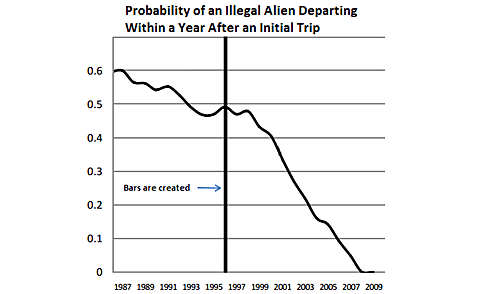
Source: Adapted and slightly edited from Doug Massey’s “Chain Reaction: The Causes and Consequences of America’s War on Immigrants.” http://www.iza.org/conference_files/amm2011/massey_d1244.pdf#page=29&nb…;
Ironically, these restrictions did more to lock unauthorized immigrants in the United States than to keep them out. The chance of an unauthorized immigrant leaving soon after his or her first trip to the United States has dropped from 50 percent to near zero since 1996. And the percentage of unauthorized immigrants who have resided in the United States for long periods of time has increased.


Source: Pew Hispanic Center. http://www.pewhispanic.org/2011/12/01/unauthorized-immigrants-length-of-residency-patterns-of-parenthood/
The number of unlawful immigrants who entered annually after 1996 was about the same as entered annually before, but since fewer left after the bars were enacted the population grew much more rapidly after the 3/10 year bars were put in place. According to Doug Massey at Princeton, if the same percentage of unauthorized immigrants had left during the 1990s and 2000s as left before the bars, there would be 5.3 million fewer unauthorized immigrants here today. Many would have returned home and others would have earned green cards through the family-based immigration system.
Keyhole Solution
All else remaining equal, immigration policy should encourage unauthorized immigrants to apply through the legal system – many of whom would now be able to reenter lawfully through the family immigration system if the 3/10 year bars were removed. Removing the 3/10 year bars would not be an amnesty for unauthorized immigrants, even though it would allow some of them here illegally to use the current system without a comprehensive reform.
Removing or Reforming the 3/10 Year Bars Isn’t Amnesty …
… but don’t take my word for it. Here are what many people, including some noted immigration restrictionists and conservative Republicans (no, they aren’t the same), have said in support of removing or reforming the bars:
- Mark Krikorian, Executive Director of the Center for Immigration Studies: “The 3/10 year bar … is not something I’m a big fan of. I think there are other ways of penalizing illegal immigrants for being illegal aliens. But no, that would not be [amnesty]—first of all, if [someone here illegally] got legal status, she would get legal status because she was the spouse of U.S. citizen through the normal immigration process.”
- Jessica Vaughn, Director of Policy Studies for the Center for Immigration Studies: “A responsible but still compassionate solution would be to offer [family members eligible for green cards] the opportunity to maintain eligibility, not through an amnesty … but by agreeing to wipe out their previous unlawful presence if they leave the country (emphasis added).”
- Paul Virtue, former general counsel of the Immigration and Naturalization Service: “Far from curtailing illegal immigration and deterring people from overstaying their visa as intended, [the] bars to admissibility are actually contributing to the unprecedented rise in the number of undocumented immigrants.”
- Former- Sen. Jim Demint (R‑SC), President of the Heritage Foundation: Sen. Demint endorsed the Krieble Foundation’s “Red Card Solution” which waives the bars and permits unauthorized immigrants to leave and return on work visas. As Demint wrote, “Congress could consider ideas for a practical, temporary worker program such as that being promoted by businesswoman Helen Krieble, called the Red Card Solution.”
- Rep. Bob Goodlatte (R‑VA), Chairman of the Judiciary Committee: “If you address some kind of reform of that aspect of it [3/10 year bars] you can avail people of an opportunity that they don’t have now.”
- Rep. Raúl Labrador (R‑ID), Republican Judiciary Committee member and former immigration attorney: “No one is going to go back home for 10 years. If we get rid of what we call ‘the bars’ … we could fix the problem for about 25 percent of the people that are here illegally. And we would do it through the proper legal system, so there’s no amnesty.”
- Rep. Steve Pearce (R‑NM), the only Republican congressman with a border district (press release): “This bipartisan immigration bill would grant discretionary authority to review specific cases for a small number of Americans who are separated from their families due to minor earlier violations which are technical in nature or occurred when the family member was a minor. Such review was permissible until 1996, when the current regulations were put in place … The American Families United Act would allow a judge or the Secretary of Homeland Security to review these cases and determine whether relief is in the public interest, an option not currently available. The legislation would prohibit this review for individuals without a legal basis to live in the U.S., or those with a serious criminal record.”
None of the people listed above would support broad-based legalization or amnesty. However, they all agree that removing or reforming the 3/10 year bars is a desirable reform that falls far short of “amnesty” but would nevertheless legalize many current unauthorized immigrants.