In the Republican debate last night, former Gov. Mike Huckabee of Arkansas criticized calls for Social Security reform, saying “people paid their money. They expect to have it,” and that the country needs to honor its promises to seniors. There are problems with this line of argument: the Social Security payroll taxes a person pays are not tied to the benefits they receive in a legal sense, and the ‘promises’ made by Social Security are, and always have been, subject to change.
Congress has had the authority to alter Social Security since its inception. Section 1104 of The Social Security Act of 1935 explicitly says: “The right to alter, amend, or repeal any provision of this Act is hereby reserved to the Congress.”
Not only does Congress have the right to make changes, it has done so multiple times in the past. Sometimes these changes are smaller things, like a technical correction to the indexation formula, but there were also larger reforms that were part of attempts to address the programs solvency issues.
The Supreme Court revisited the issue of Social Security’s promises in Flemming v. Nestor, in which Nestor, who had paid into Social Security for 19 years and begun to receive benefits, was then deported for previous ties to the Communist Party. Nestor tried to appeal the termination of his benefits, citing his previous contributions, but the Supreme Court upheld it, saying:
To engraft upon the Social Security system a concept of ‘accrued property rights’ would deprive it of the flexibility and boldness in adjustment to ever changing conditions which it demands… It is apparent that the non-contractual interest of an employee covered by the [Social Security] Act cannot be soundly analogized to that of the holder of an annuity, whose right to benefits is bottomed on his contractual premium payments.
The other aspect Huckabee touches on is the link between the taxes paid in and the benefits a person ultimately receives, implying that a worker’s contributions are kept in some kind of silo to be paid out to them at a later date. As another Supreme Court case found, this is not true.
In Helvering v. Davis (1937)the Court held that Social Security was not a contributory insurance program in the sense that “[t]he proceeds of both the employee and employer taxes are to be paid into the Treasury like any other internal revenue generally, and are not earmarked in any way.” Despite how Huckabee and his fellow defenders of the status quo describe the program, the payroll tax payments a person pays into Social Security have no direct link to the benefits that they receive in a legal sense: they are subject to future changes made by Congress and dependent on the program having sufficient revenue.
Huckabee doesn’t need to familiarize himself with these decades-old Supreme Court cases or the Social Security Act to be able to understand the problems with his invocation of the program’s ‘promises’. Anyone, including Huckabee, can see this for themselves in the Social Security Statement that the Social Security Administration periodically sends to workers:
Your estimated benefits are based on current law. Congress has made changes to the law in the past and can do so at any time.
The ‘promises’ with Social Security always came with an asterisk, and beneficiaries are not entitled to a certain amount because they have contributed payroll taxes. In the past the law has been altered to change the deal facing beneficiaries, and there will undoubtedly have to be more changes in the future if Social Security is to remain viable. If we maintain the status quo and do nothing, benefits will have to cut by 23 percent across the board when the combined trust fund is exhausted in 2034. There can be disagreements about the best way to reform Social Security, but when it is facing trillions in unfunded obligations and the certainty of drastic cuts in the future absent reform, doing nothing is not a feasible option.
Cato at Liberty
Cato at Liberty
Technically, even though the negotiations are over, the TPP isn’t finished being drafted. Lawyers are currently going over every inch of the agreement to make sure the negotiators’ intent is reflected effectively and accurately in the final text, which will presumably be released in the coming weeks. However, Wikileaks has published what appears to be the fully negotiated, pre-scrub TPP chapter on intellectual property. While the final text may have somewhat different language, the leaked version gives a clear picture of what the parties agreed to on a number of contentious IP issues.
I have been critical of the inclusion of IP rules in trade agreements generally and in the TPP in particular. Trying to resolve contentious policy differences that are not strictly trade-related impedes the important and valuable work of trade agreements in lowering trade barriers and reducing harmful protectionism. Moreover, trade negotiations are not the proper forum for devising complex patent and copyright systems, which if done poorly can have negative impacts on the rights of consumers and even hinder innovation.
It would have been best if the TPP did not impose any obligations related to IP, but it will, so the task at hand is to evaluate the individual provisions. While it’s tempting to judge TPP provisions as being good or bad policy on their face, it’s important to remember that the agreement does not exist in a vacuum. What matters is whether and to what extent the TPP is going to impact national IP laws—that includes not only changes to the law but also restrictions on a legislature’s ability to change the law later.
I offer three standards for judging individual IP provisions in the TPP. These standards are U.S.-focused, but you could do the same analysis for any other country.
- Does the provision require a change in U.S. law?
- Does the provision impose a greater obligation than past U.S. trade agreements?
- Is the provision more strict than current global rules at the World Trade Organization?
The original negotiating position of the United States in the TPP included provisions that went beyond current U.S. law. For example, U.S. negotiators wanted the TPP to require governments to limit copyright exhaustion to domestic sales, a rule that contradicts U.S. law’s global first sale doctrine. U.S. negotiators were also pushing for rules that secured more protections than previous U.S. trade agreements to match recent changes in U.S. law, the most prominent example being 12 years of market exclusivity for biologic medicines.
The latest leak reveals, however, that the United States failed to secure any of these ambitious proposals. In fact, the TPP’s IP chapter is by and large less onerous than the U.S.–Korea Free Trade Agreement, the most recent agreement negotiated by the United States before the TPP. Many provisions are less detailed and more flexible than their counterparts in the last agreement. I suspect this outcome is due in large part to the fact that the TPP has 12 members, many of whom do not want to reform their IP regimes.
But while the TPP’s IP chapter is apparently not going to impose any new international obligations on the United States, many of its provisions go beyond what is required under the rules of the WTO Agreement on Trade-Related Aspects of Intellectual Property Rights (TRIPS), and so other TPP members will have to change their laws. The most notable example of a TRIPS-plus requirement in the TPP is the provision mandating that copyrights last for 70 years after the author’s death. That is twenty years longer than the TRIPS requirement, so a number of TPP members—including Canada, Japan, and New Zealand—will have to extend copyright duration retroactively, keeping many very old works from entering the public domain for another two decades.
The IP chapter is just one of many components of the TPP that will need to be evaluated to determine whether the entire agreement is net liberalizing and therefore worth doing. Everyone should wait until the final text of the entire deal is available before making that determination.
It’s been a day since the disappointing “Nation’s Report Card” results came out, and it has given me a chance to crunch some numbers a bit. They don’t tell us anything definitive – there is a lot more that impacts test scores than a policy or two – but it is worth seeing if there are any patterns that might bear further analysis, and it is important to explore emerging theories.
Not surprisingly, while many observers have been rightly hesitant to make grand pronouncements about what the scores mean, some theories revolving around the Common Core have come out. The one I’ve seen the most, coming from people such as U.S. Secretary of Education Arne Duncan and Karen Nussle of the Core-defending Collaborative for Student Success, is that the Core will bring great things, but transitioning to it is disruptive and we should expect to see short-term score drops as a result.
That is plausible, and we can test it a bit by looking at the performance of states (and the Department of Defense Education Activity) that have demonstrated some level of what I’ll call Core aversion. Those are states that (1) hadn’t adopted the Core at the time of the NAEP test; (2) had adopted but had moved away by testing time; and (3) were still using the Core at test time but officially plan to move away. They are broken down in the following table, which uses score changes in the charts found here:

What we see in the highlighted area is that, with the exception of eighth grade math scores for states that will be departing the Core but were still in it as of NAEP testing, average score changes were better in all four testing categories for Core-averse states than the national average.
That the states that never adopted the Core outperformed the average could indicate that the disruption theory is correct: foregoing the transition to the Core enabled better performance. Of course, it could also be that the Core standards are less effective at boosting NAEP scores than what Core-averse states are using. Or that those states had better economies over the last two years. Or many other possibilities.
The problem for the disruption theory is that the states that adopted the Core but then dropped it likely underwent greater disruption than states that have been consistently working on the Core. Indeed, Michael Petrilli of the Core-supporting Fordham Institute said that Oklahoma was plunged into “chaos” when it abandoned the Core in May 2014. Yet the Core-dropping states performed better than the national average. It is also likely that the two states that announced they would be leaving the Core but were still in it as of the time of the NAEP testing – Missouri and South Carolina – experienced greater disruptions than consistent Core states.
Of course more, much deeper analysis of the NAEP data – and more iterations of the test – will be needed to reach any firm conclusions about the Core’s effects. But the disruption theory already seems to be in a bit of trouble.
Related Tags
The tax-reform landscape is getting crowded.
Adding to the proposals put forth by other candidates (I’ve previously reviewed the plans offered by Rand Paul, Marco Rubio, Jeb Bush, Bobby Jindal, and Donald Trump), we now have a reform blueprint from Ted Cruz.
Writing for the Wall Street Journal, the Texas Senator unveiled his rewrite of the tax code.
…tax reform is a powerful lever for spurring economic expansion. Along with reducing red tape on business and restoring sound money, it can make the U.S. economy boom again. That’s why I’m proposing the Simple Flat Tax as the cornerstone of my economic agenda.
Here are the core features of his proposal.
…my Simple Flat Tax plan features the following: • For a family of four, no taxes whatsoever (income or payroll) on the first $36,000 of income. • Above that level, a 10% flat tax on all individual income from wages and investment. • No death tax, alternative minimum tax or ObamaCare taxes. • Elimination of the payroll tax and the corporate income tax… • A Universal Savings Account, which would allow every American to save up to $25,000 annually on a tax-deferred basis for any purpose.
From an economic perspective, there’s a lot to like. Thanks to the low tax rate, the government no longer would be imposing harsh penalties on productive behavior. Major forms of double taxation such as the death tax would be abolished, creating a much better environment for wage-boosting capital formation.
And I’m glad to see that the notion of a universal savings account,

popularized by my colleague Chris Edwards, is catching on.
Moreover, the reforms Cruz is pushing would clean up some of the most complex and burdensome sections of the tax code.
But Cruz’s plan is not a pure flat tax. There would be a small amount of double taxation of income that is saved and invested, though the adverse economic impact would be trivial because of the low tax rate.
And the Senator would retain some preferences in the tax code, which is somewhat unfortunate, and expand the earned income credit, which is more unfortunate.
It maintains the current child tax credit and expands and modernizes the earned-income tax credit… The Simple Flat Tax also keeps the current deduction for all charitable giving, and includes a deduction for home-mortgage interest on the first $500,000 in principal.
But here’s the part of Cruz’s plan that raises a red flag. He says he wants a “business flat tax,” but what he’s really proposing is a value-added tax.
…a 16% Business Flat Tax. This would tax companies’ gross receipts from sales of goods and services, less purchases from other businesses, including capital investment. …My business tax is border-adjusted, so exports are free of tax and imports pay the same business-flat-tax rate as U.S.-produced goods.
His proposal is a VAT because wages are nondeductible. And that basically means a 16 percent withholding tax on the wages and salaries of all American workers (for tax geeks, this part of Cruz’s plan is technically a subtraction-method VAT).
Normally, I start foaming at the mouth when politicians talking about value-added taxes. But Senator Cruz obviously isn’t proposing a VAT for the purpose of financing a bigger welfare state.
Instead, he’s doing a swap, imposing a VAT while also getting rid of the corporate income tax and the payroll tax.
And that’s theoretically a good deal because the corporate income tax is so senselessly destructive (swapping the payroll tax for the VAT, as I explained a few days ago in another context, is basically a wash).

But it’s still a red flag because I worry about what might happen in the future. If the Cruz plan is adopted, we’ll still have the structure of an income tax (albeit a far-less-destructive income tax). And we’ll also have a VAT.
So what happens 10 years from now or 25 years from now if statists control both ends of Pennsylvania Avenue and they decide to reinstate the bad features of the income tax while retaining the VAT? They now have a relatively simple way of getting more revenue to finance European-style big government.
And also don’t forget that it would be relatively simple to reinstate the bad features of the corporate income tax by tweaking Cruz’s business flat tax/VAT.
By the way, I have the same specific concern about Senator Rand Paul’s tax reform plan.
My advice to both of them is to ditch the VAT and keep the payroll tax. Not only would that address my concern about enabling the spending proclivities of statists in the future, but I also think Social Security reform is more feasible when the system is financed by the payroll tax.
Notwithstanding my concern about the VAT, Senator Cruz has put forth a plan that would be enormously beneficial to the American economy.
Instead of being a vehicle for punitive class warfare and corrupt cronyism, the tax code would simply be the method by which revenue was collected to fund government.
Which gives me an opportunity to raise an issue that applies to every candidate. Simply stated, no good tax reform plan will be feasible unless it’s accompanied by a serious plan to restrain government spending.
Related Tags
The budget agreement between congressional leaders and the Obama administration would break prior budget caps and increase spending over the next two years by $80 billion. The Bipartisan Budget Act (BBA) of 2015 would theoretically offset that cost with savings down the road, but promises of future savings are worth little given that GOP leaders have shown they will break agreed-to restraints whenever the time comes. The Heritage Foundation is right that the deal is a “colossal step” in the wrong direction and “does nothing to reduce the size and scope of government.”
If passed, the deal would undermine a crucial GOP policy plank going into 2016. The issue that unifies all the Republican presidential candidates is the promise of major tax cuts for individuals and businesses. It has been heartening to see so many candidates proposing pro-growth cuts. The Tax Foundation has run the numbers on the plans, and nearly all of them would generate revenue losses for the government and savings for the people.
I’m all for a large tax cut, but how do Republicans plan on passing such a cut if they keep increasing spending? The next president will be confronted with very ugly budget numbers looking forward, thanks partly to the bipartisan profligacy of recent years. Coming into office in 2017, the new president will see deficits exploding to more than $1 trillion by the early 2020s, and $8 trillion more in debt projected to be piled up over the coming decade.
The best pro-growth tax cuts should be enacted regardless of the deficit situation. In particular, a permanent corporate tax rate cut would generate strong economic growth and would not increase the long-term deficit because the corporate tax base is so dynamic. But to cut taxes, the next president will have to convince enough members of Congress to go along, and the higher are spending and deficits, the harder it will be to get moderates on board.
By repeatedly caving into President Obama, Republican leaders are undermining the ability of the next president, if a Republican, to follow though on major tax reforms and stronger economic growth.
The chart below shows total federal spending on programs, and excludes spending on interest, which has been abnormally low in recent years. While current spending is down from the stimulus peak of 2009, it is still substantially above spending during the Bush years, which in turn was substantially above spending during the Clinton years. With the new budget deal, non-interest spending will be about 19.9 percent of gross domestic product (GDP) in 2016, up more than two percentage points from the Bush years.
That may not sound like much, but two points of GDP is about how much the government collects in corporate income taxes each year. If Obama and the Republicans hadn’t splurged on spending in recent years, we would have had the budget room to completely abolish the corporate income tax—a reform that would generate a powerful boom and rising prosperity for all Americans.
Rising spending matters because it damages the economy. But it also matters because it balloons deficits and makes desperately-needed tax reforms more difficult.

Data note: the 2009 spending spike was not quite as high as shown because recorded TARP spending did not materialize.
Related Tags
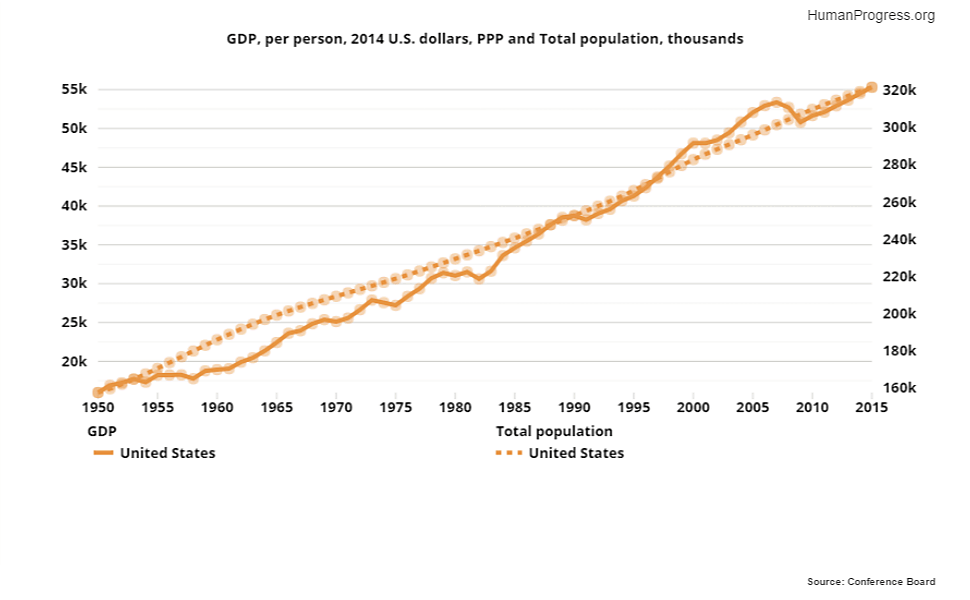
Today, China abandoned its 35-year-old one-child policy. Based on the now debunked threat of overpopulation that was popularized by Stanford University scholar Paul Ehrlich, the communist government subjected the Chinese people to forced sterilizations and abortions. Many newborn babies were either killed or left to die. Today, the Chinese population suffers from a dangerous gender imbalance that favors boys over girls at a ratio of 117:100, and a demographic implosion that threatens future economic growth and prosperity. In fact, as Human Progress advisory board member Matt Ridley shows in his book The Rational Optimist, population growth and economic expansion go hand in hand. The horrific consequences of the Chinese one-child policy are a reminder of what happens when governments are allowed to interfere in the deeply personal decisions of individual citizens and their families.
Related Tags
For decades, discriminatory housing policies in the U.S. restricted the ability of black citizens to purchase homes outside of predominantly black ghettos. From the 1950s through the 1970s, real estate speculators called “blockbusters” made some progress opening up white-only neighborhoods to black families until an odd coalition of segregationists and left-wing activists succeeded in regulating blockbusters out of existence. Tragically, the U.S. housing market has remained largely segregated even until today. Moreover, because a family’s access to a quality education is determined primarily by the location of their home, black children are disproportionately assigned to low-performing district schools, depriving them of opportunity.
Sadly, misguided suspicions about the market led left-wing leaders to support paternalistic regulations that harmed the very people they intended to help — a disastrous mistake that many modern progressives are now repeating in education policy.
In a recently updated version of his 1998 paper, “A Requiem for Blockbusting,” Dmitri Mehlhorn of the Progressive Policy Institute details the sordid history of discriminatory housing policy in the U.S. When Southern agricultural jobs dried up in the early 20th century, black workers began migrating to the industrial North. The response was ugly:
White Americans mostly reacted to this migration with coordinated and violent hatred. Driven by xenophobia, they used physical, political, and economic power to drive blacks into strictly circumscribed ghettos. The ugliness was a team sport, including local governments, state and federal agencies, courts, businesses, and the media.
At the federal level, the Federal Housing Administration encouraged racial covenants, stating that they “provide the surest protection against undesirable encroachment and inharmonious use.” These covenants contractually prohibited homes from being resold to black families. By the 1940s, integrated neighborhoods had ceased to exist in every major city in the United States.
The U.S. Supreme Court eventually ruled against racial covenants in housing, but racists found workarounds. As Mehlhorn details:
For instance, both federal and local agencies encouraged white flight by steering resources to whites seeking segregated suburban houses and schools, while cutting those resources for black families. So-called “urban renewal” laws were used to raze expanding black neighborhoods that threatened white institutions. Federal funds were used to construct massive public housing projects for the displaced black residents.
We are still feeling the effects of these discriminatory policies today, particularly in education, which is intimately linked with housing policy. According to a 2012 study by the UCLA Civil Rights Project, “80% of Latino students and 74% of black students attend majority nonwhite schools (50–100% minority), and 43% of Latinos and 38% of blacks attend intensely segregated schools (those with only 0–10% of whites students) across the nation.”
In the 1950s, “blockbusters” began selling homes in white areas to black families in violation of industry norms because they could charge blacks significantly higher prices. As Mehlhon details:
From the 1950s onward, for roughly two decades, blockbusters bought low, sold high, and moved housing supply from whites to blacks at an accelerating pace. By 1962, when blockbusting had been in existence for barely a decade, Chicago alone had over 100 operators. For a time, blockbusters around the country were on pace to destroy the price differential between white and black housing markets, making housing much more widely available for African Americans.
But make no mistake, these men were hated.
It’s easy to understand why segregationist whites hated the blockbusters, whom the segregationists accused of being race traitors perpetrating “communicide.” The reason progressives joined with the segregationists in supporting laws against blockbusting is more complicated. Progressives believed blockbusting entailed an “unconscionable exploitation of minority groups” for profit because blockbusters regularly charged blacks higher prices than whites. Congress responded by passing a series of regulations restricting blockbusting and in 1969, a federal court ruled that any black homebuyer could invalidate his property and finance contracts if he could demonstrate “that he was charged more than a white person would have been charged or that he received less favorable terms and conditions than would have been given to a white person.” On its face, that seems sensible. But practically, as Mehlhorn shows, these regulations and rulings preserved segregation:
Thus, by the early 1970s, any real estate agent who wished to sell a home to a black family faced enormous legal liabilities. If any clients alleged that their contractual terms were not identical to the terms a white family might have obtained, they would have an automatic cause of action in federal court to challenge the contracts. If a client asked about changing racial demographics, the agent would either have to decline to answer, or could be subjected to substantial civil and criminal penalties. Given the realities of the racially segregated markets of the time, the only safe way to avoid these lawsuits was to adhere to the prior professional code of racial steering: buy and sell homes only within a single race.
Blockbusters charged blacks higher prices but, as Mehlhorn explains, they also bore significantly higher risks and costs. “By dealing with blacks, blockbusters earned the social sanctions of the segregationist era, including boycotts, local government sanctions, and even death threats.” At the time, “banks would not lend to blacks and whites would not sell to blacks” so, Mehlhorn concludes, “Without the profits available from blockbusting, the real estate and finance industries might not have been willing to alienate their racist white customer base by dealing with blacks, or at the very least might have slowed their activities. The profits available to blockbusters were the biggest driver of support for black homebuyers during this period.” By eliminating those profits, well-intentioned activists eliminated blacks’ only promising avenue to escape the ghetto and live in middle-income communities.
Given all of these problems, it seems astonishing that progressive elements of society supported the anti-blockbusting movement. The problem appears to be that progressives lacked economic savvy, and in fact were openly hostile to market mechanisms. This hostility blinded them to the needs of individual blacks and allowed them to accept destructive policies. […]
The first way that blacks suffered from this bias by their leaders was at the individual level. Prior to anti-blockbusting laws, blacks had the choice of whether or not to patronize blockbusters. By the millions, blacks indicated that their preference was for blockbusting. The anti- market, anti-blockbusting progressives, however, refused to accept that choice as legitimate, and thus enacted laws that prevented blacks from acting upon these preferences. Perhaps some progressives genuinely felt that the decisions to patronize the blockbusters were the result of market distortions such as fraud. Others, however, refused even to accept the possibility that market mechanisms can empower individuals and reveal preferences.
Fear and misunderstanding about profit and market mechanisms also drives much of the modern left’s opposition to school choice. Even more prevalent is the concern that by choosing a better education for their children, parents who accept vouchers or tax-credit scholarships or enroll their children in charter schools thereby deprive traditional district schools of funding. The left’s solution, therefore, is to deprive families of that choice — and those families are disproportionately low-income minorities.
Take, for example, the case of Washington D.C.‘s Opportunity Scholarship Program (OSP). Nearly all of the OSP voucher recipients are black or Hispanic and a gold-standard study of the program found that it increased high school graduation rates by 12 percentage points. As the study’s lead researcher notes, this finding is important because “high school graduation is strongly associated with a large number of important life outcomes such as lifetime earnings, longevity, avoiding prison and out-of-wedlock births, and marital stability.” Moreover, Congress intentionally funded the OSP separately from the district schools to shield them from any fiscal impact. Yet although 74 percent of D.C.‘s mostly black residents support the OSP, all but two Democrats in Congress voted against the OSP’s reauthorization last week.
D.C.‘s non-voting member of Congress, Eleanor Holmes Norton, condemned the voucher program as Speaker John Boehner’s “pet project” and argued that “D.C. residents, not unaccountable members of Congress, know best what our children need and how to govern our own affairs.” However, by “our own affairs” Norton appears to be referring to government officials rather than individual residents and families. Norton’s language betrays the progressive inclination to celebrate democratic decision-making while dismissing decisions made in a market, a tendency that Mehlhorn detected in the progressive opposition to blockbusting:
One court made this argument explicitly, holding that blacks should be forced to express their preferences through political, instead of market, mechanisms. According to this court, the availability of housing from blockbusters actually reduced the likelihood of true justice, “by offering the long-oppressed black an unattractive yet alternative choice to that of a confrontation for equal buyers’ rights in a white neighborhood.” The explicit articulation of the court’s anti-market bias allows us to explore its moral and empirical flaws. At face value, the court’s argument seems brutal. After all, the court appears to be agreeing that individual blacks would choose blockbusters over political confrontation. Nonetheless, the court refuses to allow them that option, preferring to force them to take political action. In addition to moral problems with overtly removing decision-making power from blacks, the court’s logic has little empirical grounding. The court fails to consider the speculative nature of the eventual political relief, or the costs that would be imposed by delay while blacks waited for political reform to take effect. Moreover, it is not clear how making blacks desperate would have enhanced their ability to influence the all-white power-brokers of city government.
One hears echoes of these arguments in the claims of some modern leftists that–using Albert O. Hirschman’s lexicon–giving families an “exit option” (the ability to leave a school that isn’t working for them) undermines their exercise of “voice” (advocating for change) within in a school. However, this is an empirically testable hypothesis and it has been tested repeatedly. Of 23 studies on the impact of competition on district schools, 22 found a modest but statistically significant positive impact on student outcomes and one found no detectable difference. None found harm.
Indeed, the ability to leave may well enhance the ability of and propensity for parents to advocate change within their schools. Hirschman himself later realized that “opening up of previously unavailable opportunities of choice or exit may generate feelings of empowerment in parents, who as a result may be more ready than before to participate in school affairs and to speak out.” When administrators who know that parents have other options, they are more likely to pay attention to their concerns. And when parents see that the administration takes their concerns seriously, they’re more likely to speak up. Choice, therefore, benefits not only those who choose to leave it but also those who choose to stay.
Moreover, despite fears to the contrary, numerous studies have found that school choice improves integration. As Dr. Ben Scafidi details in a Friedman Foundation study released yesterday, school choice policies have a better track record of promoting integration than government efforts. Sadly, it is too often the case that “government restrictions on the choices of African Americans and of low-income families leads to a more segregated society.”
The market is not the enemy of social justice. As Mehlhorn observes, “Markets allow an expression of preferences, including in some circumstances the preferences of society’s worst-off.” The best way for policymakers to foster integration and remedy historical wrongs against minorities is to empower minorities to make decisions in their own best interests rather than to presumptuously make decisions for them.
To learn more about the impact of housing policy on access to quality education, watch the recent Cato Institute event, “Race, Housing, and Education”: