Just for fun: check it out, by artist Mike Wilkins (via our friend Eugene Volokh, who incidentally is the subject of a new magazine profile, on April 1). Because sometimes you want a version more whimsical (if much less portable) than Cato’s Pocket Constitution.
Cato at Liberty
Cato at Liberty
Topics
Curing Cancer with Innovation
While a “cure for cancer,” is not yet in hand, it is probably not as far away as you think. As an article in yesterday’s Wall Street Journal shows, we are making tremendous strides in the fight against cancer.
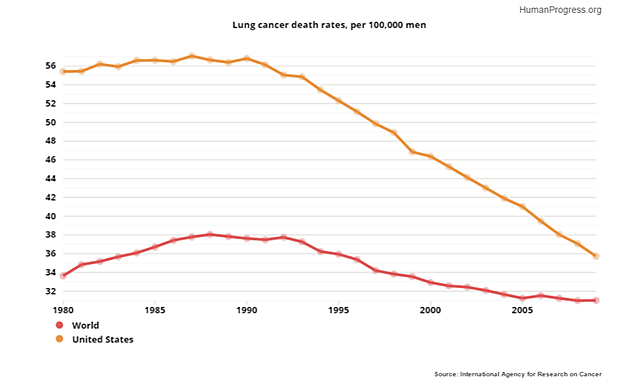
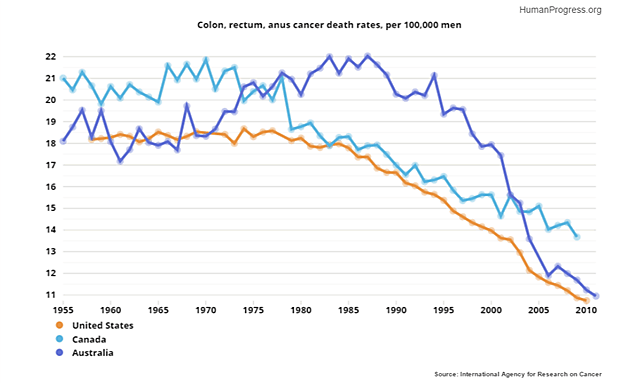
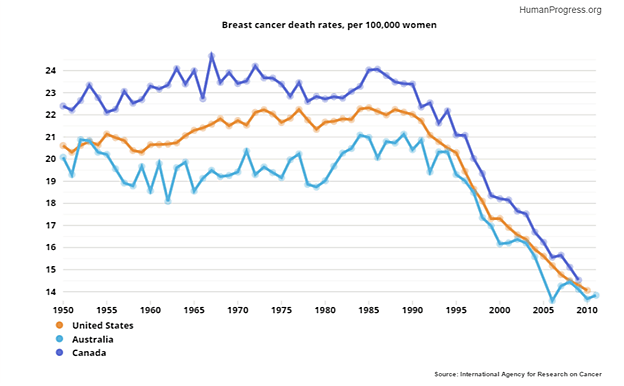
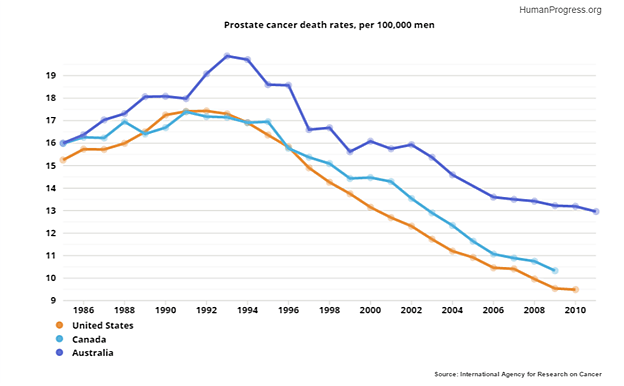
Let us take a moment to look at the data and rejoice in the many lives saved by medical innovation. We focus on gains made against the top four deadliest cancers: lung cancer, bowel cancer, breast cancer, and prostate cancer.
Consider how the lung cancer death rate per 100,000 men has decreased since the 1980s:
While the decline is global, the greatest gains can be seen in wealthy, developed countries like the United States. This is in part because, as HumanProgress.org advisory board member Matt Ridley notes, “In the western world we’ve conquered most of the causes of premature death that used to kill our ancestors,” and with old age comes an increased incidence of cancer, making gains against cancer more notable.
Next, consider how the death rate for the second deadliest cancer–colon or bowel cancer–has fallen in the developed world.
There has also been a steep decline in the breast cancer death rate per 100,000 women. The death rate for the third deadliest cancer held fairly steady from the 1950s through the early 1990s, when it began to plummet, and it has continued to fall ever since.
Finally, consider the similar drop in the death rate of prostate cancer, the fourth deadliest cancer.
Innovation and the free market are helping to propel the medical advancements leading to falling cancer death rates. Some people believe that the modern lifestyle (e.g., drinking soda) causes cancer, but those claims are uninformed–most cancer is the result of bad luck. Instead of killing us, innovation is actually saving lives.
We have seen that cancer breakthroughs abound when regulation does not slow them down. To hurry along a cure for cancer, we need to let free innovation take its course.
Related Tags
Arizona Governor Vetoes Bill Hiding the Names of Police Involved in Shootings
Arizona Gov. Doug Ducey (R) has vetoed a bill that would have prohibited disclosure of the names of police officers involved in shootings for 60 days, citing the potential unintended consequences of such a law:
“I know the goal of this legislation is to protect officers and their families, and it’s a goal I share… Unfortunately, I don’t believe this bill in its current form best achieves the objectives we share, and I worry it could result in unforeseen problems.”
While proponents argued that the bill was necessary to prevent officers from being unfairly targeted by mass protests or threatened with violence, opponents–including some in law enforcement–argued that transparency considerations and community relations outweighed that concern.
Roberto Villaseñor, chief of the Tucson Police Department and president of the Arizona Association of Chiefs of Police, told the New York Times:
“To add another law that’s going to add distrust or adversarial relationships is not the way to go. Why do I cloak it in secrecy for 60 days, and now I’m going to have this story run twice? Sixty days later, we’re going to rehash it again.”
The opaqueness of government behavior, especially surrounding the government’s use of violence, has eroded the rule of law and the relationship between civilians and police around the country. Transparency about police shootings is a necessity for effective reform and accountability. We need more transparency, not less.
Good for Governor Ducey and the Arizona law enforcement officials who stood against more police secrecy.
When It Comes to Police Body Cameras, Federalism Is Key
Last week, Sens. Rand Paul (R‑KY) and Brian Schatz (D‑HI) introduced legislation that would create a pilot grant program to assist state and local police agencies in leasing or purchasing body-worn cameras. The bill requires states, “units of local government,” and Indian tribes wishing to receive a full grant to commit to a range of reforms related to privacy, police practice, and data storage.
The bill presents something of a dilemma for libertarians like me, who want increased accountability and transparency within law enforcement but are also hesitant to support federal policy prescriptions for issues such as policing, which are often best handled at the local level. Given the worrying body camera legislation that has been proposed by some state lawmakers, it is tempting to think that a conditional federal police body camera grant program might be the best way to ensure that local government agencies implement worthwhile body camera policies. Yet Paul and Schatz’s legislation shows that police body camera policy ought to be addressed at the state and local level.
This is not to say that the legislation does not contain some good policy requirements. If the bill were to be enacted as written, an entity (state, unit of local government, or Indian tribe) interested in receiving a full grant would have to demonstrate a commitment to implementing some sensible policies before officers use the body cameras.
Among those policies is the development of public regulations and protocols relating to the use of body cameras, the storage of body camera footage, and the protection of the privacy rights of individuals recorded by body cameras. This is an important requirement. As the ACLU discovered last year, some law enforcement agencies do not have body camera policies, and some of those that do choose not to release them.
Yet while the legislation does make committing to publishing policies related to the release of body camera footage a condition for receipt of a full grant, it does not require that these policies advance transparency and accountability. The legislation only requires that a requesting entity develop and publish policies for “the release of any data collected by a body-worn camera in accordance with the open records laws, if any, of the State” (my bolding).
This is worrisome considering that, according to the AP, “Lawmakers in nearly a third of the states have introduced bills to restrict public access to recordings from police officer-worn body cameras.” Some of these bills, such as Michigan’s HB 4234 and Florida’s SB 248, aim to protect citizens from privacy violations by exempting police body camera footage of the interior of private homes from disclosure. SB 248 extends this protection to footage captured at the site of medical emergencies and on the property of social service, mental health, and health care facilities. However, other legislation such as North Dakota’s HB 1264, which has been passed by the North Dakota House and Senate, exempts body camera footage “taken in a private place” from public record requests. New Hampshire’s HB 617 would make police body camera footage exempt from public record requests, though HB 617 would allow for citizens who pay for the recording to access body camera footage in which they can be seen or heard. (HB 617 would also require state police to use body cameras and to record all interactions with the public).
There is at least one case of a public record exemption bill being gutted in state legislatures. The Arizona House cut a section of a Senate bill that would have exempted police body camera footage from public record requests.
In addition to only requiring that entities receiving grants commit to developing and publishing policies relating to existing open record laws, the Paul and Schatz legislation also states:
IN GENERAL.—Data collected by an entity receiving a grant under this section from a body-mounted camera shall be used only in internal and external investigations of misconduct by a law enforcement agency or officer, if there is reasonable suspicion that a recording contains evidence of a crime, or for limited training purposes.
Unfortunately, the legislation does not outline how this requirement is compatible with comparatively open state public record laws that may regulate the release of police body camera footage.
Given that state lawmakers are working on implementing a range of police body camera policies, federal legislation such as Paul and Schatz’s would potentially allow for law enforcement agencies that are subject to poor open record laws to receive body camera grants. A good police body camera policy will allow for footage captured by the cameras that has been sensibly redacted and is not part of an ongoing investigation to be available via public record request. As written, Paul and Schatz’s bill provides no incentive for state lawmakers to improve their public record laws as they relate to police body cameras, although it does require that within 90 days of the bill being enacted the COPS director outline grant submission requirements.
In the coming years we should expect good as well as bad body camera policies to be passed by state legislators. While the bad policies will be frustrating to those advocating for increased police accountability and transparency, this frustration will not warrant the implementation of federal body camera grants. As with many other policy areas, police body camera policy ought to be crafted within America’s laboratories of democracy. As time goes on it will become increasingly clear which police body camera policies encourage good behavior and increase transparency as well as accountability, and are therefore worth copying.
Supreme Court Reinforces Jones Conception of 4th Amendment
In a per curiam opinion this week, Grady v. North Carolina, the U.S. Supreme Court reinforced recent 4th Amendment decisions in holding that when the government physically occupies private property for the purpose of obtaining information, it engages in a search under the 4th Amendment.
The State of North Carolina subjects certain repeat offenders to a lifetime of satellite-based monitoring (SBM) after they complete their sentences. The plaintiff, Torrey Dale Grady, argued that such a program represents a violation of his 4th Amendment rights under recent U.S. Supreme Court opinions, including a 2012 case called United States v. Jones (installing a GPS tracker on a suspect’s car represents a search) and a 2013 case called Florida v. Jardines (using a drug-sniffing dog on a suspect’s porch represents a search).
The Supreme Court agreed with Grady that such monitoring constitutes a search. In light of these decisions, it follows that a state also conducts a search when it attaches a device to a person’s body, without consent, for the purpose of tracking that individual’s movements.
In concluding otherwise, the North Carolina Court of Appeals apparently placed decisive weight on the fact that the State’s monitoring program is civil in nature. See Jones, ___ N. C. App., at ___, 750 S. E. 2d, at 886 (“the instant case … involves a civil SBM proceeding”). “It is well settled,” however, “that the Fourth Amendment’s protection extends beyond the sphere of criminal investigations,” Ontario v. Quon, 560 U. S. 746, 755 (2010), and the government’s purpose in collecting information does not control whether the method of collection constitutes a search. A building inspector who enters a home simply to ensure compliance with civil safety regulations has undoubtedly conducted a search under the Fourth Amendment.
The court also rejected North Carolina’s somewhat strange argument that its monitoring program is not meant to collect information:
In its brief in opposition to certiorari, the State faults Grady for failing to introduce “evidence about the State’s implementation of the SBM program or what information, if any, it currently obtains through the monitoring process.” Brief in Opposition 11. Without evidence that it is acting to obtain information, the State argues, “there is no basis upon which this Court can determine whether North Carolina conducts a ‘search’ of an offender enrolled in its SBM program.” Ibid. (citing Jones, 565 U. S., at ___, n. 5 (slip op., at 7, n. 5) (noting that a government intrusion is not a search unless “done to obtain information”)). In other words, the State argues that we cannot be sure its program for satellite-based monitoring of sex offenders collects any information. If the very name of the program does not suffice to rebut this contention, the text of the statute surely does:
“The satellite-based monitoring program shall use a system that provides all of the following:
“(1) Time-correlated and continuous tracking of the geographic location of the subject ….
“(2) Reporting of subject’s violations of prescriptive and proscriptive schedule or location requirements.”
N. C. Gen. Stat. Ann. §14–208.40(c).
The State’s program is plainly designed to obtain information. And since it does so by physically intruding on a subject’s body, it effects a Fourth Amendment search.
The Court did not, however, examine whether the program constitutes an unreasonable, and therefore unconstitutional, search. The case was remanded to a lower court to sort through that issue.
Notwithstanding the reasonability issue, this ruling reinforces a heartening trend in 4th Amendment jurisprudence away from the nebulous “reasonable expectation of privacy” standard and toward a more concrete “common-law trespass” standard, at least insofar as searches of private property are concerned.
The Fed and the Recovery, or, QE not D
Lately more and more people seem inclined to congratulate the Fed for the great job it has done saving us from another Great Depression and getting the U.S. economy back on its feet. Frankly, I’m getting tired of it.
It’s not that I’m cock-sure that the Fed’s post-2008 actions haven’t achieved anything. It’s just that I’m pretty darn sure that all the people who claim that the Fed has done a bang-up job haven’t any solid reasons for doing so. They remind me of the characters in an episode of The Beverly Hillbillies who were certain that Granny had a concoction that could cure the common cold–certain, that is, until Granny told them that it took about ten days for the stuff to work.
Some point to Europe’s relatively feeble economy, and the ECB’s belated attempt to revive it by means of Bernanke-style Quantitative Easing, as proof of the Fed’s enlightened conduct. But that comparison may only prove that Europe’s central bank has bungled things even more than ours has. In fact, the comparison doesn’t even prove that much, since U.S. money market conditions appeared to offer better prospects for the success of quantitative easing than those that prevailed in Europe.
Apart from being better than Europe’s, our recovery offers precious little for Fed boosters to brag about. It has been remarkably slow—slower, according to some experts, than the severity of the crisis can itself account for. It has been remarkably incomplete. And it has landed us in a low low-interest-rate mire from which there’s no easy escape.
But surely, some may object, the Fed’s policies—all that Quantitative Easing and Twisting and Reverse-Repo-ing—have helped. Maybe. But proving the point isn’t just a matter—as some commentators seem to think—of pointing to improved economic numbers, noting that the numbers arrived after the Fed did this and that, and declaring Quod Erat Demonstrandum.
Why not? Because, first of all, economies tend to recover from slumps, if only very slowly and painfully, without the help of fiscal or monetary stimulus. The immediate cause of such slumps is a slow down or collapse of spending or “aggregate demand,” like the one that took place during the last half of 2008. When spending collapses, businesses generally can’t recover their costs. Nor can they hope to keep producing as before, unless the prices of their inputs decline enough to make up for their lower earnings. The ideal remedy is to get spending back up again—and fast—by increasing the total supply of dollars. But suppose you had a negligent central bank that first resisted creating new dollars, and then made sure that new dollars it did create piled up in bank vaults instead of being lent and spent. In that case, spending would remain depressingly low. [1]
What then? Well, eventually, people start to come to grips with the new reality. They stop hoping that spending will pick up again, and start thinking about getting by at a permanently lowered spending level. In economists’ fancy jargon, this means that “aggregate supply” schedules start dropping. In plain English it means that workers start to accept pay cuts they wouldn’t have considered before, while firms settle for lower product prices.
Downward supply-schedule shifts aren’t pretty. No one likes making them—and I’m certainly not recommending them. (I also promise to track-down and give a noogie to anyone who suggests otherwise.) But make them they will—eventually—if the alternative is not selling their services and goods at all. The adjustments might be delayed for a long time, and it might take much longer for them to succeed in getting the economy back to full employment. They might even take more than six years to do so. But it’s hardly likely that they would not have achieved some considerable measure of recovery during such a long stretch of time, unless it was because monetary (or fiscal) authorities discouraged needed adjustments by repeatedly promising to revive spending, and then failing to deliver on those promises.
The last observation brings me to my second point, which is that central bank actions—including some superficially expansionary ones—can delay as well as promote recovery. Policy announcements that end up giving a bigger boost to aggregate demand expectations than to aggregate demand itself are one example. (I continue to be perplexed by all the chatter since 2008 concerning the need to raise, not the actual, but the expected rate of CPI inflation–as if doing that would not have the effect of further raising supply schedules that are already too high.) And although Quantitative Easing necessarily increases the nominal supply of bank reserves, it doesn’t necessarily increase that supply more than it increases demand: as St. Louis Fed economist Li Wen has observed, when real interest rates on riskier assets are already low relative to the return on reserves, QE can cause some investors “to switch from interest-earning assets to money,” and so can actually end-up reducing instead of increasing an (already excessively low) equilibrium price level.
All of which is a long way of saying that determining the Fed’s actual contribution to the recovery takes some fancy statistical work—so fancy, indeed, that no one is quite sure how to do it. Instead we have, so far, numerous studies reaching different—and sometimes dramatically different—conclusions. (Here is another review of some of them.)
Many of these studies do find that the Fed’s policies succeeded to some degree. But “succeeded” in most of them means succeeded in lowering long term interest rates, which though perhaps a step in the right direction is not at all the same thing as boosting employment or real output. Those studies that attempt to measure the effect of the Fed’s interventions on output or employment generally report modest gains only, if not negligible ones (see, for instance, the studies by Wen and by Chen, Cūrdia, and Ferrero). Finally, even some of the larger estimates supply only very meager grounds for celebration. One recent Federal Reserve Board study, for example, has the Fed’s combined Large Scale Asset Purchases achieving a 1.2 percentage point peak reduction in the unemployment rate by early 2015. Though large compared to other estimates, this reduction in the unemployment rate is less than half as large as that attributable to the post-2008 decline in labor force participation. Also, because the actual unemployment rate in January 2015 was 5.7%, with 9,000,000 unemployed and an implied labor force of 157,894,737, the gain amounts to only about one job for every $2 million in Fed asset purchases!
Don’t get me wrong: I’m not claiming that the new jobs attributable to Fed asset purchases weren’t worth it: creating money to combat cyclical unemployment isn’t the same as spending it in a state of full employment, so the numbers I mentioned don’t amount to any sort of cost-benefit calculation. What I am saying is that its worth pondering whether, had it handled things differently, the Fed might have created a lot more jobs, without having had to create nearly as many dollars. Suppose, for instance, that, instead of engaging in sterilized direct lending, the Fed had taken steps to expand the monetary base as soon as demand started flagging (or, better still, that it had expanded preemptively, as it had done on some prior occasions when markets were badly rattled). Suppose that it had refrained from paying interest on bank reserves just when the economy was starving for want of lending and spending. Suppose that instead of trying by hook and crook to preserve an obsolete interest-rate target, it had been targeting NGDP growth all along. Suppose, to go a bit further back, that it had not rescued Bear Stearns, or that, having rescued it, it made clear that it did so for reasons that would not entitle larger investment banks to similar aid?[2] Suppose, finally, that instead of “rolling the dice” (as the New York Times put it recently), the Fed had stuck to a tried-and-true monetary rule, or that it had been obliged to follow a novel but potentially superior rule, and that it had also obeyed Walter Bagehot’s sound advice for last resort lending? Is is not possible that by doing some or all of these things it might have allowed the U.S. economy to recover at least as rapidly as it has, if not considerably more rapidly, without having to purchase trillions of dollars worth of assets?
What difference does the extent of the purchases make? Plenty. First, the wealth redistribution effects of the Fed’s policies might have been smaller and correspondingly less unpalatable. Second, the Fed might not have undermined to the extent that it has its ability to tighten money by means of conventional open-market sales. The Fed claims it can instead manage by means of a combination of reverse repos and a higher interest rate on bank reserves; but there are good reasons for being less-than-sanguine about these alternative “exit” strategies: for one thing, to the extent that they succeed in reducing banks’ excess reserve holdings, they do so by permanently increasing the Fed’s share of total financial intermediation (and correspondingly reducing the efficiency of investment), and (so far as repos are concerned) by inadvertently propping-up Money Market Mutual Funds at the expense of commercial banks.[3] Finally, by boosting the prices and lowering the term premium on low-risk assets, the Fed has given an artificial fillip to riskier ones, increasing in like measure the risk of a major correction.[4] In short, after more than six years worth of Fed experiments, we haven’t yet heard the last monetary-policy shoe drop.
Am I suggesting that the Fed could not possibly have done worse? Of course not. Only someone with a severely defective imagination could suppose so. Whatever his shortcomings, Ben Bernanke was far from being an incompetent central banker. In suggesting that we might have done better than Bernanke’s Fed did, I don’t mean that we could have used a better discretion-wielding central banker. I mean that we might have been better off avoiding seat-of-the-pants-style central banking altogether.
I struggle, moreover, to understand why more people don’t take the same view. For if it takes a stunted imagination to suppose that things couldn’t have been worse, it takes a no-less defective one to suppose that we couldn’t possibly improve upon the presently-constituted Fed. Far for supplying grounds for celebration, or warranting complacency, the events of the last decade or so ought to make it more evident than ever that our monetary system is very far from being the best of all possible alternatives.
[1] If you wonder why any monetary authority would encourage banks to hoard reserves in the middle of a spending crunch, the answer in the Fed’s case is that they did it precisely because they didn’t want Quantitative Easing to lead to increased bank lending and, thence, to a general increase in spending. “It is important to keep in mind,” a Fed source informs us, “that the excess reserves [generated by Quantitative Easing] were not created with the goal of lowering interest rates or increasing bank lending significantly relative to pre-crisis levels. Rather, these reserves were created as a by-product of policies designed to mitigate the effects of a disruption in financial markets. In fact, the central bank paid interest on reserves to prevent the increase in reserves from driving market interest rates below the level it deemed appropriate given macroeconomic conditions. In such a situation, the absence of a money-multiplier effect should be neither surprising nor troubling.” Got that?
[2] Here, for once, the FCIC got things right:
The lesson taught by the rescue of Bear was that all large financial institutions—and especially those larger than Bear—would be rescued by the government. The moral hazard introduced by this one act irreparably changed the position of Lehman Brothers and every other large firm in the world’s financial system. From that time forward, (i) the critical need for more capital became less critical; the likelihood of a government bailout would reassure creditors, so there was no need to dilute the shareholders any further by raising additional capital; (ii) firms such as Lehman that might have been saved through an acquisition by a larger firm or an infusion of fresh capital by a strategic investor drove harder bargains with potential acquirers; (iii) the potential acquirers themselves waited for the U.S. government to pick up some of the cost, as it had with Bear—an offer that never came in Lehman’s case; and (iv) the Reserve Fund, a money market mutual fund, apparently assuming that Lehman would be rescued, decided not to sell the heavily discounted Lehman commercial paper it held; instead, with devastating results for the money market fund industry, it waited to be bailed out.
[3] This fear that it might trigger such a correction is of course one reason for the Fed’s reluctance to absorb excess liquidity by selling any substantial share of the assets it has acquired.
[4] Actually only 94 MMMF’s are so favored. As Bob Eisenbeis points out, they all belong to a relatively small number of U.S. and foreign financial institutions.
[Cross-posted from Alt‑M.org]
Ukraine: The World’s Second-Highest Inflation
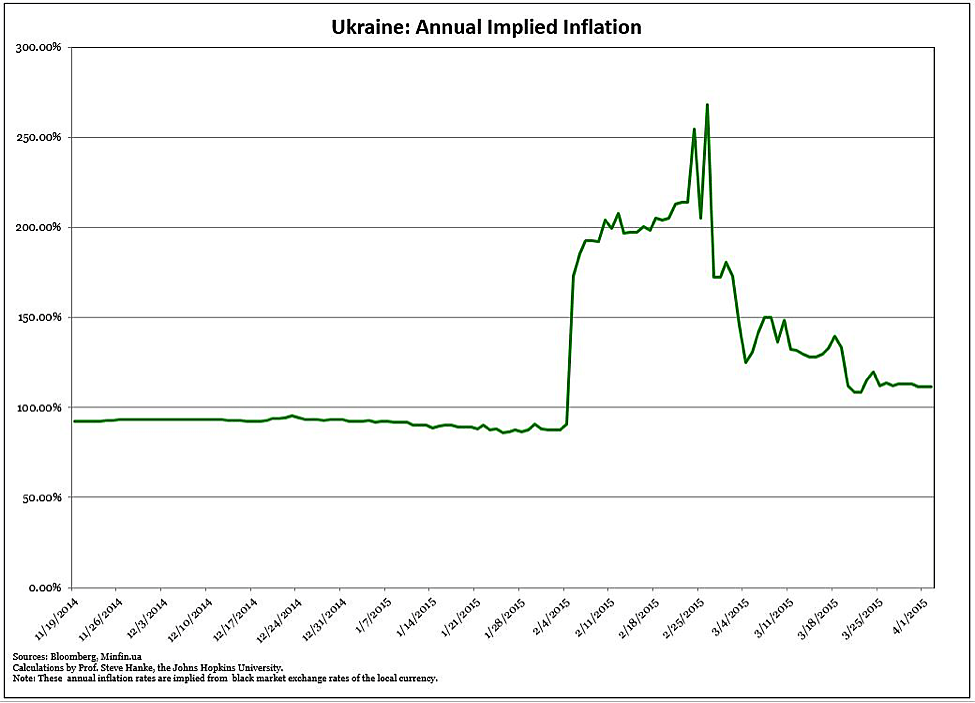
Venezuela has the dubious honor of registering the world’s highest inflation rate. According to my estimate, the annual implied inflation rate in Venezuela is 252%.
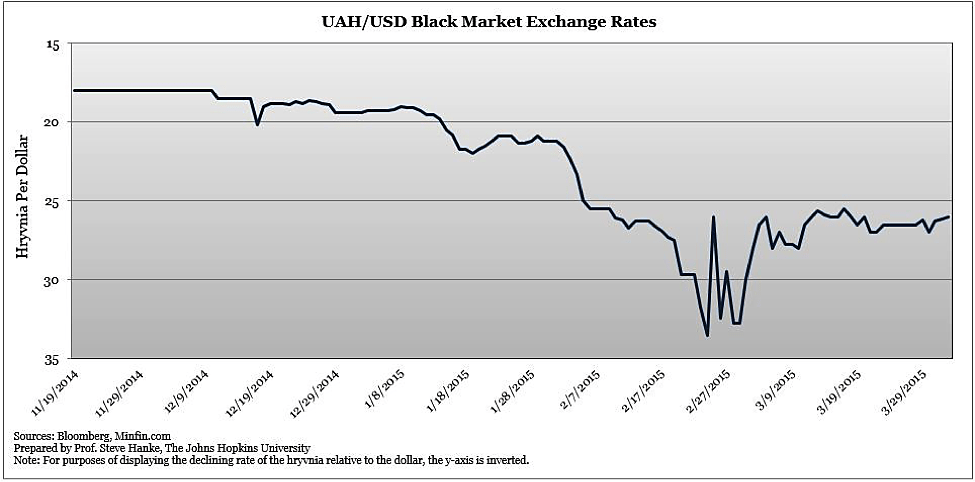
The only other country in which this rate is in triple digits is Ukraine, where the inflation rate is 111%. The only encouraging thing to say about Ukraine’s shocking figure is that it’s an improvement over my February 24th estimate of 272%—an estimate that attracted considerable attention because Matt O’Brien of the Washington Post understood my calculations and reported on them in the Post’s “Wonk blog.”
As a bailout has started to take shape in Ukraine, the dreadful inflation picture has “improved.” Since February 24th, the hryvnia has strengthened on the black market from 33.78 per U.S. dollar to 26.1 per U.S. dollar. That’s almost a 30% appreciation (see the accompanying chart).
As night follows day, currency strength is followed by lower inflation. When inflation rates are elevated, standard economic theory and reliable empirical techniques allow us to produce accurate inflation estimates. With free market exchange-rate data (usually black-market data), the inflation rate can be calculated. The principle of purchasing power parity (PPP), which links changes in exchange rates and changes in prices, allows for a reliable inflation estimate.
To calculate the inflation rate in Ukraine, all that is required is a rather straightforward application of a standard, time-tested economic theory (read: PPP). Using black-market exchange rate data that the Johns Hopkins-Cato Institute Troubled Currencies Project has collected over the past year, I estimate Ukraine’s current annual inflation rate to be 111%.
That rate is much higher than the “official” rate of 34.5%. Both the International Monetary Fund’s Extended Fund Facility for Ukraine (which has recently been approved) and Ukraine’s debt rescheduling negotiations (which have just commenced) are sitting on quicksand. Programs and negotiations based on a false premise are always treacherous affairs.