- Republicans have a big opportunity to undo Obamacare and reform Medicaid and Medicare all at once.
- It’s a good thing, too, because we’re facing a big debt crisis and if we don’t change course, federal spending will crest 42% of GDP by 2050.
- There’s also a big elephant in the room in an excessively complicated tax code.
- One has to wonder if the Republicans intend to put the big sacred cow of defense spending on the table.
- Unrelated to the budget, education choice proponents scored a big victory in the U.S. Supreme Court yesterday in ACSTO v. Winn, a decision that upheld education tax credits:
Cato at Liberty
Cato at Liberty
Today POLITICO Arena asks:
Paul Ryan’s budget — hard-headed fiscal sanity or inhumane?
My response:
Either we discipline ourselves, painfully, or soon enough the Chinese and other lenders will do it for us, more painfully still, by refusing to loan to us any longer at currently low interest rates. And in that event, the debt service will be all consuming. Neither individuals nor nations can go down the road we’re on without paying the price.
Margaret Thatcher put it plainly: “The trouble with socialism” — let’s be honest, we’re socializing the costs of our appetites by imposing them on our children and grandchildren — “is that eventually you run out of other people’s money.”
Inhumane? The inhumanity is among those demagogues who put us on this path, promising something for nothing year in and year out. Paul Ryan deserves our gratitude for biting the bullet at last. The ball is now in the court of the demagogues.
Related Tags
As I described yesterday in the context of Cato’s latest brief, Virginia’s challenge to the constitutionality of the individual mandate is now on appeal before the Fourth Circuit (the federal appellate court that covers Maryland, Virgnia, and the Carolinas). Before the court even considers the constitutional merits, however, it must confirm that the state has standing to bring the lawsuit in the first place.
Indeed, two amicus briefs filed by some law professors argue that the state does not have the legal power to challenge the constitutionality of Obamacare. But Pacific Legal Foundation attorney and Cato adjunct scholar Timothy Sandefur filed a brief responding to those briefs and arguing that Virginia does have standing to bring the case.
Here’s the issue: Article III of the Constitution only lets federal courts hear “cases and controversies,” which means that a plaintiff — whether an individual, a state, a corporation, or any other entity — must have been actually harmed in a way that courts can address. For example, courts can’t review abstract political arguments or give advisory opinions. Here, Virginia argues that it’s been injured because it passed a Health Care Freedom Act that prevents citizens from being forced to buy health insurance — which is obviously in conflict with the individual mandate.
The professors say, in contrast, that states can’t pass laws that conflict with federal law as a means of getting in court and challenging the constitutionality of the federal law. They point to Massachusetts v. Mellon, a 1923 decision that said states don’t have the “duty or power to enforce … [citizens’] … rights in respect of their relations with the Federal Government. In that field it is the United States, and not the State, which represents them as parens patriae.…” They argue that the “the state’s interest in enforcing its legal code must necessarily give way to federal law whenever a conflict arises,” and that “[m]anufacturing a conflict with federal law cannot of itself create an interest sufficient to support standing.”
PLF’s brief explains, however, that states have had the power to do precisely that since at least McCulloch v. Maryland, the 1819 case that upheld the constitutionality of the national bank (and which is central to the Necessary and Proper Clause analysis at the heart of the larger constitutional debate over Obamacare). In McCulloch, Maryland passed a law taxing the bank simply to give it the ability to challenge the bank’s creation in the Supreme Court. Although the Court found the bank constitutionally kosher, it never denied that the state couldn’t raise its claims. And the Supreme Court has allowed states in many other cases to challenge federal laws that intrude on their constitutionally retained sovereignty.
In South Dakota v. Dole (1987), for instance, the Court allowed the state to challenge the constitutionality of laws that infringed on the power to regulate alcohol consumption (by tying federal highway funds to states’ raising their drinking age to 21) — a power that the Twenty-First Amendment leaves to states. If states can defend powers retained by the Twenty-First Amendment, why can’t they defend powers retained by the Tenth Amendment?
And states should have the power to bring these lawsuits, because the Founders intended for states to serve as a check against Congress going beyond its constitutional authority. In Federalist 46, for example, Madison assured skeptics that states would have “means of opposition” against federal overreaching, and those means would include “the embarrassments created by legislative devices.” States are supposed to defend their turf in the federal constitutional scheme. As for cases like Mellon, PLF argues that these cases involved “political questions” and so were not rulings about standing: in those cases the states weren’t really exercising their sovereign powers. But in this case, Virginia has clearly exercised its sovereignty by passing the Health Care Freedom Act.
Interestingly, one reason PLF argues that states should have standing to bring these cases is because there’s some question whether individual citizens are allowed to bring Tenth Amendment challenges. That question will be resolved this term in Bond v. United States, a case in which Cato filed an amicus brief in December. If individuals are hard-pressed to defend the federalist structure, then states certainly should be able to.
In short, PLF’s brief (which was also filed on behalf of Americans for Free Choice in Medicine and Matt Sissel, PLF’s client in a different Obamacare case) makes a complicated but crucial argument supporting states’ ability to defend federalism by challenging the constitutionality of federal overreaching. More at PLF’s blog.
House Budget Committee chairman Paul Ryan (R‑WI) is proposing reforms to Medicare and Medicaid as part of his budget proposal for fiscal 2012. Readers who are interested in getting a better understanding of these pillars of the federal welfare state should check out two Cato essays on our Downsizing Government website.
An essay on Medicare explains the program’s numerous shortcomings and an essay on Medicaid examines that program’s flaws. Suggested reforms in the essays are similar to reforms in Rep. Ryan’s proposal, including converting Medicaid to a block-grant program.
Every week, the National Journal’s Education Expert blog tackles a different issue, and from hereon out I’ll be weighing in on many of them, crossposting at Cato@Liberty. I sent in my first entry today, which appears as a “guest response” while they set me up to appear as a regular. It’s on my favorite topic — education and social cohesion — so hopefully I’ve started with a bang.
Enjoy, and thanks to the National Journal for bringing a libertarian perspective on board:
Looking at the evidence suggests that school choice is the best educational system to build strong communities. A lot, though, depends on how you define “community.”
Diane Ravitch essentially defines a community as a “neighborhood,” and certainly neighborhoods can be a form of community. But neighborhoods are hardly close to the only type of community, and to the extent that neighborhoods – or, given education reality these days, school districts, states, and the federal government – often include people with very diverse backgrounds, desires, and norms, public schools can be very destructive to social cohesion.
Start with simple logic: If diverse people are required to support a single system of schools, is it more likely to result in unity or conflict? The answer, of course, is conflict. If people cannot agree on what math curriculum to use, they have to fight it out politically. If they cannot agree on whether or not there should be school uniforms, they have to fight that out. Indeed, any disagreement has to be resolved in a political arena, and the term “arena” certainly does not connote cohesion.
We see this forced conflict manifested constantly in education. States and communities are regularly inflamed over the teaching of human origins, whether we’re talking Scopes Monkey or Intelligent Design. We have disputes of which religious groups will get their holidays off from school. And then there’s the ever contentious teaching of U.S. history.
And conflict is only one manifestation of the division caused by trying to bring diverse people under a single government umbrella. Renowned social capital theorist Robert Putnam has found that where there is significant diversity there is also major atomization – people “pull in like a turtle” – quite possibly because they have few recognized, shared norms to hold onto. So not only don’t you have cohesive – but separated – groups, you have seriously compromised intra-group cohesion as well. Communities of all types are weak.
How do you overcome these very real problems through the education system? Let people choose schools – especially private schools – with the money that currently all goes to public schools. Then, not only can you phase out the inherently adversarial system that is public schooling, you can empower people to choose schools based on their shared norms and values.
But won’t this “balkanize” Americans? Maybe, in that many people will choose to attend schools with people like themselves. That, though, is certainly preferable to forcing us at each others’ throats. Moreover, there is evidence that allowing people to choose schools helps to meaningfully overcome serious divisions. Research by Jay Greene and Nicole Mellow, for instance, found that lunch tables – where students sit by true, voluntary choice – at private schools were better integrated by race than those at public institutions. Why? There could be many explanations, but a very reasonable one is that the ties that bind kids at private schools – common religious values, perhaps shared interest in a particular curriculum – help to overcome divisions such as race.
Does more work need to be done to prove that choice is crucial to building communities? Absolutely. Unfortunately, for the most part we haven’t even considered that government schooling might be more divisive than unifying, despite the very real – and painful – evidence that that could indeed be the case. Well, we need to seriously consider the possibility that choice is better mortar for building communities than government schooling because, respect for “neighborhood schools” notwithstanding, the evidence in favor of choice – and against government schooling – is both real and mounting.
One of the rationales commonly given for massively subsidizing our mortgage market is that without such homeownership would be out of reach for many households. Such a rationale implies that more debt should be associated with more homeownership. (Let’s set aside the obvious, how are you actually an owner without any equity?)
But is that the case. The chart below compares the homeownership rate with the average debt-to-value ratio of U.S. households. (Data on debt-to-value is from the Fed’s Flow of Funds and homeownership is from the Census Bureau).
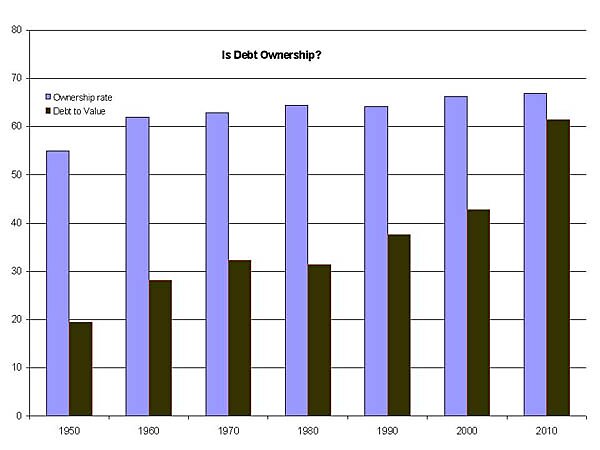
By 1960, the homeownership rate was already over 60%, yet debt-to-value was less than 30%, half of the current value. Even in 1990, when homeownership reached over 64%, debt-to-value was still under 40%. From 1990 until today, the percentage of mortgage debt to value increased by over 50%, all to gain a 2 percentage point increase in homeownership. So it seems the story of the last 20 years has been a massive increase in home debt with very little increase in actual homeownership rates. The converse should also hold: reducing homeowner leverage should have little, if any, impact on homeownership rates.
A recent poll showed that 22% of Americans believe Obamacare has been repealed and 26% aren’t sure. Yet here at Cato, we’re all too aware that the massive, unconstitutional, and fundamentally unworkable overhaul of our health care system still looms on the horizon.
While two lower courts have struck down Obamacare in whole or in part, three others have ruled it constitutional, including a D.C. District Court opinion that claimed for the federal government the right to regulate the “mental activity” of decision-making. As litigation progresses to the appellate level, this latter decision has proven to be more a hindrance to Obamacare’s supporters than a help, its Orwellian pronouncement being hard to ignore while the government downplays the significance of the power Congress is asserting. Nevertheless, Obamacare’s constitutionality—with a focus on the individual health insurance mandate—remains an open question until ruled upon by the Supreme Court.
Cato’s latest amicus brief is in the Fourth Circuit, in the case brought by Virginia Attorney General Ken Cuccinelli. In this case, unlike in the Sixth Circuit (in which we also filed a brief), it is the federal government that appealed an adverse district court decision that struck down the individual mandate. In our brief, joined by the Competitive Enterprise Institute and Prof. Randy Barnett (the intellectual godfather of the Obamacare legal challenges, and also a Cato senior fellow), we argue that the outermost bounds of existing Commerce Clause jurisprudence prevent Congress from reaching intrastate non-economic activity regardless of whether it substantially affects interstate commerce. Nor under existing law can Congress reach inactivity even if it purports to act pursuant to a broader regulatory scheme.
Allowing Congress to conscript citizens into economic transactions is not only contrary to existing Commerce and Necessary and Proper Clause doctrine—as broad as that doctrine is—but it would fundamentally alter the relationship between the sovereign people and their supposed “public servants.” The individual mandate “commandeers the people” into Congress’s brave new health care world. If Obamacare is allowed to stand, the only limit on federal power will be Congress’s own discretion.
The case will be argued before the Fourth Circuit in Richmond on May 10. Read more from Prof. Barnett on Obamacare here and check out the half-day event we recently held on the legal and economic problems with the law. Finally, though his name isn’t on our brief because he hasn’t yet become a member of the bar, many thanks to legal associate Trevor Burrus for his work on it.