Restore honor and dignity to the White House
Free trade
Comprehensive immigration reform
Prudent diplomacy
Defend freedom of speech
Rein in executive abuse of power
Balance the budget
Support the president
Restore honor and dignity to the White House
Free trade
Comprehensive immigration reform
Prudent diplomacy
Defend freedom of speech
Rein in executive abuse of power
Balance the budget
Support the president
In a remarkable surrender to Big Government, Senator Ted Cruz of Texas voted for the budget deal last week that hiked spending $300 billion over two years. The deal essentially scraps the Budget Control Act, pushes the deficit over $1 trillion, and sets the stage for $1.5 trillion more in spending over the coming decade.
Why did Cruz do it?
Because the deal included disaster-related spending for Texas, according to Cruz’s comments. Yet the senator surely knows that for practical and constitutional reasons, federal subsidies for local and private disaster rebuilding makes little sense. (I discuss here).
In his comments on the deal, Cruz lamented, “This bill will increase our deficits and increase our debt. That’s foolhardy…we should be reining in government spending.”
Yet Cruz explains: “Washington logrolling sometimes forces lousy choices. This is one of those choices.”
That is the key point. Before recent decades, federal spending on local disaster recovery was very limited. But now that such spending is routine, one of the most conservative senators was bought off in classic logrolling fashion to support Washington’s spending orgy.
Here is one lesson: the size of the budget and scope of federal activities are related. As the scope expands, logrolling becomes easier, which strengthens support for all spending programs. The more different programs there are, the more different levers can be pulled to generate support for each program and for overall spending increases.
Suppose the government had just two programs, A and B. Supporters would seek spending increases, but some legislators may not have much A and B spending in their states, and thus might favor restraint to save money.
Now Congress adds a new program, C. It appeals to members with different interests and in different states than A and B. The addition of C strengthens support for A and B because supporters of C must vote for A and B to gain support for their program.
Perhaps you know that Congress puts farm subsidies and food stamps in the same bill to combine the support of rural and urban members. But you may not know that Congress started subsidizing dams in the West a century ago because Western legislators wanted something in return for their support of Army Corps projects in the East. That is logrolling. It explains much of the history of federal government expansion, and it runs counter to the democratic ideal of true majorities approving specific policies, as I explain here.
Anyway, the Cruz vote suggests a “network effort” for logrolling in Congress. Adding new programs strengthens support for existing programs because more programs make logrolling easier.
The figure shows a hypothetical relationship between the size and scope of the government. Let’s call it the “Spending Size and Scope Curve.” As the number of programs increases, total spending rises for two reasons. First, each new program costs money. Second, the logrolling network effect. As it adds programs, the government spends more on existing programs as well as the new ones, so the curve bends upwards.
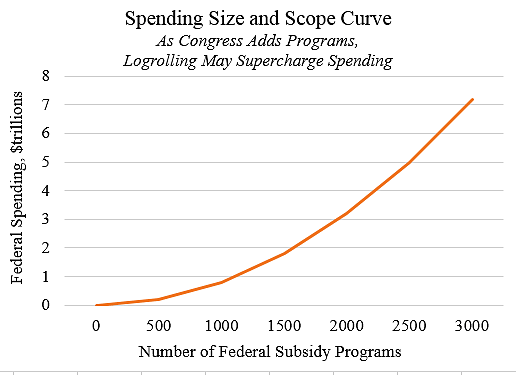
The federal government currently spends $4.1 trillion a year and has about 2,300 subsidy programs.
The chart is theoretical and would need to be assessed empirically. In reality, the upward bend may be muted because other forces are at work. For one thing, there may be competition between programs for funding within Congress. Conservatives may favor restraint in nondefense programs to create budget room for defense. Liberals may favor restraint in defense to create budget room for nondefense programs. So as new programs are added, it may intensify spending competition between programs.
Unfortunately, such funding competition between programs has been greatly weakened by today’s massive deficits. Federal deficits have trended upwards since the 1950s, which has buttressed the power of logrolling by undermining the need for legislative trade-offs.
What’s the upshot? The number of federal subsidy programs has doubled since the 1980s. That has strengthened the power of logrolling and put upward pressure on spending. It would have been harder for congressional leaders to buy off Senator Cruz in the 1980s because the federal government was not in the business of huge disaster bailouts at that time.
How can we restrain federal spending? A constitutional cap on spending or deficits would force more funding competition between programs. Also, fully eliminating even small programs would reduce the fuel source for logrolling. We’ve seen in recent years that many members line up to support major bills if even small scraps for obscure programs are thrown their way.
I discuss the mechanics of logrolling here.
“A well regulated Militia, being necessary to the security of a free State, the right of the people to keep and bear Arms, shall not be infringed.” According to the U.S. Court of Appeals for the Ninth Circuit, however, acquiring arms has nothing to do with keeping and bearing them. This was the court’s logic when it ruled in John Teixeira’s case that buying and selling guns was beyond the scope of the Second Amendment.
Teixeira sought to open “Valley Guns and Ammo” in Alameda County, California (the East Bay, with Oakland as its seat). The one problem with his plan was a county zoning ordinance that forbids a firearms business from being “within five hundred feet of a ‘[r]esidentially zoned district; elementary, middle or high school; pre-school or day care center; other firearms sales business; or liquor stores or establishments in which liquor is served.’” That left virtually no place in the county where a gun store could practicably be located.
After being denied the requisite permits due to complaints of people who may or may not have been within 500 feet of his business’s proposed location, it became apparent to Teixeira that the zoning rule was, in effect, a ban on gun stores. He sued the county and promptly lost in federal district court. A three-judge panel of the Ninth Circuit vacated the lower court’s perfunctory ruling and remanded the case with instructions to consider the ordinance’s Second Amendment implications and have the county justify its rule.
Unfortunately, the county, supported by the state of California, petitioned the Ninth Circuit for a rehearing en banc—normally all the court’s judges, but in the sprawling Ninth, the chief judge and 10 other randomly selected judges. The en banc court reversed the panel, so now the case is up on petition for review to the Supreme Court. Cato, along with Jews for the Preservation of Firearms, the Independence Institute, and the Millennial Policy Center, filed an amicus brief supporting that petition.
Our brief tracks the historical scope of the Second Amendment to establish that buying and selling is indeed part of the overall right to keep and bear arms. That right is not only fundamental, but enumerated—and therefore more straightforward for the judiciary to protect. When the government seeks to take an action that impairs such a right, it’s not supposed to be allowed to easily. The lower courts should have required the county to provide substantial evidence that gun stores increase crime around their locations or, in and of themselves, negatively impact the aesthetics of an area. Instead, the Ninth Circuit went up to bat for the county, manufacturing their own justifications and failing to have the county carry its evidentiary burden.
The Supreme Court needs to step in and curb the errant Ninth Circuit’s increasingly boisterous departures from fundamental-rights jurisprudence in the Second Amendment context. We’ll know whether it will take up Teixeira v. Alameda County later this winter or spring.

A New York Times article this week tackled the “conservative social agenda” supposedly packed into the Promoting Real Opportunity, Success, and Prosperity through Education Reform (PROSPER) Act that recently moved through the House education committee. The 590-page bill is an effort to renew the Higher Education Act, through which massive federal aid—currently around $136 billion—flows to students. The article and bill are reminders of how far we’ve strayed from a basic understanding of how a free society works.
A free society is pretty easy to grasp. Individuals are allowed to freely act, including to join or not join together based on their own decisions, rather than because they were forced to associate or not associate under threat of physical harm. The ability to legally inflict physical harm—even to kill—is ultimately what empowers government, but only so that government can protect against others inflicting harm on you, or you on them. Government is instituted to maximize freedom.
Reading the Times article, it seems some people don’t get this. The bill itself is a little less confused.
Higher education has been roiled lately with accusations of censorship, political correctness, and discrimination, largely by conservatives concerned about speakers such as Anne Coulter being barred from speaking on campuses. But folks on the left have had their own concerns, including Christian colleges firing professors for violating tenets of faith.
What should this mean for government?
Public institutions—government institutions—must not hire or fire based on faith, or discriminate against speech on campus. Ultimately, legalized violence must not be brought to bear for or against people based on their faith or opinions. Similarly, public institutions must not tell students who choose to freely associate in clubs or groups whom they must let in or keep out to get institutional funding or access to space; that is government punishing or rewarding people based on their associations.
The federal government, in contrast, must not reward or punish private institutions over their rules on association or speech as long as when a student enters and pays her bill a college does not deceive her about its rules. The institution’s rules, freely accepted by the student, are a part of free association, while deception is fraud.
How does the PROSPER Act do on keeping these things straight?
First, the bill would protect religious colleges from losing access to government funding if the loss were based on schools having religious policies some view as discriminatory, such as prohibiting homosexual student relationships, or firing faculty for violating articles of faith. In the Act this is explicitly a defense of religious freedom, but any voluntary association deserves protection. Meanwhile, one may absolutely despise and loudly condemn what an association stands for, but government must not punish members for their beliefs.
How about college rules that say student organizations must be non-discriminatory in whom they admit, or allow to serve as officers? Such rules should be unacceptable at public institutions—they are government curbing freedom of association—but at private institutions you exercise your freedom of association when you enroll, and if that institution wants to have rules about clubs within it, that is fine from a government perspective. Freedom of association includes the right to make constricting rules for members.
PROSPER gets this partially right. It correctly requires only public schools to allow religious groups to make their own decisions about who can join or become an officer. But protection, again, should extend to all associations.
Partial correctness also applies to the Act’s handling of controversial speakers and free speech zones. It says colleges, regardless of type, only court trouble for restricting speech if they say they have one speech policy but in practice have one that is more constrictive. That is the right policy toward private institutions—it would only punish fraud—but for public colleges no speech curbs are acceptable.
The bill also gets things only half right when it comes to allowing students to join single-sex organizations such as sororities. It would prohibit schools from taking “adverse action” against students who join such organizations. The impetus for this, according to the Times, is unhappiness with Harvard for punishing students who are in such groups. PROSPER’s provision should absolutely apply to public institutions, but not a private school like Harvard. Again, students freely agree to its rules when they decide to attend.
Of course, there is a gigantic elephant in the room: Taxpayers are compelled to pay for all colleges indirectly through student aid, and directly through government assistance to institutions. But the problem is the forced funding, not the freedom of association. To fully protect freedom of association—which includes deciding what we fund—we must eliminate the subsidies. We must not further curb freedom because of the subsidies, as happens when we conclude, “you take government money, you take its rules.”
We cannot eliminate subsidies overnight, and at best the PROSPER Act would make a tiny dent. (Even if it trimmed $1.5 billion per year, as the CBO estimates, that would only be about 1 percent of total federal student aid). To minimize compulsion short of elimination, student grants—which are not repaid—should be eliminated, and aid delivered in the form of loans or income-share agreements. Students should ultimately fund their decisions themselves. State funding for public colleges should also be transformed into students loans.
This would not be perfect—free association also means you are not forced to lend people money—but it would get us a lot closer to where we need to be: people freely associating and making rules for themselves, not having government decide whose associations do or do not prosper.
Carl and Angela Larsen are videographers who offer their skills to those getting married, capturing the magic of that special day for posterity. The state of Minnesota requires that they film same-sex as well as opposite-sex weddings. The Larsens, who believe in traditional marriage, object to the state’s claimed power to compel them to produce expressive messages with which they disagree. They brought a lawsuit to vindicate their First Amendment rights.
Nearly three years have passed since the Supreme Court recognized the constitutional right of gay couples to commit themselves in marriage on equal terms with their fellow straight citizens. In that time, the debate has shifted from the status of these unions to the rights of those who do not wish to participate in the vows. In December, the Supreme Court heard oral argument on the question of whether bakery owners may be compelled by law to decorate cakes in celebration of these nuptials, with a decision expected in June. Cato filed a brief in that case supporting the baker—the only organization to do so that also filed briefs supporting the plaintiffs in Obergefell and the other marriage cases—and his right to refrain from conveying messages with which he disagrees.
We likewise have now filed a brief in the U.S. Court of Appeals for the Eighth Circuit in support of the videographers’ right to do the same, joined by 11 professors of constitutional law. We advocated that the Supreme Court extend the bonds of matrimony to gay couples—and just as their rights should be respected by the government, so too should the rights of those who disagree with us.
The principle is straightforward: can the government compel you to express a message you don’t agree with? The answer should be no.
Just as the government cannot demand a Cato scholar write an article supporting the government’s preferred policy, it cannot compel those in expressive professions like filmmaking, photography, or musical performance to harness their artistic gifts in support of the state’s message. That the artists are offering their services commercially is no matter; how many rock bands play all their gigs for free?
A world of government-approved art would be a boring one indeed. If you doubt this, attend a gallery exhibition of socialist realism.
What happens when one of the most irresistible of contemporary regulatory trends — the continued chipping away of financial privacy — runs into one of the most formidable of interest groups, organized lawyerdom? The lawyers resist, and in this case the lawyers are right:
ABA President Hilarie Bass is expressing concerns that an anti-money laundering bill would undermine the attorney-client privilege and impose “burdensome and intrusive regulations” on small businesses and their lawyers.
In a letter to leaders of the Senate Judiciary Committee, Bass asks the committee to oppose the bill, known as the TITLE Act for True Incorporation Transparency for Law Enforcement, according to an ABA press release.
The ABA opposes provisions that would regulate many lawyers and law firms as financial institutions under the Bank Secrecy Act when they help clients to establish small corporations and limited liability companies.
The bill would require small businesses and their lawyers to gather extensive beneficial ownership information on businesses when they incorporate. The information would be held and disclosed on request to many governmental agencies and financial institutions.
Sponsors of S. 1454, or the TITLE Act (for True Incorporation Transparency for Law Enforcement) include Sen. Chuck Grassley (R‑Iowa), Dianne Feinstein (D‑Calif.), and Sheldon Whitehouse (D‑R.I.)
Concerns about erosion of attorney-general privilege have played a role in resisting numerous bad regulatory and prosecutorial initiatives in recent years, including the Obama Labor Department’s abysmal “persuader rule” proposal; proposals to forbid targets of Consumer Financial Protection Board investigatory letters from disclosing that they are under CFPB investigation; and calls for inculcating client disloyalty among lawyers who handle environmental matters for corporations. See also this paper from the ABA’s Larson Frisby for the Washington Legal Foundation on white-collar prosecution and attorney-client privilege.
Now if only the rest of us who are not lawyers could get someone to stand up so effectively against the government on behalf of our privacy interests.
The rise of Donald Trump and his unorthodox Presidential administration has reignited debates over American foreign policy and America’s role in the world. Policy-relevant academic research on key questions of international security and national security policy is more important than ever.
The Cato Institute will be hosting a paper workshop for graduate students on topics broadly related to international security and national security policy in Washington, D.C. from October 19–20, 2018. Topics may include a wide range of security issues, including but not limited to U.S. foreign policy, the sources and consequences of conflict, military effectiveness, grand strategy, civil-military relations, alliances and security institutions, terrorism, military intervention, diplomatic history, arms control and nuclear proliferation.
Participants will be expected to produce an original paper of journal-article length; the workshop will focus on paper presentations, discussion and suggestions for improvement, with the expectation that authors will go on to seek publication in external journals or to build upon this research as they move towards the dissertation phase of their studies.
Participants are particularly expected to highlight the policy relevance of their work. In keeping with the Cato Institute’s commitment to moving U.S. foreign policy towards prudence and restraint, the policy implications of papers should be broadly compatible with a pragmatic realist approach to foreign policy.
The workshop will be held at Cato’s offices in Washington, D.C. Participants will receive a stipend of $500, and will have reasonable travel and accommodation costs for the workshop covered.
To apply, submit an abstract of around 500 words detailing your proposed research project, along with a CV, by no later than March 15, 2018 to juniorscholars@cato.org. Candidates should have a background in political science, history, public policy or a related field, and must have completed at least one year of graduate study in a PhD program by the time of the workshop. All candidates will be notified of the status of their application by May 1st, and draft papers will be due on September 30th.