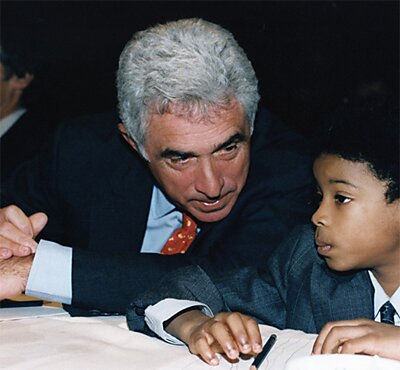
I am debating the need for more government spending to goose the economy and create jobs over at PolicyMic.com. I argue that we’ve had enough government “stimulation” (see here). My opponent argues that the federal government hasn’t spent enough money (see here). Readers will decide the “winner” and can add their own two cents.
Cato at Liberty
Cato at Liberty
Topics
General
Live Commentary on Tonight’s GOP Debate
The American Enterprise Institute, the Heritage Foundation, and CNN are set to co-host a national security presidential debate at 8:00 pm ET tonight.
Get commentary on the debate as it happens from Cato Institute foreign policy scholars:
- Follow Malou Innocent via Cato’s foreign policy Twitter feed, @CatoFP.
- Follow Christopher Preble on Twitter via @CAPreble.
- Follow Justin Logan as he live blogs at RealClearWorld.
divEarlier Christopher Preble offered some questions the candidates should answer. You can tweet suggested questions to @WolfBlitzerCNN with the hashtag #CNNDebate.
Related Tags
What the Supercommittee’s Failure Says About U.S. Foreign Policy
The so-called supercommittee has failed to come to an agreement on a package of spending cuts and/or tax increases that would add up to $1.2 trillion over the next ten years. Some inveterate spenders have portrayed the faux cuts as draconian, painful, and irresponsible, but they would have been quite modest relative to expected spending over the next ten years. Remember, according to Washington’s unique math, spending is “cut” when it increases less than previously projected. Several of my colleagues have weighed in on the tax and domestic spending aspects. I have some thoughts as it pertains to military spending.
The reason why this particular method for reining in out-of-control spending failed was both predictable and predicted. The Sword of Damocles known as sequestration — supposedly automatic spending cuts divided between the Pentagon and the rest of the discretionary budget — proved a particularly dull weapon. It was intended to force Democrats and Republicans to compromise, but few people believed that the cuts would actually occur, and Republicans, in particular, were working to exempt the Pentagon before the ink from August’s debt ceiling deal had dried. As former McCain adviser Kori Schake observed last month, it is difficult to see “how either the math or the politics work to bring federal spending into line with receipts if conservatives rule defense out of bounds.”
The politics might actually be tougher than the budgetary arithmetic. Not all conservatives believe that the Pentagon’s budget is sacrosanct, but those who wish to stick with the status quo, or dramatically increase military spending (as Mitt Romney wishes to do), have a story for the upcoming election that they believe will play well with voters. They will accuse the Democrats of wanting to “gut defense,” cut off funds for troops in harm’s way, and otherwise undermine American security. They will expect the public to ignore that much of what we spend on military is completely irrelevant to keeping us all safe — it is intended, instead, to make other countries feel safe, and therefore disinclined to spend more on their own defense.
Americans are ignorant of such things because the political class likes it that way. As SAIS Professor Michael Mandelbaum, one of the leading advocates for our current foreign policy, explained several years ago, Americans were opposed to playing the role of the world’s policeman, while other countries free ride on our largesse. And this shouldn’t surprise. “To make sacrifices largely for the benefit of others counts as charity,” Mandelbaum explained, “and for Americans, as for other people, charity begins at home.” The solution for sustaining this state of affairs is simple: keep the people in the dark: “The American role in the world,” Mandelbaum concluded, “may depend in part on Americans not scrutinizing it too closely.” Observes Christopher Fettweis in a recent book, “Democracy at home can apparently be a handicap to those who would promote it most fiercely abroad.”
President Obama and the Democrats are poorly positioned to capitalize on this disconnect between the public and the elites because they share the blame for a system in which Americans spend far more money on our military than do people in other countries. Indeed, Republicans and Democrats alike have presided over a considerable expansion of U.S. global commitments since the end of the Cold War. And that pattern has actually accelerated as the U.S. fiscal crisis has grown more dire. The president has just returned from a trip to Asia in which he implied that U.S. security commitments to wealthy, stable allies in the region would expand in coming years.
In other words, the president expects that U.S. taxpayers will spend even more money to defend countries that can defend themselves, and that he will pay no serious political price for making such promises.
Given that his Republican challenger — whoever that might be — is likely to criticize him for not doing enough to “reassure” the countries in Asia, he is probably correct.
Related Tags
Education Philanthropist Ted Forstmann, RIP
Ted Forstmann passed away yesterday at the age of 71. Forstmann was most famous for his pioneering work in the business world, and he was for a time a board member of the Cato Institute, but many others knew him as one of the most generous and thoughtful education philanthropists of our time. I first met him in the late 1990’s, when he was planning the launch of the Children’s Scholarship Fund (CSF) with his friend John Walton. CSF is a non-profit K‑12 scholarship organization that provides tuition assistance to low-income families wishing to send their children to private schools. Understanding that direct financial responsibility encourages parents to be more involved in their children’s education, Forstmann ensured that CSF grants required parents to make a co-payment out of their own pockets, based on what they could afford.
Critics argued that poor parents would be unwilling or unable to come up with even a small fraction of the cost of private school tuition to make these co-payments. But when CSF was launched in 1998, there were 1.25 million requests for the 40,000 scholarships initially available. The myth that poor, inner-city parents don’t care about their kids’ education was shattered. Since its inception, the program has raised nearly half a billion dollars and served 123,000 children.
The Children’s Scholarship Fund continues to operate today, and its website can be found here.
Ted Forstmann wanted all families to have access to a free and dynamic education marketplace. He didn’t live to see it, but he greatly advanced that cause. The fact that it is now within reach is in no small part due to his efforts. Scholarship programs like CSF are now operating around the country, many of them bolstered by education tax credit programs that allow donations to them to be written off, dollar for dollar, from state taxes. Such programs exist in Florida, Pennsylvania, Arizona and four other states, with a new program passed this year in Oklahoma and another under consideration in Ohio. By scaling-up these programs it would be possible to achieve the goal of universal access to the marketplace that Forstmann and many others have long pursued.
We’ll keep working toward that goal. And we’ll miss you, Ted.
Related Tags
Supercommittee Fails; Now Let’s Talk Specific Cuts
It looks like the congressional supercommittee has failed to agree on a deficit-reduction plan. That’s probably a good thing because it sets up an automatic sequester to trim spending by $1.2 trillion over 10 years.
If the supercommittee had agreed to a deal, it might have paired phony spending cuts with real tax increases. For example, while Republicans had offered to raise taxes by $400 billion, there had been talk of adopting smoke-and-mirrors savings of $700 billion for the withdrawal of troops from Iraq and Afghanistan.
Also, one of the tax increases that Republicans were apparently offering was to change the indexing of income tax brackets. That would have been the worst kind of tax hike, as it would have been a hidden way of steadily increasing marginal tax rates over time.
A sequester is far from the best way to cut spending, and spendthrift members of Congress will have until January 2013 to try and weasel out of cuts. However, it does help to put the big spenders on the defensive. If defense hawks such as Senator John McCain want to reverse the roughly $55 billion a year in defense savings, then they have the burden of coming up with alternative cuts that can gain broad agreement.
CBO has analyzed the sequester mechanism. In typical congressional style, the simple sequester idea of “across-the-board cuts” has morphed into complex procedures that only Washington lawyers would love. The sequester’s main effect will be to reduce the discretionary caps on defense and nondefense spending that are in place from the Budget Control Act passed earlier this year. The sequester will make only tiny cuts to so-called entitlement programs. Still, any cuts are good cuts.
What’s the next step for budget control? Conservative Republicans have focused nearly all of their energy this year on trying to impose overall limits on the budget. The Budget Control Act and likely sequester have established discretionary caps for the next decade. Meanwhile, an effort to pass a Balanced Budget Amendment has failed.
Now Republicans should do what most of them have been evading all year—start pushing cuts to particular programs in order to launch a discussion about the federal government’s proper role. How about ending federal subsidies for public housing, high-speed rail, urban transit, farm businesses, and energy? How about raising the Social Security retirement age, increasing Medicare deductibles, and block-granting Medicaid?
To his credit, Rep. Pompeo is showing the way with his push to eliminate the Economic Development Administration. The EDA is a relatively small program, but Pompeo did a nice job on Fox last week making the case for termination. We need every fiscal conservative in Congress to do some research and then target a handful of specific programs for repeal.
Enough of the “noncommittal gibberish” about cuts, as Robert Samuelson says today. The nation’s “adult discussion” on the budget will begin when policymakers start talking specifics.
Related Tags
This Week at Libertarianism.org
This week at Libertarianism.org,
- George H. Smith published another in his Excursions series of original essays, this time looking at the question of whether Thomas Jefferson was a plagiarist.
- John Samples wrote about equality and political speech, particularly attempts to increase the former by restricting the latter. “Tax financing of campaigns is a lot like establishing a religion: citizens are forced to act contrary to their deepest convictions in service to some alleged greater good,” Samples wrote. “I assume that such compulsion has no place in a liberal society.”
- Jason Kuznicki blogged about NPR’s recent story on Ayn Rand, writing, “If you don’t like what you hear about Ayn Rand in this story, you probably won’t like her, either. If you do like what you hear, or if you just find it intriguing, then you should definitely read further.”
- Miles Pope continued his careful analysis of Jan Narveson’s social contract defense of a free society, The Libertarian Idea.
Related Tags
Solyndra: Crooked Politics or Just Bad Economics?
Amy Harder has a good take on the Solyndra issue in National Journal Daily (subscription required):
Lesser evil: crony capitalism or bad policy?
Energy Secretary Steven Chu is about to find out when he testifies before a House panel on Thursday about the $535 million loan guarantee his department awarded to Solyndra, the now-bankrupt solar-energy company that was, before its demise, the poster child for America’s renewable-energy industry and President Obama’s 2009 Recovery Act.
The White House and the Energy Department say the influence of political donors such as Oklahoma oil billionaire George Kaiser, whose venture-capital firm was the major investor in Solyndra, did not sway any of the administration’s decisions on Solyndra’s loan guarantee, which was funded from the stimulus package.
By denying politics was involved, the administration is saying that its top officials genuinely and continuously thought Solyndra was a good bet—despite numerous warnings raised both inside and outside of the administration—and that the loan-guarantee program was being carefully managed despite oversight reports and an internal West Wing memo that said otherwise.
“As time went on, there was a growing concern because of the cash-flow,” Chu said in an interview with NPR on Tuesday. “And so we certainly were watching this and looking at this very closely. And eventually we recognized they were in deep trouble.”
Yet, throughout the two years Solyndra was borrowing money from federal coffers, the DOE essentially stayed the path right up until the bitter end when the California-based manufacturer went bankrupt in September. When Solyndra was on the brink of bankruptcy in late 2010, DOE decided to restructure the loan to try to keep the company afloat.
Meanwhile, in today’s congressional hearing, Energy Secretary Steven Chu insisted that “the final decisions on Solyndra were mine, and I made them with the best interest of the taxpayer in mind.… I did not make any decision based on political considerations.” This came on a day when the front page of the Washington Post reported:
In the two years preceding its collapse, Solyndra and its biggest investor aggressively asserted themselves in dealings with the Obama administration, pushing Energy Secretary Steven Chu to visit the company’s headquarters to help it raise private money and later suggesting it would file for bankruptcy if the Energy Department rejected its proposed rescue plan.…
“The DOE really thinks politically before it thinks economically,” a Solyndra board member wrote in December to George Kaiser, an Obama fundraiser whose family funds owned a third of the company.