Cato at Liberty
Cato at Liberty
General
Earlier this week I wrote about the perils of the NRA’s single-issue politics. Now it’s breastfeeding moms in the crosshairs – different issue, same principle.
In the NRA case, it seems that they’re going after a Tennessee state legislator – a long-time NRA member and supporter, no less – who opposed a bill that would have allowed employees to keep guns in their cars while parked in their private employers’ parking lots. The principle at issue there could not be simpler or more basic to a free society: individuals, including private employers, should have a right to determine the conditions on which others may enter their property. The NRA’s mistake is in asking the state to restrict that right in the name of the Second Amendment, which of course applies only against governmental, not private, restrictions.
The breastfeeding moms make a similar mistake. We learn from NPR this morning that a number of them have just gathered en masse and staged a “Great Nurse-In” at the U.S. Capitol. Their aim is to secure “federal protection of breastfeeding everywhere.” Everywhere? In my home, my business?
Don’t get me wrong: I’m no more against the right to breastfeed than I am against the right to keep and bear arms. That’s not the point. Rather, the point is that, in a free society, the property right is fundamental, starting with your property in your person and your liberty, which you can exercise only to the extent that you respect the equal rights of others. Property rights set the lines that determine where one person’s rights end and the next person’s begin, which is why getting those lines right is so crucial to a society that aspires to protecting equal rights.
The breastfeeding moms might well object if they were forced to allow people to carry guns into their businesses, just as the gun owners might object to being forced to allow breastfeeding in theirs. And it isn’t that some values are better than others. We can argue over that all day and get nowhere. With rights, by contrast, there’s a good possibility of agreement. In fact, the nation is based on a live-and-let-live principle we largely agreed on at the outset – and lived by, for the most part, until we started asking government to impose our values on others, leading to the war of all against all that we see all about us today and to the politicization of everything, including parking lots and breastfeeding.
This morning’s newspaper brings news of government officials seeking to punish individuals who provided relevant information to the public. In this case, the officials are seeking individuals who leaked secret information about national security issues.
Here’s the problem with these investigations: disclosing the source of the leaks will lead to retaliation by government officials against the leaker which in turn will lead to fewer leaks in the future and less information for the public. As the New York Times puts it, “Investigations into Security Leaks is Casting Chill on Coverage.”
Yet the editorial board of that same newspaper has long supported public disclosure of the sources of campaign spending which can lead to retaliation from government officials against the source of the spending, thereby discouraging future spending on speech and in the end, less information for the public.
Why the differences in perspective? The cynical among us might think the costs of disclosing the sources of national security leaks fall on the media (above all, the New York Times) while the costs of disclosing campaign spending fall on people who compete with the media for public attention. But I am not so cynical to think the media are so narrowly self-interested.
Media folks may also think that retaliation is much more likely from national security officials than from officials concerned about winning elections. But why? The incentives seem at least equally strong in both cases. If anything, suppressing speech seems more directly related to election outcomes than keeping official secrets. How many votes did Wikileaks cost the Obama administration in 2010?
A “business model” explanation also comes up short. The media does depend on national leakers for information to repackage and sell. So they are protecting their inputs. The media also repackage disclosed campaign spending information. But such information would be much more valuable to the media if it were secret in the first place. Has anyone received a Pulitzer for writing yet another story about SuperPACs?
Consider this alternative explanation for the difference. Egalitarianism is the view that politics should be about helping the oppressed and harming the oppressor. In the national security context, the oppressor class comprises military and national security officials. They are icons of inequality working as they do in hierarchical organizations wasting public money that could be redistributed to the truly deserving. In campaign finance, the oppressors are business people — i.e. “the rich and powerful” — who have unequal wealth. Disclosing sources in the national security case helps the oppressor and increases inequality. Not disclosing sources in the campaign finance case has the same effect. The question is not what the government does but rather its effect on equality.
I conclude we should not call use the broad term “civil libertarian” to refer to everyone concerned about government limiting information to the public. Instead, we should focus on the purposes and values that inform political action. Media folks are largely “civil egalitarians.” Those concerned about liberty from government are properly called “civil libertarians.”
Why does this matter? Naturally I would be happy if “civil egalitarians” would become, by my lights, more consistent and thus, “civil libertarians.” Even if they do not, both sides should keep in mind when working together on politics that theirs is coalition of circumstances and not a coalition of common purpose.
Jonathan Adler and I have a post at the at the Health Affairs blog where we respond to Timothy Jost’s critique of our working paper, “Taxation without Representation: the Illegal IRS Rule to Expand Tax Credits under the PPACA.” Jost has been our most tenacious (if not most consistent) critic.
Here’s an excerpt. Keep in mind that although we say “tax credits,” government spending accounts for about 80 percent of the money involved. Which is a lot: the cost of this illegal IRS rule could be in the hundreds of billions of dollars.
The dispute is over whether the [Patient Protection and Affordable Care] Act authorizes the IRS to provide tax credits only in Exchanges established by states (under Section 1311) or also in Exchanges established by the federal government (under Section 1321). Three facts are key to this dispute.
First, both sides acknowledge that the statutory language governing eligibility for tax credits is clear and unambiguous. The Act provides that taxpayers are eligible for tax credits if they purchase a health plan through “an Exchange established by the State under section 1311.” That language clearly authorizes tax credits only in state-established Exchanges, and the Act employs or refers to that language no less than six times when authorizing tax credits. There is no parallel language anywhere in the statute authorizing the IRS to offer tax credits through federal Exchanges established under Section 1321.
Second, there is nothing in the statute that conflicts with the plain meaning of that language. Indeed, the rest of the statute supports that plain meaning. Nor has anyone identified anything in the law’s legislative history that conflicts with that language. The only statement anyone has found on this point shows the statutory language was intentional. During congressional debate, the bill’s lead author, Senate Finance Committee chairman Max Baucus (D‑MT), explained that the bill conditions tax credits on the establishment of a state-run Exchange.
Third, even though some members of Congress and the President might have preferred a law that authorized tax credits in federal Exchanges, they nevertheless enacted a law that did not. Many advocates of health care reform urged passage of the Senate bill even though there were parts of the bill they did not like, and knowing full well that not all defects could or would be fixed through the reconciliation process. Congress amended the sections of the Senate bill that authorize tax credits and cost-sharing subsidies a total of 12 times through the reconciliation process, but left the language limiting tax credits to state-established Exchanges undisturbed. Again, many of those amendments support the clear meaning of that language, and none of them conflict with it.
And yet, in late May the IRS finalized a rule that will issue tax credits—and therefore will trigger cost-sharing subsidies and employer-mandate penalties—through federal Exchanges, contrary to the plain language of the statute. It is our contention that this rule is illegal.
We invite everyone to read our working paper alongside Jost’s post, and our reply, and to decide for themselves whether the IRS is breaking the law.
You can also watch Jost and me testify before Congress on the IRS rule tomorrow at 9am ET in room 2154 of the Rayburn House Office Building.
I’m not a big fan on international bureaucracies, particularly the Paris-based Organization for Economic Cooperation and Development. The OECD, funded by American tax dollars, has become infamous for its support of statist pro-Obama policies.
- The OECD has allied itself with the nutjobs from the so-called Occupy movement to push for bigger government and higher taxes.
- The OECD, in an effort to promote redistributionism, has concocted absurdly misleading statistics claiming that there is more poverty in the US than in Greece, Hungary, Portugal, or Turkey.
- The OECD is pushing a “Multilateral Convention” that is designed to become something akin to a World Tax Organization, with the power to persecute nations with free-market tax policy.
- The OECD supports Obama’s class-warfare agenda, publishing documents endorsing “higher marginal tax rates” so that the so-called rich “contribute their fair share.”
But I’m a policy wonk, so I’ll admit that I often utilize certain OECD’s statistics. After all, if numbers from a left-wing organization help to advance the cause of liberty, that makes it harder for opponents to counter our arguments.
With that being said, let’s look at some truly remarkable statistics from the OECD website on comparative living standards in industrialized nations. This chart shows average levels of individual consumption (AIC) for 31 OECD countries. There are several possible measures of prosperity, including per-capita GDP. All are useful, but AIC is thought to best capture the well-being of a people.
As you can see from this chart, the United States ranks far ahead of other nations. The only countries that are even close are Norway, which is a special case because of oil wealth, and Luxembourg, which also is an outlier because it is a tiny nation that also serves as a tax haven (a very admirable policy, to be sure).
At the risk of making an understatement, this data screams, “THE U.S. SHOULD NOT BECOME MORE LIKE EUROPE.”
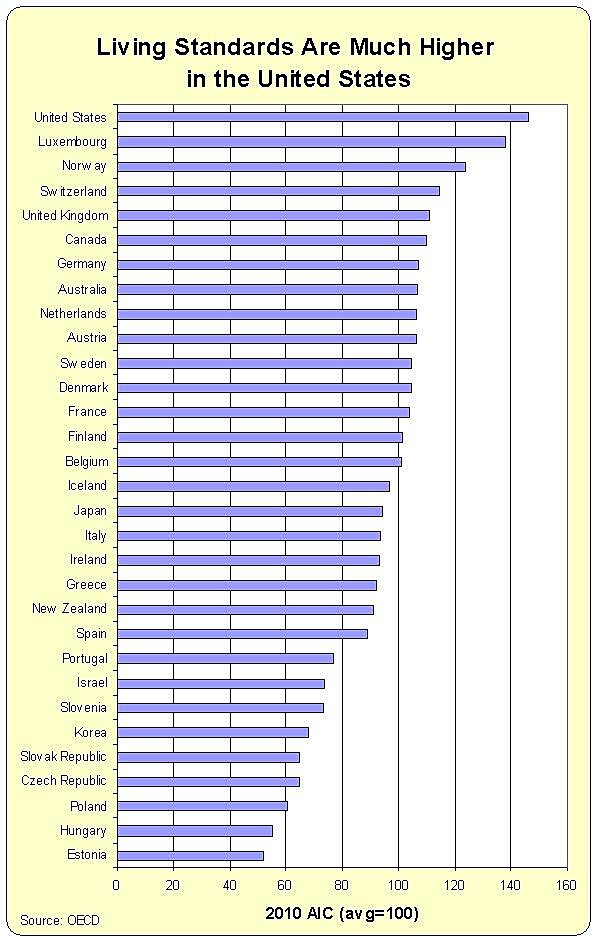
For all intents and purposes, Americans are about 40 percent better off than their European counterparts, in part because we have less government and more economic freedom.
Yet Obama, with his plans to exacerbate class-warfare taxation and further expand the burden of government spending, wants America to be more like nations that have lower living standards.
And don’t forget European living standards will presumably fall even further — relative to the U.S. — as the fiscal crisis in nations such as Greece, Spain, and Italy spreads to other welfare states such as France and Belgium
Here’s another chart that looks at the G‑7 nations. Once again, the gap between the U.S. and the rest of the world is remarkable.
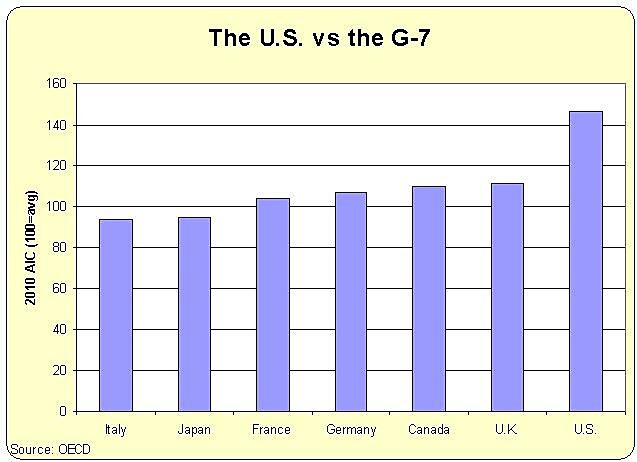
Maybe, just maybe, the United States should try to copy nations that are doing better, not ones that are doing worse. Hong Kong and Singapore come to mind.
Getting there is simple. Just reduce the size and scope of government.
Related Tags
Yesterday Sen. Tom Harkin (D‑IA), Chairman of the Senate Health, Education, Labor, and Pensions Committee, released his magnum opus on for-profit colleges, the culmination of two years of excoriating, browbeating, shaming, and generally demagoguing that fast-growing but relatively small sector of American higher education. His report is everything you’d expect from a crusade characterized by an almost complete unwillingness to address the central role of the federal government in creating pervasive rot not just in for-profit higher education, but the entire Ivory Tower.
The for-profit college sector is certainly raking in lots of cash and producing very little for it, with big revenues but very low completion rates. It’s probably not as bad as Harkin would have us believe—I’ve chronicled much of the exaggeration and misrepresentation that has punctuated his attack—but there’s little question that lots of students drag heaps of taxpayer dough into for-profit schools and get little of value for it.
The thing is, that happens across higher education, including the profit-taking.
As I’ve cited ad nauseum, completion rates throughout higher education are abominable. Looking at first-time, full-time students—an imperfect sample, yes, but the best we’ve got—the top completion rate is for bachelor’s students at private not-for-profit schools. But that’s only 65.4 percent completing within six years. The worst is at public two-year institutions—community colleges—which see only 20.4 percent finish their programs within 150 percent of normal time. That’s just one-in-five!
Surprisingly, Harkin’s report mentions the atrocious completion rates at community colleges. But only very briefly, and mainly to assert that “the cost of for-profit programs makes those programs more risky for students and Federal taxpayers.” That proviso is technically correct, but as misleading as much of the behavior for which Harkin condemns for-profit schools. Community colleges are cheaper to students in large part because they get direct taxpayer subsidies, and while those don’t come mainly from Washington they do come from taxpayers, just at the state and local level. In the 2009-10 school year, state and local appropriations to community colleges totaled $5,412 per pupil. Meanwhile, public four-year schools—with six-year graduation rates of just 56 percent—received almost $8,000 per student in federal, state, and local appropriations. And, of course, all “not-for-profit” schools get favored tax status, paying no taxes on most of their revenue and benefiting from tax deductible largess of donors.
But don’t think those schools aren’t profiting. Harkin’s report blows off the possibility that putatively not-for-profit schools make profits simply by stating that “by definition” such schools “do not retain any revenue as profit.” But as Vance Fried illustrated in his 2011 policy analysis, most public and not-for-profit private colleges make thousands of dollars per-undergraduate beyond the cost of educating them. They just use the money to reward the people in the school, or to pay for things that often make the school more bloated, instead of distributing the profits to investors.
Putting the for-profit sector in the context of all of higher education, it’s clear the witch hunt has been on. But there’s also been major scapegoating: by enabling students to pay for school with other people’s money, and with almost no regard for their ability to do college work, it is federal student aid that largely causes the rot in higher ed, quashing both school and student incentives to economize, and student incentives to think critically about consuming higher ed. By demonizing institutions that dare admittedly make profits, politicians like Sen. Harkin shift the blame from where it belongs—themselves—to those who do what the politicians want: “educate” people regardless of their ability. It’s exactly like housing: the politicians demand that everyone be able to buy a home, condemn anyone who might fail to furnish the uncreditworthy with mortgages, then blame the lenders when things go horribly wrong. They seem to want the votes—their profits—but no blame when things go south.
Sen. Harkin, the fault for what ails not just for-profit higher education, but the entire Ivory Tower, sits largely with you and your colleagues. Please quit shifting blame and do what must be done: phase out student aid and make all schools earn their money.
Related Tags
Today is the 100th anniversary of Milton Friedman’s birth and wonderful pieces have appeared all over the Web to commemorate the occasion. I particularly like Stephen Moore’s editorial in the Wall Street Journal, and economist Bryan Caplan’s brief but thoughtful blog post.
To add to the celebration, we’ve put together a brief interview with Bob Chitester, producer of Milton’s “Free to Choose” documentary series, and provided a link to the site where you can watch the whole thing for free. I’ve also added a few thoughts of my own on Milton’s impact on the school choice movement, and the high standards he set in his life and work.