The Cato Institute’s Roger Pilon, Ilya Shapiro, Michael F. Cannon, Michael D. Tanner and Trevor Burrus evaluate today’s Supreme Court ruling on the Affordable Care Act.
Cato at Liberty
Cato at Liberty
Government and Politics
Thanks to today’s Supreme Court ruling, the federal government has gained broad new powers to control the nation’s health care system. This, we are told by the President and his fellow travelers, will save money, expand access, and improve quality. One way to gauge the chances of that is to see what benefits federal oversight has brought to education in the one district in the nation over which Congress has ultimate authority: the District of Columbia public schools.
As I wrote earlier this week, the Census Bureau has now confirmed my finding that DC public schools spend about $30,000 / pupil annually. That is more than double the national average of public schools. Access to schooling may be universal in the District, but access to a quality education is not. As Economist Mark Perry writes, despite its stratospheric spending, DC’s graduation rate of 58.6% is far lower than the national average of 75.5%. The academic performance of its students is also significantly below the national average, and also below the average for other big city districts–in both reading and mathematics. Its achievement gaps by race and socio-economic status are also larger than in other public school districts.
That is how the only public school district in the nation under the control of Congress performs. Nor have nationwide federal education programs shown promise, as the chart below illustrates.
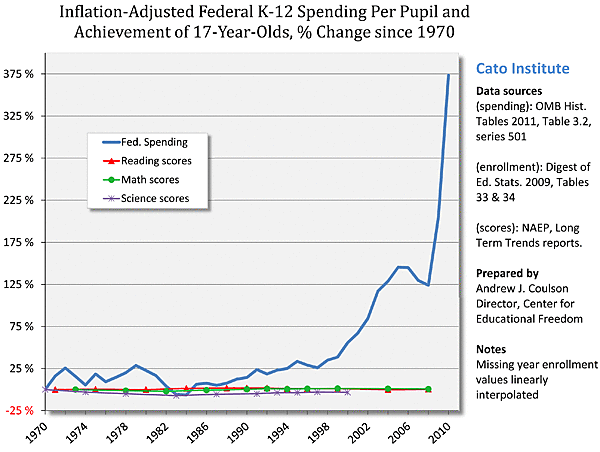
If our experience with education is any guide, a bigger federal role in health care does not bode well.
Related Tags
As you digest Chief Justice Roberts’ opinion, it is worth re-reading the opening part of my DePaul colleague David Franklin’s Slate piece from a while back. In it, he notes the current Chief Justice’s admiration for Chief Justice John Marshall, and then speculates that Roberts’ “Obamacare” opinion may try to ape Marshall’s strategy in Marbury v. Madison. David writes:
Everyone knows Marbury v. Madison as the case in which the court first asserted the power to declare acts of Congress and the president unconstitutional. What’s less well known is that the defendants in Marbury (Secretary of State James Madison and, by extension, President Thomas Jefferson) got off on a technicality.… Marbury promised sizzle and ended with fizzle.
But all of this was by design. John Marshall, the brilliant but unassuming chief justice, always intended to use Marbury to hand his cousin and arch-foe Jefferson a narrow legal victory while dealing him a long-lasting political blow. By lecturing Jefferson about his legal duties, Marshall put the president in his place. (Ours is ‘a government of laws, and not of men.’) And by laying the foundation for judicial review, Marshall carved out a prominent new place for the court. Most important, Marshall did all of this without ordering Madison or Jefferson to actually do anything. No wonder historian Robert McCloskey called Marbury ‘a masterwork of indirection.’ ”
Was Roberts trying to ape his hero Marshall’s “masterwork of indirection” when he crafted his opinion? The idea isn’t totally implausible, especially if you credit libertarian lawprof Jon Adler’s and Slate pundit Tom Scocca’s takes on the decision. Both note that while the decision hands President Obama a legal victory, the opinion may contain a considerable silver lining for advocates of limited government over the longer term. Whether or not you think this is true, it at least opens a plausible window on the mind of Chief Justice Roberts.
Update: David Franklin has posted a sequel to the article quoted above in a new Slate piece that expands on the connection between Roberts’ “Obamacare” opinion and Roberts’ Marshall-philia. David may be too sanguine about the long term potential for Roberts’ opinion to help libertarians. David has also altered me to a piece by Daniel Epps at the Atlantic, which also explores the link between Roberts’ thinking and Marbury. Epps takes the long-term potential of Roberts’ decision to help advocates of limited government more seriously than David does. For those looking for insights into Roberts’ motivations, both are well worth reading.
I’m not a lawyer, or an expert on the Constitution, though I sometimes play one on TV.
But I can read, and I’ll agree with my friends on the left that the federal government has a broad power to tax. I wish the 16th Amendment had never been ratified, but its language gives the federal government a green light to rape and pillage.
The Congress shall have power to lay and collect taxes on incomes, from whatever source derived, without apportionment among the several States, and without regard to any census or enumeration.
That being said, the power to tax is not the same as the power to spend. And at the risk of sounding old fashioned, my big objection to the Obamacare decision is that health care is not listed as one of the federal government’s enumerated powers in Article I, Section VIII of the Constitution.
Sadly, that horse got out of the barn many decades ago, culminating in a horrible 1942 Supreme Court decision that said a man couldn’t grow crops on his own land to feed his own animals for consumption by his own family.
But let’s look at the bright side. Even though the Obamacare case was decided incorrectly, at least the judiciary is beginning to reconsider these issues, thanks in large part to the work of the Cato Institute’s legal scholars and adjunct legal scholars.
P.S. While the federal government has a broad power to tax, I should add that this doesn’t — or at least shouldn’t — vitiate other provisions of the Constitution. This is why it is so disappointing that we’ve seen the erosion of key civil liberties such as the presumption of innocence and the 4th Amendment’s protection against unreasonable searches and seizures.
P.P.S. This Michael Ramirez cartoon about Obamacare and the Constitution is amusing, though that’s not much solace given what happened. And here’s another one of his cartoons, this one on the broader theme of Obama vs. the Founding Fathers.
P.P.S. Speaking of cartoons, this one seems especially appropriate today.
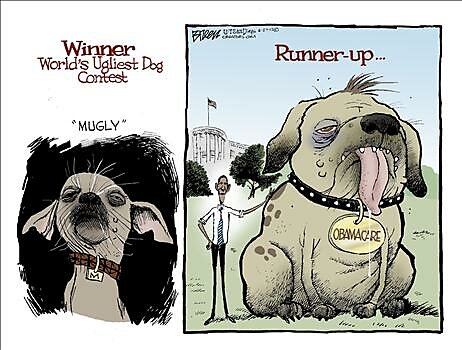
If you like that one, you can see another Breen cartoon here.
Today’s baby-splitting decision rewrites the Affordable Care Act in order to save it. It’s certainly gratifying that a majority rejected the government’s dangerous assertion of power to require people to engage in economic activity in order to then regulate that activity. That vindicates everything that we who have been leading the constitutional challenge have been saying: The government cannot regulate inactivity. It cannot, as Chief Justice Roberts put it, regulate mere existence.
Justifying the individual mandate under the taxing power, however, in no way rehabilitates the government’s constitutional excesses. As Justice Kennedy said in summarizing his four-justice dissent from the bench, “Structure means liberty.” If Congress can slip the Constitution’s structural limits simply by “taxing” anything it doesn’t like, its power is no more limited than would it be had it done so under the Commerce Clause. While imposing new taxes may be politically unpopular and therefore harder to do than creating new regulations, that political check does not obviate constitutional ones—and in any event, Congress avoided even that political gauntlet here by explicitly structuring the individual mandate as a commercial regulation.
Nor does the Court vindicate its constitutional sleight-of-hand by rewriting the Medicaid expansion to tie only new federal funding to an acceptance of burdensome and fundamentally transformative regulations. While correct on its face—and a good exposition of the spending power and what strings the federal government can attach to its funds—that analysis is relevant to a hypothetical statute, not the one that Congress actually passed. Moreover, allowing states to opt out of the new Medicaid regime while leaving the rest of Obamacare in place throws the insurance market into disarray, increases costs to individuals, and gives states a different Hobson’s choice—different but no less tragic than the one it previously faced. As Justice Kennedy wrote in dissent, while purporting to apply judicial modesty or restraint, the Court’s rewriting of the law is anything but restrained or modest.
In short, we have reaped the fruits of two poisonous trees of constitutional jurisprudence: On the one (liberal activist) hand, there are no judicially administrable limits on federal power. On the other (conservative pacifist) one, we must defer to Congress and presume (or construe) its legislation to be constitutional. It is that tired old debate that produces the Frankenstein’s monster of today’s ruling. What judges should be doing instead is applying the Constitution, no matter whether that leads to upholding or striking down legislation. And a correct application of the Constitution inevitably rests on the Madisonian principles of ordered liberty and limited government that the document embodies.
In any event, the ball now returns to the people, who opposed Obamacare all along, and whence all legitimate power originates. It is ultimately they who must decide—or not—to rein in the out-of-control government whose unconstitutional actions have taken us to the brink of economic disaster.
The Supreme Court ruled that ObamaCare’s individual mandate is not constitutional under the Commerce Power, which was how Congress framed the mandate to avoid a political backlash from calling it a tax. Congress and the president swore up and down that the mandate was not a tax. Yet the Court upheld the mandate as a valid use of that disavowed taxing power. What Congress said the individual mandate is, the Court said is not constitutional. What Congress said the mandate is not, the Court ruled is constitutional. Everybody got that?
Where does that leave us?
- The Supreme Court just enacted a law that Congress never would have passed.
- The Court just told Congress it is okay to lie to the people to avoid political accountability.
With the Supreme Court ruling on President Obama’s health care law, everyone is wondering what’s next for big government. Here are some ideas for federal policymakers to consider:
Federal Broccoli Act of 2013: Eat your broccoli, else pay the IRS $1,000.
Federal Recycling Act of 2014: Fill your blue box and put on the curb, else pay the IRS $2,000.
Federal Green Car Act of 2015: Make your next car battery powered, else pay the IRS $3,000.
Federal Domestic Jobs Act of 2016: Don’t exceed 25 percent foreign content on family consumer purchases, else pay the IRS $4,000.
Federal Obesity Act of 2017: Achieve listed BMI on your mandated annual physical, else pay the IRS $5,000.
Federal National Service Act of 2018: Serve two years in the military or the local soup kitchen, else pay the IRS $6,000.
Federal Housing Efficiency Act of 2019: Don’t exceed 1,000 square feet of living space per person in your household, else pay the IRS $7,000.
Federal Population Growth Act of 2020: Don’t exceed two children per couple, else pay the IRS $8,000.