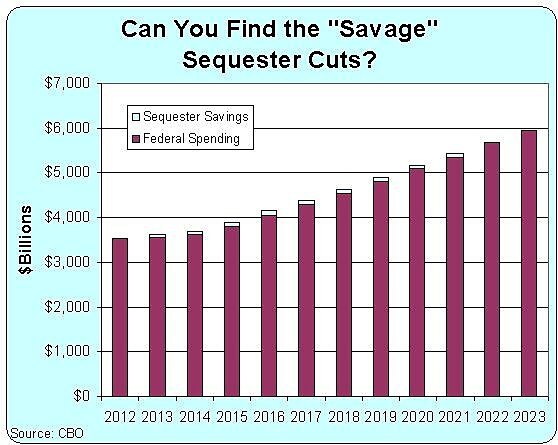
Will sequestration undermine U.S. national security? Hardly. Today, the Cato Institute released a new infographic putting these minor cuts in perspective.
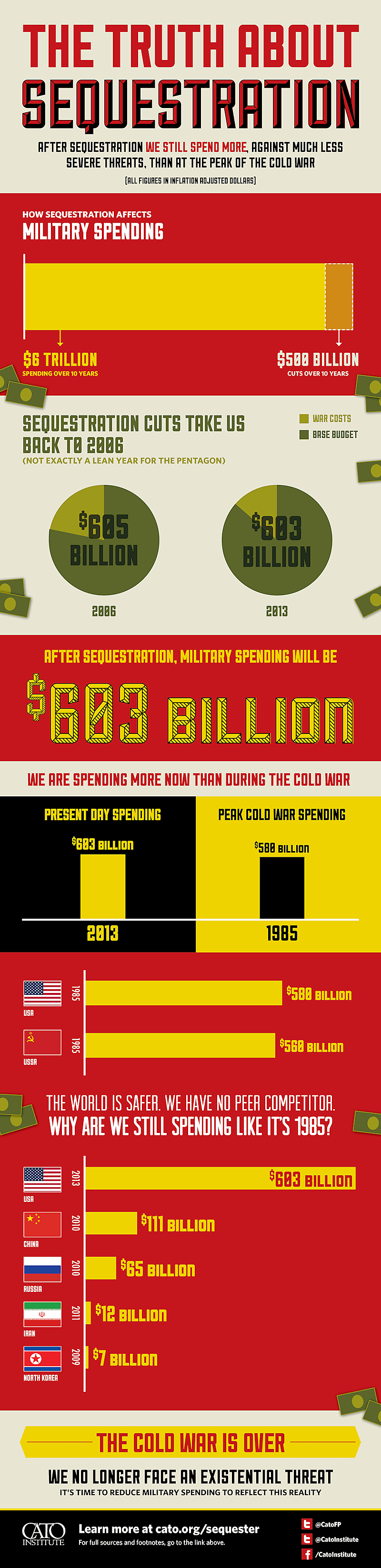
Military spending will remain at roughly 2006 levels—$603 billion, higher than peak U.S. spending during the Cold War. Meanwhile, we live in a safer world. The Soviet Union has been dead for more than two decades; no other nation, or combination of nations, has emerged since that can pose a comparable threat. We should have a defense budget that reflects this reality.
To be clear, sequestration was no one’s first choice. But the alternative—ever-increasing military spending detached from a legitimate debate over strategy—is worse. We should have had such a debate, one over the roles and missions of the U.S. military, long before this day of reckoning. And politicians could have pursued serious proposals to prudently reduce military spending. Instead, they chose the easy way out, avoiding difficult decisions that would have allowed for smarter cuts.
Until now, there have been few constraints on Washington’s ability to spend what it pleases on the military. As my colleagues Benjamin Friedman and Justin Logan put it, Americans “buy defense like rich people shop, ignoring the balances of costs and benefits.”
Policymakers can’t postpone the tradeoffs forever, especially when the public has grown increasingly weary of foreign entanglements. If forced to choose between higher taxes, less military spending, or lower domestic spending, in order to balance the budget, the military fares least well, with solid pluralities favoring cuts in military spending over cuts in other programs.
Which is why it is so important to get the foreign policy debate right. If we are going to give our military less, we need to think about asking it to do less.
A number of experts have done that, rethinking the military’s purpose, and documenting the savings that would flow from a more modest foreign policy. The sequester is a first step, albeit an imperfect one, that could finally compel policymakers to do the same.
Download and share this infographic on your blog, Twitter, or Facebook.
My thanks go out to Harrison Moar and Zach Graves for conceiving this, pulling the data together, and making it look really cool.
Additional Cato resources on sequestration and military spending:
- “Sequestration Is Still Better than the Alternatives,” by Christopher A. Preble
- “Budgetary Savings from Military Restraint,” by Christopher A. Preble and Benjamin H. Friedman
- “Economic Effects of Reductions in Defense Outlays,” by Benjamin Zycher
- Video: “Sequestration Panic!”
- Video: “The Truth about Sequestration”
Infographic sources (in order of figures listed, left to right):
- $6 trillion (current dollars): Congressional Budget Office, “The Budget and Economic Outlook: Fiscal Years 2013 to 2023,” Table 1–5, February 2013, http://www.cbo.gov/sites/default/files/cbofiles/attachments/43907-BudgetOutlook.pdf.
- $500 billion (current dollars): Widely cited approximate figure. See Army Sgt. 1st Class Tyrone C. Marshall, Jr., “Panetta Thanks Congress, Seeks End to Sequestration,” American Forces Press Service, United States Department of Defense, January 2, 2013, http://www.defense.gov/News/newsarticle.aspx?ID=118907; and Editorial, “Defense and the Sequester,” New York Times, February 24, 2013, http://www.nytimes.com/2013/02/25/opinion/defense-and-the-sequester.html?ref=global&_r=0.
- $605 billion (constant FY 2012 dollars): Department of Defense, “Fiscal Year 2012 Green Book,” Table 6–8 – Dept. of Defense BA by Title, March 2011, http://comptroller.defense.gov/budget2012.html. War costs totaled $132 billion.
- $603 billion (current dollars): Congressional Research Service, Memorandum from Amy Belasco, “Potential Effects on Defense Spending of a Year-long Continuing Resolution and the March 2013 Sequesters,” Table 1, February 7, 2013, http://www.pogoarchives.org/straus/CRS-Sequester-20130207.pdf. Figures based on FY 2013 Continuing Resolution. War costs total $82.1 billion.
- $580 billion (constant FY 2012 dollars): Department of Defense, “Fiscal Year 2012 Green Book,” Table 6–8 – Dept. of Defense BA by Title, March 2011, http://comptroller.defense.gov/budget2012.html.
- $560 billion (constant 2012 dollars): State Department,“World Military Expenditures and Arms Transfers: 1989,” Table I, Released October, 1990, http://www.state.gov/t/avc/rls/rpt/wmeat/c50834.htm. Author’s inflationary calculations.
- $111 billion (2010 estimate): International Institute of Strategic Studies, The Military Balance 2012, (London: Routledge, 2012), p.215.
- $65 billion (2010 estimate): International Institute of Strategic Studies, The Military Balance 2012, (London: Routledge, 2012), p.192.
- $12 billion (2011 estimate): International Institute of Strategic Studies, The Military Balance 2012, (London: Routledge, 2012), p. 323.
- $7 billion (2009 estimate): Approximation based on estimated military expenditure as a percentage of GDP from U.S State Department document and CIA World Factbook. State Department, “North Korea Background Note,” April 4, 2012, http://www.state.gov/outofdate/bgn/northkorea/200972.htm; and Central Intelligence Agency, “World Factbook: Korea, North,” https://www.cia.gov/library/publications/the-world-factbook/geos/kn.html.