Cato at Liberty
Cato at Liberty
Topics
Leaving High-Tax Connecticut for Low-Tax Florida
The exodus of the wealthy from high-tax Connecticut continues, according to the Wall Street Journal:
After four years on the market, and three price cuts, a stately Colonial-style home on Greenwich, Conn.’s tony Round Hill Road is being sold in a way that was once unthinkable in one of the country’s most affluent communities: It is getting auctioned off. Once asking $3.795 million, the four-bedroom property will be sold May 18 with Paramount Realty USA for a reserve price of just $1.8 million.
Seller Isaac Hakim, a real-estate investor, said it is time to move on …. Many wealthy New Yorkers are opting to live in the city, rather than in the suburbs. Some of the wealthiest, like Mr. Hakim, have decamped to Florida in search of more favorable tax rates.
… Owners who paid top dollar for their homes in the Fairfield County town in the mid- to late-2000s are routinely selling for less than they paid. Dramatic price cuts are the order of the day.
… Starwood CEO Barry Sternlicht, a former Greenwich resident, declared it to be the worst housing market in the country. “You can’t give away a house in Greenwich,” he said while speaking at an investment conference. Mr. Sternlicht’s company has since relocated from Greenwich to Miami Beach, Fla.
Data from both the Census Bureau and Internal Revenue Service have long shown that Americans are, on net, moving from higher-tax states such as Connecticut to lower-tax states such as Florida. The 2017 Tax Cuts and Jobs Act (TCJA), which capped state and local tax deductions, has likely strengthened these existing migration patterns.
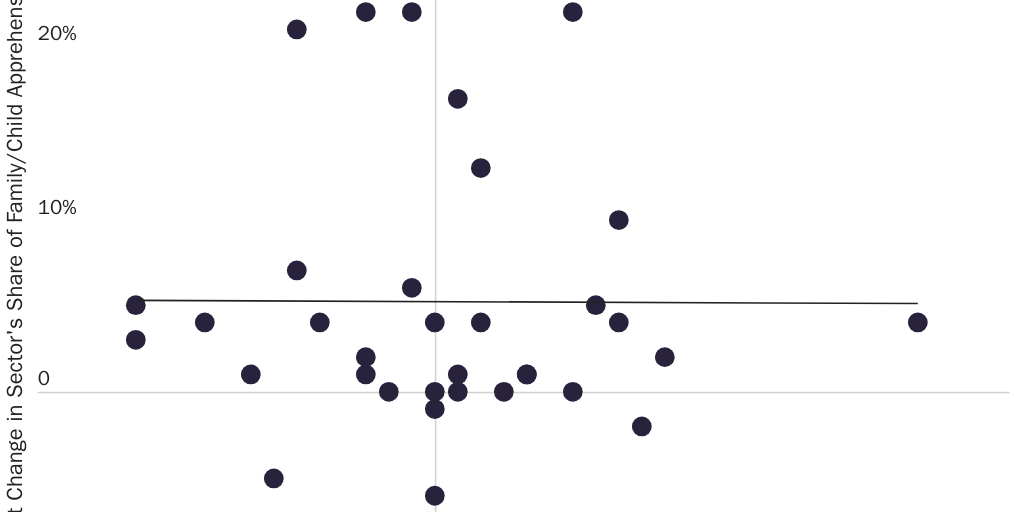
These patterns are shown in the chart below. Each blue dot is a state. The vertical axis shows the mid-2017 to mid-2018 Census net interstate migration figure as a percentage of state population. The horizontal axis shows state and local household taxes as a percentage of personal income. The red line shows the fitted relationship between the two variables.
On the right, most of the high-tax states have net out-migration. On the left, nearly all the net in-migration states have household tax loads of less than 8.5 percent of personal income.
The TCJA should be a wakeup call for out-migration states such as Connecticut. Such states need to reduce their taxes and trim their government costs. News articles reveal that the wealthy are taking a hit on selling their Connecticut homes. But the whole state takes a hit when highly productive people and their businesses decamp for tax-friendlier locations.
I profile some of the other wealthy expatriates from Connecticut here.
A new study published by NBER summarizes the latest international evidence on tax-induced mobility.
Related Tags
ITC Report on Economics of USMCA Out; Next Up, Politics
The U.S. International Trade Commission (ITC) released its report on the likely impact on the U.S. economy and specific industry sectors from the U.S.-Canada-Mexico Agreement (USMCA). The main finding is unsurprising: “if fully implemented and enforced, USMCA would have a positive impact on U.S. real GDP and employment.” Since the North American Free Trade Agreement (NAFTA) was already beneficial to Canada, Mexico and the United States, the changes were not expected to be on net negative.
However, the topline figure which “estimates that USMCA would raise real U.S. GDP by $68.2 billion (0.35 percent) and U.S. employment by 176,000 jobs (0.12 percent)” is slightly higher than expected, but still small in terms of its overall impact on the U.S. economy.
Both exports and imports will increase as a result of the deal, though many of the gains remain small or modest, such as in textiles and apparel, chemicals and pharmaceuticals, electronic products, energy products and services. The reason why smaller gains are expected here is because NAFTA already liberalized most trade in these sectors, so any additional reductions would be minor.
There are two notable outcomes worth highlighting. First, the largest gains are expected to come from new rules on international data transfers and e‑commerce, which were not part of the original NAFTA. Locking in existing commitments on the free cross-border flow of information is likely to deter future barriers to data transfers, such as data localization. The reduction of policy uncertainty in these areas is a key factor in the higher than projected gains. In addition, the higher de minimis thresholds on e‑commerce exports is also net liberalizing, and likely to increase exports to Canada by $332 million and $91 million to Mexico.
The biggest harm, and largest impact of the USMCA, comes from an area that was expected—the restrictive rules of origin (ROO) on the automotive sector. The report states that these new requirements “would strengthen and add complexity to the rules of origin requirements in the automotive sector” and are “estimated to increase U.S. production of automotive parts and employment in the sector, but also lead to a small increase in the prices and a small decrease in the consumption of vehicles in the United States.” Essentially, cars will become more expensive (0.37 percent for pick-up trucks and 1.61 percent for small cars) and total consumption will decline by 140,000 vehicles. These production costs will be the result of, as footnote 7 states, “the shifting sourcing of core parts to the United States, even though the non-preferential tariff rates they would face (for many vehicle types) if they did not comply with the new automotive ROOs would be small.” Basically, the economic analysis assumes that companies will be willing to pay non-preferential tariffs instead of complying with the stricter auto ROO.
Furthermore, footnote 66 of the report states:
“Commissioner Kearns notes that, as described above, the model appears to suggest that the trade restrictiveness of ROO is inversely related to its positive impact on the U.S. economy. Carried to its logical conclusion, this would appear to suggest that the best ROO is a very weak or nonexistent ROO.”
This essentially means that one of the biggest trumpeted gains, the new auto rules, are actually the worst part of the new agreement.
There are a number of other small increases expected, such as in agriculture, particularly due to the fact that Canada increased its tariff rate quotas on dairy products, poultry, meat, eggs, and also wheat and alcoholic beverages. The gains, however, are still modest, projected to increase U.S. agricultural and food exports by 1.1 percent.
The main takeaway is that since NAFTA removed almost all tariff barriers, the gains from USMCA are modest and largely come from reductions in the remaining non-tariff barriers. While the gains are higher than expected, this is likely due to the change in methodology by ITC to incorporate the impact of the gains from reducing these non-tariff barriers. At the end of the day, the final number is still modest, and is unlikely to sway anyone in Congress from changing their already strongly held opinions on the agreement. If anything, the release of the ITC report clears the way for implementing legislation to come forward and the real battle for the passage of USMCA to begin.
Latest Opioid “Sting” Again Illustrates The Power of Prohibition to Corrupt
The front page of today’s Wall Street Journal reports on a federal sting operation that led to the arrest of 31 doctors, 7 pharmacists, 8 nurses, and other health care professionals including dentists for distributing more than 32 million prescription opioid pills to patients in five Appalachian region states.
Federal prosecutors described doctors handing out pre-signed blank prescriptions in exchange for cash. In some instances, doctors provided prescriptions in return for sexual favors. One Alabama doctor allegedly recruited prostitutes to become patients and let them use drugs at his house. Dentists performed unnecessary teeth extractions on cooperative patients so they can have a legal excuse to prescribe them the opioid pills they desired. Some doctors knowingly sold prescriptions to nonmedical drug users and then billed Medicare and Medicaid for the evaluations and tests they performed as a cover.
Brian Benczkowski of the Department of Justice told reporters, “When medical professionals behave like drug dealers, the Department of Justice is going to treat them like drug dealers.”
Mr. Benczkowski is right to consider these professionals “drug dealers.” This is just the latest and most graphic example of how prohibition fuels the so-called opioid crisis. In 2017 the DOJ arrested 412 doctors, pharmacists, and others for engaging in similar schemes in Florida.
As I have written here, drug prohibition creates lucrative black market opportunities for people willing to sell drugs illegally. Prescription pain pills sell for a much higher price on the black market than they do legally at the pharmacy. The lure of easy money tempts corrupt doctors, dentists, nurse practitioners, and pharmacists to leverage their degrees to nefarious ends, especially because they can use the third party payment system to “double-dip:” they get paid by drug dealer middlemen for churning out and filling prescriptions which then get sold on the black market, and at the same time get reimbursed for their “services” by Medicare, Medicaid, and insurance companies.
Prohibition brings out the worst in people. It provides the corrupt and the corruptible with irresistible money-making opportunities.
Meanwhile, desperate chronic pain patients, already the civilian casualties in the government’s war on opioids, are justified in their concern that politicians will react to the latest news with further crackdowns on opioid prescribing while more doctors will abruptly taper their chronic pain patients or abandon treating pain altogether out of fear they might risk being the next target of law enforcement wrath.
If lawmakers, policymakers, and the press want to know where to place the blame for the ugly facts revealed by this latest sting operation the answer is obvious: blame prohibition.
Related Tags
The Ruins of Old Tech Monopolies
Look on my works, ye Mighty, and despair!
Mar 2000: Palm Pilot IPOs at $53 billion
Sep 2006: “Everyone’s always asking me when Apple will come out with a cellphone. My answer is, ‘Probably never.’” – David Pogue (NYT)…
Jun 2007: iPhone released
Nov 2007: “Nokia: One Billion Customers—Can Anyone Catch the Cell Phone King?” (Forbes)
Geoffrey Manne and Alec Stapp at Truth on the Market have written a brief history of impregnable tech monopolies that were pregnable after all, in fields from personal computers to video distribution to social media. Sen. Elizabeth Warren and others are now arguing that the government should break up and closely regulate tech giants Google, Amazon, Facebook, and Apple “claiming they have too much power and represent a danger to our democracy.” Manne and Stapp offer examples of sector after sector in which what was seen as structural, inescapable tech monopoly turned out to be not so unassailable. Here’s music distribution:
Dec 2003: “The subscription model of buying music is bankrupt. I think you could make available the Second Coming in a subscription model, and it might not be successful.” – Steve Jobs (Rolling Stone)
Apr 2006: Spotify founded
Jul 2009: “Apple’s iPhone and iPod Monopolies Must Go” (PC World)
Jun 2015: Apple Music announced
They conclude by quoting two observations by Benedict Evans, a venture capitalist at Andreessen Horowitz, first on “why competition in tech is especially difficult to predict”:
IBM, Microsoft and Nokia were not beaten by companies doing what they did, but better. They were beaten by companies that moved the playing field and made their core competitive assets irrelevant. The same will apply to Facebook (and Google, Amazon and Apple).
And why “we will not be stuck with the current crop of tech giants forever”:
With each cycle in tech, companies find ways to build a moat and make a monopoly. Then people look at the moat and think it’s invulnerable. They’re generally right. IBM still dominates mainframes and Microsoft still dominates PC operating systems and productivity software. But… It’s not that someone works out how to cross the moat. It’s that the castle becomes irrelevant. IBM didn’t lose mainframes and Microsoft didn’t lose PC operating systems. Instead, those stopped being ways to dominate tech. PCs made IBM just another big tech company. Mobile and the web made Microsoft just another big tech company. This will happen to Google or Amazon as well. Unless you think tech progress is over and there’ll be no more cycles … It is deeply counter-intuitive to say ‘something we cannot predict is certain to happen’. But this is nonetheless what’s happened to overturn pretty much every tech monopoly so far.
Related Tags
A Gold Standard Does Not Require Interest-Rate Targeting
Stephen Moore and Herman Cain, the two recent nominees to the Federal Reserve Board of Governors, have in the past suggested returning to a gold standard (although Moore now says he favors merely consulting a broad range of commodity prices as leading indicators). In response, a number of recent op-eds criticized the idea of reinstating a gold standard. The critics unfortunately show little theoretical understanding of the mechanisms by which a gold standard works, and consult no evidence about how the classical gold standard worked in practice.
I don’t seek to defend the nominees, who I think are poor choices on other grounds that have been enumerated by Will Luther. And I don’t seek here to answer many common criticisms of the gold standard, since I have tried to do that here and here. I want to focus on one novel criticism. It stems from imagining that a gold standard regime works like our present regime in the sense that the central bank uses a short-term interest-rate target to steer the economy toward its long-run goal. The only difference is that the central bank pursues a constant dollar price of gold rather than another nominal goal like a gradually rising price-level or nominal-income path.
Thus a Washington Post reporter, Matt O’Brien, declares that a gold standard is “a disaster” and “might be the worst guide to setting policy.” That he sees the gold standard as a “guide to setting policy” already signals a misconception. O’Brien comes to the “disaster” conclusion by starting from the false premise that the wild price volatility of today’s demonetized gold tells us how volatile the price of gold would be under an international gold standard absent domestic central bank action. To offset that potential price volatility, he supposes, the central bank would have to undertake wild and often inappropriate swings in its interest rate policy. If you look at the track record of the classical gold standard, however, you don’t find such wild central bank policies. In the United States, you don’t even find a central bank.
In a classic article on “Econometric Policy Analysis: A Critique,” the Nobel-laureate monetary economist Robert E. Lucas enunciated what has come to be known as “the Lucas Critique.” The Critique warns us against assuming that a statistical relationship observed under one policy regime would persist under a different policy regime. Under the regime of the classical gold standard, a newly minted US $10 dollar coin contained .48375 troy ounces of gold. Alternatively put, the gold definition of the dollar equated 1 troy oz. of gold to $20.67. The dollar price of gold in the US did not vary from that par value (except within the narrow band around parity set by the cost of shipping gold in or out, estimated at less than ±0.33% of par value) despite the absence of offsetting central bank policy. Matt O’Brien’s view is inconsistent with the historical record of the classical gold standard.
Where did O’Brien get his initial false premise and its incorrect implication about monetary policy under a gold standard? He refers to a piece by the economist Menzie Chinn on the blog Econbrowser that asks the question: “What Would It Take to Implement Cain’s Gold Standard, Interest-Rate-Wise?” As its title suggests, Chinn’s piece takes it for granted that a gold standard is implemented by having a central bank adjust interest rates as necessary to maintain a constant nominal price of gold. This is an odd conception of a gold standard because, as already noted, the United States didn’t have a central bank while it was on a gold standard before 1914. The mechanism for maintaining the dollar-gold parity was something quite different: The redeemability of dollar deposits and banknotes for gold coin or bullion, and international transfers of gold, enabled the quantity of money to adjust endogenously to bring about monetary equilibrium at the given parity. The redemption was performed mostly by private commercial banks before 1914.[1]
With the founding of the Federal Reserve (which opened in 1914), and after the 1933 mandate that all commercial banks and individuals turn in their monetary gold to the federal government, the right to redeem dollar-denominated claims to gold could now be exercised only by foreign central banks, and only against the US Treasury. The decentralized automaticity of the classical international gold standard was gone, and central banks ruled the roost. In the mid-1960s President Johnson began restricting foreign redemption of dollars, and in 1971 President Nixon ended it. Since then the dollar price of gold has been free to fluctuate as the public hedges against fiat-money inflation and speculates about a variety of other risks.
Chinn’s piece does not look at the classical gold standard period in the US. He plots data on the dollar price of gold only from 1968 to the present, then regresses the dollar price of gold during that non-gold-standard period on a short-term Treasury bond yield. In disregard of the Lucas Critique, he then quite remarkably draws conclusions about the working of a gold standard. He writes:
Stabilizing the price of gold in US dollars requires adjusting the interest rate (akin to how the exchange rate is managed). … [A] return to the gold standard would imply that the Fed funds rate would have to be about 15 percentage points higher than it was in January 2000 in order to keep the dollar’s value stable at January 2000 levels — a rate 18 percentage points higher than actually recorded in March 2019.
Chinn’s estimate of the required Fed funds rate is based on the coefficients produced by his regression of recent gold prices on a Treasury yield rate. He reports the following point estimate of the relation between “the log price of gold and the real 3 month Treasury yield, estimated over the 1968M03-2019M02 period”:
pgold = 6.423 – 10.210 fedfunds
He infers from the negative sign that the Fed can raise interest rates to lower the price of gold. To maintain a constant dollar-gold parity, he then supposes, the Fed must raise interest rates (its only policy tool considered) to offset what would otherwise be a rise in the dollar price of gold. But that is plainly not how the parity is or was maintained under a gold standard as conventionally defined or as historically experienced. Rather, the parity is maintained by redeemability of dollars into coined gold at the defined par rate. The dollar money stock endogenously adjusts—either via the price-specie-flow mechanism a la David Hume or via goods arbitrage a la McCloskey and Zecher—until it is consistent with the quantity of money demanded at the defined parity.
Chinn’s idiosyncratic conception of how a gold standard works is inconsistent with at least two historical facts. First, as a recent working paper by Christopher Hanes shows, the Bank of England, which did vary its discount rate to manage gold flows, never had to raise its rate above 7 percent during the classical period 1880–1913. There is nothing remotely like a 20 percent rate to be seen. Second, as already noted, the United States maintained a fixed dollar-gold parity over the same span without any central bank. A central bank varying an interest-rate policy target obviously cannot be the key to explaining how the US maintained a fixed dollar-gold parity before 1914. Having a central bank adjust the interest rate can hardly be a requirement for keeping the dollar at its defined par value with gold. Although there is no central bank policy rate to track, the observed range of rates on prime commercial paper in the United States remained between 3 percent and 6.5 percent during 1888–1914, as shown in a published paper by Gene Smiley.
The Lucas Critique may not always be pertinent criticism, as found by a paper that Professor Chinn has cited. But the Critique provides a highly relevant warning against extrapolating from the behavior of the dollar price of gold under our current fiat regime to the behavior of the dollar price of gold under a gold standard regime. As already noted, the dollar price of one troy ounce of gold does not vary under a gold standard (except within the very narrow band between the gold import and export points). Rather, the dollar sticks to its definition in terms of gold due to redemption and equilibrating money flows. If one were to repeat Chinn’s exercise with data from the classical gold standard, regressing the log dollar price of gold on a constant plus the real 3‑month Treasury rate, I venture to predict that he would find very different coefficients. Namely, the constant would be the log of $20.67, and the coefficient on the Treasury rate would be zero.
Whatever the demerits of Stephen Moore and Herman Cain as potential Federal Reserve Governors, the working of a gold standard should not be misunderstood or misrepresented as part of the argument against them. As Tyler Cowen has noted, one of the nominees’ chief shortcomings is their loyalty to a President who gives partisan monetary policy advice, whereas a great merit of an automatic gold standard system is that it provides a barrier against partisan manipulation of money. Both supporters and critics of the nominees should make a real effort to study the self-adjusting mechanisms and track record of the classical gold standard before they absurdly proclaim it a disaster.
[1] George Selgin and I have explained why redemption by private commercial banks, constrained by competition and the rule of law, is more reliable than redemption by monopolistic bodies with sovereign immunity.
Related Tags
Fentanyl as a WMD? The War on Opioids Reaches a New Level of Misinformation
“This is like declaring ‘ecstasy’ as a WMD,” an anonymous source from the Department of Defense counter-WMD community commented incredulously. This source was quoted by a Task and Purpose reporter investigating a Department of Homeland Security internal memo discussing designating the synthetic opioid fentanyl as a weapon of mass destruction. This is just the latest example of how misinformation and hysteria inform federal and state policy regarding the overdose crisis.
Policy makers maintain their state of denial about the role of prohibition in the overdose crisis. Denial fosters vulnerability to misinformation and “alternative facts” to prop up falsely held views. Denial that the war on drugs is responsible for most of the death and destruction surrounding illicit drug use makes policymakers susceptible to claims about fentanyl that are not based in reality.
Misinformation about fentanyl leads to avoidable stress and overreaction among first responders. But misinformation about the causes of the opioid overdose crisis causes much more harm.
Lawmakers and policy makers continue to believe the overdose crisis was caused by doctors too liberally prescribing pain pills. This ignores the government’s own data that shows there is no correlation between the number of pills prescribed and the incidence of nonmedical use or pain reliever use disorder. It ignores evidence that nonmedical drug use was on a steady exponential increase well before the doctors began prescribing more liberally, and is showing no signs of letting up. As I have written before, the main driver of the overdose crisis has always been prohibition. Policies that fail to recognize this and focus on reducing prescriptions only serve to drive nonmedical users to more dangerous drugs and make patients suffer in the process.
The WMD hypothesis probably derives from a lone instance in 2002 when fentanyl was pumped into a Moscow theater by Russian police to end a hostage crisis, resulting in nearly 200 deaths. The means by which it was aerosolized have never been made public. Much remains secret. American authorities believe a second disabling substance might have been mixed in with the fentanyl. And Russian doctors complained that delays in entering the building and the failure to have naloxone available contributed to the deaths.
However, a 2017 position statement from the American College of Medical Toxicology states, “At the highest airborne concentration encountered by workers, an unprotected individual would require nearly 200 minutes of exposure to reach a dose of 100 mcg of fentanyl… evaporation of standing product into a gaseous phase is not a practical concern.”
The urban myth that even minimal skin contact with fentanyl or an analog can cause a drug overdose has been difficult to eradicate. Because it not easily absorbed through the skin it took years of research before pharmaceutical companies finally devised a means to deliver fentanyl trans-dermally using a skin patch, now one of the most common ways it is prescribed in the outpatient setting. In its position paper, the ACMT also affirms that even extreme skin exposure to fentanyl “cannot rapidly deliver a high dose” of fentanyl.
Yet reports abound of first responders being rushed to emergency rooms after manifesting overdose symptoms upon exposure to fentanyl, only to be cleared and released upon evaluation. This may be attributable to the nocebo effect, an exquisite example of the power of suggestion that has a neurochemical explanation. Guidelines on preventing occupational exposure from the Centers for Disease Control and Prevention and first responder alertsfrom the Drug Enforcement Administration that state, “Exposure to an amount equivalent to a few grains of sand can kill you,” only serve to enhance the nocebo effect and feed the hysteria.
The DEA states almost all of the fentanyl it seizes is “illicit fentanyl”—fentanyl and fentanyl analog powders made in clandestine labs in Asia and now in Mexico. It is often purchased on the “dark web” and shipped to the US in the mail. Fentanyl’s appearance in the underground drug trade is an excellent example of the “iron law of prohibition:” when alcohol or drugs are prohibited they will tend to get produced in more concentrated forms, because they take up less space and weight in transporting and reap more money when subdivided for sale.
Licit fentanyl is an excellent drug, not usually produced in powdered form, and is used in many different clinical settings, not the least of which is in the operating room as an anesthetic adjunct.
Illicit fentanyl is mainly used to enhance the strength of heroin and as an additive to cocaine (for “speedballing”). Drug dealers also use pill presses to press fentanyl into counterfeit prescription pain pills and sell them to unsuspecting drug users.
The Drug Enforcement Administration recently moved several illicitly produced analogs of fentanyl to Schedule 1 (no known medical use), thus banning them.
This will do nothing to stop the fentanyl trade. The DEA already claims that almost all of the fentanyl seized is illicit fentanyl. Making it schedule 1 will not cause these labs to shut down or the cartels to stop their already lucrative trade. Dozens of fentanyl analogs have been developed and more are on the way. They are as easy to make in the lab as making meth from Sudafed or P2P.
As they develop scenarios and contingency plans for weaponized fentanyl, policymakers refuse to see that the actual weapon of mass destruction is America’s endless war on drugs.