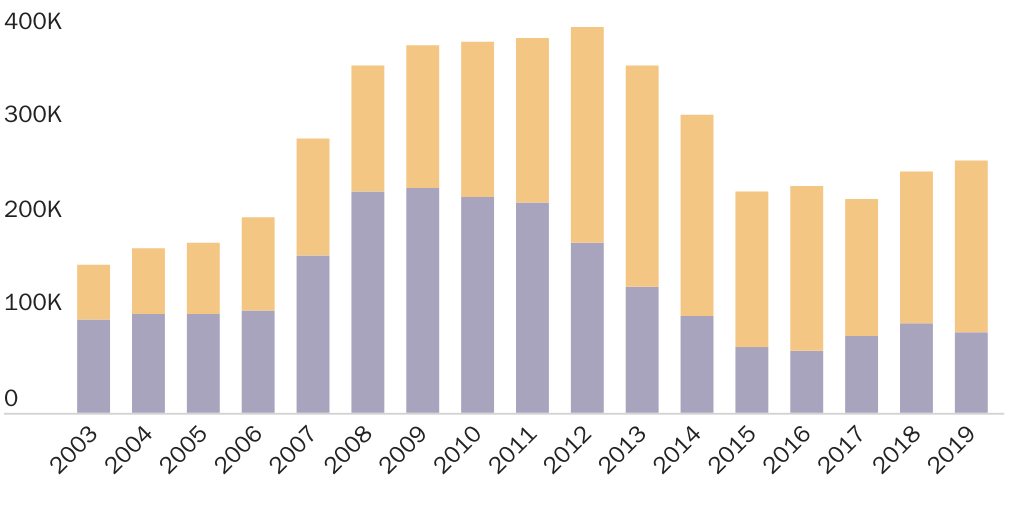
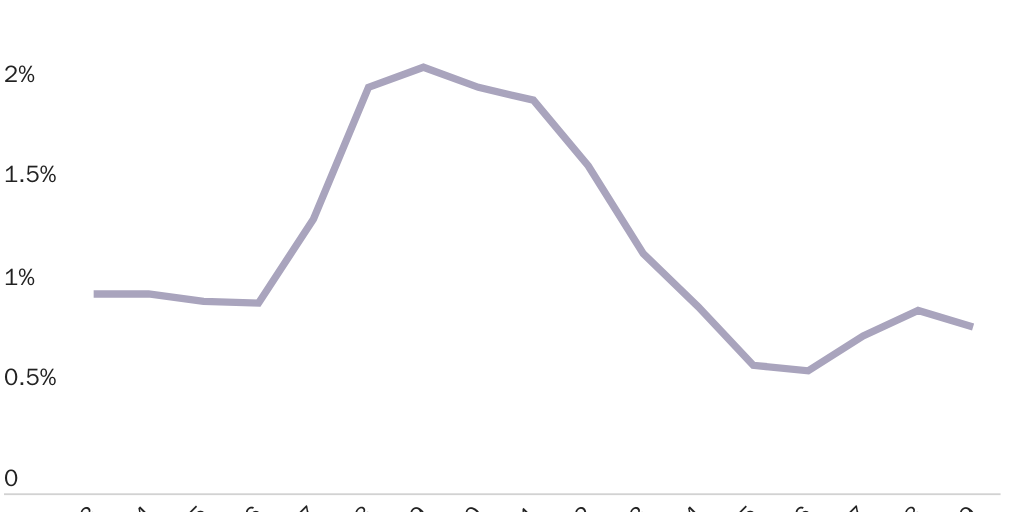
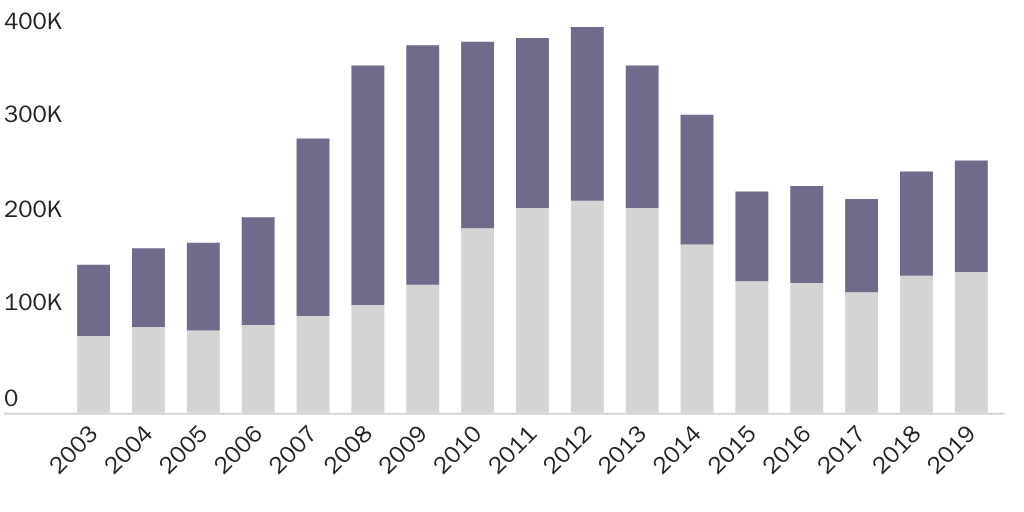
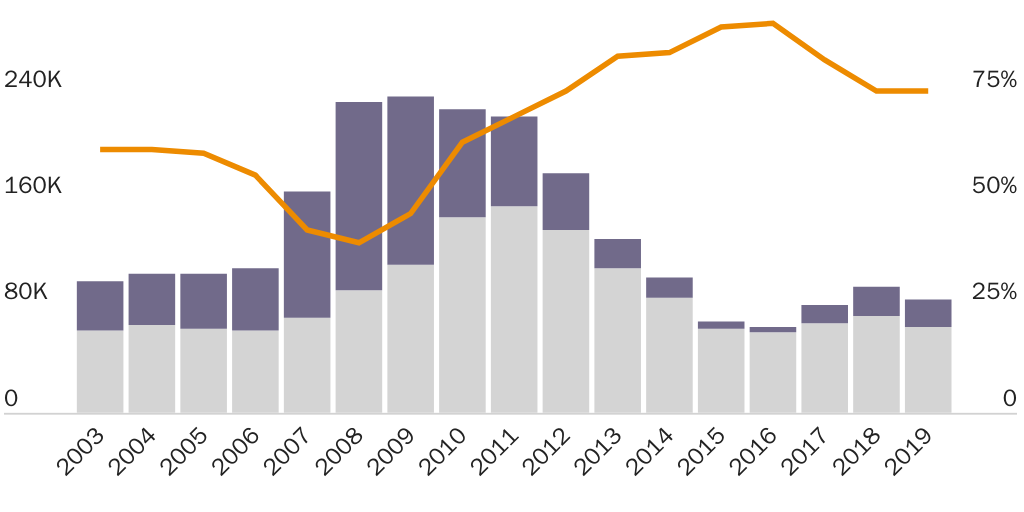
Earlier today Senator Mike Lee introduced a bill to repeal the Jones Act. Such a move is long overdue. In place since 1920, the Jones Act mandates that goods transported by water between two points in the United States be done by vessels that are U.S.-flagged, U.S.-crewed, U.S.-owned, and U.S.-built. Ostensibly meant to bolster the U.S. maritime sector, the Jones Act has instead presided over its decline whether measured in the number of oceangoing ships, mariners to crew them, or shipyards to build them.
While its benefits may be mythical, the law imposes very real burdens such as higher transportation costs, more highway congestion, more pollution, and even reduced access to U.S.-made products. In addition, the Jones Act’s rejection of competition and consumer choice should be considered an affront to cherished American principles. It’s time to rid ourselves of this antiquated law and chart a new course based on innovation and competition rather than discredited protectionism.
To learn more please visit www.cato.org/jonesact.
Cato at Liberty
Cato at Liberty
Topics
Lightbulb Efficiency Standards
The Washington Post recently criticized the Trump administration for proposing to eliminate an Obama administration rule that would extend minimum lightbulb energy efficiency standards to specialty bulbs and add them to a list of incandescent lights that will be effectively banned in 2020. The Post argues that the policy of imposing energy efficiency standards on lightbulbs “has no downside.” Energy efficiency regulations are often described as the equivalent of a free lunch, but these rules, like all regulations, have both benefits and costs.
Lightbulb efficiency standards were included in the Energy Independence and Security Act of 2007 (EISA), which established efficiency standards for “general service lamps.” These standards applied to various technologies, including traditional incandescent bulbs, CFLs, and LEDs, but excluded many types of specialty bulbs, such as decorative candelabra bulbs. The act also required the Department of Energy (DOE) to initiate procedures to determine whether the lightbulb standards should be increased and required a final rule to be published before 2017. If the DOE was unable to fulfill this requirement, the act created a backstop that would impose a 45 lumen (a measure of light intensity) per watt (lm/W) minimum on lightbulbs starting January 1, 2020. A traditional 100 watt incandescent bulb emits 1600 lumens of light, only 16 lumens per watt, and thus would be banned.
After passage of the EISA, Republicans in Congress stymied implementation of the standards by inserting language in DOE appropriation bills prohibiting the use of federal money for their implementation and enforcement. During the Obama administration the DOE attempted to circumvent the appropriation restrictions by creating new rules that expand the lighting standards to include many of the originally exempted lightbulbs and apply the 45 lm/W backstop in 2020. These regulations were published shortly before Trump’s inauguration in January 2017. The new proposed rules eliminate the Obama revisions.
Despite the Post’s assertion, the Obama regulations do impose costs. As the 2017 rule notes,
DOE acknowledges that manufacturers may face a difficult transition if required to comply with a 45 lm/W standard. Manufacturers have voiced concern regarding the loss of domestic manufacturing jobs, the stranding of inventory, the ability to meet the demand for all general service lamps with lamps using LED technology, and the burden associated with testing and certifying compliance for all general service lamps.
The fact that manufacturers are upset by the rule indicates there are some costs. Furthermore, limiting consumer choice itself is costly; some specialized incandescent bulbs may not be available after 2020.
The benefits of the standards also may be small. The Post states that the lack of the mandate would cost consumers $12 billion per year and 140 billion kilowatt-hours in energy waste. But these estimates assume that consumers will not choose LED and more energy efficient lamps over incandescent bulbs on their own.
Ever since the first oil shocks in the 1970s there has been a debate about the necessity of energy efficiency standards for autos, trucks, and appliances. Consumer groups and engineers, often working at federal energy laboratories, have argued consumers fail to purchase vehicles and appliances that are more expensive initially but save money over time through less energy use. Economists have responded with evidence that consumers make appropriate tradeoffs between initial costs and savings over time and that public programs to promote energy conservation have costs that are greater than benefits.
As I have previously summarized, the most extensive evidence exists for cars. According to this research, consumers are quite willing to pay more initially for a vehicle that saves them money in gasoline costs over the ownership life. The same argument applies for appliances and lightbulbs. As the president of the Alliance to Save Energy, a pro-efficiency standard group, argued,
There aren’t many people out there clamoring for outdated light bulbs that use four or five times as much energy. Consumers have moved on and embraced high-efficiency bulbs like LEDs because prices are plummeting and because they’re getting a better-performing, longer-lasting product that saves them money.
I recently replaced the incandescent candelabra bulbs in the outdoor lights outside my front door that used 40 watts of electricity with LED equivalents that used 4. The market provided me with an energy saving option even though no regulation required it to do so. If the light is used 3 hours a day 365 days a year and the electricity costs 10 cents per kWh, then the annual savings is $3.94 per year ($4.38 annual costs for the 40 watt bulb vs. $.438 for the 4 watt) which pays for the $8.26 cost of the LED bulb in a little over 2 years.
As the economic literature, manufacturers, and even some proponents of efficiency standards recognize, I am not unique. Consumers understand the cost savings of LEDs, so the economic and environmental benefits propounded by the Post will occur without the tradeoffs required by government mandate.
Written with research assistance from David Kemp.
Related Tags
Philadelphia’s Ban on Cashless Stores
In an attempt to help lower-income consumers, Philadelphia has just become
the first major U.S. city to ban cashless stores, placing it at the forefront of a debate that pits retail innovation against lawmakers trying to protect all citizens’ access to the marketplace.
As with other regulation that allegedly helps the poor (e.g., restrictions on pay-day lending), this new regulation is misguided.
Some stores, in response to this ban, will keep accepting cash but raise prices. Other stores will close their Philadelphia locations entirely. Both effects harm lower-income consumers in particular.
Regulation adds costs, so it normally exacerbates rather than ameliorates poverty.
A better way to help “the unbanked” is to reduce regulation of debit cards and other non-cash payment mechanisms.
Related Tags
Subsidizing Passenger Rail Makes Little Sense
A Wall Street Journal article on an upgrade to a Midwest rail line illustrates the shortcomings of pumping tax dollars into passenger rail.
Amtrak’s route from Chicago to St. Louis would seem an ideal place for the U.S. to adopt high-speed rail such as in Europe and Asia, where passenger trains can race along at 200 miles an hour. The stretch in Illinois is a straight shot across mostly flat terrain.
In fact, a fast-rail project is under way in Illinois. Yet the trains will top out at 110 mph, shaving just an hour from what is now a 5½-hour train trip.
After it’s finished, at a cost of about $2 billion, the state figures the share of people who travel between the two cities by rail could rise just a few percentage points.
Behind such modest gains, for hundreds of millions of dollars spent, lie some of the reasons high-speed train travel remains an elusive goal in the U.S.
Laying dedicated track is expensive but relying on existing track owned by freight rail firms limits speed and on-time performance. The latter approach also undermines the freight rail system, which is an efficient and powerful engine of the U.S. economy.
Illinois didn’t have the money, or the right-of-way, to lay tracks that would be exclusively for a high-speed service. So its fast passenger trains will have to share the track with lumbering freight trains.
“To build the kind of infrastructure that is stand-alone—that is, just for high-speed passenger rail—it is just absurdly expensive and just takes years and years and years to get through the permitting and environmental process,” said Randy Blankenhorn, who was Illinois’s transportation secretary until this year.
“Land acquisition alone [would] take half a decade,” he said. “If we were to have said from the beginning, right off the bat go to 200-mile-an-hour service, we’d still be in the implementing and design phase.”
Illinois settled for weaving improvements along the route and rebuilding an existing single-track line that is owned by freight railroads. In effect, it chose higher-speed rail rather than actual high-speed.
… The Illinois rail project has consisted of making major improvements to the route on which Amtrak provides service. Work started in September 2010 and was supposed to finish in seven years. A federal mandate requiring trains to have an automatic mechanism to prevent certain accidents helped push back the timeline.
It has been a monumental undertaking that required dealing with railroad companies, cities and landowners, said John Oimoen, deputy director of railroads in the state transportation department. More than 300 road crossings had to have separate agreements covering upgrades or closures.
By late 2015, agency officials feared the project was dead, simply because so many deals needed to be negotiated before a deadline to spend the federal grant. The agency ultimately assigned its highway real-estate department to help finish the project.
Upgrading road crossings often meant rebuilding them, from drainage pipes up, to smooth passage for faster trains. Two extra signal arms were added to many crossings to keep drivers from going around them.
Another problem is federal micromanagement. Anything involving federal subsidies includes layers of regulations, which adds costs and delays.
[Illinois] also faced years of delays in getting new rail cars. Nippon Sharyo of Nagoya, Japan, landed a contract in 2012. Because the federal grant that funded the work required cars to be built in the U.S. from U.S.-made parts, the Japanese company expanded a 460,000-square-foot factory in Rochelle, Ill., and rebuilt its supplier network.
The company struggled to adapt designs and failed U.S. crashworthiness tests. In 2017 it withdrew from the contract and later closed the plant, meaning a side benefit Illinois hoped for—local jobs assembling rail cars—fizzled. The work moved to a Siemens AG facility in California.
Amtrak is plagued by lousy customer service. Trains do not run frequently and they have a poor on-time record.
Heidi Verticchio takes the train a few times a week between her home in Carlinville, Ill., north of St. Louis, and Bloomington-Normal, where she directs a speech and hearing clinic for Illinois State University. Because the trains don’t run frequently enough, she often has to drive the 120 miles when she needs more flexibility.
A higher speed won’t mean Ms. Verticchio will be taking the train more often. She estimates it might cut 10 to 15 minutes from her ride.
“It’s not going to make any difference,” she said.
Most of the Chicago-St. Louis train corridor remains a single track. Freight railroads Union Pacific and Canadian National own most of the route. They coordinate all traffic, including passenger trains.
In the year that ended with November, according to an Amtrak report, Canadian National caused 1,672 minutes of delay per 10,000 Amtrak train-miles logged on the route. Union Pacific caused 1,036 minutes of delay per 10,000 Amtrak train-miles, Amtrak said. Both exceeded Amtrak’s target of 900.
The report attributed about two-thirds of the delays to “freight-train interference.” It found that 73% of rail passengers arrived on time, but for those who faced delays, these averaged 45 minutes.
Finally, U.S. passenger rail is run by the government There is more private-sector involvement abroad, which is a better approach. So I agree with Puentes that the Florida and Texas projects bear watching.
Robert Puentes, president of the Eno Center for Transportation in Washington, notes that the U.S. has used just one approach to passenger rail since the 1970s, Amtrak. The government-owned corporation was cobbled together from remnants of major railroads’ passenger services. It is funded through fares and state and federal subsidies.
European rail networks feature a mix of government and business owners and operators. Mr. Puentes said new investor-owned passenger rail ventures in Florida and Texas bear watching.
More on Amtrak here.
Romance of the Rails can be ordered here.
Related Tags
Edgy Rap Lyrics Shouldn’t Land a Man in Jail
Jamal Knox was arrested on drug-related charges and released pending further court proceedings. During the interim, he created a rap video in which he made disparaging remarks about the police and named two of the officers who arrested him. The Pennsylvania Supreme Court held that the video demonstrated subjective intent to harm under the “true threats” doctrine and imposed a criminal penalty on Mr. Knox.
The First Amendment protects the right of every person to speak freely without fear of punishment; it specifically protects the ability to criticize government officials. Indeed, the Constitution’s protection of speech is at its highest when government attempts to prosecute someone for his spoken words. One narrow exception is the “true threats” doctrine, which allows a government to punish a person for what he says if his words amount to an actual threat of harm, such as a bomb threat. But just how narrow this exception is remains a mystery.
Courts are divided over whether to consider only the speaker’s subjective intent, or the speaker’s intent and the objective nature of the threat—whether a reasonable person would view the speech as a threat. The second standard offers more protection to the speaker, because the government must prove show both subjective and objective elements of a “threat.” Cato, joined by the Rutherford Institute, has filed an amicus brief asking the U.S. Supreme Court to review this case and ultimately choose the higher standard of protection.
The ambiguity over whether and how the government may criminally prosecute someone for the content of speech is a serious threat to liberty. The situation is more alarming given that the United States is undergoing a communications revolution, driven by unprecedented new forms of online expression—and unprecedented new attempts by government to monitor and restrict such expression. This case presents an opportunity for the Court to set clear boundaries for the government’s authority to limit online expression through criminal prosecution.
The Court really does need to step in to avoid chilling protected expression. The subjective-intent-only test fails to protect defendants who are prosecuted for their speech, insulates “true threats” convictions from appellate review, and leaves controversial speakers unprotected even with respect to political or artistic expression.
No Free Lunch At Whole Foods
Recently, I wrote about “other channels of adjustment” for firms facing minimum wage increases (other than reducing hiring or laying off workers). My main point was this: though a minimum wage hike need not lead to job losses at every single firm, in the absence of firms not knowing how to incentivize their workers properly to maximize profitability, other business responses are not costless.
A good example can be seen in today’s story about Whole Foods. Under pressure from campaigners, Amazon recently raised its pay for its lowest-paid employees to $15-an-hour. Now some workers aren’t enjoying the effects:
The Illinois-based worker explained that once the $15 minimum wage was enacted, part-time employee hours at their store were cut from an average of 30 to 21 hours a week, and full-time employees saw average hours reduced from 37.5 hours to 34.5 hours. The worker provided schedules from 1 November to the end of January 2019, showing hours for workers in their department significantly decreased as the department’s percentage of the entire store labor budget stayed relatively the same.
“We just have to work faster to meet the same goals in less time,” the worker said.
…
The labor budget and schedule cuts at Whole Foods in the wake of the minimum wage increase appear to be similar to changes Amazon made after it raised the pay of warehouse workers to a minimum wage of $15 an hour. That move was widely praised but Amazon also cut stock vesting plans and bonuses that had provided extra pay to some workers.
Some Whole Foods workers say the cuts have led to understaffing issues. “Things that have made it more noticeable are the long lines, the need to call for cashier and bagging assistance, and customers not being able to find help in certain departments because not enough are scheduled, and we are a big store,” said one worker in California.
Whole Foods and Amazon therefore seem to be adjusting to higher hourly pay in several ways: cutting hours for employees and sweating them harder during those reduced hours, cutting back on stock plans and bonuses, and passing on the extra cost to consumers in the form of worse service. None of these are costless:
— cutting hours or bonuses negates the earnings boost from hourly pay increases
— sweating workers harder makes the work environment less pleasant, and may reduce job opportunities for workers incapable of “upping their game”
— a worse shopping experience is a quality-adjusted price increase for consumers
These are exactly the types of impacts I was referring to re: high minimum wages. When statutory wage floors are increased, the fact that the firm would not have opted to undertake these changes in the absence of the wage hike suggests changes would otherwise not have been profitable, and as such are still costly (though some firms are no doubt currently not efficient – making it feasible for some that higher minimum wages could jolt them to a better business model.)
There’s a great discussion of this issue towards the end of a brilliant EconTalk podcast on the minimum wage this week.
For more on the minimum wage, read here, here, here, here, here, here and here.
Related Tags
Senator Hawley’s Apostasy and the Substantive Due Process Problem
A week or so ago, the nomination of George Mason Law’s Neomi Rao to fill Justice Brett Kavanaugh’s seat on the D.C. Circuit ran into some unexpected headwinds when Missouri’s freshman Republican senator, 39-year-old Josh Hawley, raised several concerns about her views, all centered around his opposition to abortion. Fearing that the nomination might fail in committee, the Wall Street Journal’s editorial board took the extraordinary step last week of running not one but two house editorials questioning Senator Hawley’s “judgment.” In the end, the senator came around. On Thursday, Prof. Rao, since July 2017 the head of the Office of Information and Regulatory Affairs and a highly credentialed critic of the administrative state, was voted out of committee on a straight party-line vote of 12–10.
But questions linger about the motivation and thinking behind Sen. Hawley’s opposition, not least because he himself is highly credentialed (Stanford, Yale Law, clerk for Chief Justice Roberts), and he came of age when the issues he raised were being hotly debated on the Right. He was quoted initially, for example, as saying that “I am only going to support nominees who have a strong record on life”—the “litmus test” approach to nominations more often associated with the Left. But he was also cited as concerned, more broadly, that Rao “might be comfortable with substantive due process,” the doctrine the Supreme Court employed in 1973 when it found a right to abortion. It seems, however, that he may have finally reconsidered that larger concern, for the Journal’s second editorial tells us that “Mr. Hawley now claims he doesn’t object to using this method to incorporate the Bill of Rights to states, only to progressive abuses of substantive due process.”
Few constitutional doctrines have more vexed conservatives than substantive due process, so a word is in order on the subject, especially given that it’s likely to reemerge with future nominations. Justices Scalia and Thomas have called the doctrine an “oxymoron,” yet that hasn’t stopped the Court’s conservatives from employing it variously, as in finding that the Second Amendment binds the states pursuant to the Fourteenth Amendment’s instruction that no state shall “deprive any person of life, liberty, or property, without due process of law.” And a fortnight ago, joined this time by the Court’s liberals, they again invoked the Fourteenth Amendment’s Due Process Clause to apply the Eighth Amendment’s Excessive Fines Clause against the states, although here, as elsewhere, Justices Thomas and Gorsuch expressed their concerns that the Fourteenth Amendment’s Privileges or Immunities Clause might be the better way to go: “No State shall make or enforce any law which shall abridge the privileges or immunities of citizens of the United States.”
Thomas and Gorsuch are right, but they’re up against stare decisis. In one of its worst decisions ever, especially considering its context and implications, the Reconstruction Court in the infamous Slaughterhouse Cases of 1873 rendered the Privileges or Immunities Clause “a vain and idle enactment,” as Justice Stephen Field put it in dissent. Meant to protect “the natural and inalienable rights which belong to all citizens,” the Court majority read the clause as protecting only a few federal rights, like “the right to use the navigable waters of the United States.” There the clause has sat, all but “idle” ever since. One might think that result an embarrassment for conservative originalists, constitutional textualists as they generally are.
What then explains their refusal to override stare decisis, a principle at its weakest in constitutional adjudication. Hawley put his finger on it: progressive abuses of substantive due process. After the Slaughterhouse debacle, Fourteenth Amendment cases continued to come before the Court, of course. With the Privileges or Immunities Clause having been reduced to a nullity, however, the Court turned to the Due Process Clause, finally incorporating its protection for property rights in 1897, for contractual freedom in 1905, free speech in 1925, and so on, one right at a time. But after the New Deal constitutional revolution, the Court was largely deferential to the political branches and the states, until the mid-1950s when it got its second wind, and not a moment too soon in the case of civil rights, criminal procedure, and certain other rights. But at the same time, the Warren and Burger Courts were finding other “rights” that were nowhere to be found, even among the unenumerated rights the Ninth Amendment was written to protect. And that led to a conservative backlash and a call for “judicial restraint.”
It is that fear that lingers today among a fair number of conservatives, although in the last few decades, the debate has shifted on the Right, with ever more conservatives, prodded often by classical liberals and libertarians, recognizing the political infirmities of judicial restraint and, more important still, its constitutional inconsistency. For if textualism is originalism’s bedrock methodological principle, then judges cannot ignore the plain text of the Ninth and Tenth Amendments—they must be read together—or the Privileges or Immunities Clause of the Fourteenth Amendment. Rather than restrained, judges must be engaged. And that means, when necessary, informing the text with the rich natural rights and common law theory that stands behind it.
So Senator Hawley was right, eventually: The problem is with progressive abuses of substantive due process—with court’s finding rights nowhere to be found (and powers nowhere granted). Thus, the Griswold Court was right. The Connecticut statute that criminalized the sale and use of contraceptives, like the Texas statute years later in Lawrence that criminalized private same-sex sodomy, was enacted under the state’s police power, the power mainly to secure our rights. But in those cases, there were no rights to be secured—no plaintiffs who might have brought a civil suit or criminal complaint against the defendants—yet there were rights the statutes did infringe, our basic natural right to liberty, a right “retained by the people.”
Roe v. Wade, however, is a very different case, for the question there was whether the Texas statute at issue was indeed protecting rights, the rights of the unborn child. Here too the scope of the police power was at issue. Just after Samuel Alito’s 1985 Justice Department memo on abortion came to light—his 2007 Supreme Court confirmation hearings about to begin—I argued in the Wall Street Journal that because abortion at bottom is a criminal law matter concerning where to draw a line about which reasonable people can reasonably disagree, this police power question belongs with the states, which in 1973 were already drawing that line, in different ways, as they should have been left to do. That is a point that no less than then-Judge Ruth Bader Ginsburg made in her NYU Madison Lecture in 1993, two months before she was nominated for the High Court—and it almost nixed the nomination!
Thus, contrary to what too many conservatives have too long believed, it is hardly difficult for judges to read the text of the Constitution—the whole text—in light of the document’s structure and background assumptions and theory. Griswold, Lawrence, and similar cases, especially many involving economic liberty, are straightforward rights cases, easily decided by courts. Roe was more difficult, but in the end, because the inherent line-drawing belongs properly to the people and their state legislatures, absent egregious examples like those that would sanction infanticide, it was a federalism case.
Unfortunately, with the Slaughterhouse Cases, the Fourteenth Amendment got off to a bad start, and it’s never fully recovered. And the debate over substantive due process, a concept with roots in Magna Carta, has often only clouded matters. The Due Process of Law Clause will do the job, but it takes more work than many judges are prepared to do. As I wrote above, Justices Thomas and Gorsuch are right. The Privileges or Immunities of citizens of the United States Clause is the better route, because it takes us more directly to the Constitution’s text and, especially in light of the ample debates that produced it, to the natural rights theory that lends substance and legitimacy to our political and legal order.