Endless war. A $28 trillion national debt. Intrusive regulation. Criminal injustice. Presidents who don’t think the Constitution limits their powers. The rise of illiberalism on both left and right. It’s easy to point to troubling aspects of modern America, and I spend a lot of time doing that. But when a journalist asked me what freedoms we take for granted in America, I found it a good opportunity to step back and consider how America is different from much of world history — and why immigrants still flock here.
If we ask how life in the United States is different from life in most of the history of the world — and still different from much of the world — a few key elements come to mind.
Rule of law. Perhaps the greatest achievement in history is the subordination of power to law. That is, in modern America we have created structures that limit and control the arbitrary power of government. No longer can one man — a king, a priest, a communist party boss — take another person’s life or property at the ruler’s whim. Citizens can go about their business, generally confident that they won’t be dragged off the streets to disappear forever, and confident that their hard‐earned property won’t be confiscated without warning. We may take the rule of law for granted, but immigrants from China, Haiti, Syria, Afghanistan, and other parts of the world know how rare it is.
Equality. For most of history people were firmly assigned to a particular status — clergy, nobility, and peasants. Kings and lords and serfs. Brahmins, other castes, and untouchables in India. If your father was a noble or a peasant, so would you be. The American Revolution swept away such distinctions. In America all men were created equal — or at least that was our promise and our aspiration. Thomas Jefferson declared “that the mass of mankind has not been born with saddles on their backs, nor a favored few booted and spurred, ready to ride them legitimately, by the grace of God.” In America some people may be smarter, richer, stronger, or more beautiful than others, but “I’m as good as you” is our national creed. We are all citizens, equal before the law, free to rise as far as our talents will take us.
Equality for women. Throughout much of history women were the property of their fathers or their husbands. They were often barred from owning property, testifying in court, signing contracts, or participating in government. Equality for women took longer than equality for men, but today in America and other civilized parts of the world women have the same legal rights as men.
Self‐government. The Declaration of Independence proclaims that “governments are instituted” to secure the rights of “life, liberty, and the pursuit of happiness,” and that those governments “derive their just powers from the consent of the governed.” Early governments were often formed in the conquest of one people by another, and the right of the rulers to rule was attributed to God’s will and passed along from father to son. In a few places — Athens, Rome, medieval Germany — there were fitful attempts to create a democratic government. Now, after America’s example, we take it for granted in civilized countries that governments stand or fall on popular consent.
Freedom of speech. In a world of Fox and MSNBC, Facebook and Twitter, it’s hard to imagine just how new and how rare free speech is. Lots of people died for the right to say what they believed. In China, Russia, Africa, and the Arab world, they still do. Fortunately, we’ve realized that while free speech may irritate each of us at some point, we’re all better off for it.
Freedom of religion. Church and state have been bound together since time immemorial. The state claimed divine sanction, the church got money and power, the combination left little room for freedom. As late as the 17th century, Europe was wracked by religious wars. England, Sweden, and other countries still have an established church, though their citizens are free to worship elsewhere. Many people used to think that a country could only survive if everyone worshipped the one true God in the one true way. The American Founders established religious freedom.
Property and contract. We owe our unprecedented standard of living to the capitalist freedoms of private property and free markets. When people are able to own property and make contracts, they create wealth. Free markets and the legal institutions to enforce contracts make possible vast economic undertakings — from the design and construction of airplanes to Bitcoin and Venmo. But to appreciate the benefits of free markets, we don’t have to marvel at skyscrapers while listening to music on our iPhones. We can just give thanks for enough food to live on, and central heating, and the medical care that has lowered the infant mortality rate from about 20 percent to less than 1 percent.
A Kenyan boy who managed to get to the United States told a reporter for Woman’s World magazine that America is “heaven.” Compared to countries that lack the rule of law, equality, property rights, free markets, and freedom of speech and worship, it certainly is. A good point to keep in mind this Thanksgiving Day.
A version of this article was published in 2004 and was included in my book The Politics of Freedom.
Cato at Liberty
Cato at Liberty
On November 18 the Wall Street Journal ran a front page story entitled “Drug Overdose Deaths, Fueled by Fentanyl, Hit Record High in U.S.” It reported on provisional data from the Centers for Disease Control and Prevention that reveal a heartbreaking 100,306 drug overdose deaths for the 12 months running through April 2021, a 29 percent increase over the previous 12 month period.
The report released by the CDC on November 17 stated that 75,673 of the more than 100,000 overdose deaths were opioid-related, up from 56,064 the previous year. The remainder of overdose deaths involved cocaine, methamphetamine, and other psychostimulants with abuse potential. Fentanyl was involved in 85 percent of the opioid-related overdose deaths in the most recent data.
The WSJ article went on to state:
Fentanyl has for years been a major catalyst in an intensifying U.S. overdose crisis. The nation was reporting fewer than 50,000 fatal overdoses as recently as 2014. In 2020, the number surged to a record of about 93,330.
I submitted a letter to the editor of the Wall Street Journal, shown below, that reflects on the tragic new numbers. Regrettably, my letter wasn’t published.
Dear Editor:
Of the 75,000 opioid-related overdose deaths reported by the Centers for Disease Control and Prevention for the 12 months ending in April 2021, 85 percent involved illicit fentanyl, made in labs and smuggled into the U.S. by Mexican drug cartels. Meanwhile, opioid prescription volume has dropped roughly 60 percent since 2012. Powerful anecdotes of patients developing addiction notwithstanding, government data show no correlation between prescription volume and non-medical use of opioids or opioid addiction. The overdose crisis has always been fueled by drug prohibition and the lucrative, dangerous black market that results. In recent years fentanyl–50 times more potent than heroin, and easy to make in labs–has emerged as the main cause of overdoses. Initially used to fortify heroin, it now is used to make counterfeit prescription pain pills sold to unsuspecting non-medical users, mixed with cocaine or methamphetamine for “speed balling,” or as a heroin substitute. The latter has become more prevalent as the COVID pandemic has disrupted heroin supply chains.
This was never really an “opioid crisis.” It has always been a prohibition crisis. Depriving patients of needed pain relief only makes matters worse. One way to ameliorate the problem is to promote harm reduction, and to permit cities like Philadelphia and states like Rhode Island to have safe consumption sites, currently banned by federal law. But harm reduction will only go so far to alleviate the situation. The deaths will continue to mount until drug prohibition ends.
Sincerely,
Jeffrey A. Singer, MD–Senior Fellow, Cato Institute
Related Tags
The Federalist Society’s recent National Lawyers Convention featured a panel titled, “Private Control Over Public Discussion.” The panel, which focused on proposals to regulate the content moderation decisions made by prominent social media firms, featured a presentation by Georgetown Law Professor and Cato Institute Senior Fellow Randy Barnett. Barnett presented an argument for social media regulation grounded in public accommodation law that I have not addressed yet. While among the most interesting arguments in favor of requiring social media firms to host more content, it fails thanks to a few conceptual flaws.
Those who have been following the policy debates surrounding social media content moderation will be familiar with a number of arguments for policies that would force social media companies to host more content. Many of these arguments rest on weak foundations. For example, PragerU argued that YouTube is a “company town” like Chickasaw, Alabama. In Marsh v. Alabama (1946) the Supreme Court held that First Amendment protections applied in Chickasaw, a town owned by a private company. The 9th Circuit correctly noted in its PragerU v. Google ruling that the Google-owned YouTube is nothing like a company town. Unlike the company town under consideration in Marsh, YouTube does not run the municipal functions of a town.
Others, such as Barnett’s co-panelist Michigan State University Prof. Adam Candeub, argue that social media firms should be subject to common carriage regulation. I have written about this argument before and debated Candeub last September. I am not convinced that common carriage regulation for social media firms is appropriate. Such an approach rests on a misunderstanding of the Internet infrastructure and how social media companies present themselves to the public. Those interested in reading more of my thoughts on common carriage regulation should read these posts.
Barnett’s argument does not rest on common carriage regulation or company town status. Rather, Barnett embraces an understanding of public accommodation law and applies it to prominent social media companies. As best as I can tell, Prof. Barnett has not presented this article in writing anywhere. What I will discuss in the next few comments is based only on his comments at the recent National Lawyers Convention.
Barnett does not outline specific policy recommendations. The talk is best understood as an exploration of an idea: the application of public accommodation law to social media companies. Barnett deploys an analogy using the civil rights movement of the 1960s. During the civil rights movement many protestors and activists used their freedom of movement, as guaranteed under the 14th Amendment, to travel. Many non-government institutions such as hotels, motels, and restaurants discriminated against African Americans and their allies, giving rise to the famous Green Book.
Barnett argues that institutions within civil society need not be “private non government” or “public government.” A third category, developed over hundreds of years of common law, is available: “public non-government.” Institutions in this category are “affected by a public interest.” Hotels, motels, gas stations, and restaurants fall into this category. They might be private, but they also operate along critical infrastructure (i.e. roads) and offer vital services. Similarly, Barnett argues, social media firms operate on critical infrastructure (i.e. the Internet) and offer vital services. Accordingly, perhaps social media firms should be subject to viewpoint anti-discrimination policies similar to the racial anti-discrimination policies found in accommodations laws.
There are a number of reasons why I think applying public accommodation laws to social media firms would be inappropriate. As I will argue below, the analogy between social media companies and motels is weak. Even if the analogy was conceptually sound, applying public accommodation laws to social media firms would result in a social media environment that very few people anywhere on the political spectrum would find amenable to debate, advocacy, education, or journalism.
In his comments at the Federalist Society conference Barnett said the following:
I suggest that to the extent that a private company has created a forum for the public to communicate their ideas, such a company is limited to barring speech that the Supreme Court has found to be unprotected from government restriction. If a governmentally provided public forum cannot restrict such speech then neither can a non-governmentally provided public forum.
The first problem with this framing is that of definitions. Plenty of online spaces can be considered a “forum for the public to communicate their ideas.” Social media platforms such as those run by Twitter, YouTube, Facebook, and Reddit come to mind, but the definition could as easily apply to Wikipedia, Rotten Tomatoes, Telegram, Discord, Twitch, WhatsApp, Yelp, and many, many others. Even comments sections belonging to traditional institutions such as newspapers could be considered “for the public to communicate their ideas.” “Social media” is much in the news these days, but it is a difficult term to define. If Barnett’s argument is a solution to the perceived problem of anti-conservative content moderation in “Big Tech” firms it will require a more specific definition in order to avoid over-inclusion.
Perhaps the most notable problem with Barnett’s argument is that social media companies do not hold themselves out to the public in the same way that motels and restaurants do. Prominent social media companies do not hold themselves out to the public as venues for all legal speech. Each of the most prominent social media firms list policies that describe legal speech they choose to prohibit on their platforms, including discrimination against some political speech.
Nor are social media firms necessary to civic society in the way motels and restaurants were during the civil rights era. Civil rights activists driving across the Jim Crow South had nowhere to turn if a gas station owner in a remote location refused to serve them. The same is not true for Facebook and YouTube. Those seeking to speak online have a plethora of options to choose from. If you are booted from Twitter you can speak online elsewhere with ease.
That is not to dismiss the inconveniences of being booted from a popular online platform such as Twitter or Facebook and losing out on beneficial network effects. But with an Internet ecosystem that includes alternatives to “Big Tech” platforms such inconveniences do not justify public accommodation regulation.
It might be the case that the Internet is as critical a piece of infrastructure as roads are, but Google, Facebook, and Twitter are not the Internet. An argument in favor of applying accommodation laws to web hosts such as GoDaddy, Cloudflare, and AWS would be stronger as the services they provide are more akin to critical infrastructure than Facebook and Google. Such arguments may be particularly appealing in the wake of complaints over AWS suspending service to Parler.
If social media firms were prohibited from barring legal speech they would lose much of their utility. Harassment, spam, and other categories of content most online speakers and readers detest would be difficult or impossible to address. Debates and discussions that would otherwise be valuable would run the risk turning into a morass of irrelevant and objectionable content. Some might argue that such content is already a feature of contemporary online debates. Yet if you think that there is plenty of objectionable content on Facebook, Twitter, and YouTube with their content moderation rules in place imagine how much worse online speech will become when these firms must treat all legal speech equally and are forbidden from engaging in viewpoint discrimination. A glimpse at Facebook’s “Dangerous Individuals and Organizations List” should give you some idea.
Those discussing social media regulation should keep in mind the influence of “Big Tech” social media firms. Some have taken to describing Facebook and other prominent social media sites as operating a “public square.” But this is to exaggerate their influence. Most Americans are not on Twitter. Facebook and YouTube are more popular than Twitter, yet less than a quarter of Americans claim that they “often” get their news from social media. Facebook is losing popularity among teens and young adults. We should recall that it was not that long ago that commentators were discussing MySpace’s monopoly.
Barnett’s argument is a welcome change to a debate that is unfortunately often characterized by misunderstandings of law and content moderation policies. Barnett’s argument is safely grounded in an understanding of the law. Its flaw is the assumption that a “public non-government” category, which is applied to motels, restaurants, and gas stations, is appropriate for social media platforms. Many are upset with how Facebook, Twitter, and YouTube have treated some third party speech. Fortunately, there are other venues for online speech available, and those concerned with ideological bias in Silicon Valley remain free to speak elsewhere.
Related Tags
The recently passed infrastructure bill includes $36 billion for “federal-state partnerships for intercity passenger rail grants.” As page 1008 of the bill states, $24 billion is earmarked for the Boston-Washington Northeast Corridor while the rest of the country will divide up the remaining $12 billion. Based on how the Obama administration divided up high-speed rail funds in 2009 and 2010, the Midwest will get about $3 billion of this.
As revealed in a Midwest Regional Rail Plan published last month, Illinois and other midwestern states are ready to spend $3 billion and a little more. Make that a lot more: the plan calls for spending $116 billion to $162 billion building about 1,500 miles of new high-speed rail and upgrading another 1,000 miles of rail to 125-mile-per-hour standards.
The Midwest Rail Plan: Purple and green are routes that would be mostly built new and dedicated to passenger trains running faster than 125 miles per hour; orange routes would mostly use shared but improved track at speeds up to 125 mph; yellow would use shared track at speeds up to 90 mph.
Midwestern state transportation agencies have a lot of nerve writing this plan considering that they’ve already clearly demonstrated their incompetence in building such projects. Since 2009, using a combination of Obama high-speed rail funds, other federal funds, and state funds, Illinois, Michigan, and other midwestern states spent more than $3.5 billion to increase speeds and frequencies of passenger trains on routes between Chicago and St. Louis, Chicago and Detroit, Chicago and Omaha, and others.
Now, 12 years later, one of those routes–Chicago-Quincy–knocked 2 minutes off its schedule, increasing average speeds by 0.4 miles per hour. Otherwise, despite spending nearly $2 billion in the Chicago-St. Louis corridor and the better part of a billion in the Chicago-Detroit corridor, none of the Midwest routes saw any increases in either frequencies or speeds.
Federal funds also included $370 million to buy 88 passenger cars and 21 locomotives. So far, only four cars and one locomotive have been delivered. Basically, the states wasted $3.5 billion.
Despite this failure, the Midwest rail plan calls for building roughly three times as many miles of high-speed rail lines as was planned for California. That state, of course, has seen costs balloon: originally projected to cost $20 billion in 2000, the Los Angeles-to-San Francisco line is now expected to cost more than $100 billion. Construction continues on the least expensive and least populated portion of the route, but no one knows where the money will come from to do the rest.
Even if midwestern states could complete construction of a rail system, it wouldn’t be competitive with the transportation that already exists in the region. One problem with the rail plan is that it is a hub-and-spoke system centered on Chicago. That’s fine for people going to or from Chicago, but people going from, say, Kansas City to Nashville, Cincinnati to St. Louis, or Minneapolis to Omaha would have to go hundreds of miles out of their way if they went by rail.
Even the more direct routes won’t be competitive. Airlines are currently selling tickets between most city pairs on the Midwest rail plan for $59 to $64 for trips taking about 60 to 90 miles. Just to cover operating costs, Amtrak or whoever runs the rail system would have to charge a lot more for trips taking a lot longer. Shorter trips, such as Chicago-Milwaukee or Chicago-Indianapolis, would compete against buses whose fares are a lot lower.
The rail plan projects that ticket revenues would “nearly” cover operating costs by attracting at least 17 million riders paying an average of $88 per trip. But that’s overly optimistic. The Midwest has fewer people who are more spread out (and thus less suited for passenger rail) than the Northeast Corridor, and that corridor attracted only 12.5 million riders in 2019. The Midwest plan also underestimates operating costs, claiming that the cost of operating six corridors each as long as the Northeast Corridor would be just 15 to 50 percent greater than Amtrak’s cost of running the Northeast Corridor.
Passenger train advocates claim that trains emit fewer greenhouse gases per passenger mile than commercial airliners. The reality is that Diesel-powered trains that would operate over most of the Midwest network produce as much or more greenhouse gases per passenger mile. The 1,500 miles of new routes might be powered by electricity, but most electricity in the Midwest comes from fossil fuels.
More important, building those 1,500 miles would generate billions of tons of greenhouse gases. A study of California’s high-speed rail plan projected that it would take 71 years of savings to repay the greenhouse gas construction cost, rail lines must be reconstructed about every 30 years, generating more greenhouse gases.
The Midwest already has more than a million miles of roads, nearly 38,000 route-miles of railroads, and more than 4,400 airports. The Midwest rail plan proposes to lay a network of expensive new infrastructure on a region that already has plenty of infrastructure. That new infrastructure would not be able to compete with transportation that uses the existing infrastructure, which is why it would require such large subsidies.
The Midwest Regional Rail Plan is a disaster waiting to happen. Taxpayers can only hope that none of it is funded. For more information, see my four-page policy brief reviewing the Midwest rail plan in detail.
Related Tags
Sen. Ron Johnson (R‑Wisconsin) has been urging his state’s legislature to seize control of federal elections without going through the normal legislative process. As he explained to the Milwaukee Journal-Sentinel, he believes that the Constitution empowers the Republican-controlled legislature to act on its own, without presenting a bill to the state’s Democratic governor, Tony Evers, for his signature or veto.
This theory is based on a superficially plausible but long-rejected interpretation of two clauses in the Constitution: the Elections Clause in Article I and the similar Electors Clause in Article II, which outline the authority of states over congressional and presidential elections. The relevant provisions are as follows:
The Times, Places and Manner of holding Elections for Senators and Representatives, shall be prescribed in each State by the Legislature thereof; but the Congress may at any time by Law make or alter such Regulations, except as to the Places of chusing Senators. …
Each State shall appoint, in such Manner as the Legislature thereof may direct, a Number of Electors [for president and vice president], equal to the whole Number of Senators and Representatives to which the State may be entitled in the Congress…
As Johnson points out, “there’s no mention of the governor” in these clauses.
It’s not the first time this issue has come up: When the Constitution refers to a state’s “legislature,” does that mean only the elected representatives and senators, or does the term mean the state’s regular lawmaking process as defined by its state constitution, including things like a potential veto by the governor or a popular referendum?
Settled Law
The constitutional text is admittedly subject to interpretation on that point, especially regarding the legislative role of a state’s chief executive. There’s not much evidence that the Framers ever considered how a simple reference to each state’s legislature could be ambiguous in this way.
There are other references to state legislatures in the Constitution that clearly do refer to only the legislative body itself, acting alone. For example, prior to the Seventeenth Amendment, state legislatures elected U.S. senators. It was never understood that the governor could veto the legislature’s selection in the same way he or she might veto a bill. Likewise, when ratifying constitutional amendments, each state’s legislature acts on its own, with governors getting no say in the process, nor can the legislature’s decision to ratify be rescinded by referendum.
On the other hand, state power over elections has always been exercised through the normal process of lawmaking. In Smiley v. Holm, the Supreme Court ruled in 1932 that congressional redistricting is this sort of “lawmaking function” in which the state constitution’s normal processes apply. That case explicitly settled a challenge to the governor’s ability to veto such bills.
The line the Court has drawn is one of structural implication: sometimes the Constitution’s reference to a “legislature” means the state’s elected legislators acting as in effect a distinct body to play a particular role in a federal process, while other times the nature of the relevant function is inextricably tied up with state lawmaking. Administering elections, by both practical necessity and longstanding practice, clearly falls into the latter category. And as Johnson’s proposal reveals, it would be untenable to read the Elections Clause and the Electors Clause the way he wants.
In 2015’s Arizona State Legislature v. Arizona Independent Redistricting Commission, the Court upheld a ballot initiative which had taken away the legislature’s power to draw congressional districts and instead given it to an independent commission. There, the Court again ruled that in this case “legislature” refers to the state’s legislative power, however it might be arranged by the state’s constitution.
Writing for the minority in Arizona, Chief Justice Roberts argued for a stricter literal interpretation of “legislature” on originalist grounds, which would have precluded using ballot initiatives and unelected commissions to cut the elected legislators out of the picture altogether. But as he explained, the dissenters drew a line between mere procedural requirements and substantive restrictions on a legislature’s authority. He made clear gubernatorial vetoes fall into the former category, in much the same way bicameral legislatures must pass bills through both chambers.
In other words, even when they went furthest in the direction of Johnson’s argument, all of the justices held that gubernatorial vetoes are a valid part of making election laws. And that has been the universal practice in the states since the Constitution was ratified, so long as the state gives its governor a general veto power over legislation.
Practical Implications
The body of law and agencies under which elections are conducted in each state are a unified whole, not easily divisible into some things which can be done by regular legislation and other things which could be done by some other process under some other authority. The whole bundle constitutes each state’s election code and is implemented by the same set of officials and, ultimately, by the same set of voters.
For one thing, the state has to fund the administration of its elections through its regular process of appropriations. It wouldn’t make sense for the legislature alone to be able to order things it can’t fund, and state legislatures can’t typically fund things without presenting a bill to their governor to either sign or veto. This is one aspect which distinguishes the legislature’s role here from things like electing senators (pre-Seventeenth Amendment) or ratifying constitutional amendments, which require no funding or further actions by state officers to carry into effect.
In most states, including Wisconsin, elections for state offices are held on the same day and on the same ballot as federal elections. As even Johnson concedes, his governor-excluding constitutional theory would only apply to elections for federal offices, potentially resulting in a bizarre bifurcation of election rules and procedures. Every time that deeply impractical possibility has been raised before, action has quickly been taken to avoid it, including once when Congress and the states acted in record time to amend the Constitution.
Each state must also determine who is responsible for running its elections. In many states, this job falls to the secretary of state, typically themselves an elected official. In others, the state has created a separate nonpartisan agency or a bipartisan commission to oversee elections.
Wisconsin falls into the latter category, having created the bipartisan Wisconsin Elections Commission (WEC), which consists of three Republicans and three Democrats. WEC is only a few years old, created by Republicans over Democratic objections in 2015 to replace the previous board of retired judges who had handled both elections and campaign finance laws. But now, WEC is seen by some of its critics as insufficiently aligned with the GOP.
In 2020, as in many states, WEC adopted a number of administrative changes to accommodate the COVID-19 pandemic. These changes included waiving the need for state employees to visit nursing homes to assist residents in casting absentee ballots, a change which was not controversial or challenged at the time, when access to nursing homes was heavily restricted to protect the most vulnerable.
But in the aftermath of Joe Biden’s victory and Donald Trump’s attempts to overturn the result, these sorts of changes to election procedures were blamed (implausibly) for having produced Biden’s narrow wins in key states, including Wisconsin’s 20,682-vote margin. Some officials have even threatened to indict the WEC commissioners for felonies for allegedly violating the state’s election laws. It is in this context that Johnson has urged the legislature to unilaterally take away WEC’s power over congressional and presidential elections and assign it to somebody else.
If state legislators act on Johnson’s idea, the result would not only be unconstitutional, it would also produce absolute chaos. Local polling places would have to, in effect, administer two separate elections while reporting to two different authorities. They might even have to run two different ballots, if WEC and the new legislative authority make conflicting decisions about ballot design. Worst of all, the rules for who can vote and how might differ.
It’s this last point which reveals the constitutional incoherence of such a possibility, because it would violate an explicit constitutional command. Article I requires that for elections to the House of Representatives, “the Electors in each State shall have the Qualifications requisite for Electors of the most numerous Branch of the State Legislature.” The Seventeenth Amendment applies identical language to elections for the Senate. If you’re eligible to vote for the members of your state’s legislature, you must also be allowed to vote for your state’s members of Congress.
But that wouldn’t be the case if the elections for state offices and elections for federal offices are governed by different rules and different agencies, raising the possibility of some people being allowed to vote for one while being excluded from the other. For example, if two different sets of rules were adopted for absentee voting, or for voter ID requirements, then some people would inevitably be allowed to vote under one but not the other. This would be a clear violation of one of the Constitution’s most unambiguous requirements, which is why the Constitution does not intend or contemplate splitting the state’s authority over elections in this way.
Back to the Drawing Board
There are plausible constitutional arguments about the limits of executive actions or judicial decisions to stray from what the legislature has directed by state law, and those arguments can and should be litigated prior to Election Day. As the Arizona case revealed, there are also divisions on the Court about if voters or unelected bodies can be included as part of the “legislature,” but there’s no such dispute about the inclusion of governors. The bottom line is that any attempt to change election statutes must follow the state’s constitutional procedures for making laws, with the governor either signing a bill or else the legislature mustering the votes to override his veto.
Elections have consequences. In Wisconsin, those consequences currently include a divided government with neither party in total control. Since the state’s governor is a Democrat, and Republicans do not have a veto-proof legislative supermajority, that means any change to the state’s election rules must garner bipartisan support. In other states, the situation is reversed, with contentious redistricting decisions pitting Republican governors against Democratic legislators.
When a state’s constitution and the choices voters have made force members of both parties to work together, that’s a feature, not a bug. The federal Constitution does not provide a way around it.
Related Tags
Last month, I reported on Cato CEF’s most recent private school enrollment survey, which among other things indicated that majorities or pluralities of schools—depending on how pre‑K students were handled—saw enrollment increases between last school year and the current one. Unfortunately, our survey had a high margin of error due to low response rates, but new data are consistent with our findings.
Last week, The Economist reported on enrollment increases in Roman Catholic schools, which appeared to be hardest-hit sector during the pandemic, and are the largest private-schooling sector other than independent schools:
The National Catholic Educational Association is still collecting and analysing the latest pupil data, but its preliminary numbers show increases in most dioceses.
The Brooklyn-Queens diocese in New York, one of the biggest in the country, saw increases for the first time in a decade or more. Nearly 60% of its schools are growing, with many increasing by 10%. Partnership Schools, a network of Catholic schools in New York City and in Cleveland, saw a 16% increase. The diocese of Springfield, in Massachusetts, is up by 13%. Arlington’s diocese, which takes in the suburbs of Washington, dc, increased by 6%. The Archdiocese of Baltimore, the county’s oldest, saw a similar increase. Chicago’s archdiocese, which includes some suburbs, saw a 5% increase. Enrolment increased by nearly 4% in Catholic elementary schools in Philadelphia’s archdiocese.
What’s driving the increase? Consistent with previous findings on school responses to the pandemic, The Economist writes that Catholic schools, like private schools broadly, tended to re-open to in-person instruction more quickly than public schools. “Last autumn many public-school systems delayed reopening and did not offer full-time in-class learning,” says the article. “When Catholic schools reopened, most provided in-person learning. This appealed to families who struggled with remote learning.”
Since publishing our survey findings last month we also received two additional responses via ground mail, which had been disrupted when we were doing our data collection. Incorporating the information from those schools makes our results a bit more positive, with the share of schools reporting enrollment increases between the end of last school year and the beginning of the current one rising from 52.6 percent to 53.5 percent when looking at schools with pre‑K and including pre‑K students. Increasers rise from 47.1 percent to 48.6 percent when looking at all schools and excluding pre‑K students.
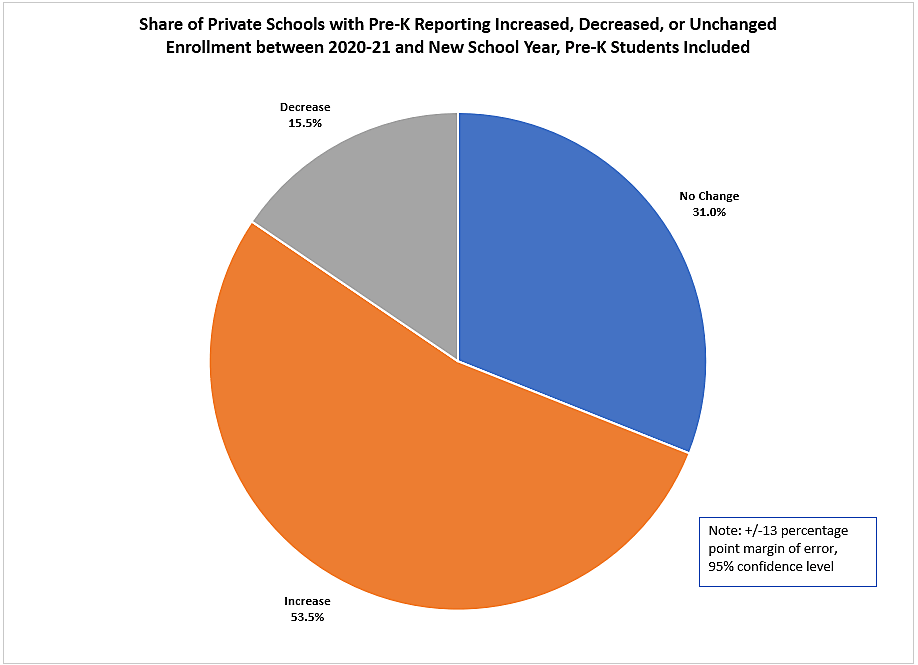
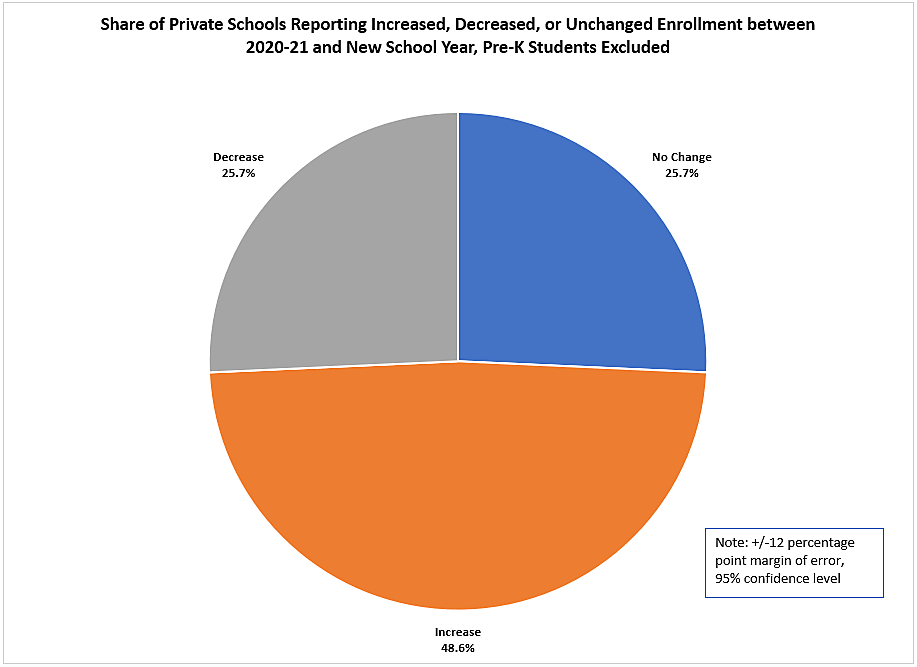
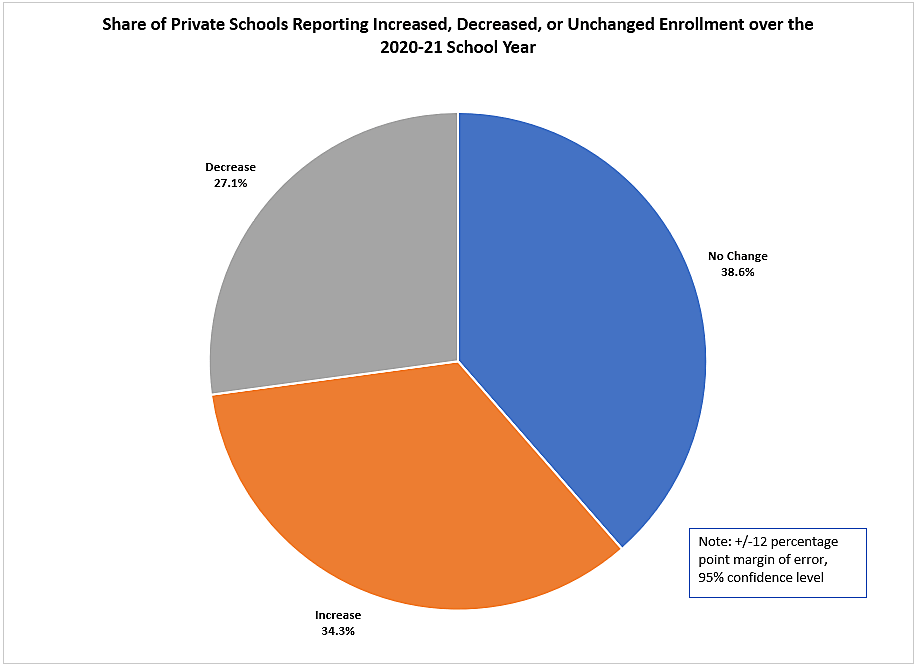
On the flip side, the average enrollment change dropped from a gain of 13 to 12 students among schools with pre‑K, and stayed at 7 for non pre‑K. We also saw a dip in the share of schools saying they saw enrollment increases over the course of the previous school year.
The data on our now-retired COVID-19 Permanent Private School Closures tracker also supports the likelihood that private schools have been gaining enrollment, having recorded very few closures since August 2020. Meanwhile, our new Private Schooling Status Tracker, which presents private school opening and closing data for roughly the current school year, has catalogued 20 openings or opening announcements since August 1, 2021, and only 1 closure.
Evidence increasingly indicates that private schools have been seeing something of an enrollment boom over the last year or so. The long-term question is whether the increases will end, and possibly reverse, when COVID ceases to be such a big part of our lives.
We will keep monitoring private schooling “health” trends to find out. And to help make our data as accurate as possible, please send us any information you find about private schools opening or closings.
Related Tags
Michael Flynn, who once had a distinguished career in the military culminating in his leadership of the Defense Intelligence Agency, has more recently spiraled down into election-overturning and appearing at Alex Jones rallies. At one such recent rally, he drew headlines for his declaration that
If we are going to have one nation under God, which we must, we have to have one religion. One nation under God, and one religion under God.
For centuries, even millennia, that was a commonly held view. But as I wrote in The Libertarian Mind:
The Reformation contributed more to the development of liberal ideas. The Protestant reformers, such as Martin Luther and John Calvin, were by no means liberals. But by breaking the monopoly of the Catholic Church they inadvertently encouraged a proliferation of Protestant sects, some of which—such as the Quakers and Baptists—did nurture liberal thought.
After the Wars of Religion people began to question the notion that a community had to have only one religion. It had been thought that without a single religious and moral authority, a community would witness an endless proliferation of moral commitments and literally fall to pieces.
That profoundly conservative idea has a long history. It goes back at least to Plato’s insistence on regulating even the music in an ideal society. It has been enunciated in more recent times by the British jurist Patrick Devlin, who argued that “society is entitled to enforce its constitutive morality, whatever it happens to be, in order to prevent social disintegration,” and by the socialist scholar Robert Heilbroner, who wrote that socialism requires “a deliberately embraced collective moral goal” to which “every dissenting voice raises a threat.” And it can also be heard in the fears of the residents of rural Catlett, Virginia, who told the Washington Post about their worries when a Buddhist temple was built in their small town: “We believe in one true God, and I guess we were afraid with a false religion like that, maybe it would have an influence on our children.”
Fortunately, most people noticed after the Reformation that society did not fall apart in the presence of differing religious and moral views. Instead it became stronger by accommodating diversity and competition.
It is disappointing to hear such pre-modern, illiberal sentiments from a man who once held positions of such trust. But I’m confident Americans today, knowing that we live in a country where no single religion comes close to dominating, are happy to live in a world of religious freedom.