Sen. Rand Paul (R‑KY) gave a great speech on surveillance last week at FreedomFest. Actually, he gave two good speeches, but the one embedded below is his short 6‑minute talk at the Saturday night banquet. He talks about our slide toward state intrusion into our phone calls, our emails, our reading habits and so on. You know how big the surveillance state has gotten? The answer is “a gazillion.” Watch the speech—complete with high-falutin’ references to Fahrenheit 451 and the martyr Hugh Latimer!
Cato at Liberty
Cato at Liberty
President Obama recently got himself in hot water with his “you didn’t build that” remark, which trivialized the hard work of entrepreneurs.
But he is right—in a perverse way—about government playing a big role in the life of small businesses. Thanks to a maze of regulations, the government is an unwelcome silent partner for every entrepreneur. And we’re not talking small numbers.
- Americans spend 8.8 billion hours every year filling out government forms.
- The economy-wide cost of regulation is now $1.75 trillion.
- For every bureaucrat at a regulatory agency, one study estimated that 100 jobs are destroyed in the economy’s productive sector.
But sometimes an image helps to make things easy to understand. Here’s a chart from the Joint Economic Committee, which maps out the web of regulation imposed by Washington:
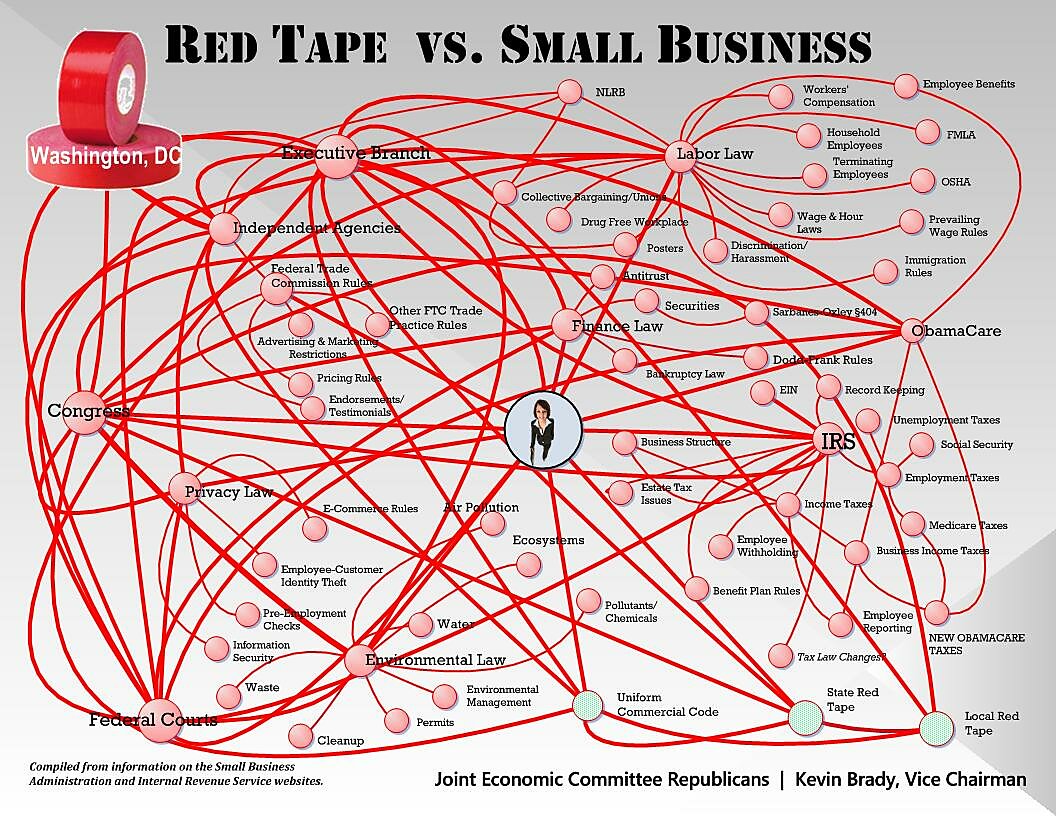
This chart does more than just show sources of red tape coming from Washington. It shows that “Washington” is really several entities, such as Congress, the executive branch, the courts, and so-called independent regulatory agencies. These entities then impose regulatory burdens in various fields, such as labor, finance, tax, and environment.
Keep in mind, by the way, that each small pink circle actually represents an entire field of regulation. So when you see, for instance, the “Obamacare” circle (below), what you’re really seeing is the nightmarish image of regulatory complexity.

And don’t forget the role of state and local government.
Last but not least, remember that each regulatory bureaucracy is capable of making individual decisions that … well, you judge for yourself:
- puts a store out of business for selling toy guns.
- adopts regulations that make it difficult for trucking firms to weed out drunk drivers.
- implements a year-long sting operation by the federal milk police.
- harasses coffee shops with bikini-clad sales staff.
- requires expensive safety harnesses for people working 11 feet off the ground.
- imposes rules for employees with “shy bladder syndrome.”
- elevates foreign tax law above U.S. tax law.
Gee, it’s almost enough to make you think regulation might be the problem and not the solution.
Related Tags
A study in this week’s New England Journal of Medicine finds that when three states expanded their Medicaid programs, mortality rates fell 6 percent relative to four neighboring states. The study found evidence that the mortality gains were concentrated in poorer counties — i.e., where people were most likely to become eligible for Medicaid.
As always, the study comes with caveats. The results “may not be generalizable to other states,” may have been driven by unobservable confounding factors, et cetera. Speaking only for myself, I hope these results are accurate. I hope Medicaid does save lives. That program spends nearly half a trillion dollars per year. It damn well better save lives.
Even so, that does not mean politicians should expand Medicaid. If saving lives is the goal, then politicians should instead find the lowest-cost way of doing so, because that enables the greatest number of lives to be saved with the available resources. It is generally accepted among health economists that other strategies (e.g., discrete health programs targeted at hypertension or diabetes) could save more lives per dollar spent than expanding health insurance. This study says nothing about how much it costs to save lives through Medicaid, much less whether alternative uses of those resources could save even more lives. It could be that other uses of the money would save — I don’t know — twice as many lives.
Absent evidence that Medicaid saves the most lives per dollar spent, expanding Medicaid does not show how much politicians care about saving lives. It shows how little they care about saving lives, because they are willing to forgo additional reductions in mortality for the sake of…whatever else expanding Medicaid gives them.
The head of a fast food chain, Dan Cathy, president of Chick-fil‑A, is opposed to allowing gay people to create the mutual obligations and rights of marriage. I disagree with him. I’ve never eaten in one of his stores, so I couldn’t really boycott his business, but I can explain to him why I disagree.
What I would not do is to take any of his rights from him for his expression of his views. He has the right to them.
The mayor of Boston has threatened to punish Mr. Cathy for exercising his right to express his views. He raked Mr. Cathy over the coals in a letter that was then posted on the City of Boston’s Facebook page. In an interview with the Boston Herald the mayor not only expressed his own opinion, which he is free to do; he went further and threatened to use his power illegitimately to deny the rights of Mr. Cathy and his partners, shareholders, and employees to do business in the city of Boston.
Opinion: “Chick-fil‑A doesn’t belong in Boston. You can’t have a business in the city of Boston that discriminates against a population. We’re an open city, we’re a city that’s at the forefront of inclusion.”
Threat: “If they need licenses in the city, it will be very difficult—unless they open up their policies.”
I’m a supporter of the right of gay people to create mutual obligations and rights of marriage. I’m a supporter of freedom of speech. And I’m a supporter of freedom of enterprise. I disagree (strongly) with Mr. Cathy and hope that he will change his mind.
Mayor Menino should retract his threats and, at the very least, apologize. Mayor Menino is no friend of human rights. His threat is tyrannical.
In my August 2012 Globe Asia column, “Money, Where’s the Money?”, I explained why the global economy is still sputtering, and proposed a partial solution. In short, I called for governments (not central banks) to engage in debt market operations – a way to increase the money supply directly, without increasing the overall level of government debt. A number of readers have since contacted me with questions about the specific example I discussed in my column. The most frequent question was:
“Isn’t your proposal just the same as the Fed’s Operation Twist, where the Fed purchases long-term government securities from the public and increases high-powered money?”
The answer is, in short, no – and here’s why:
The first thing that should be noted is that both a central bank and a government can conduct debt market operations. Debt market operations constitute either central bank, or government, transactions with non-banks, which change the bank deposits held by those non-banks. There are many combinations of such operations that can be employed, but with all debt market operations of the type I am envisioning, long-dated debt is replaced with short-dated debt (and so, in one sense, there would be some similarity with Operation Twist).
In my Globe Asia example, however, the government would conduct the debt market operations with no involvement by the central bank. The government would borrow from private banks and purchase outstanding long-dated government debt from the public, and then cancel the debt that had been purchased. The result would be an increase in the money supply, with no change in the monetary base. If the government were instead to borrow from the central bank, both base money and broad money would increase – a fundamental difference.
The central bank could engage directly in debt market operations (and several have done so in recent QE operations). But, in this case, the long-dated bonds purchased by the central bank would end up on the central bank’s balance sheet. The debt would not be canceled out, as it would be if the government was to conduct debt market operations. It is this fact that defines one of the fundamental differences between debt market operations conducted by a central bank and those conducted by a government. A central bank engaged in debt market operations would be left with holdings of long-dated government debt and be exposed to interest rate risk on those securities. It could incur large accounting losses if interest rates were to rise. This would not be the case if the government conducted debt market operations.
Related Tags
“Denver rethinks the modern commuter,” heralds the Wall Street Journal. The article goes on to say that, instead of building parking lots at its rail stations, Denver is encouraging developers to build high-density, mixed-use developments. Somehow, this is supposed to be news.
Let’s think this through. First of all, no one is “rethinking the modern commuter.” The Census Bureau reports that transit carried less than 5 percent of Denver-area commuters in 2010, while more than 85 percent drove. Instead, what RTD, Denver’s transit agency, is rethinking is the role of public transit.
The old-style public transit system used cheap, flexible buses whose routes could be altered overnight to take people from where they were to where they wanted to go. When Denver first built rail, it substituted expensive but glamorous trains for inexpensive buses, but still allowed people to go from where they were–provided they were willing to drive to a park-and-ride station–to where they wanted to go–provided they wanted to go downtown.
Under RTD’s latest “rethink,” transit will no longer take people from where they are to where they want to go. Instead, planners will try to coerce and entice people to live in places served by rail transit and go where those rail lines go. On one hand, this is far more intrusive on people’s lifestyles; on the other hand, it is a far more limited view of the purpose of transit. Instead of “mobility for those who can’t or don’t want to drive,” the new purpose is “mobility for those who are willing to completely rebuild their lifestyles around transit.”
This has been tried before, of course, most notably in Portland. How well did it work there? In 1980, under the old bus-transit model, transit carried 9.8 percent of Portland-area commuters to work. By 2010, with seven different rail lines and scores of transit-oriented developments, transit carried just 7.1 percent of the region’s commuters to work.
The sad part is that the Wall Street Journal not only thinks this is newsworthy, but that it is laudable. In fact, it is government at it worst: inefficient, coercive, and unable to learn from past mistakes.
Transit should serve people and not the other way around. It is time to rethink the rethink.
Related Tags
Perhaps the first thing you should know about campaign finance “reform” proposals — at least those coming from the left — is that their ultimate goal is to deter speech about political issues. Whether it’s limiting campaign donations or spending, restricting the ability of corporations or other groups to publicize their views, or imposing disclosure rules, the goal isn’t to have better-informed voters or a more dynamic political system, but to have less speech. Those who advocate these things want the government to have the power to control who speaks and how much.
That lesson was repeated to me during two public events I participated in yesterday. First, at a Senate hearing (which you can watch here; my opening remarks, a longer version of which you can read here, begin at 59:50) several senators seemed incredulous at my suggestion that we need more speech rather than less. After Sen. Dick Durbin (D‑IL) tried to get me to admit that I was a Koch pawn, a particularly laughable charge in a year when the Kochs sued Cato over management issues, Sens. Sheldon Whitehouse (D‑RI) and Richard Blumenthal (D‑CT) were incredulous that I would want fewer restrictions and less disclosures than them. If I favor certain disclosure rules for donations to campaigns — which I do, in conjunction with eliminating donation caps, as I wrote yesterday — why am I against the DISCLOSE Act, which would impose certain further reporting requirements on independent political spending (and which failed last week after getting zero Republican votes)?
I should’ve just referred the senators to John Samples’s analysis of an earlier version of the proposed legislation, but in any event, the answer boils down to the idea that the required disclosures (of expenditures — which shouldn’t be confused with donations) are so onerous as to burden and deter speech with negligible impact on voter information. That is, as former FEC chairman Brad Smith explains in this video, disclosing that a TV commercial was paid for by Americans for Apple Pie, one of whose donors is the local chamber of commerce, one of whose donors is the U.S. Chamber of Commerce, one of whose donors is the national widget manufacturers’ associations, one of whose donors is Acme Widgets … doesn’t tell a voter anything. What it does do is require 20 seconds of the 30-second ad to be given over to disclosure rather than the actual political speech. So what’s the purpose of the regulation if not to deter that speech?
Moreover, Super PACs already have to disclose their donors, and if their donors are corporations/associations rather than individuals, you can look up the people leading those entities in their corporate filings. And if the problem is “millionaires and billionaires” — there was more than one reference to the Kochs during the hearing, and I helpfully suggested that I’m happy to defend Georges Soros and Clooney as well — then no law short of a complete ban on political speech by individuals will do. Luckily, we have the First Amendment in place to stop self-interested incumbents from trying that.
My second public event was an unlikely appearance on the Rachel Maddow Show, where I joined Harvard law professor Larry Lessig, who also appeared at the earlier Senate hearing, to discuss campaign finance regulation. I thought it went pretty well, and you can watch for yourself (segment titled “How to take American democracy back from the .000063 percent”). What’s telling is that guest-host Ezra Klein was more even-handed than the senators at the earlier hearing.
Finally, here’s another nugget from yesterday: As I exited the Senate hearing room, a young “reform” activist said to me, “I think you’re a fascist.” And here I thought that I did a decent job of getting across the point that we should have less government, not more.