Cato at Liberty
Cato at Liberty
Topics
Will Mattis Be a Voice of Caution at the Pentagon?
“We are going to appoint ‘Mad Dog’ Mattis as our secretary of defense,” President-elect Donald Trump told a crowd in Cincinnati last night. He added, “They say he’s the closest thing to Gen. George Patton that we have.”
To be successful, James Mattis will also have to be this generation’s George Marshall, and perhaps its Dwight Eisenhower and George Washington, too.
Which, of course, is impossible. The problems that afflict this nation’s foreign policy are too daunting to be repaired by a single man, even one as remarkable as Gen. Mattis. But within the Trump administration he could be a critical voice of caution with respect to the wisdom or folly of the use of force going forward.
Mattis exudes a combination of toughness and thoughtfulness. His voracious appetite for reading is the stuff of legend. The “Warrior Monk” has a deep knowledge of history which could serve him well, if President Trump is inclined to listen to his SecDef.
Early signs suggest that he will. For example, during the campaign, Trump spoke blithely about bringing back torture. After the election, Mattis apparently convinced him to reconsider.
Even before Trump’s announcement of Mattis as SecDef, a number of commentators despaired over the president-elect’s apparent fixation with filling civilian offices with military officers. This included several people who admitted to loving Gen. Mattis. The principle of civilian control, they explained, is more important than any one man.
I share those concerns. I’m particularly worried that the one common trait among the officers that have caught Trump’s eye is their willingness to challenge their commander-in-chief at the time, Barack Obama. It seems unlikely that Trump will value that same independent spirit when he’s in charge.
On the other hand, as public trust in a number of institutions has cratered, respect for the military remains high. This is true despite the fact that the public also senses that our wars haven’t served the country’s interests. In other words, Americans are holding accountable the civilians that sent the country to war with dubious rationales, not the men and women in uniform who have answered the call. Up this point, Mattis has been on the receiving end of these orders. Going forward, he would be the one giving them, or at least advising those who do.
In addition, in my experience, men and women who have served in the military are less likely to support military interventions than those who have never worn the uniform. They are especially wary of wars fought for questionable reasons, or where the means don’t align with the ends. Robert Gates commented on this in his memoir, From the Shadows, long before his tenure as Secretary of Defense (H/T Micah Zenko).
There are exceptions, to be sure: John McCain and Tom Cotton, both combat veterans, remain strong advocates of the use of force. Both have called for American no-fly zones over Syria, and Cotton claimed that war with Iran would only take “several days.” I have no idea whether Jim Mattis is more like them, or more like Gens. Zinni, or Shinseki, or a number of other generals who quietly (or not so quietly) questioned the wisdom of invading Iraq in 2002.
However, within the small circle of foreign policy advisors in any given administration, the president is most likely to hear from those making the case for action — recall Madeleine Albright during Bill Clinton’s administration, or Hillary Clinton during Obama’s first term. That is why it is so important for any administration to have a strong contingent of intervention skeptics, or at least a few people who are willing to ask tough questions.
A brief clip near the tail end of the documentary “American Umpire” (starts at 46:34) suggests that James Mattis, if confirmed as the country’s next Secretary of Defense, could play that role.
As I look back over these wars since World War II — Korea, Vietnam, Iraq, dare I say Afghanistan, stick Somalia in there somewhere, other expeditions — when America goes to war with murky political end states, then you end up in a situation where you are trying to do something right, but you’re not sure if it’s the right thing. And suddenly you end up with a situation where the American people say “what are we doing here?” And “what kind of people are we that we do this sort of thing?”
If you don’t know what it is that you’re going to achieve, then don’t be surprised that eventually you’ve wasted treasure, lives, and the moral authority of the United States.
Related Tags
Upcoming Cato Discussion on China’s Role in Dealing with North Korea
The United Nations Security Council has approved another round of sanctions against North Korea in response to its latest nuclear test. No one really believes that the new penalties, focused on Pyongyang’s coal and other exports, will have any effect. In fact, it is doubtful that China, which purchases most of the North’s goods, will fully enforce the new resolution.
Still, with most policymakers giving up any hope that the so-called Democratic People’s Republic of Korea will voluntarily negotiate away its nuclear program, Beijing remains the best option for constraining the DPRK’s nuclear ambitions. The People’s Republic of China so far has refused to play its assigned role, but Washington continues to press the PRC to act.
Getting Beijing to take strong action against North Korea is a long-shot, as I explain in an upcoming Policy Analysis, but worth serious effort by Washington. What that would involve is the subject of a forum at Cato at noon on December 8. Susan Glaser of the Center for Strategic and International Studies and Scott Snyder of the Council of Foreign Relations will join me in a panel discussed moderated by Cato Vice President Christopher Preble to discuss the challenges and possibilities of engaging China over the issue.
One thing is clear. Washington and its East Asian allies need to persuade rather than demand that the PRC act. How best to convince Beijing, and what mix of carrots and sticks would be most effective in doing so, will be among the issues discussed on the 8th. I hope you can join us: the details, including where to RSVP, are included here.
Related Tags
How Much Defense is Enough? The Outlier’s Take
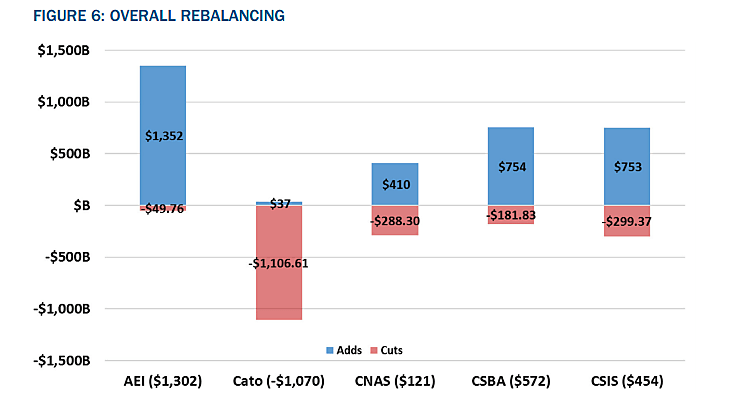
A new study from the Center for Strategic and Budgetary Assessments, “How Much is Enough? Alternative Defense Strategies,” reports on military spending plans produced by teams from five think tanks, including Cato. CSBA asked each team to use its “Strategic Choices” software to make hundreds of choices amounting to a ten-year budget plan for the Pentagon and to provide a brief statement of their strategic rationale. The report includes those rationales, summaries of each budget, and comparative analysis of them.
As you can tell from the chart below, the Cato team’s answer was that way less is enough. We cut $1.1 trillion over the period. We’d have cut even more had the software allowed us to target all the spending going to “Overseas Contingency Operations,” intelligence programs and nuclear weapons. You can also see that our plan was the outlier. The others all raised spending—in AEI’s case, massively, by $1.3 trillion.
Why did our budget so diverge from the others? The simple answer is that our defense strategies diverge. Our teams’ choices follow a grand strategy of restraint. The others differ on details but accept the current grand strategy of primacy or liberal hegemony, which holds that U.S. security requires global stability maintained everywhere by U.S. military activism—alliances backed by garrisons and threats, naval patrols, and continual warfare, at least. As we put it in the report, the restraint strategy follows from four underlying claims:
First, U.S. geography, wealth, and technological prowess go far to secure the United States from attack, especially considering our historically weak enemies. Second, we should generally avoid wars meant to stabilize fractured states or to liberalize oppressive ones because they tend to backfire at tragic cost. Third, while allies can be useful in balancing the power of a threatening hegemon, like Nazi Germany or the Soviet Union, alliances should not be permanent. Today no such threat exists, and vast chunks of U.S. military spending goes to maintaining forces meant to defend states that can afford to defend themselves. Our protection can also encourage allies to avoid accommodating rivals and instead to heighten conflicts that can entangle U.S. forces. Fourth, while U.S. forces, especially the Navy, should protect trade routes from disruption during conflict, almost nothing threatens peacetime trade. Overseas garrisons and naval patrols are not needed to protect it.
The other groups’ shared desire to increase spending reflects rejection of those claims—with some dissent on the second.
Their budgets also suggest a deficiency of primacy. Strategy, by definition, is logic for choice, a means to prioritize resources. In defense, that means choosing among threats to confront, types of warfare, and weapons programs. Because primacy sees U.S. military power as necessary to peace everywhere, it suggests a force that is always busy and nearly ubiquitous—either present or capable of being there fast. Primacy is then less a strategy than a sophisticated way of answering “faster, better, more” whenever military spending choices arise. That’s one reason why the other groups increase spending and say little about what our military can safely not do.
A more general explanation for the plans’ divergence is the complexity of defense budgeting. It is impossible to precisely calculate how much defense is enough, let alone achieve agreement on a figure. In his classic work on the subject, Warner Schilling attributes the difficulty to uncertainty—about future threats, what defense goals best meet threats, which military means best serve those goals, and how to compare the value of military and other spending. The result of this complexity, Schilling writes, is that:
A multiplicity of answers, all of them “right,” must be admitted to the question of how much it is rational to spend on defense. The opportunities for reasoned and intelligent conflict with regard to the factual premises involved are legion. The questions of value involved are, in the final analysis, matters of personal preference…Choice is unavoidable: choice among the among the values to be served, and choice among the divergent conceptions of what will happen if such and such is done. It is for this reason that the defense budget, while susceptible to rational analysis, remains a matter for political resolution.
The report’s competing expert advice shows why the question of how much defense is enough is best answered through democratic politics, not military judgement or expert analysis, even ours. Outside expertise is useful less as guidance for policy choice than to frame it by revealing tradeoffs that political rhetoric obscures.
The report’s conclusion points to a current example. Congressional leaders and the president-elect suggest that global military dominance and fiscal prudence, even liberally defined, are compatible. They aren’t. That’s one point of agreement among the report’s contributors, at least.
Related Tags
Tax Policy Center’s Flawed $6.2 Trillion Revenue Loss from Trump Tax Plan
A crucial graph in the Wall Street Journal article, “Trump Fiscal Plain Roils the GOP,” relies on estimates from the Tax Policy Center. Unfortunately, the TPC provides only static estimates of revenue effects of House Republican or Trump tax plans. That is, they assume lower marginal tax rates on families and firms have literally no effect at all on tax avoidance or long-term economic growth.
The Wall Street Journal graph purports to project budget deficits over the next 10 years under Congressional Budget Office (CBO) baseline, the House Republican tax plan and the Trump tax plan. This is quite misleading, because all three scenarios treat future federal spending as given, unchangeable. Federal spending rose from 17.6% of GDP in 2001 to 19.1% by 2007, and is now 20.7% in 2015. The 2017 Budget projects spending to reach to 22.4% by 2021 and keep rising.
The CBO August baseline projects federal spending to total $50.2 trillion from 2017 to 2026, so a mere 5% reduction in that growth would exceed $2.5 trillion.
Under President-elect Trump’s revised tax proposal, claims the Tax Policy Center, “revenues would fall by $6.2 billion over the first decade before accounting for interest costs and macroeconomic effects. Including those factors, the federal debt would rise by at least $7 trillion over the first decade.”
Do not confuse these alleged “macroeconomic effects” with dynamic analysis used in Tax Foundation models and academic studies. The Tax Foundation estimates, for example, that the House Republican tax plan “would reduce federal revenue by $2.4 trillion over the first decades on a static basis,” but that figure shrinks to $191 billion once they properly account for improved investment incentives, greater labor and entrepreneurial effort and therefore faster economic growth.
By contrast, the Tax Policy Center presents only “macro feedback” estimates for the Trump plan. The TPC Keynesian model and Penn-Wharton models assume that revenue losses are 2.6% of GDP, the same as static estimates. But interest rates are higher, adding to deficits and debt.
The TPC Keynesian model is all about alleged effects of budget deficits on demand and interest rates — not about supply-side microeconomic incentives to raise potential output by raising labor force participation, entrepreneurship and investment.
According to the Tax Policy Center, “The marginal rate cuts would boost incentives to work, save and invest if interest rates do not change [emphasis added] … However, increased government borrowing could push up interest rates and crowd out private investment, thereby offsetting some or all of the plan’s positive effects on private investment unless federal spending was sharply reduced to offset the effect of the tax cuts on the deficit.”
This is confusing or confused. TPC begins by admitting lower marginal tax rates on labor and capital “would” provide incentive for more and better labor and capital, and therefore faster long-run growth of the economy and taxable income. In the short run, “TPC estimates that the impact on output could be between 0.4 and 3.6 percent in 2017, 0.2 and 2.3 percent in 2018 and smaller amounts in later years.” Their mid-range estimate is that “the Trump tax plan would boost the level of output by about 1.7 percent in 2017, by 1.1 percent in 2018, and by smaller amounts in later years.” Despite faster economic growth for 5 years, the net “feedback effect” supposedly reduces the 10-year static revenue loss by a surprisingly trivial 1.9% (from $6.15 trillion to $6.03 trillion) for reasons hidden inside the Keynesian model.
“The TPC’s Keynesian model takes into account how tax and spending policies alter demand for goods and services… and how close the economy is to full capacity.” Despite references to supply-side incentives, the Keynesian model does not allow such incentives to enlarge “full capacity” — potential GDP: “TPC plans to build a neoclassical model of potential output whose results could be integrated with those the Keynesian model, but that work is still in progress.” This denial of supply-side effects is a fatal flaw in the model’s revenue estimates. The Trump tax plan is assumed to raise economic growth for only five years before we bump up against “full capacity” because tax rates are assumed to affect only demand, not supply.
For example, the TPC says “allowing businesses to elect to expense investment would create an incentive for businesses to raise investment spending, further increasing demand. These effects on aggregate demand would raise output relative to its potential for several years … [emphasis added].
On the contrary, more investment spending clearly increases supply – increasing capacity and potential GDP. Lower marginal tax rates on added labor income likewise raise the supply of human capital (participation rates and incentives to invest in education).
If Trump’s tax policy “would boost incentives to work, save and invest” then the future economy and tax base must be larger than otherwise. It follows that future deficits cannot be nearly as large as the static TPC estimates claim. It also follows that there will also be more savings with which to finance both public and private borrowing.
Related Tags
Revenues from Trump Plan Unfairly Compared to Fanciful CBO Projections
Tax Policy Center estimate of a 10-year $6.2 trillion revenue loss is used to predict higher interest rates, and those higher interest rates prevent the economy from growing faster, which in turn vindicates the static assumption of a $6.2 trillion revenue loss.
The circularity of this tangled fable is remarkably illogical. How could interest rates remain higher if private investment is crowded out leaving GDP growth unchanged?
The TPC tells a similar story about the House Republican tax plan. “Although the House GOP tax plan would improve incentives to save and invest, it would also substantially increase budget deficits unless offset by spending cuts, resulting in higher interest rates that would crowd out investment [emphasis added].” This too is an unsupported assertion. The TPC analysis predicts more private savings and therefore cannot simply assume deficits “would crowd out investment.”
The TPC’s stubborn notion that deficits raise interest rates dates back to a 2004 Brookings paper by Bill Gale and Peter Orzsag which estimated that “a sustained 1 percent of GDP rise in projected deficits would raise current yields by between 20 and 60 basis points, holding other factors constant.” In reality, actual and projected deficits have been much higher since 2004, yet bond yields fell dramatically. Japan routinely runs deficits of 5–7% of GDP with bond yields near zero.
The TPC alludes to the Penn-Wharton Budget model as though it is less Keynesian than their own (or that of the CBO). Yet the architect of that model, Kent Smetters argues that “tax cuts will lead the government to increase its borrowings, which in turn will increase the debt with the general public… Such debt will compete with private capital for household savings and international capital flows.” Like the TPC, Smetters first assumes the TPC static revenue loss is a meaningful number and then goes on to theorize about U.S. and foreign investors making fewer private investments because they (rather than U.S. and foreign central banks) must supposedly purchase more Treasury bills and bonds. Like the TPC model, the Smetters model also assumes potential output is unaffected by greater investment and work effort, so faster growth in the first few years must supposedly be offset by slower growth after 2024. Assume slow productivity gains and slow labor force growth, then slow GDP growth must (by definition) be the best we can do.
The Tax Policy Center estimates that the revised Trump plan would reduce revenues by 2.6% of GDP (regardless of economic growth). But it is important to realize that this “loss” is only in comparison with the rising CBO baseline. With no change in tax policy, the CBO projects the individual income tax will rise faster than GDP every year with no adverse effects on the economy. The individual income tax is projected to be 8.5% in 2017, then 8.7% in the following year, then 8.9%, 9.1%, 9.2% 9.3%, 9.4%, 9.5%, 9.6%, 9.7%, 9.8% and so on.
This ever-increasing tax burden is mainly because ever-increasing real wages will supposedly push more and more families into the 35% and 39.6% tax brackets, and also subject them to Obamacare’s 0.9% surtax on labor and 3.8% surtax on investments.
If revenues from the individual income tax instead remain at the unusually high 2003–2015 level of 8.3 percent of GDP (which would beat any previous 10-year average), then revenues over the next ten years will turn out to be $2.62 trillion smaller than the CBO projects.
In other words, nearly half of the Tax Policy Center’s $6.2 trillion static revenue loss from the revised Trump plan is due to the CBO’s implausible assumption of endless automatic tax increases, rather than to a huge “tax cut” (at least in the House GOP plan) when compared with taxes we have actually been paying.
Related Tags
78% of Trump Tax Cuts Are for Businesses — not Individuals
The Urban-Brookings Tax Policy Center produced some estimates of the tax revenues supposedly lost by the most recent (September) Trump tax plan, which raised the top tax rate from 25% to 33%.
These estimates are being widely misunderstood by the Wall Street Journal, New York Times and others, so it may help to actually see the TPC 10-year totals organized by tax changes proposed for individuals, corporations and pass-through businesses.
The estimates themselves are questionable as are related estimates of the distribution of tax cuts by income groups. I will deal with those issues in separate posts.
What most needs emphasizing at this point is that although reporters are writing as though the Trump package is about personal income tax cuts, that only accounts for 22% of the estimated revenue loss (relative to bloated CBO estimates). Moreover, the 10-year $1.5 trillion loss of revenue from modestly lower individual income tax rates is much smaller than estimated revenue increases from repealing personal exemptions ($2 trillion) and capping itemized deductions ($559 billion).
The only significant net reduction in taxes on non-business income is from (1) repeal of the alternative minimum tax ($413 billion), and (2) more than doubling the standard deduction ($1.7 trillion) – neither change being of any help to top-income taxpayers.
TAX POLICY CENTER ESTIMATES OF 10-YEAR REVENUE LOSS FROM TRUMP TAX PLAN, 2016–2026, $ billions
| Repeal Obamacare 3.8% investment income tax |
-145 |
| Repeal alternative minimum tax |
-413 |
| Repeal head of household filing status |
131 |
| Repeal personal exemptions |
2,000 |
| Individual income tax rates of 12, 25, and 33 percent |
-1,490 |
| Increase standard deduction to $35,000/couple ($24,000 in GOP plan) |
-1,688 |
| Cap itemized deductions at $100,000 ($200,000 joint return) |
559 |
| Childcare refundable tax credit |
-132 |
| Repeal estate, gift and GST taxes but tax capital gains at death. |
-174 |
|
TOTAL INDIVIDUAL TAX LESS PASS-THROUGH BUSINESS = 22% of Total |
-1,353 |
|
|
|
| Elective flat rate of 15 percent on pass-through income |
-895 |
| Shifting of wages and salaries to 15% business income (tax avoidance) |
-649 |
| Allow expensing of non-corp investment & disallow interest deduction for those electing to expense |
-689 |
| Tax carried interests as ordinary business income |
10 |
| Repeal certain pass-through business tax expenditures |
58 |
|
TOTAL PASS-THROUGH BUSINESS = 35.2% of Total |
-2,164 |
|
|
|
| Reduce corporate rate to 15% & repeal corporate AMT |
-2,355 |
| Allow expensing of corp investment & disallow interest deduction for those electing to expense. |
-593 |
| Deemed repatriation 10 yrs. of untaxed foreign earnings then tax foreign subsidiaries on accrued profit |
148 |
| Repeal certain corporate tax expenditures |
167 |
|
|
|
|
TOTAL CORPORATE BUSINESS = 43.8% of Total |
-2,633 |
|
|
|
|
TOTAL STATIC REVENUE LOSS |
-6,150 |