In unanimous decisions this morning, the Supreme Court turned away both partisan gerrymandering cases on grounds other than their ultimate merits — Gill v. Whitford (Wisconsin) by declaring the individual complainant to lack Article III standing arising from injury in his own district and sending the case back for him to establish that, and Benisek v. Lamone (Maryland) by finding it not an abuse of discretion for the lower court to deny a preliminary injunction, which does not mean the case will not be back at the regular injunction stage. Neither decision reaches or resolves the main constitutional issues raised by the two cases, which both remain alive. As I mentioned in February, the Court had already signaled that it was not in a rush to resolve the issue right away (the calendaring was leisurely) and that Justice Anthony Kennedy was not going to prove an easy recruit for the four liberals. (He joined the conservatives in staying the Wisconsin decision below.) In the Wisconsin case, the majority held that the complainant needs to go back and demonstrate that his own district, and not merely others in the state, has been subject to “packing” or “cracking.” (The Maryland complainants had already made this kind of showing; they were suing over the lines of their own district, not the whole state map.) Justices Thomas and Gorsuch went further, saying the Wisconsin complainant’s failure to establish individual standing should have ended his case, rather than resulting in a do-over. In a concurrence on behalf of the four liberals, Justice Elena Kagan agreed on the need to send the case back for a showing of individual-district standing but emphasized that, in her view, once the complainant established that he could then introduce statewide evidence and seek statewide remedies. This would preserve more or less the full scope of what liberal litigation groups have been hoping to achieve with the Wisconsin case. Significantly, Justice Anthony Kennedy did not join the liberals on these points — although of course he could view the case as having been resolved without needing to reach such issues. Nor did the majority opinion, written by Chief Justice Roberts, concede Kagan’s assertion that courts “have a critical role to play in curbing partisan gerrymandering.” Whatever happens in the Court — and a North Carolina case could bring the issues back next term — there are good reasons for states to act on their own to curb the evils of partisan gerrymandering without waiting for marching orders from the nine Justices. Measures to take line-drawing out of the hands of self-interested incumbents, to prescribe strong standards of compactness and congruence with counties and other political subdivisions, to provide for transparency, open data access, and public map submission, and to ensure strong judicial review, make sense in themselves and do not require waiting on a Court that has shown a reluctance to decide. The Court has kicked the issue of partisan gerrymandering down the road. States shouldn’t.
Cato at Liberty
Cato at Liberty
There is lots of talk from the Trump administration these days about how the U.S. is getting cheated on trade. In this context, they have done some cherry-picking of the data to emphasize high foreign tariffs, while conveniently ignoring high U.S. tariffs. For example, Trump will mention a 270% Canadian tariff on dairy products, without mentioning U.S. tariffs of up to 187% on sour cream. Or White House trade adviser Peter Navarro will mention EU auto tariffs of 10% and argue that those are much higher than the 2.5% tariffs for car imports to the U.S, but he won’t mention the 25% U.S. tariff on truck imports.
So what’s the reality of tariff levels? The cherry-picking approach emphasizes particular products where tariffs are high, and as can be seen in the examples above there are still a few of these “tariff peaks,” including some imposed by the U.S. But with so much variation on tariffs by product, an average tariff level is more informative. Unfortunately, it can be difficult to get an accurate picture of this (as discussed here). Here’s a sampling of a few countries and the EU (explanations to follow):
| Simple Average (2016) (WTO) |
Trade Weighted Average (2016) (World Bank) |
Trade Weighted Average (2015) (WTO) |
|
| New Zealand |
2 |
1.3 |
2.5 |
| Australia |
2.5 |
1.2 |
4 |
| US |
3.5 |
1.6 |
2.4 |
| EU |
5.2 |
1.6 |
3 |
| Japan |
4 |
1.4 |
2.1 |
| Canada |
4.1 |
0.8 |
3.1 |
| Switzerland |
6.3 |
0 |
2 |
| Mexico |
7 |
4.4 |
4.5 |
| China |
9.9 |
3.5 |
4.4 |
| Brazil |
13.5 |
8 |
10.4 |
As you can see, the table has three categories of average tariffs. That’s because measuring tariff levels is not that easy and there are several different methodologies. The “simple average” in the first column takes all of the tariff levels set out in a country’s tariff schedules and averages them. But that figure can be misleading. For example, with some products, there might not be much trade even without a tariff in place, so counting a high tariff in the average is misleading.
The second and third columns — the first from the World Bank, and the second from the WTO and two other organizations, using different methodologies — look at tariffs applied on actually traded goods. But that can be misleading too, because a 100% tariff might eliminate all trade, and therefore a high, trade-retricting tariff would not show up in the figures.
The best approach I can see here is to provide both kinds of figures, which is what I’ve done in the table. Taking all of these tariff figures into account, it can be hard to come up with a precise ranking, but you can see that New Zealand and Australia are the low tariff leaders. The U.S., EU, Canada, Japan, and Switzerland come next, clustered closely together. Mexico has tariffs that are a bit higher. Then come China and Brazil with even higher tariffs.
One important point to note is that these are the generally applied tariffs, but some of these countries have FTAs with each other, under which special lower tariffs apply (the World Bank averages are the only ones that take into account lower FTA tariffs). For the U.S., that means NAFTA, under which almost all tariffs (dairy and peanuts, among others, excepted) are zero; the U.S. — Australia FTA; and various other FTAs.
The lower FTA tariffs lead to an important point. If you are on the Trump administration trade team, and you think foreign tariffs are too high, the solution is to negotiate trade agreements that lower them (in both directions). So far, unfortunately, that has not been their focus.
This week’s good news is that the East Antarctic Ice Sheet (EAIS), by far the world’s biggest ice mass, was largely intact during the entire Pliocene epoch. The Pliocene was slightly less than three million years in length, and preceded the Pleistocene, the epoch of the ice ages.
The implications for human-caused warming from enhanced carbon dioxide are enormous. The good news was published in the same issue of Nature that carried an article about the loss of slightly less than three trillion metric tons of Antarctic ice since 1992.
These things are best viewed in a larger perspective. By itself, that ice loss would raise sea level by about a third of an inch, something probably impossible to detect with land-based tidal gauges. But it was also likely somewhat balanced by the probability of enhanced snowfall over the continent thanks to a (very) slightly warmed surrounding ocean. But the melting of the EAIS would be apocalyptic, itself raising sea level by 175 feet.
Even though this seemed like a very remote possibility, we can now confidently say that human-induced climate change cannot make it happen.
Here’s why.
Global temperatures during the Pliocene averaged around 2–3⁰C higher than the 20th century average. But the massive thermal inertia of Antarctica means it probably wasn’t that much warmer there. Let’s be very conservative and say it was about one degree warmer.
The Pliocene heat load over the EAIS then becomes:
3,000,000 years X 1⁰ = 3,000,000 degree-years.
Now let’s also be conservative about how long human-induced climate change might last, say, 1000 years. But again, climate change is attenuated over the vast ice-covered continent, so let’s posit we induce a global warming of 5⁰ (which is probably too large), and Antarctica warms half as much.
The maximum heat load over Antarctica then is:
1,000 years X2.5⁰ = 2,500 degree-years.
The Pliocene heat load was 1,200 times what humans could possibly exert on the EAIS, and it still remained largely intact. Because of that, fears about the ultimate climate catastrophe can no longer even be entertained.
Related Tags
Former White House economist Gary Cohn expressed concerns yesterday that Trump’s tariffs would erode the benefits from tax reform. Since the on-again-off-again 25 percent tariffs on imports from China are—as of 3:23pm, Friday, June 15, 2018—“on again,” let me share this back-of-the-envelope analysis that shows why Cohn’s concerns are justified.
Certainly, the additional profits expected from the reduction in corporate rates from 35 to 21 percent could be entirely wiped out for the manufacturing sector. In 2017, according to Census Bureau data, the pre-tax profits of the U.S. manufacturing sector were $691 billion. At 35 percent, the taxes on paper would be $242 billion. At 21 percent, the average tax bill is $145 billion. So, roughly speaking, the reduction in rates is estimated to be worth about $97 billion in terms of 2017 profits.
Well, in 2017, the value of U.S. goods imports was $2.33 trillion. Commerce Department data show that half of that value was comprised of intermediate goods (raw materials, production inputs, capital equipment)—the purchases of producers, not households. In other words, approximately $1.17 trillion of imports are U.S. costs of production.
If a tariff of, say, 10 percent were imposed on these imports, the cost of production for manufacturers would rise, roughly speaking, by $117 billion. That’s a $117 billion reduction in profits. Meanwhile, assuming foreign governments responded in kind and hit U.S. exports with 10 percent tariffs, manufacturing revenues also would take a hit. U.S. exports of manufactured goods in 2017 amounted to $1.24 trillion. Again, roughly speaking, that 10 percent tariff would reduce U.S. manufacturing revenues by $124 billion. That, too, reduces profits.
The combined effect of the increased costs and reduced revenues comes to a $241 billion reduction in profits (a 35 percent reduction in manufacturing’s 2017 pre-tax profits). So, ceteris paribus, a 10 percent across-the-board tariff would reduce the U.S. manufacturing sector’s profits by about 35 percent. With that kind of “downturn” in profitability, from where would the resources come to make capital investments, build new production facilities and R&D centers, and to offer new employment opportunities?
Let’s apply this ball park estimate to the actual situation on the ground. The tariffs Trump has already imposed or announced (steel and China tech products—leaving out aluminum, washers, and solar panels) subject $100 billion of imports to tariffs of 25 percent. The retaliation so far announced (by China, Canada, Mexico, and the EU) is commensurate—it will be approximately 25 percent on $100 billion of U.S. exports. So, at the moment, $200 billion of U.S. trade is in the crosshairs.
But a new Trump investigation into the national security implications of auto and auto parts imports could add another $600 billion of trade to the mix—$300 billion of imports hit with 25 percent duties and $300 billion of retaliation. The president wants to get the investigation completed before the election in November, so we could be up to $800 billion of U.S. trade by year’s end. (That’s 20 percent of all U.S. goods trade, by the way.)
So, 25 percent duties assessed on $800 billion of trade, approximately half of which would be U.S. manufacturing inputs and U.S. manufactured exports comes out to a combined $100 billion hit on the sector’s profits (25 percent of $400 billion). That eclipses the $97 billion gain from the corporate rate reduction.
While this is all bad news for the economy, I wonder whether the tax-reform advocates who held their noses and excused Trump’s trade transgressions because tax reform would make everything right will start to speak out. Paging Larry Kudlow, Steve Moore, and Art Laffer.
Would hate speech laws reduce discrimination, violence, and psychic injuries to vulnerable groups? Nadine Strossen says they would not in her new book, Hate Speech: Why We Should Resist It with Free Speech, Not Censorship. She believes we have insufficient evidence to conclude that “hate speech” in general harms others, and even less evidence that constitutionally protected “hate speech” does so.
Naturally, proponents of “hate speech” laws blame expression for anti-social attitudes and conduct. Strossen maintains that we should refrain from censorship on the basis of expected effect, “simply because it might have bad effects.” The perceived harmfulness of any given utterance is context contingent, depending largely on variables like location, tone of voice, relationship between speaker and listener, and personality characteristics.
Strossen draws attention to a study conducted by Laura Leets of Stanford University. Leets recruited Jewish and LGBT college students to read several anti-Semitic and homophobic slurs all drawn from real situations. The subjects then answered questions about how they would have responded if they themselves had been the targets of these messages. Interestingly, a common response by the students was that the “hate speech” would have had “no effect” upon them in either the short run or the long run. Many of the participants also expressed the belief that the speaker was motivated by ignorance, “and therefore should be the object of pity, not anger” (124).
A national survey of incoming first-year college students conducted by the UCLA Higher Education Research Institute found that “the entering freshman class of 2015 ranks among the most ambitious” in the areas of student activism, political and civic engagement. The study notes that this particular class of incoming first-years had witnessed “protests and outcries on college campuses and in communities” in response to “local incidents of bias and discrimination.” These students did not respond to “hate speech” and bias crimes with withdrawal and depression, but rather with engagement and dialogue. Such speech seems to foster political engagement within the larger community, a necessary component of a healthy democracy.
Although these studies focus on college students, Strossen notes that resources for developing one’s ability to resist the potentially negative effects of hateful speech are available to all. These tools include cognitive-behavioral therapy techniques for reducing anxiety or other negative reactions that might result from stressful situations (including exposure to “hate speech”), education about utilizing social media to respond to “hate speech,” and providing access to supportive organizations and other resources. Education and other responses may turn a negative experience into a hard-won moment in personal growth.
Strossen also addresses the question of whether “hate speech” fosters hateful and discriminatory attitudes and actions among those who hear it. She notes that “a comprehensive review of social science research about the potential links between media messages and audience behavior concluded that the effects on audience behavior are ‘weak and affect only a small percentage of audience members’” (127).
We should keep in mind that speech does not force people to act badly. Those who hear extreme utterances are responsible for their subsequent actions. British writer Kenan Malik remarks:
Racists are, of course, influenced by racist talk. It is they, however, who bear responsibility for translating racist talk into racist action. Ironically, for all the talk of using free speech responsibly, the real consequence of the demand for censorship is to moderate the responsibility of individuals for their actions.
If creators were held responsible for the anti-social acts that some individuals committed after viewing the material, “certainly neither the Bible nor the Qu’ran” would be safe, as “both have been accused of instigating countless individual and mass crimes” (128).
In summary, we should not outlaw speech because it might have bad effects. This approach would allow government to punish speech because it disfavors the speaker or the message without directly acknowledging this motive. Moreover, “given the endless array of speech about public concerns that could have such an impact, any other rule would largely muzzle democratic discourse” (127).
This the third post in series on Nadine Strossen’s new book, Hate Speech. The first and second posts may be found here and here.
In his Election Day tweet attacking Rep. Mark Sanford, President Trump declared that Sanford’s opponent, Katie Arrington, “is tough on crime and will continue our fight to lower taxes.” Well, maybe. She doesn’t mention either issue on her campaign website. (In fact, she has nothing but bland buzzwords about any issue.)
This tweet is typical. It seems like every time Trump tweets an endorsement or a criticism of a candidate, he calls the candidate “strong (or weak) on crime.” I count 60 Trump tweets since his inauguration that use the word “crime.” Some complain that he is being investigated for a “made up, phony crime” or charge Hillary Clinton with “many crimes.” But most seem to relate to a candidate: Dan Donovan is “strong on Borders & Crime.” Kevin Cramer of North Dakota is “strong on Crime & Borders.” Doug Jones is “WEAK on Crime.” Adam Laxalt is “tough on crime!” “Chuck and Nancy…are weak on Crime.” Ralph Northam is “weak on crime.” Also “VERY weak on crime!” “Keep our country out of the hands of High Tax, High Crime Nancy Pelosi.” And so on.
It’s not obvious that this makes political sense. Candidates aren’t talking much about crime, perhaps because they recognize the substantial decline in crime rates. In numerous Gallup polls over the past year, only 2 to 4 percent of Americans have identified crime as the country’s most important problem. Though about 50 percent of people say they worry a great deal about crime when asked that question directly.
But here’s the thing. Crime in the United States is in fact way down.
Here’s a long-term look at the most visible crime, homicide:
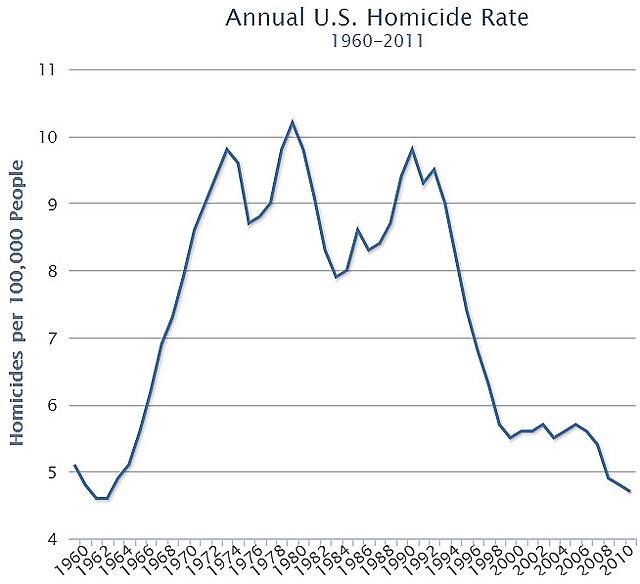
Here’s a picture of broader crime rates:

And yet, as the same source illustrated, at the very time when crime rates had fallen steadily and substantially for 20 years, 68 percent of Americans said the national crime rate was getting worse. (Crime rates continued to fall after 2011, though there was an uptick in murders in 2015 and 2016. The rate appears to have fallen in 2017.)
Of course, the president is better informed than average Americans. Surely White House staff have explained the crime statistics to President Trump. So why does he talk about “this American carnage” and pound away at the “crime” issue when endorsing candidates who never talk about it? Perhaps it’s part of his continuing use of racially charged language. Perhaps “crime and borders” is just shorthand for the kinds of social change he thinks his voters fear. Or maybe it reflects the fact that he grew up in New York City during a time of sharply rising crime. We all get ideas in our youth (“American cars aren’t well made”) that may stick with us even us as the facts change.
Whatever the reason, it seems curious that he so often cites “strong and crime” as the reason to support political candidates who haven’t talked about crime.
Many of you are probably suffering from tariff fatigue right now. Every day, there is a new tariff in the news. Tariffs on Canada, tariffs on the EU, tariffs on China; tariffs on industrial products, tariffs on agricultural products; retaliatory tariffs by Canada, the EU and China; tariffs in effect today, tariffs going into effect soon. It’s hard to keep track of it all.
The latest is the announcement from USTR today of U.S. tariffs to be imposed on $34 billion of Chinese imports on July 6:
The Office of the United States Trade Representative (USTR) today released a list of products imported from China that will be subject to additional tariffs as part of the U.S. response to China’s unfair trade practices related to the forced transfer of American technology and intellectual property.
On May 29, 2018, President Trump stated that USTR shall announce by June 15 the imposition of an additional duty of 25 percent on approximately $50 billion worth of Chinese imports containing industrially significant technologies, including those related to China’s “Made in China 2025” industrial policy. Today’s action comes after an exhaustive Section 301 investigation in which USTR found that China’s acts, policies and practices related to technology transfer, intellectual property, and innovation are unreasonable and discriminatory, and burden U.S. commerce.
…
The list of products issued today covers 1,102 separate U.S. tariff lines valued at approximately $50 billion in 2018 trade values. This list was compiled based on extensive interagency analysis and a thorough examination of comments and testimony from interested parties. It generally focuses on products from industrial sectors that contribute to or benefit from the “Made in China 2025” industrial policy, which include industries such as aerospace, information and communications technology, robotics, industrial machinery, new materials, and automobiles. The list does not include goods commonly purchased by American consumers such as cellular telephones or televisions.
This list of products consists of two sets of U.S tariff lines. The first set contains 818 lines of the original 1,333 lines that were included on the proposed list published on April 6. These lines cover approximately $34 billion worth of imports from China. USTR has determined to impose an additional duty of 25 percent on these 818 product lines after having sought and received views from the public and advice from the appropriate trade advisory committees. Customs and Border Protection will begin to collect the additional duties on July 6, 2018.
The second set contains 284 proposed tariff lines identified by the interagency Section 301 Committee as benefiting from Chinese industrial policies, including the “Made in China 2025” industrial policy. These 284 lines, which cover approximately $16 billion worth of imports from China, will undergo further review in a public notice and comment process, including a public hearing. After completion of this process, USTR will issue a final determination on the products from this list that would be subject to the additional duties.
Trying to divine the Trump administration’s true intent with regard to all of its various tariffs is a challenge. One view is that the administration is just negotiating, and it believes it can get the best deal by threatening tariffs, as this will cause our trading partners to offer more in the negotiations. In this view, a threat of duties to be imposed on July 6 is supposed to induce China to make more significant concessions in the ongoing negotiations that have been taking place on the various trade practices noted by USTR above.
There’s not much evidence that negotiating trade agreements in this way is effective, especially with a larger economy like China. In fact, it may make a successful negotiation more difficult. Other countries have their own politics to deal with, and no foreign leader wants to look weak by caving it to American pressure.
Another possibility is that the administration thinks it is good policy for the U.S. to impose tariffs, and while they may talk about negotiations, their real objective is to have higher tariffs. They know others will retaliate, but they think the U.S. wins on balance, maybe in part because they think manufacturing is more important than anything else, and the U.S. tariffs tend to be on manufactured products and related inputs, whereas the foreign tariffs are often on agricultural products.
If this is the adminstration’s intent, the economy may be in for a bumpy ride. The quantity of the imports subject to all of the Trump administration’s various tariffs is getting large (and may get much larger soon if they impose tariffs on auto imports), and the negative impact on the economy may, as Gary Cohn has acknowledged, become apparent once all the tariffs are in effect (the tariffs could even erase the gains from tax reform).
Things are looking pretty bleak right now for U.S. trade policy. Congress could and should step in here, but that does not look likely at the moment. Retaliation by U.S. trading partners might get the administration’s intention, but as noted, the administration may see all the additional tariffs as a win. In the end, the costs of all this to the U.S. economy will become apparent. In the meantime, all Americans will pay a price for whatever it is the administration thinks it is doing.