My latest podcast, “IPAB: ObamaCare’s Next Constitutional Hurdle.”
Cato at Liberty
Cato at Liberty
The Federal Trade Commission issued a report today calling on companies “to adopt best privacy practices.” In related news, most people support airline safety… The report also “recommends that Congress consider enacting general privacy legislation, data security and breach notification legislation, and data broker legislation.”
This is regulatory cheerleading of the same kind our government’s all-purpose trade regulator put out a dozen years ago. In May of 2000, the FTC issued a report finding “that legislation is necessary to ensure further implementation of fair information practices online” and recommending a framework for such legislation. Congress did not act on that, and things are humming along today without top-down regulation of information practices on the Internet.
By “humming along,” I don’t mean that all privacy problems have been solved. (And they certainly wouldn’t have been solved if Congress had passed a law saying they should be.) “Humming along” means that ongoing push-and-pull among companies and consumers is defining the information practices that best serve consumers in all their needs, including privacy.
Congress won’t be enacting legislation this year, and there doesn’t seem to be any groundswell for new regulation in the next Congress, though President Obama’s reelection would leave him unencumbered by future elections and so inclined to indulge the pro-regulatory fantasies of his supporters.
The folks who want regulation of the Internet in the name of privacy should explain how they will do better than Congress did with credit reporting. In forty years of regulating credit bureaus, Congress has not come up with a system that satisfies consumer advocates’ demands. I detail that government failure in my recent Cato Policy Analysis, “Reputation under Regulation: The Fair Credit Reporting Act at 40 and Lessons for the Internet Privacy Debate.”
Related Tags
The Washington Post puts public opinion on gas prices in stark red and blue:
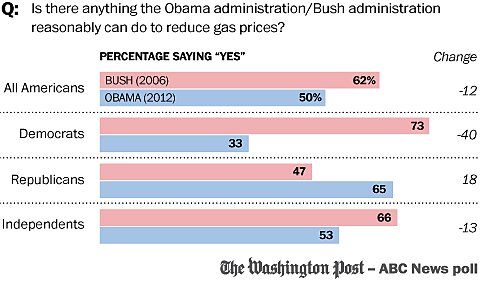
Pretty clear Red Team/Blue Team answers. Republicans in 2006 accepted that there wasn’t much the president could do to reduce gas prices, but most of them think Obama could. Democrats show an even sharper shift; they overwhelmingly said that Bush could bring prices down, but few expect Obama to do so. I hope the fact that both Independents and Americans as a whole are 12–13 points less likely to think that presidents set gas prices is a sign of improvement in general economic understanding.
Back around 2003 or 2004 a colleague was escorted through the hallways of CNN by a junior staffer or intern, who asked him, “Do you think Bush is raising gas prices now so he can lower them before the election?” With perceptions like that among budding journalists, is there any hope for better public understanding of economics?
For examples of informed and nonpartisan analysis of gas prices, check out
Last week, I appeared on NPR’s Tell Me More program. My discussion with host Michel Martin gives a good synopsis of why ObamaCare is both harmful to consumers and unconstitutional. Listen to the segment here.
For a contrary perspective, listen to former Obama administration acting solicitor general Neal Katyal, who appeared on the program the next day. If you do listen to both programs, let me know what you think about Katyal’s comments, specifically this part:
MARTIN: First, I want to play a short clip from Michael Cannon of the Cato Institute who spoke to us yesterday as we said. This is a little of what he told us. Here it is.
MICHAEL CANNON: If the Supreme Court were to uphold this unprecedented and really breathtaking assertion of government power, there would be nothing to stop the Congress from forcing Americans to purchase any private product that Congress chose to favor. That could be a gym membership. That could be stock in Exxon Mobil. That could be broccoli if Congress decided that any of these products move in interstate commerce and that forcing you to buy it was essential to the regulatory scheme they wanted to enact.
MARTIN: What is your response to that?
KATYAL: Well, I mean, that’s a lot of rhetoric and not really a legal argument because it’s not responsive to what the government is asking for here. What the government is saying is, look, everyone consumes healthcare in this country, you and I. And, you know, even if I might say to myself, I don’t need health insurance. I won’t get sick. The fact is, as human beings with mortality, we are going to get sick and it’s unpredictable when.
You could get struck by a heart attack or cancer or hit by a bus and wind up in the emergency room and then it’s average Americans who have to pick up the tab for that. And so the government is not saying here we have the power to force people to buy goods. They’re saying, look, you’re going to already buy the goods. You’re going to use it. And the only question is, are you going to have the financing now to pay for it.
And so the government is regulating financing. It’s kind of like a government law that says you’ve got to pay cash or credit. It’s not the government coming in and saying, oh, consume this product you wouldn’t otherwise consume. And as for the kind of, you know, ludicrous suggestion that this would somehow lead to the government forcing people to eat broccoli or the like, I mean, I would think that someone from the Cato Institute would know that the Bill of Rights and the privacy protections in the constitution would protect against such drastic hypotheticals.
Now, I’ve been at this for a while. I’ve seen people evade uncomfortable questions and mischaracterize things I’ve said. But for some reason, this instance really surprised me. Maybe Katyal was nervous.
Related Tags
As most readers are no doubt aware, the Supreme Court this week takes up six hours of argument in the Obamacare litigation. Constitutional claims that were originally dismissed as “frivolous” and “easy” are now getting three days of hearings — unprecedented in the modern era. The Court has thus signaled what the American people have known all along, that the government’s breathtaking assertion of power goes beyond anything attempted in the history of the Republic.
Rather than repeat my previous writings on the subject, here’s a sketch of each of the four issues the Court will examine, along with a link to my recent op-ed on the subject (this month I’ve written on three of the four) and the relevant Cato amicus brief:
- Whether the challenge to the individual mandate is barred by the Anti-Injunction Act. –- 90 minutes on Monday — op-ed and brief.
- Whether Congress has the power to enact the individual mandate. –- 2 hours on Tuesday — op-ed and brief.
- Whether and to what extent the mandate, if unconstitutional, is severable from the rest of the law. –- 90 minutes — op-ed (with Richard Epstein and Mario Loyola) and brief.
- Whether the new conditions on all federal Medicaid funding (expanding eligibility, greater coverage, etc.) constitute an unconstitutional coercion of the states. – 1 hour — brief.
Are there any constitutional limits on what the federal government can do in the name of regulating interstate commerce? The government hasn’t offered any and we’ll see this week whether that’s good enough for the Supreme Court.
Here further is an analytical point-counterpoint I did with University of California-Irvine Law School dean Erwin Chemerinsky previewing the arguments, and here are a series of blogposts by Cato adjunct scholar Tim Sandefur doing the same. Finally, you can view Cato’s recent conference on the subject here (individual mandate panel) and here (Medicaid expansion panel).
Let’s hope that the Court says that we have a government of laws rather than men, allowing Congress then to get back to the hard work of crafting a true national health reform that both improves the system and stays within constitutional bounds.
May the odds be ever in liberty’s favor!
In a not so subtle brief for taxing the rich, Washington Post business and economics columnist Steven Pearlstein looks critically today at Rep. Paul Ryan’s latest House Republican budget proposal. Addressing what he sees as “the false choice between equality and efficiency,” he starts out well enough, with the “bedrock principle of economics: Incentives matter.” In fact, he rightly quotes Ryan’s budget rationale – that “Republicans ‘don’t want to turn the social safety net into a hammock that lulls able-bodied people to live lives of dependence and complacency, that drains them of their will and incentive to make the most of their lives.’” Echoing the oft-noted aperçu that “those systems that have put liberty ahead of equality have done better by equality than those that have put equality above liberty,” Pearlstein concludes that:
In a society where incomes are made to be too equal, there is little reason to work harder or to defer current consumption in order to save and invest. There is no incentive to take the risk of launching a new enterprise or to spend hours in the lab or the garage dreaming up the next breakthrough technology. Without the prospect of earning more or getting ahead, there would be less reason for getting much beyond the most basic education and training. And it is precisely these factors – work effort, investment in human and physical capital, development of technology – that are key to determining how fast an economy grows.
So far so good. But then Pearlstein goes astray, charging that Ryan Republicans, ignoring that “society wants both fairness and economic growth,” have “not only elevated growth as the sole objective of economic policy” – thus himself ignoring Ryan’s “social safety net” – “but declared that fairness is everywhere and always a deterrent to growth.” All of which brings Pearlstein to ask “if we’ve reached the point where any additional increase in inequality results in less growth, not more?”
A fair question, in answer to which Pearlstein cites two IMF economists who’ve argued recently “that countries that experienced longer periods of strong economic growth were significantly more likely to be characterized by more equality than less.” But they also speculated that inequality
might amplify the risk of financial crises, which are often followed by long periods of slow or negative growth. It might bring about political instability, which can discourage investment. Inequality might make it harder for ordinary citizens to invest in entrepreneurial activity, or even invest in their own training and education.
And why might inequality produce those untoward results? Citing the rise in inequality over the past 20 years, accompanied by “repeated and severe financial crises,” Pearlstein offers up a mix of “explanations,” so called: households taking on too much debt as they struggled in light of nearly three decades of stagnant wages; the wealthy “misallocating” their wealth by bidding up the prices of “houses in the Hamptons” and private schools; “a dramatic slowdown in college graduation rates,” and “a decline in business startups and other measures of entrepreneurial activity.” And then he adds an “explanation” that gets closer to the heart of the matter, even as he misreads it:
Can anyone doubt the connection between rising inequality and the increasingly partisan and divisive nature of American politics, which has made it difficult, if not impossible, for government to respond quickly and intelligently to the major economic challenges facing the nation? Surely that can’t be good for growth.
Yet from that, Pearlstein draws exactly the wrong conclusion. Finding it “strange that Republicans assign such overriding importance to economic incentives for investors, executives and hedge-fund managers while remaining totally clueless about the economic incentives faced by everyone else,” he notes that “over the past 30 years, the entire increase in the nation’s income has been captured by the 10 percent of households at the top of the income scale.” We then get the clincher: “Do you think that maybe, just maybe, the lack of a pay raise for the other 90 percent might have had any impact on their productivity, their work effort, their creativity or their willingness to take risk?”
Couple that with Pearlstein’s finding that it is difficult, if not impossible, for government to respond to the economic challenges facing the nation, and it’s clear that the unstated assumption, echoing the “Occupy” refrain, is that something ought to be done about “the lack of a pay raise for the other 90 percent” – and it ought to be done by government.
But isn’t that just what brought about the financial crises of the past many years? After all, it was in the name of government seeking to reduce inequality that the Fed, Fannie, and Freddie, along with the Community Reinvestment Act, encouraged households to take on too much debt, to take just one of Pearlstein’s examples. More far-reaching still, however, like all who call on government to take measures to reduce inequality in the countless ways they do, Pearlstein seems oblivious to the fact that we’ve had a surfeit of such measures in recent years, yet they’ve only increased inequality, and for reasons economists have long understood: rich people more than poor, large corporations more than small, are all far more able to adjust to those intrusions into the workings of the market.
And so we’re back to the basic insight: If you want to reduce economic inequality, don’t shoot for it through government redistributive programs; get out of the way and let the market bring about whatever measure of equality is optimal. Few have put that point better, more than two and a half centuries ago, well before the rise of public choice economics, than the Scottish enlightenment philosopher David Hume:
Render possessions [or income] ever so equal, men’s different degrees of art, care, and industry will immediately break that equality. Or if you check these virtues, you reduce society to the most extreme indigence; and instead of preventing want and beggary in a few, render it unavoidable to the whole community. The most rigorous inquisition too is requisite to watch every inequality on its first appearance; and the most severe jurisdiction, to punish and redress it. But besides, that so much authority must soon degenerate into tyranny, and be exerted with great partialities; who can possibly be possessed of it, in such a situation as is here supposed? Perfect equality of possessions, destroying all subordination, weakens extremely the authority of magistracy, and must reduce all power nearly to a level, as well as property.
Related Tags
Like most political discussions, the student aid debate is driven far more by sentiment than reasoned analysis. If we used the latter, we’d be demanding big aid cuts for the sake of students and taxpayers alike.
As I testified to a Senate panel earlier this week, the evidence is powerful that there is massive overconsumption of higher education, and cheap federal aid ultimately fuels the college price skyrocket while encouraging students to tackle programs and debt they often can’t handle.
I won’t go into all the evidence here—you can get much of it in my testimony, and even more in this report—but here are a few of the big points that plead for us to stop the rhetoric and attack the waste:
- Aid and prices have both increased at breakneck speeds over the last several decades. Growing empirical research shows that this is not an accident—colleges raise their prices to capture the aid—though there is a limit to what research can prove. Fortunately, logic can fill in the rest: People who work at colleges are normal human beings and will take every dollar they can get their hands on. They always have something good—either personally or professionally—they think they can do with it.
- Inflation is not explained just by state and local budget cuts. Both public and private colleges have seen decades of rampant inflation; total state and local funding to colleges has not dropped during that time; and on a per-pupil basis public schools have raised tuition revenue by roughly $2 for every $1 lost in appropriations.
- Only 57 percent of first-time, full-time students at four-year colleges finish their programs within six years. Huge numbers of the students we encourage to go to college, including with federal grants and loans, languish there and likely never finish.
- Roughly one-third of people with bachelor’s degrees are in jobs that don’t require them.
- Most of the jobs expected to have the biggest growth in the coming decades will not require college attendance, but on-the-job training.
The list could go on, but the point is unmistakable: Talk all you want about the power of education or the future economy; the public dollars we lavish on higher education—including federal student loans with generous terms and interest rates—are largely being squandered, even if with good intentions. Add all this to the nation’s staggering debt, and it is well past time that we stop all the talk and start dealing with reality.
C/P from the National Journal’s “Education Experts” blog.