Since man bites dog stories are all the rage lately, I thought it might be a good time for me to point out that the rising Democratic attacks on teachers unions are largely misdirected.
Cato at Liberty
Cato at Liberty
Yesterday, Federal Judge Kimba Wood dismissed the jury “tampering” indictment against a peaceful jury nullification advocate. Julian Heicklen, an 80-year-old retired chemistry professor, had been indicted for standing outside a Manhattan federal courthouse handing out pamphlets explaining the legal theory that jurors who disagree with a law may acquit a defendant accused of violating that law.
Whew! It’s safe to hand out pamphlets again.
Rachel Barkow, law professor at New York University, says, “I don’t think sensible prosecutors should have even brought this case.” Right, but since this case was publicized, we know there’s no sensible supervision of these prosecutors either—so the problem is deeper.
Previous coverage here.
I’ve complained many times about the pointless nature of anti–money laundering laws. They impose very high costs and force banks to spy on their customers, but they are utterly ineffective as a weapon against criminal activity. Yet politicians and bureaucrats keep making a bad system worse, and the latest development is a silly scheme to ban $100 bills!
It also seems that poor people are the main victims of these expensive and intrusive laws. According to a new World Bank study, half of all adults do not have a bank account, with 18 percent of those people (click on the chart below for more info) citing documentation requirements—generally imposed as part of anti–money laundering rules—as a reason for being unable to participate in the financial system.
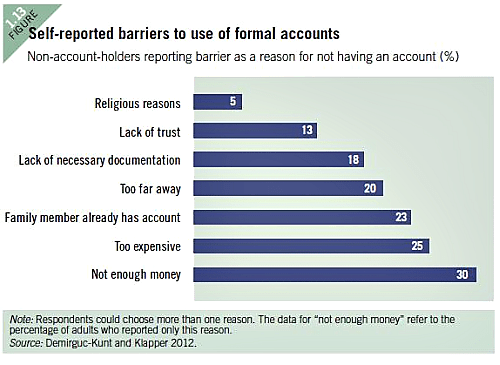
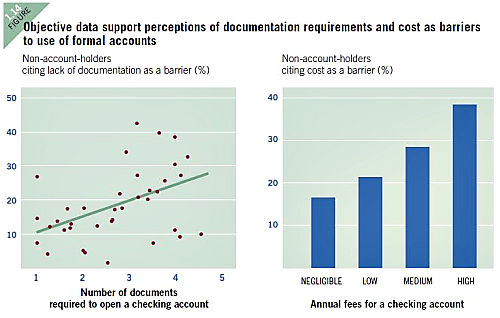
But this understates the impact on the poor. Of those without bank accounts, 25 percent said cost was a factor, as seen in the chart below. One of the reasons that costs are high is that banks incur regulatory expenses for every customer, in large part because of anti–money laundering requirements, and then pass those costs on to consumers.
Here are some of the key points in the World Bank report:
The data show that 50 percent of adults worldwide have an account at a formal financial institution… Although half of adults around the world remain unbanked, at least 35 percent of them report barriers to account use that might be addressed by public policy.
…The Global Findex survey, by asking more than 70,000 adults without a formal account why they do not have one, provides insights into where policy makers might begin to make inroads in improving financial inclusion.
…Documentation requirements for opening an account may exclude workers in the rural or informal sector, who are less likely to have wage slips or formal proof of domicile. …Analysis shows a significant relationship between subjective and objective measures of documentation requirements as a barrier to account use, even after accounting for GDP per capita (figure 1.14). Indeed, the Financial Action Task Force, recognizing that overly cautious Anti–Money Laundering and Terrorist Financing (AML/CFT) safeguards can have the unintended consequence of excluding legitimate businesses and consumers from the financial system, has emphasized the need to ensure that such safeguards also support financial inclusion.
One would hope leftists, who claim to care about the poor, would join with libertarians to roll back absurd anti–money laundering requirements. Heck, one would hope conservatives, who claim to be against pointless red tape, would join the fight as well.
Here’s the video I narrated on the general topic of money laundering laws. I think it makes very good points, but I wish these data had been available when I did the video so I could explain in greater detail how low-income people are the main victims.
Last but not least, I should point out that statists frequently demagogue against so-called tax havens for supposedly being hotbeds of dirty money, but take a look at this map put together by the Institute of Governance and you’ll find only one low-tax jurisdiction among the 28 nations listed.
P.S. You probably didn’t realize you could make a joke involving money laundering, but here’s one starring President Obama.
Frank Harty of the Iowa law firm Nyemaster Goode describes a new kind of employer headache arising from the Obama administration’s hardline enforcement efforts on the Americans with Disabilities Act (ADA) front:
…Common sense dictates that any medication that carries with it a warning that it “may cause drowsiness” or that the patient should “use caution” if operating machinery may pose a risk in the workplace. It is for this reason that many employers adopt a policy requiring employees to self report the use of prescription pain killers. This is especially important in potentially dangerous workplaces such as manufacturing and construction.
In a recent action that defies common sense, the Equal Employment Opportunity Commission has taken the position that such policies are unlawful under the Americans With Disabilities Act. The ADA prohibits an employer from conducting “medical inquiries” without a business reason to do so. In EEOC v. Product Fabricators, Inc., an action in federal court in Minnesota, the EEOC required a manufacturing employer to abandon its policy of encouraging employees to inform supervisors if they are under the influence of narcotic pain killers such as Vicodin. The EEOC took the position that an employer cannot ask about prescription pain killer usage unless it has “objective” evidence that an employee is impaired on the job.
This places employers in a very difficult position.…
In particular, it puts employers to a choice between waiting until there is an actual accident caused by an employee’s nodding off or zoning out — thus at last providing “objective” evidence of risk — and the risk of a large judgment payable to an employee who has not yet gotten into accidents and whose lawyer will claim that there was no objective evidence to support a suspicion of impairment.
The Eighth Circuit upheld the agency’s stance earlier this year and an EEOC press release from February notes that the company agreed to pay $40,000 to settle the dispute. Harty notes that one “thing is certain: it will be employers, not the Equal Employment Opportunity Commission, who deal with the fallout from the loss of life and limb in the workplace.”
A few days ago Rep. Virginia Foxx (R‑NC), chairwoman of the House higher education subcommittee, had the audacity to say in a radio interview that she didn’t have a lot of sympathy for students who racked up $80,000 to $200,000 in college debt. Opportunists have leapt at the chance to attack her, branding her as either mean, or out of touch because what led to her discussion of college debt was retelling how she grew up poor and paid her way through school.
Now let’s be clear: Foxx wasn’t deriding bachelor’s grads holding average debt — about $25,000 for the two-thirds of students with debt — but people with big multiples of that. You know, the ones seemingly featured in every news story or congressional hearing dealing with higher education. And it is, often, very hard to sympathize with such people if you are able to track down crucial information about them such as what they’ve studied, where they’ve chosen to go to school, and what they spend their money on. This CBS News piece is a classic of the Woe-is-Huge-Student-Debtor genre, which Radley Balko and I took apart at the time of its airing.
There’s no question that the price of higher education has been rising at breathtaking rates, and profit-maximizing schools – and politicians who fuel the maximization – bear a good chunk of the blame. But is it really beyond the pale to suggest that maybe some students, who seem to accumulate debt without a care in the world until payment comes due, bear some responsibility for their predicament? Indeed, aren’t these supposed to be pretty smart people — you know, “college material” — who should at a minimum be capable of estimating costs, loan burdens, and potential earnings? Of course, but try bringing that up in the higher education cost debate. You’ll instantly become the Dean Wormer of the group, reviled for killing all the fun of poverty-crying students.
And here’s the thing: Giving the impression that students face an even greater burden than they do — which is exactly the effect of repeatedly focusing on fringe debtors — only encourages Washington politicians to pour even more money into student aid, letting schools raise prices even faster.
The vitriolic response to Rep. Foxx is exactly why so little progress is made in politics generally, and higher ed specifically. There are just some things you can’t talk about, no matter how important than may be, and if you dare bring them up you can expect anything but an honest discussion. You can expect only cheap shots and smears.
Related Tags
An article in the Wall Street Journal offers another example of the problem with the federal government tackling issues that should be left to the states to resolve. Congress passed a law in 1977 requiring coal companies to pay a fee that was to be used to help the states clean up abandoned mines. As is often the case, the distribution of funds to the states has been distorted by politics:
Wyoming officials figured they would get large payouts every year because their state was producing so much coal. But the money had to be “appropriated” by Congress, meaning lawmakers had to vote each year on who would receive it. That often didn’t happen, so a lot of the money sat unused, including hundreds of millions of dollars that Wyoming officials believed belonged in their state.
In 2006, as parts of the law were set to expire, Sen. Mike Enzi (R., Wyo.) won passage of a measure that allowed the money to flow as “mandatory” spending, meaning it didn’t have to be voted on by Congress each year. In addition, it allowed Wyoming, three other states and three Native American tribes to use their money, including funds not distributed in prior years, with virtually no strings attached. Those four states and three tribes were certified as having taken care of their most severe abandoned coal mine problems. Other states had to use the money more narrowly for mine problems.
The next year, the Wyoming legislature voted to spend $50 million in coal-mine funds to build a new science, technology, engineering and math building at the university. Groundbreaking for the building, to be named after Mr. Enzi, is slated to begin this year.
Federal and state officials from Wyoming argue that if their coal companies generated the fees, Wyoming should get the money. The Obama administration argues that the funds were supposed to be used for cleaning up abandoned mines, not renovating a basketball area at the University of Wyoming, which is what the state’s legislature intends to spend $10 million in federal mine cleanup money on.
Both sides have a point, but I think there’s a better, simpler solution: let Wyoming and the rest of the states with abandoned mines decide how to clean them up. Why must the fee (i.e., tax) money be laundered through Washington where it’s inevitably going to be manipulated by parochial-minded politicians? The answer is that it needn’t, but getting the politicians in Washington to part with a pot of money is like trying to take a bone from a bulldog. And for all their complaining about federal involvement in state affairs, state politicians love getting money from Washington to spend because it allows them to avoid having to directly ask their taxpayers to pony up.
See this Cato essay for more on fiscal federalism. See here for more on downsizing the Department of the Interior.
Related Tags
With the possible exception of the Scottish parliamentarian George Galloway (here he is saluting Saddam Hussein), no other politician in modern-day Britain has been as staunchly socialist as the former mayor of London, Ken Livingstone (a.k.a. “Red Ken”). The bane of Lady Thatcher in the 1980s and a fan of Hugo Chavez in the 2000s, “Red Ken” has been a poster child for the British left for decades. As far as he was concerned, no taxes were too high, no government intervention in the economy too excessive. It was with some glee, therefore, that I read that Red Ken is also a bit of a tax dodger – using apparently legal but not very “lefty” ways to limit his tax exposure. But wait, there is more… Ken has recently attacked the plans of the Conservative government to make the National Health Service (NHS is a monopoly public health provider) a little less socialist. “The people of our capital city deserve top quality care and demand our health care should not be broken up, sold off or be privatized by the back door,” he wrote. Lo and behold, it turns out that Red Ken has been benefiting from private health care for some years. Even by the low standards of contemporary politics, this is an extraordinary degree of hypocrisy.