Harvey Silverglate is an adjunct scholar with Cato.
For more information about the work of FIRE, go here.
Harvey Silverglate is an adjunct scholar with Cato.
For more information about the work of FIRE, go here.
As China’s economic and military power continues to grow, the country’s political leaders are engaging in increasingly assertive, if not abrasive, behavior. Two recent examples confirm that Beijing is determined to play diplomatic hardball.
The first was a stunningly meager pledge of aid to the Philippines in response to Typhoon Haiyan. In an article over at China‑U.S. Focus, I point out that while such countries as the United States, Australia, and Japan rushed to provide generous relief assistance, China’s response was miserly and grudging. Beijing initially offered a paltry $100,000 in aid funds, and then after some apparent reluctance upped that total to a still very modest $1.6 million.
That appeared to be a deliberate snub, and the Chinese leadership seemed willing to incur the negative international publicity. Beijing’s relations with Manila have been quite frosty in recent years, primarily because of competing territorial claims in the South China Sea. Tensions surged again earlier this year when the Philippines filed an unprecedented arbitration case—over Beijing’s strenuous objections—regarding those claims with the United Nations’ Convention on the Law of the Sea. Chinese officials have been doing a slow burn since that filing.
One should not underestimate the depth of China’s anger about such developments, or the willingness of Chinese officials to “send Manila a message”—including by withholding humanitarian aid during a time of great need. The message is that there will be a substantial price to pay for any nation that defies China’s policy preferences and seeks to undermine China’s interests.
The second episode that confirms Beijing’s willingness to play diplomatic hardball was the announcement on November 23rd of a new Air Defense Identification Zone over the East China Sea. Portions of that ADIZ overlapped similar zones that Japan and South Korea had long implemented. China’s ADIZ also included the airspace over the Senkaku/Diaoyu Islands, which are the subject of a bitter territorial dispute between China and Japan, and airspace near another island involving a bilateral dispute with South Korea. Beijing insisted that all foreign military and commercial aircraft flying through the new zone file approved flight plans with the Chinese government.
That action was not well received. Unless Chinese leaders were uncharacteristically obtuse, Beijing had to anticipate that the Japanese and South Korean governments would not tamely accept the new proclamation and the procedures it outlined. They also had to assume that Washington would back the position of its allies. The decision appeared to be a diplomatic ploy to strengthen China’s territorial claims in the East China Sea, and quite possibly to be a precedent for creating a similar ADIZ in the South China Sea, where Beijing has even more extensive claims that various neighboring countries challenge.
What Chinese leaders may not have fully calculated was the nature of the reaction from the United States and its allies. Tokyo, Seoul, and Washington did not confine their response to diplomatic protests. Instead, all three countries promptly sent military aircraft (in Washington’s case, B‑52 bombers) through the zone without complying with any of Beijing’s requirements. That defiance has infuriated the Chinese government, and tensions have now reached worrisome levels.
The measures that the United States and its allies adopted were both premature and excessive. China’s proclamation may not have been the most skillful diplomatic initiative, but creating a new ADIZ was not outrageous—especially since Japan has insisted on similar requirements in the same area for years. Indeed, Tokyo warns violators that they risk interception by Japanese military aircraft, and apparently has occasionally even carried out such intercepts. In any case, engaging in a provocative display of military power to defy China’s ADIZ was a clumsy response that has made matters even worse. This is an issue that cries out for restraint and sober dialogue on the part of all parties.
Over at Cato’s Police Misconduct Reporting Project, we have named the worst case for the month of November. It was the repeated, forced cavity search of two young men—in separate incidents—in New Mexico.
The first victim, David Eckert, was pulled over by police for failing to make a complete stop at a stop sign. After a police K‑9 who was uncertified for drug searches indicated the presence of marijuana, the officers told a judge that the victim appeared to be “clenching his buttocks” and requested a body cavity search warrant, which the judge granted. The officers took Eckert to a local hospital and requested that doctors perform the search, but the hospital doctors refused. The cops then took Eckert to a second hospital, in a neighboring county that was not covered by the warrant, where they found doctors willing to perform the search.
First, the doctors took an x‑ray of Eckert’s abdomen, which showed no hidden drugs. Next, they forcibly probed Eckert’s anus with their fingers, which again uncovered no drugs. Undeterred, the doctors inserted an enema and forced Eckert to defecate in front of the officers: again, no drugs. The enema search was repeated twice, and still no drugs were found. Another x‑ray was taken: no drugs. To cap off Eckert’s nightmare ordeal, the officers had the doctors sedate him and perform a colonoscopy, probing his anus, colon, rectum, and large intestines. No drugs found. All of this was done against Eckert’s protest, in a county not covered by the search warrant, with part of the search done after the warrant had expired.
The second victim, Timothy Young, was brutalized in a similar manner after he was pulled over for failing to signal before making a turn, and after another marijuana indication by the same non-certified police dog. He was taken to the same hospital as Eckert and subjected to similar searching methods against his protests.
Cato’s Police Misconduct website often reports instances of police rape and sexual misconduct. In those cases, the offending officers typically do not contend that they have the legal right to abuse their victims’ bodies and are typically punished for their crime, even if often more lightly than others would be punished. Cases like this are entirely different. These cases show that officers can drum up warrants—for a dog’s bark and a perceived “clench”—to repeatedly and forcefully penetrate the depths of the human body for hours on end, and still think they have the power and lawful authority to repeat the process. Even worse, the futile, repeated nature of the searches seriously calls into doubt whether the officers were actually searching for drugs or just torturing the victims under the banner of law enforcement.
There’s a saying in sports that teams that come back to win in the final minutes often “snatch victory from the jaws of defeat .”
I don’t like that phrase because it reminds me of the painful way my beloved Georgia Bulldogs were defeated a couple of weeks ago by Auburn.

But I also don’t like the saying because it describes what President Obama and other advocates of big government must be thinking now that Republicans apparently are about to do away with the sequester.
Specifically, the GOP appears willing to give away the sequester’s real and meaningful spending restraint and replace that fiscal discipline with a package of gimmicks and new revenues.
I warned last month that something like this might happen, but even a pessimist like me didn’t envision such a big defeat for fiscal responsibility.
You may be thinking to yourself that even the “stupid party” couldn’t be foolish enough to save Obama from his biggest defeat, but check out these excerpts from a Wall Street Journal report.
Sen. Patty Murray (D., Wash.) and Rep. Paul Ryan (R., Wis.), chief negotiators for their parties, are closing in on a deal… At issue are efforts to craft a compromise that would ease across-the-board spending cuts due to take effect in January, known as the sequester, and replace them with a mix of increased fees and cuts in mandatory spending programs.
The supposed cuts wouldn’t include any genuine entitlement reform. And there would be back-door tax hikes.
Officials familiar with the talks say negotiators are stitching together a package of offsets to the planned sequester cuts that would include none of the major cuts in Medicare or other entitlement programs that Mr. Ryan has wanted… Instead, it would include more targeted and arcane measures, such as increased fees for airport-security and federal guarantees of private pensions.
The package may get even worse before the ink is dry.
Democrats on Thursday stepped up their demands in advance of the closing days of negotiations between Ms. Murray and Mr. Ryan. House Democratic Leader Nancy Pelosi (D., Calif.) brought a fresh demand to the table by saying she wouldn’t support any budget deal unless in included or was accompanied by an agreement to renew expanded unemployment benefits that expire before the end of the year—which would be a major threat to any deal.
Gee, wouldn’t that be wonderful. Not only would the GOPers surrender the sequester and acquiesce to some tax hikes, but they could also condemn unemployed people to further joblessness and despair.
That’s even worse than the part of the plan that would increase taxes on airline travel to further subsidize the Keystone Cops of the TSA.

But look at the bright side—for D.C. insiders. If the sequester is gutted, that will be a big victory for lobbyists. That means they’ll get larger bonuses, which means their kids will have even more presents under the Christmas tree.
As for the rest of the nation? Well, you can’t make an omelet without breaking a few eggs.
P.S.: I suppose we should consider ourselves lucky that this looming agreement isn’t as bad as some past budget deals, such as the read-my-lips fiasco of 1990.
Reporters who cover state and local government should heed the example of the Topeka-Capital Journal’s Andy Marso. It’s my opinion that reporters often insufficiently examine how state and local politicians spend federal tax dollars. Heck, I’m even surprised when a reporter mentions that the money originated from Uncle Sam to begin with.
Marso recently looked at the use of federal Community Development Block Grant money by Osage City in Kansas (see this Cato essay for more on the CDBG program). In particular, $750k from federal taxpayers that was wasted on a now defunct modular home builder:
Osage City Mayor Quintin Robert says John Samples and his modular housing company Kan Build Inc. was about as safe an investment as a company could be in 2006.
Samples owned Kan Build when the city council and Kansas Department of Commerce approved funneling $750,000 in federal money to the company through the Community Development Block Grant program. The business had nearly closed one year earlier, but Samples stepped in, leading a group of investors in buying the manufacturing facility.
Samples was a successful businessman who had bought and rehabilitated the company once before. Despite the turmoil, Robert, who was on the city council at the time, said betting on Samples seemed like a good play.
“I think the decision was based on, ‘Hey, this guy bought this plant when it closed, got multiple grants, was one of the only people to pay them back and had an award, an entrepreneur of year award,’ ” Robert said in a recent phone interview. “He got a lot of accolades, because it is a big deal in a small community. A couple hundred jobs are a big deal.”
Then the housing market crashed, and by February 2011 the plant closed and the 108 jobs it had when it got the grant money disappeared.
Mayor Robert’s simple-minded comments on the deal demonstrate the folly of allowing politicians to play economic planner with other people’s money. It’s even worse when a politician uses money that he or she didn’t have to first collect from his or her voters/taxpayers, which is a fundamental problem with federal subsidies to state and local government. Under that arrangement, local citizens have little incentive to pay attention to how their elected officials are spending money.
As Marso notes, the Osage City City Council’s spent all of three minutes on the decision to give Kan Build the money. If that wasn’t bad enough, it turns out that Mayor Robert “worked for Kan Build in various capacities in the early 1980s, early 1990s and from 1999 until it closed.” The Office of the Inspector General for the Department of Housing and Urban Development might want to look into that.
Anyhow, great work by Marso. There are a lot of similar stories out there waiting to be told.
It’s no secret that I dislike the value-added tax.
But this isn’t because of its design. The VAT, after all, would be (presumably) a single-rate, consumption-based system, just like the flat tax and national sales tax.
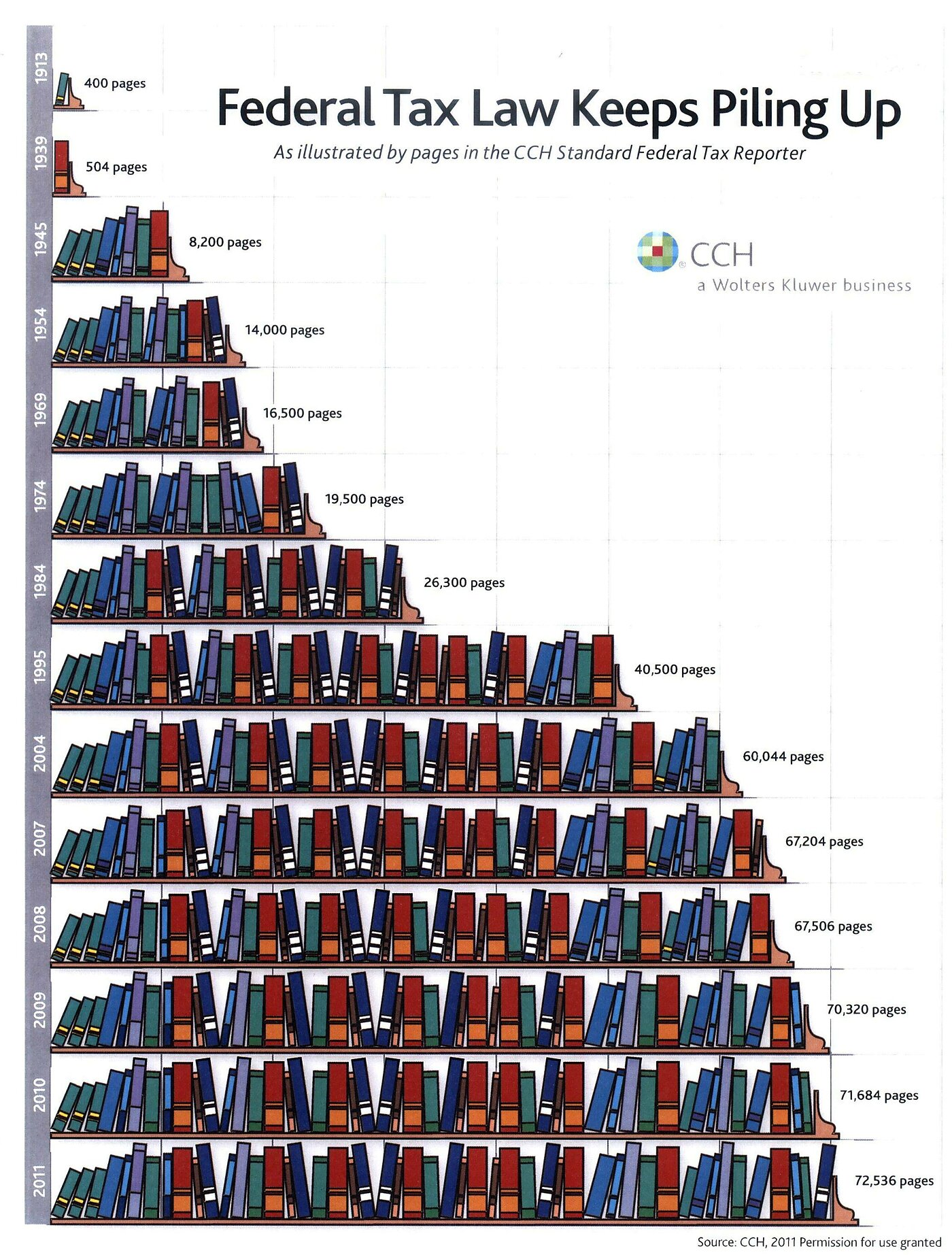
And that’s a much less destructive way of raising revenue compared to America’s corrupt and punitive internal revenue code.
But not all roads lead to Rome. Proponents of the flat tax and sales tax want to replace the income tax. That would be a very positive step.
Advocates of the VAT, by contrast, want to keep the income tax and give politicians another big source of revenue. That’s a catastrophically bad idea.
To understand what I mean, let’s look at a Bloomberg column by Al Hunt. He starts with a look at the political appetite for reform.
There is broad consensus that the U.S. tax system is inefficient, inequitable and hopelessly complex. …a 1986-style tax reform — broadening the base and lowering the rates — isn’t politically achievable today. …the conservative dream of starving government by slashing taxes and the liberal idea of paying for new initiatives by closing loopholes for the rich are nonstarters.
I agree with everything in those excerpts.
So does this mean Al Hunt and I are on the same wavelength?
Not exactly. I think we have to wait until 2017 to have any hope of tax reform (even then, only if we’re very lucky), whereas Hunt thinks the current logjam can be broken by adopting a VAT and modifying the income tax. More specifically, he’s talking about a proposal from a Columbia University Law Professor that would impose a 12.9 percent VAT while simultaneously creating a much bigger family allowance (sometimes referred to as the zero-bracket amount) so that millions of additional Americans no longer have to pay income tax.
Hunt likes this idea.
The Graetz initiative offers something for both sides. It starts, he suggests, with countering the observation once offered by former Treasury Secretary Larry Summers that liberals fear a value-added tax because it’s regressive and conservatives fear it because it’s a money machine. Graetz’s measure overcomes both objections.
Regarding the final sentence of that excerpt, he’s half right. Folks on the left will be happy to know that there will be a lot more redistribution through the tax code.
Graetz addresses the regressivity of most sales taxes, not by exempting food, drugs and other necessities as most of the older European systems do, but with a system of credits and offsets… He provides a payroll tax cut and expanded child-care credits focused on low- and moderate-income workers.
But what do advocates of small government get out of the deal?
Well, they do get something in the short run. Graetz wants to use the VAT money to reduce the burden of the income tax. Rates for households are lowered, with the top rate falling to 31 percent. And the best part of the plan may be that it reduces America’s uncompetitive corporate tax rate to 15 percent.

But I’m more worried about the long run, particularly after looking at evidence from Europe and Japan.
What’s in the plan, for instance, that would prevent the VAT from becoming a “money machine”? Or what guarantees would be put in place to prevent politicians from re-expanding the income tax?
Unfortunately, there don’t appear to be any safeguards. Professor Graetz has expressed some support for supermajority rules to protect against tax hikes, but he’s quoted in the article explicitly stating that a VAT could be used to generate more money to prop up the welfare state.
The Tax Policy Center found that his proposal succeeds in raising the same amount of revenue as current law. If revenue is to be part of any longer-term deficit reduction, Graetz observes, the value-added tax or the income taxes could be tweaked. “Actually, this would put us in a better situation to address the fiscal crunch down the road,” he says.
That statement scares the heck out of me. We desperately need the right kind of entitlement reform to save America from becoming another doomed welfare state. But what are the odds of getting good changes if politicians think they can continuously kick the can down the road by raising the VAT every couple of years.
Before you know it, we’re Greece!
If you don’t believe me about the VAT being a money machine, perhaps you’ll be more trusting of analysis from the International Monetary Fund. That bureaucracy actually supports the VAT,

but the IMF inadvertently revealed in some research last year that the VAT is far more effective at generating new revenue than the income tax.
And that’s true for poor nations and rich nations.
This video from the Center for Freedom and Prosperity, narrated by yours truly, explains why the VAT would finance the road to serfdom.
Last but not least, it’s worth pointing out that Professor Graetz’s proposal has become more punitive over time. Check out this portion of a Tax Policy Center study showing that the VAT rate has been increased and that a new class-warfare tax rate has been added to the proposal.

So if the proposal has become more onerous on paper, imagine how much worse it will get once politicians get their hands on it.
P.S. To be fair, there’s very little indication that Prof. Graetz wants bigger and more expensive government. He’s proposing a VAT for the same reason Cong. Paul Ryan has proposed a VAT. They think the revenue can be used to reduce the burden of the income tax. They’re not wrong in theory. They just don’t appreciate the danger of giving politicians a new source of revenue.
P.P.S. George Will correctly warns that the VAT should be off the table until and unless the 16th Amendment is repealed. And Robert Samuelson gives several reasons why this levy should be rejected.
P.P.P.S. Some advocates say the VAT is needed to forestall higher income tax rates, but that certainly hasn’t been the case in Europe.
P.P.P.P.S. You can enjoy some amusing VAT cartoons by clicking here, here, and here.
Over at SeeThruEdu I’ve got a post responding — sort of — to a recent article on the Common Core by National Review’s Ramesh Ponnuru. It’s only “sort of” because for the most part Ponnuru is right on the money: Some of the allegations against the Core are highly dubious, but so are many of the arguments proffered for it. My only quibble is that Ponnuru says that the Core doesn’t represent “Big Brother in the classroom.” Narrowly that’s right — the Core itself is just the standards — but when you look at the data collection and overall federal policy of which the Core is an integral part, fears about Big Brother — or maybe Big Micromanager — coming to a school near you are reasonable.
Check it out!