In unanimous decisions this morning, the Supreme Court turned away both partisan gerrymandering cases on grounds other than their ultimate merits — Gill v. Whitford (Wisconsin) by declaring the individual complainant to lack Article III standing arising from injury in his own district and sending the case back for him to establish that, and Benisek v. Lamone (Maryland) by finding it not an abuse of discretion for the lower court to deny a preliminary injunction, which does not mean the case will not be back at the regular injunction stage. Neither decision reaches or resolves the main constitutional issues raised by the two cases, which both remain alive. As I mentioned in February, the Court had already signaled that it was not in a rush to resolve the issue right away (the calendaring was leisurely) and that Justice Anthony Kennedy was not going to prove an easy recruit for the four liberals. (He joined the conservatives in staying the Wisconsin decision below.) In the Wisconsin case, the majority held that the complainant needs to go back and demonstrate that his own district, and not merely others in the state, has been subject to “packing” or “cracking.” (The Maryland complainants had already made this kind of showing; they were suing over the lines of their own district, not the whole state map.) Justices Thomas and Gorsuch went further, saying the Wisconsin complainant’s failure to establish individual standing should have ended his case, rather than resulting in a do-over. In a concurrence on behalf of the four liberals, Justice Elena Kagan agreed on the need to send the case back for a showing of individual-district standing but emphasized that, in her view, once the complainant established that he could then introduce statewide evidence and seek statewide remedies. This would preserve more or less the full scope of what liberal litigation groups have been hoping to achieve with the Wisconsin case. Significantly, Justice Anthony Kennedy did not join the liberals on these points — although of course he could view the case as having been resolved without needing to reach such issues. Nor did the majority opinion, written by Chief Justice Roberts, concede Kagan’s assertion that courts “have a critical role to play in curbing partisan gerrymandering.” Whatever happens in the Court — and a North Carolina case could bring the issues back next term — there are good reasons for states to act on their own to curb the evils of partisan gerrymandering without waiting for marching orders from the nine Justices. Measures to take line-drawing out of the hands of self-interested incumbents, to prescribe strong standards of compactness and congruence with counties and other political subdivisions, to provide for transparency, open data access, and public map submission, and to ensure strong judicial review, make sense in themselves and do not require waiting on a Court that has shown a reluctance to decide. The Court has kicked the issue of partisan gerrymandering down the road. States shouldn’t.
Cato at Liberty
Cato at Liberty
Constitutional Law
Would hate speech laws reduce discrimination, violence, and psychic injuries to vulnerable groups? Nadine Strossen says they would not in her new book, Hate Speech: Why We Should Resist It with Free Speech, Not Censorship. She believes we have insufficient evidence to conclude that “hate speech” in general harms others, and even less evidence that constitutionally protected “hate speech” does so.
Naturally, proponents of “hate speech” laws blame expression for anti-social attitudes and conduct. Strossen maintains that we should refrain from censorship on the basis of expected effect, “simply because it might have bad effects.” The perceived harmfulness of any given utterance is context contingent, depending largely on variables like location, tone of voice, relationship between speaker and listener, and personality characteristics.
Strossen draws attention to a study conducted by Laura Leets of Stanford University. Leets recruited Jewish and LGBT college students to read several anti-Semitic and homophobic slurs all drawn from real situations. The subjects then answered questions about how they would have responded if they themselves had been the targets of these messages. Interestingly, a common response by the students was that the “hate speech” would have had “no effect” upon them in either the short run or the long run. Many of the participants also expressed the belief that the speaker was motivated by ignorance, “and therefore should be the object of pity, not anger” (124).
A national survey of incoming first-year college students conducted by the UCLA Higher Education Research Institute found that “the entering freshman class of 2015 ranks among the most ambitious” in the areas of student activism, political and civic engagement. The study notes that this particular class of incoming first-years had witnessed “protests and outcries on college campuses and in communities” in response to “local incidents of bias and discrimination.” These students did not respond to “hate speech” and bias crimes with withdrawal and depression, but rather with engagement and dialogue. Such speech seems to foster political engagement within the larger community, a necessary component of a healthy democracy.
Although these studies focus on college students, Strossen notes that resources for developing one’s ability to resist the potentially negative effects of hateful speech are available to all. These tools include cognitive-behavioral therapy techniques for reducing anxiety or other negative reactions that might result from stressful situations (including exposure to “hate speech”), education about utilizing social media to respond to “hate speech,” and providing access to supportive organizations and other resources. Education and other responses may turn a negative experience into a hard-won moment in personal growth.
Strossen also addresses the question of whether “hate speech” fosters hateful and discriminatory attitudes and actions among those who hear it. She notes that “a comprehensive review of social science research about the potential links between media messages and audience behavior concluded that the effects on audience behavior are ‘weak and affect only a small percentage of audience members’” (127).
We should keep in mind that speech does not force people to act badly. Those who hear extreme utterances are responsible for their subsequent actions. British writer Kenan Malik remarks:
Racists are, of course, influenced by racist talk. It is they, however, who bear responsibility for translating racist talk into racist action. Ironically, for all the talk of using free speech responsibly, the real consequence of the demand for censorship is to moderate the responsibility of individuals for their actions.
If creators were held responsible for the anti-social acts that some individuals committed after viewing the material, “certainly neither the Bible nor the Qu’ran” would be safe, as “both have been accused of instigating countless individual and mass crimes” (128).
In summary, we should not outlaw speech because it might have bad effects. This approach would allow government to punish speech because it disfavors the speaker or the message without directly acknowledging this motive. Moreover, “given the endless array of speech about public concerns that could have such an impact, any other rule would largely muzzle democratic discourse” (127).
This the third post in series on Nadine Strossen’s new book, Hate Speech. The first and second posts may be found here and here.
In his Election Day tweet attacking Rep. Mark Sanford, President Trump declared that Sanford’s opponent, Katie Arrington, “is tough on crime and will continue our fight to lower taxes.” Well, maybe. She doesn’t mention either issue on her campaign website. (In fact, she has nothing but bland buzzwords about any issue.)
This tweet is typical. It seems like every time Trump tweets an endorsement or a criticism of a candidate, he calls the candidate “strong (or weak) on crime.” I count 60 Trump tweets since his inauguration that use the word “crime.” Some complain that he is being investigated for a “made up, phony crime” or charge Hillary Clinton with “many crimes.” But most seem to relate to a candidate: Dan Donovan is “strong on Borders & Crime.” Kevin Cramer of North Dakota is “strong on Crime & Borders.” Doug Jones is “WEAK on Crime.” Adam Laxalt is “tough on crime!” “Chuck and Nancy…are weak on Crime.” Ralph Northam is “weak on crime.” Also “VERY weak on crime!” “Keep our country out of the hands of High Tax, High Crime Nancy Pelosi.” And so on.
It’s not obvious that this makes political sense. Candidates aren’t talking much about crime, perhaps because they recognize the substantial decline in crime rates. In numerous Gallup polls over the past year, only 2 to 4 percent of Americans have identified crime as the country’s most important problem. Though about 50 percent of people say they worry a great deal about crime when asked that question directly.
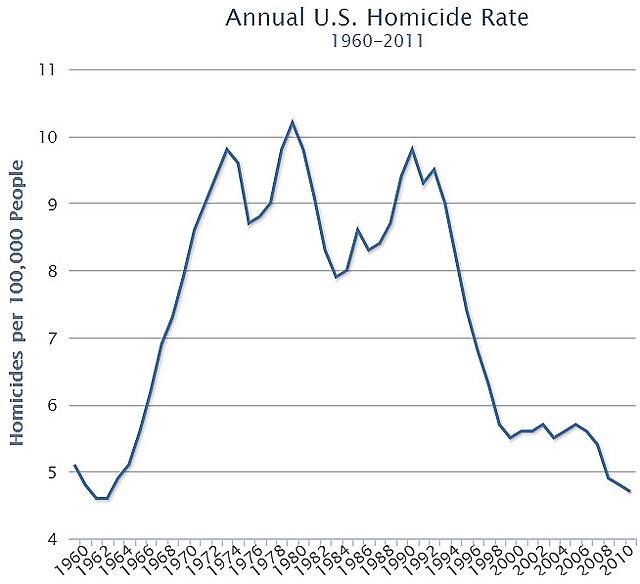
But here’s the thing. Crime in the United States is in fact way down.
Here’s a long-term look at the most visible crime, homicide:
Here’s a picture of broader crime rates:

And yet, as the same source illustrated, at the very time when crime rates had fallen steadily and substantially for 20 years, 68 percent of Americans said the national crime rate was getting worse. (Crime rates continued to fall after 2011, though there was an uptick in murders in 2015 and 2016. The rate appears to have fallen in 2017.)
Of course, the president is better informed than average Americans. Surely White House staff have explained the crime statistics to President Trump. So why does he talk about “this American carnage” and pound away at the “crime” issue when endorsing candidates who never talk about it? Perhaps it’s part of his continuing use of racially charged language. Perhaps “crime and borders” is just shorthand for the kinds of social change he thinks his voters fear. Or maybe it reflects the fact that he grew up in New York City during a time of sharply rising crime. We all get ideas in our youth (“American cars aren’t well made”) that may stick with us even us as the facts change.
Whatever the reason, it seems curious that he so often cites “strong and crime” as the reason to support political candidates who haven’t talked about crime.
In a 7–2 decision today, the Supreme Court struck down Minnesota’s blanket ban on wearing anything with a political insignia at a polling place. Chief Justice Roberts’s opinion agreed with many parts of Cato’s brief, particularly regarding the inherent unworkability of such a broad ban on political speech. The decision is a small but important victory for free speech.
In highlighting the unpredictability of the what counts as “political,” Chief Justice Roberts’s opinion cites one moment from oral argument that Supreme Court observers found particularly telling. When asked by Justice Alito whether the law would ban a shirt with the text of the Second Amendment, Daniel Rogan, counsel for Minnesota, said “I think that that could be viewed as political.” Alito then immediately asked whether the same would be true of a shirt with the text of the First Amendment. Observers in the courtroom laughed, and Rogan said “no your honor, I don’t think the First Amendment,” only to be interrupted by the Chief Justice, “No what, that it would be covered or wouldn’t be allowed?,” Roberts asked. “It would be allowed,” replied Rogan, but the Chief Justice seemed surprised, “it would be?,” he asked.
There’s a saying in Supreme Court practice that a case can’t be won at oral argument, but it can be lost. While Minnesota had a tough law to defend, but that exchange underscored the arbitrariness of the law. At a Cato forum in February, before the case was argued, I had a similar exchange with Ginger Anders of Munger, Tolles, and Olson, LLC when I asked her whether a Gerald Ford or a Ronald Reagan shirt would be banned. No to Ford, she said, but yes to Reagan.
So did Minnesota lose the case at oral argument? Roberts’s opinion goes almost out of its way to explain that bans on political expression in polling places are often valid, if not desirable:
Casting a vote is a weighty civic act, akin to a jury’s return of a verdict, or a representative’s vote on a piece of legislation. It is a time for choosing, not campaigning. The State may reasonably decide that the interior of the polling place should reflect that distinction.
From this language, it would seem that Roberts is writing to uphold the law. But “the State must draw a reasonable line,” he goes on to write, and “the unmoored use of the term ‘political’ in the Minnesota law, combined with haphazard interpretations the State has provided in official guidance and representations to this Court” mean the law should be struck down.
Every state and the District of Columbia have laws that prohibit certain types of speech around polling places on election day. If a state’s law provides specific enough standards for prohibited speech, then today’s decision won’t affect it. Those that let election judges make arbitrary distinctions, however, will likely be struck down.
This morning, the Supreme Court ruled 7–2 that a Minnesota law banning “political” apparel at polling places violates the First Amendment. This was ultimately an easy case, as it should have been all along, and this decision was predictable after oral argument.
Obviously voters shouldn’t be allowed to harass, intimidate, misdirect, or otherwise interfere with other voters — and politicking or electioneering can be disruptive, so there’s nothing wrong with restricting that. But merely wearing a “political” hat or T‑shirt doesn’t do any of those things, which are covered by other laws anyway. As Cato argued in our amicus brief, a complete ban on political expression should be met with the most searching judicial inquiry, regardless of the setting.
In this time when the freedom of speech is becoming an increasingly controversial idea, the Supreme Court did well to remind us that the First Amendment protects expression even and especially when Americans go to vote.
I’ve blogged several times now about Cato’s ongoing campaign to challenge the doctrine of qualified immunity. This judge-made doctrine — invented out of whole cloth, at odds with the text of Section 1983, and unsupported by the common-law history against which that statute was passed — shields public officials from liability for unlawful misconduct, unless the plaintiff can show that the misconduct violated “clearly established law.” This standard is incredibly difficult for civil rights plaintiffs to overcome, because courts generally require not just a clear legal rule, but a prior case on the books with functionally identical facts. Not only does this doctrine deny relief to victims whose rights have been violated, but at a structural level, it also erodes accountability for government agents (especially law enforcement).
I’m thrilled to report, however, that in the last 36 hours, we’ve had three promising developments in this front:
First, in a Section 1983 case in the Eastern District of New York, Judge Jack Weinstein denied qualified immunity to police officers alleged to have beaten up a man after he refused to allow them to enter his home without a warrant. His comprehensive opinion not only denied immunity in this case, but also discussed recent criticisms of the doctrine, both on legal and policy grounds, and suggested that the law “must return to a state where some effective remedy is available for serious infringement of constitutional rights.” Judge Weinstein thus joins other lower court judges, like Lynn Adelman of the Eastern District of Wisconsin and Jon O. Newman of the Second Circuit, who have criticized the Supreme Court’s qualified immunity jurisprudence. Lower court judges are, of course, obliged to follow Supreme Court precedent with direct application, but this is exactly the kind of criticism and commentary that can help explain to the Court why that precedent should be reconsidered.
Second, Joanna Schwartz, a law professor at UCLA, has just put up on SSRN a forthcoming article in the Notre Dame Law Review, titled The Case Against Qualified Immunity. Professor Schwartz previously published an influential article in the Yale Law Journal called How Qualified Immunity Fails, which empirically demonstrates how the doctrine of qualified immunity is failing to achieve its professed purposes. But her latest piece weaves together the legal, historical, and prudential arguments against the doctrine, and argues that the Supreme Court can and should reconsider it. We know that the Supreme Court pays attention to scholarship in this area, as both Justice Thomas and Justice Sotomayor have recently cited Will Baude’s article Is Qualified Immunity Unlawful?, so I have every expectation that Professor Schwartz’s comprehensive broadside will likewise be taken seriously by the courts. (Professor Schwartz is also blogging about her new article at the Volokh Conspiracy this week.)
Third, this morning the Supreme Court ordered a response to the cert petition in Allah v. Milling, which explicitly asks the Court to reconsider the doctrine of qualified immunity. This is the case I recently blogged about, and in which Cato filed an amicus brief, where a pretrial detainee was kept in extreme solitary confinement for nearly seven months, for no legitimate reason. Although every single judge in his case agreed that Mr. Allah’s constitutional rights were violated, a split panel of the Second Circuit granted qualified immunity to the prison officials, simply because there was no prior case holding that the “particular practice” used by this prison was unlawful. The case is an ideal vehicle for the Court to reconsider the doctrine of qualified immunity, because there are no disputed facts, and Mr. Allah has already won a judgment at trial, so the outcome turns solely on the legal question of whether the defendants should get immunity for their unlawful misconduct.
“Calling for a response” doesn’t necessarily mean that the Court is going to hear the case, but it’s a sign that they’re looking at it closely. The defendants in this case tried to waive their right to respond to the cert petition (a common practice, because respondents want to avoid signaling that the case is important), but the Court basically said “no, this is important enough that we want to hear your argument about why we shouldn’t take the case.” The defendants will therefore be required to put forward actual legal justifications for qualified immunity — so we’ll see what they come up with. The response is due July 11th, and Mr. Allah will then get the chance to file a reply, so I’ll be sure to cover those briefs when they come in.
Overall then, the fight continues, but we’ve got some promising signs of real progress.
In his prime tweeting time, bright and early last Monday, President Trump proclaimed:

“Numerous legal scholars?” I harrumphed to myself: “come on.” Given that no president has ever been crazy enough to try it, the self-pardon is a novel question of constitutional law. When I first looked into the issue last year, I could find only two law review articles devoted to the subject, one pro, one con.
But sure enough, in the week that followed, “numerous legal scholars” chimed in with impressive confidence. Jack Goldsmith has a useful roundup over at Lawfare, noting that while the “constitutional text does not speak overtly to the issue and there is no judicial precedent on point… that doesn’t stop people from voicing strong opinions” on each side of the issue.
Since Goldsmith’s post, two more right-leaning legal heavyweights have made the case for the self-pardoning power. In the Wall Street Journal, Richard Epstein insists that Article II, Section 2, allows the president to issue himself a get-out-of-jail-free card, but—not to worry—we’ll always have “the powerful check public opinion places on the president.” And in a Washington Post oped that ran Friday, former 10th Circuit judge Michael W. McConnell argues that “presidents do have the constitutional authority to pardon themselves.”
The main piece of evidence McConnell offers to support that proposition is a September 15, 1787 exchange between Edmund Randolph and James Wilson at the Constitutional Convention. As captured in Madison’s notes, it went like this:
Mr. RANDOLPH moved to “except cases of treason” [from the reach of the pardon power]. The prerogative of pardon in these cases was too great a trust. The President may himself be guilty. The Traytors may be his own instruments.
Col. MASON supported the motion.
Mr. Govr. MORRIS had rather there should be no pardon for treason, than let the power devolve on the Legislature.
Mr. WILSON. Pardon is necessary for cases of treason, and is best placed in the hands of the Executive. If he be himself a party to the guilt he can be impeached and prosecuted.
Q.E.D., apparently. “The framers of the Constitution thus specifically contemplated and debated the prospect that a president might be guilty of an offense and use the pardon power to clear himself,” McConnell writes.
That is… not at all clear. The Randolph-Wilson exchange could just as easily be read to refer to the president’s power to pardon co-conspirators (the “Traytors” he’s in league with), as in a similar exchange, also featuring George Mason, at the Virginia Ratifying Convention the next summer. Renewing Randolph’s objection, Mason warned that the president “may frequently pardon crimes which were advised by himself…. If he has the power of granting pardons before indictment, or conviction, may he not stop inquiry and prevent detection?” (If he’d understood the September 15 conversation the way McConnell does, Mason might have strengthened the point by adding “he can even pardon himself!”)
Professor McConnell insists that when Wilson said the president “can be impeached and prosecuted,” he meant “prosecuted before the Senate,” i.e., in an impeachment trial. Maybe! But what makes him so sure? It seems just as likely that Wilson is referring to criminal prosecution, per (what became) Article I, sec. 3, cl. 7, under which a civil officer convicted in an impeachment trial “shall nevertheless be liable and subject to Indictment, Trial, Judgement and Punishment, according to Law.”
In the leading (possibly lone) law review article supporting the constitutionality of self-pardons, the authors have a different take on the Randolph-Wilson colloquy. In their reading of the passage: “while not addressing self-pardons directly, there is a clear indication that pardons were available to protect one’s cohorts in a treason attempt. Wilson further argued that if the President committed treason, he could be impeached and even prosecuted after impeachment” [emphasis added]. Brian Kalt, author of the best full-length case against the presidential self-pardon, points out that “When Randolph suggested the possibility of presidential treason, his solution was to eliminate the treason pardon, not to prohibit self-pardons, which would have been a more direct solution.” He further notes that “the self-pardon was nowhere mentioned in the debates.”
But let’s say McConnell is spot-on about what the Randolph-Wilson exchange signified. If so, we have, at most, one example of the Framers implicitly recognizing a presidential power to self-pardon, in a forum governed by secrecy, whose deliberations weren’t directly available to the ratifiers, who, in turn showed no evidence of sharing that understanding. On the other side, we have textual ambiguity, historical silence, and the fact that the underlying rationale for the pardon power—“humanity and good policy”—would seem to be weakest when the president’s letting himself off the hook. Is that one piece of evidence enough? Is that how originalism works? Libertarian legal scholar Randy Barnett has argued the Constitution should be interpreted in light of a “Presumption of Liberty.” But what interpretive principle is at work here? In disputed cases, a tie goes to the president? A Presumption of Executive Power?
Neither Epstein nor McConnell address the best argument against the constitutionality of the self-pardon, one based on the text of Article II, Section 2 itself: The President shall have Power to grant Reprieves and Pardons for Offenses against the United States.” “Grant” implies a grantor and a grantee, “pardon,” a donor and a recipient. The power is “inherently bilateral,” the argument goes.
McConnell’s right, however, that some of the arguments on the other side aren’t very good. The Nixon-era Justice Department memorandum denying a self pardon power, he notes, rests on a single line of analysis, rejecting the power because it violates “the fundamental rule that no one may be a judge in his own case.”
But here’s an interesting wrinkle: that same memo suggests—far more credibly—that the president can accomplish the same end, via the 25th Amendment, provided the vice president is willing to go along.
This is a very different “25th Amendment Solution” than the one that Never Trumpers and #Resistance leaders favor. In their version, Mike Pence and a majority of the Cabinet or “such other body as Congress may by law provide” invoke Section 4 of the amendment to declare the president “unable to discharge the powers and duties of his office.”
The DOJ memo focuses instead on Section 3, which allows the president to make the call himself, stepping aside temporarily while the vice president steps in. So far, Section 3 has served as the Constitution’s “Colonoscopy Clause,” invoked mainly when presidents are getting their polyps snipped. According to the memo, however,
A different approach to the pardoning problem could be taken under Section 3 of the Twenty-Fifth Amendment. If the President declared that he was temporarily unable to perform the duties of his office, the Vice President would become Acting President and as such he could pardon the President. Thereafter the President could either resign or resume the duties of his office.
As “Acting President,” the veep accedes to all the powers of the office, including the power to pardon. If Trump could strike a deal with Mike Pence, then a de facto self-pardon, minus the legal uncertainty, could be accomplished in an afternoon. Nor would he run any great risk if Pence refused to hold up his end of the corrupt bargain. Either way, Trump could reassume his post as quickly as he could fire off a letter to Congress.
As with the #Resistance version, this twist on the 25th Amendment Solution is the stuff of political thrillers: it’s quite unlikely to happen in real life. Both versions require Pence’s cooperation to get off the ground. In the Section 4 scenario, he has to be willing to shiv his boss; the Section 3 scheme requires Pence to torch his own political career. Still, if you had to pick which “Solution” was more likely… take a look at one of those Cabinet meeting videos, then place your bet.