Joel Klein was able to impose his will on the Microsoft Corporation, much to consumers’ detriment, but he made less headway against the Education Blob. Perhaps ironically for someone who had served as an antitrust enforcer, his first great accomplishment as chancellor of the New York City schools was to centralize control in his own office. Calculating test scores accurately revealed that they barely budged during his eight-year tenure. As for the “rubber rooms,” where teachers accused of gross misconduct sit around for months or years, drawing full pay — made famous in the documentaries “The Rubber Room” and “Waiting for ‘Superman’ ” — Klein got them formally eliminated. But teachers who can’t be fired are now making six figures for doing clerical work. Maybe, in the words of “Waiting for Superman,” Klein changed the system from “rubber rooms” to “dance of the lemons.”
Cato at Liberty
Cato at Liberty
Government and Politics
Arnold Schwarzenegger’s days as governor of California are almost over—so he made a stop at one of the late nite shows and made news by saying, “You want to smoke pot? Who cares?”
Well, Mr. Governor, as you well know, it is a federal crime to smoke marijuana. People get arrested and jailed for smoking marijuana. And you, Mr. Governor, could have done something about the war against cannabis because there was this ballot initiative called Prop. 19 in your state that would have made it legal for adults to smoke marijuana in private. Instead of fighting for Prop. 19, you opposed it! Apparently, you have decided to place yourself on both sides of the marijuana question—preserve penalties for use, but proclaim your opposition to penalties. Clever.
For that and his other forgettable deeds as California governor, one can conclude that Schwarzennegger was a political wimp. In sharp contrast, Governor Gary Johnson of New Mexico really fights for reform.
I’ve already written about the terrible work of the Congressional Budget Office. The CBO did an awful job on the stimulus, for instance, repeatedly asserting that diverting money from the private sector to government somehow would create jobs. CBO also was a disaster on Obamacare, claiming that a giant new entitlement program would reduce budget deficits. And the legislative bureaucracy even has argued that higher tax rates boost growth.
That sounds absurd (and it is), but CBO is not the only taxpayer-funded bureaucracy on Capitol Hill producing this kind of nonsensical analysis. The Congressional Research Service just published a new report asserting that higher tax rates will boost economic performance. Here’s an excerpt from that CRS publication.
…it is ambiguous whether tax cuts lead to more or less work, saving, and investment. The expiration of the tax cuts would nevertheless reduce the budget deficit, absent other policy changes, which economic theory predicts would have a positive effect on the economy in the long run.
To be fair, CRS doesn’t actually claim higher taxes are good for growth. And neither does CBO. But CRS and CBO both assert that there is no clear evidence that higher taxes hurt growth. Budget deficits, however, supposedly have a very negative impact on economic performance according to these Capitol Hill bureaucrats. More specifically, CRS and CBO believe that government borrowing leads to higher interest rates, and they think that higher interest rates reduce investment. And since investment is a key to long-run growth, this leads them to endorse any policy — including higher taxes — that reduces red ink.
Taking the CRS and CBO analysis to its logical extreme (and neither bureaucracy has stated that there are limits to their methodology), tax rates of 100 percent would be the most effective way of maximizing prosperity.
This video explains that the real problem is spending, and that deficits are just a symptom of a government that is too big. This is not to say that CRS and CBO are completely wrong. We have record budget deficits and very low interest rates today, but it’s possible that interest rates might be even lower without all the red ink. And it’s certainly true that interest rates are one of the many factors that determine investment choices, so there’s nothing wrong with including them in the equation.
But magnitudes matter. For all intents and purposes, CRS and CBO want us to believe that more government borrowing will have a very significant impact on interest rates and that those higher interest rates will have a very negative impact on investment. Yet neither bureaucracy offers any evidence for these linkages, in large part because the academic research shows that the relationships between deficits, interest rates, and investment are weak.
By contrast, CRS and CBO have no problem supporting higher tax rates — including more double taxation of income that is saved and invested. Yet there is considerable evidence that punitive tax rates have a significant impact not only on decisions to earn income and be productive, but also on decisions whether to consume today or to save and invest (and thus consume in the future). CRS and CBO also assume, rather naively, that politicians would use any additional revenue for deficit reduction instead of new spending.
Let’s call this the triumph of left-wing theory over real-world evidence. To add insult to injury, the sloppy analysis at CRS and CBO is financed by our tax dollars. So we pay bureaucrats so they can tell politicians to seize more money from us. Gee, what’s not to love about a scam like that?
P.S. If Republicans are actually serious about restraining government spending, CRS and CBO are target-rich environments. Just saying.
Related Tags
This Reuters headline says it all: “Cigna CEO: Don’t repeal U.S. health law.”
Related Tags
As a campaigner, President Obama promised that bills sent him by Congress would be posted online for five days before he would sign them. It’s a simple, measurable transparency promise that we have followed on this blog.
With attention beginning to turn to the 2012 presidential election (believe it or not!), President Obama’s fealty to campaign promises will become a focus. So here’s an update on his Sunlight Before Signing promise.
First, a brief summary table. Congress has presented President Obama 283 bills, 124 in 2009 and 159 in 2010. He posted six online for the requisite number of days in 2009, and 103 in 2010. (One emergency bill did not require posting. It’s non-posting is consistent with the president’s promise so we treat it as “compliant” in summary materials.)
| Number of Bills | Emergency Bills | Bills Posted Five Days | |
|---|---|---|---|
| 2009 | 124 | 0 | 6 |
| 2010 | 159 | 1 | 103 |
| Overall | 283 | 1 | 109 |
The graph below illustrates well that the administration has improved on the, frankly, lousy start it got with Sunlight Before Signing. In the month of May, every bill was posted on Whitehouse.gov for five days before the president signed it.
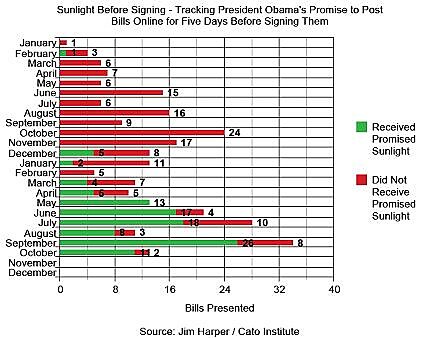
There remains a residuum of bills that don’t seem to get Sunlight Before Signing, and those may be the ones where political expedience takes precedence over the president’s campaign promise to his voters. But the White House is clearly positioned to fulfill this promise completely in the second half of the president’s term.
The chart below (that is, after the break) exhibits the same data—Sunlight Before Signing compliance by month—with percentages of non-compliance and compliance. After that, you’ll find a table of every bill the president has signed and its treatment in terms of sunlight.
There will be a short spate of bills during the lame duck session. The next report in late December will capture the entire first half of the president’s term, setting the stage for reporting on the White House’s 100% success rate in 2011 and 2012.
Full compliance will give the press and public a way to know exactly what hits the president’s desk, and an opportunity to make a habit of reviewing Congress’ work before bills become laws.
Sunlight Before Signing, Month-by-Month (%)
| Did Not Receive Promised Sunlight | Received Promised Sunlight | |
|---|---|---|
| January | 1 (100%) | 0 (0%) |
| February | 3 (75%) | 1 (25%) |
| March | 6 (100%) | 0 (0%) |
| April | 7 (100%) | 0 (0%) |
| May | 6 (100%) | 0 (0%) |
| June | 15 (100%) | 0 (0%) |
| July | 6 (100%) | 0 (0%) |
| August | 16 (100%) | 0 (0%) |
| September | 9 (100%) | 0 (0%) |
| October | 24 (100%) | 0 (0%) |
| November | 17 (100%) | 0 (0%) |
| December | 8 (62%) | 5 (38%) |
| January | 11 (85%) | 2 (15%) |
| February | 5 (100%) | 0 (0%) |
| March | 7 (64%) | 4 (36%) |
| April | 5 (50%) | 5 (50%) |
| May | 0 (0%) | 13 (100%) |
| June | 4 (19%) | 17 (81%) |
| July | 10 (36%) | 18 (64%) |
| August | 3 (27%) | 8 (73%) |
| September | 8 (24%) | 26 (76%) |
| October | 2 (15%) | 11 (85%) |
Sunlight Before Signing, Bill-by-Bill
(Parentheses indicate a separate Whitehouse.gov page with a link to Thomas legislative database)
* Page now gone, but it was either directly observed, evidence of it appears in Whitehouse.gov search, or White House says it existed.
[Brackets indicate a link from Whitehouse.gov to Thomas legislative database]
† Bill was posted for five days after final passage, though not formal presentment. Counted as “Yes.”
‡ Link to final version of bill on impossible-to-find page.
E! Emergency legislation not subject to five-day posting. Counted as “Yes” in simplifying graphs and tables.
Related Tags
This month at Cato Unbound we’re debating campaign finance regulation, with a panel of notable contributors and a big, new idea.
That idea is semi-disclosure, in which information about campaign funding is collected and disseminated, but, much like the census, personal names and addresses aren’t attached. Political scientist Bruce Cain suggests semi-disclosure might break the impasse between privacy and the right to know. Others? Well… you’ll just have to wait and see. Joining us will be Nikki Willoughby of Common Cause, election law scholar Richard Hasen of Loyola Law School, and the Cato Institute’s own John Samples. Discussion will run through the rest of the month on this vital issue to our nation’s democracy.
The White House recently released a video, narrated by Austan Goolsbee of the Council of Economic Advisers, asserting that higher tax rates on the so-called rich would be a good idea.
Since Goolsbee’s video made so many unsubstantiated assertions and was guilty of so many sins of omission, here’s a rebuttal video, narrated by yours truly.
This new Center for Freedom and Prosperity video includes the full footage of the White House production, so viewers can decide for themselves which side is correct.