Cato adjunct scholar Shirley Svorny’s recent paper, “Could Mandatory Caps on Medical Malpractice Damages Harm Consumers?,” has sparked a debate with the Manhattan Institute’s Ted Frank at PointOfLaw.com.
Cato at Liberty
Cato at Liberty
Government and Politics
My new post at Huffington Post looks at a dinner of the Panetta Institute and what it says about cozy relationships among the Washington establishment:
So let’s see … an institute founded by and bearing the name of the secretary of defense, who also served 17 years in Congress, including four years as chairman of the House Budget Committee, and as director of the Office of Management and Budget, White House chief of staff, and director of the CIA, is giving an award to his immediate predecessor, who also served as CIA director, and to a quintessentially establishment Washington journalist, and to a scholar at both Georgetown University and the Brookings Institution who in addition to her time at the Federal Reserve has served as director of the Congressional Budget Office, director of OMB, co-chair of the Bipartisan Policy Center’s Task Force on Debt Reduction. That is like an entire Washington establishment at one head table.
More on what this establishment has wrought, and right and wrong ways to break up the iron triangle, at the link.
Related Tags
Matt Yglesias criticizes my comment in today’s USA Today when he writes, “making preventive health care free to the patient is…very cost-effective.”
Except it isn’t “free” to the patient.
And it isn’t cost-effective. The evidence strongly suggests we would “buy” as much health if we just waited for people to get sick and treated them then.
Related Tags
Often when surveying the political landscape here in Washington, one can’t help but be struck by the feeling “is this the most important thing we have to discuss”? That was my reaction to today’s Politico story on party differences with extending the payroll tax cut. The difference, as Politico would have us believe, are that Democrats want millionaires to pay, while Republicans want government employees to bear the costs. It seems to be the case with whatever the issue is, who pays?
Quite simply, this debate between Republicans and Democrats over who should bear the costs of government is completely misplaced. We should be asking ourselves why the government has such a deep involvement in our lives in the first place.
If the government should not be involved in an activity, how is said activity any more just if its paid for by millionaires or the middle class. Would the fact that we have the largest prison population in the world somehow be more just if only more of the cost of it was borne by millionaires? Would having our failed drug war funded solely by millionaires turn it into a success? How about the U.S. playing world policeman? Would we be more loved around the world if our military was funded more by millionaires? Would we be viewed as honest brokers in the Middle East if our foreign aid was funded by millionaires? Is having children struck in failing public schools more just if those schools are funded by millionaires?
Here’s my offer to both my Democrat and Republican friends, you let me decide what the size and scope of government is going to be, and I am happy to let you decide upon “who pays”.
Related Tags
A new poll conducted for The Hill found that 67 percent of likely voters think members of Congress should take a pay cut. With the economy still struggling and the government’s debt continuing to mount, congressional pay is — understandably — a sore subject with voters. However, I get the impression that a lot of people think that cutting Congress’s budget would have a sizable impact on the government’s financial situation.
It wouldn’t.
The following chart shows fiscal 2011 spending for the House and Senate, the entire legislative branch, and the entire government:
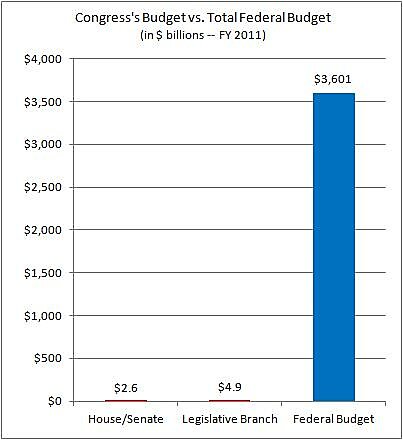
Spending for the House and Senate, which includes salaries, mailings, and committee expenses, represents only .07 percent of total federal spending. The entire legislative branch includes additional expenses for the Government Accountability Office, the Congressional Budget Office, the Library of Congress, and other functions that can be viewed here. It only amounts to .14 percent of total federal spending.
Please do not take this post to mean that I believe that congressional pay is completely unimportant. The point is that congressional pay is relatively unimportant when measured against the overall size of the federal budget. Therefore, I think those readers who are concerned about government spending and debt should focus their attention on considerably larger problems like Social Security, Medicare, and military spending.
Related Tags
About a week ago, I wrote that people in western nations need the freedom to own guns just in case there are riots, chaos, and social disarray when welfare states collapse.
Much to my surprise and pleasure, this resulted in an invitation to appear on the National Rifle Association’s webcast to discuss the issue.
As I noted in the interview, I’m just a fiscal policy wonk, but the right to keep and bear arms should be a priority for anyone who believes in freedom and responsibility. And even though I only have a couple of guns, you can see that I’m raising my kids to have a proper appreciation for the Second Amendment.
I don’t think we’ll ever get to the point where we suffer societal breakdown, but I won’t be too surprised if it happens in some European countries. We’ve already seen the challenges faced by disarmed Brits during recent riots in the United Kingdom.
In the NRA interview, I pointed out that law enforcement is one of the few legitimate functions of government, so it is utterly despicable when politicians fail to fulfill that responsibility and also deprive households from having the ability to protect themselves.
Last but not least, watch this video if you want to be inspired about protecting the Second Amendment. Pay close attention around the five-minute mark.
And would we have music, art, and books without the UN? The great jazz pianist Herbie Hancock suggests in a Washington Post op-ed that our cultural life would be barren without UNESCO:
I cannot imagine a world without music, art, film, dance, theater and books. It would be a dreary and colorless existence, with little cooperation and communication among citizens. The arts are the glue that holds us together, the cultural fabric of our lives, and they sow the seeds for inventive, universally shared experiences.…
UNESCO helps ensure that our world remains soulful, spirited and full of life.
Case in point: UNESCO recently endorsed April 30 as International Jazz Day. This is an opportunity to spread the gospel of jazz, its message of peace and cooperation, and its unique American traits. …
Music is an essential ingredient of my life, and I am in awe of its power.…
That is why U.S. engagement in UNESCO and the United Nations must continue.…
During these crucial times, the work of UNESCO is needed more than ever.
Herbie Hancock is a great pianist and composer. But here he seems to have let UNESCO bureaucrats lead him into a ridiculous argument. Ridiculous enough to remind one of Hillary Clinton, who said when Republicans threatened to eliminate the National Endowment for the Arts, “This is an ominous time for those of us who care for the arts in America. A misguided, misinformed effort to eliminate public support for the arts not only threatens irrevocable damage to our cultural institutions but also to our sense of ourselves and what we stand for as a people.” Oh, come on. The arts are a lot more important in our lives than anything that the NEA and UNESCO do. And they get far more “public support” than these modest government expenditures.
Supporters of government arts spending produce economic studies finding that nonprofit arts and culture institutions spend $63 billion a year. Americans donate $13 billion a year to arts and culture organizations. And of course those numbers are dwarfed by American spending on for-profit cultural activities: $443 billion in 2010 on entertainment and media, $28 billion on books.
Compared to such numbers, the National Endowment for the Arts’ annual budget of about $150 million and whatever portion of UNESCO’s $325 million annual budget is spent on arts are pocket change. If both of them disappeared, music, art, film, dance, theater and books would continue to thrive.