Since man bites dog stories are all the rage lately, I thought it might be a good time for me to point out that the rising Democratic attacks on teachers unions are largely misdirected.
Cato at Liberty
Cato at Liberty
Government and Politics
Politico has a great story about how free-market groups are defeating ObamaCare Exchanges at the state level:
Conservatives like John Graham of the Pacific Research Institute have also been touring states with the platform provided by the American Legislative Exchange Council to help kill off state-based exchanges, a key piece of health reform that will help millions of people purchase insurance coverage — often with federal subsidies — starting in 2014.
“Our approach has to be absolute noncollaboration, civil disobedience — well, not civil disobedience but resistance … by whatever means,” said Graham.
Two years into the law’s implementation, conservative emissaries have contributed to impressive stats. Almost all red states are holding off on exchange legislation at least until the Supreme Court decides on the Affordable Care Act, and in most of those states, exchange-building legislation has crawled to a stop.
I have to point out three problems with the story, though. First, the Cato Institute and I are libertarian, not conservative.
Second, the article identifies Cato, ALEC, and AFP as being “funded partly by the Koch brothers.” Even though these groups have no direct or indirect financial interest in this issue, and even though Cato currently receives no funding from the Kochs, and even though Cato is currently fighting a hostile takeover attempt by the Kochs, I guess that’s a fair categorization. What isn’t fair is how the article fails to disclose that Leavitt Partners has a direct financial interest in this issue: Leavitt is getting paid by states to help implement Exchanges. (See “Health Exchanges: A New Gold Mine,” Politico, June 27, 2011.) It would have been nice if the article mentioned that all the moneyed interests – including health insurance carriers and many Chambers of Commerce – are on the pro-Exchange side. But it at least should have mentioned Leavitt’s financial interest.
Third, I’m not sure what basis there is for saying “most legal experts think” the federal government can offer tax credits and subsidies in federal Exchanges. My co-author Jonathan Adler and I have been following that debate closely. Only a handful of scholars have even commented on the issue, and they are fairly evenly split. If I’m unaware of others who have weighed in, I’d like to hear about them.
Related Tags

In the March/April issue of Foreign Policy magazine, Republican strategists Karl Rove and Ed Gillespie opened an article titled “How to Beat Obama” with this paragraph:
In an American election focused on a lousy economy and high unemployment, conventional wisdom holds that foreign policy is one of Barack Obama’s few strong suits. But the president is strikingly vulnerable in this area. The Republican who leads the GOP ticket can attack him on what Obama mistakenly thinks is his major strength by translating the center-right critique of his foreign policy into campaign themes and action. Here’s how to beat him.
There are two basic themes here: 1) that the conventional wisdom that foreign policy isn’t a big issue in this election is wrong, and 2) that foreign policy can and should be a winning issue for the GOP candidate. They go on to outline how [Mitt Romney] should try to make foreign policy an issue. Then, oddly, the article circles back around to this paragraph:
Absent a major international crisis, this election will be largely about jobs, spending, health care, and energy. Voters do, however, want a president who leads on the world stage and a commander in chief who projects strength, not weakness.
Now one of Romney’s foreign policy advisers is going on offense, saying that Obama’s approach to strategy could be characterized as a game of “Mother, may I?”
So–should the GOP try to make foreign policy an issue or not? The idea that foreign policy can be a winning issue for Romney was interesting to me, and I criticized the Rove/Gillespie article here (with Rob Farley) and here in a podcast. So I was intrigued when Chris Wallace asked Gillespie on Fox News Sunday, “In one paragraph, two or three sentences, what’s the choice for voters?” Here’s Gillespie’s response:
The choice for voters is if we are going to have a dynamic pro-growth economy based on free enterprise, that creates jobs, that lifts people out of poverty, that provides upward mobility for someone like my father who was an immigrant, who came to this country and was able to become a small business owner, versus a government-centered society — one that requires, you know, to meet mandates and comply with regulations and fill out forms and seek waivers, and try to get your subsidies, where people in Washington, D.C. are making decisions about how people their spend money, as oppose to free enterprise and personal religious freedom and personal freedom that has made this country great and has helped to create more jobs than anything, any government we’ve ever seen.
Not a word about foreign policy. It will be interesting to see if Rove and Gillespie prevail on Romney and get him to try to make foreign policy an issue. Beyond inchoate laments about Obama not understanding American exceptionalism, not “leading” and nonspecific rhetoric like that, I’m betting they won’t.
Related Tags
Charles Kolb is president of the Committee for Economic Development and was a domestic policy adviser to Bush the Elder. Over at Huffington Post, he articulates why (he thinks) the Constitution’s Commerce Clause empowers Congress to force people to purchase health insurance, but not broccoli. That is to say, he offers (what he thinks is) a limiting principle that (he thinks) would enable the Supreme Court to uphold ObamaCare’s individual mandate, but still leave some constraints on Congress’s ability to force people to buy things. Like broccoli.
Yet Kolb’s proposed limiting principle is no more a limiting principle than Harvard law professor Noah Feldman’s proposed limiting principle, because the two make the same argument. Almost verbatim. So rather than regurgitate my response to Feldman, I’ll just link to it.
Okay, I’ll regurgitate this part:
Like every other so-called limiting principle offered by ObamaCare’s defenders, Feldman’s[/Kolb’s] has no basis in the Constitution or any other law. It is a post hoc rationalization, made by people who are shocked to find themselves before the Supreme Court, defending the constitutionality of their desire to bully others into submission.
Couldn’t resist.
Related Tags
A few days ago, I explained why I’m a big fan of tax competition. Simply stated, we need to subject governments to competitive pressure to at least partially offset the tendency of politicians to over-tax and over-spend.
Tax havens play an important role in this liberalizing process, largely because they do not put themselves under any obligation to enforce the bad tax laws of other jurisdictions. They also use privacy laws to protect their sovereign control of what gets taxed inside their borders (this is what separates a “tax haven” from a more conventional low-tax jurisdiction). This means they are fiscal safe zones, particularly for people who want to protect their assets from the pervasive double taxation that exists in so many nations.
Not everybody agrees with my analysis (gee, what a surprise). To cite one example, the petty bureaucrats at the OECD got so agitated at me in 2009 (when I was offering advice to representatives of so-called tax havens while standing in a public lobby of a public hotel) that they threatened to have me thrown in a Mexican jail.
Now I have a new critic, though hopefully someone who would never consider thuggish tactics to suppress dissent. Ann Hollingshead writes for the Task Force on Financial Integrity and Economic Development, which (notwithstanding the name of the organization) seems to favor bigger government.
Anyhow, she wrote an article specifically criticizing my work on tax havens. So I figured it was time for a fisking, which means a point-by-point rebuttal. Here’s how she begins, and I’ll follow up her points with my responses.
Officially Dan Mitchell is a Senior Fellow at the Cato Institute, a conservative public policy research organization, and a researcher on tax reform. Unofficially, he has (perhaps ironically?) called himself the “world’s self-appointed defender of so-called tax havens.”
No irony on my part. As I have openly stated, tax havens are a key part of tax competition, which is a necessary (though sadly not sufficient) process to restrain the greed of the political class.
Oddly enough, Mitchell and I agree on many of the facts about these havens. We both have observed, for example, that there are buildings in Delaware and the Cayman Islands that house thousands of corporations. Mitchell concludes there is nothing wrong with either; I conclude there is something wrong with both. Mitchell also agrees that the United States“could be considered the world’s largest tax haven.” On that topic, he’s even cited my paper on non-resident deposits in secrecy jurisdictions. In his comment, he does not take issue with my methodology or my results, but rather concludes that my finding that the United States is the largest holder of non-resident deposits “makes the case for pro-market policies.” I, on the other hand, have argued that these findings support across the board reform, rather than that limited to traditional offshore financial centers.
Fair enough. We both recognize that the United States is a big tax haven. But we have different conclusions. I think it is unfortunate that only non-resident foreigners can benefit from these policies, while Ann wants to crack down on small low-tax jurisdictions such as Monaco, Bermuda, Liechtenstein, and the Cayman Islands, as well as big nations such as the United States. Sadly, Ann’s side has somewhat prevailed, and many of the havens have agreed to become deputy tax collectors for nations with bad tax law.
So how is it that two (relatively intelligent?) people can draw such different conclusions? I would argue our differences lie not in our facts, or perhaps even our economics, but in our underlying philosophical and theoretical differences.
I guess I should be happy that she holds out the possibility that I’m “relatively intelligent.”
Mitchell implicitly takes the position that tax havens do enable tax evasion and this helps to lower tax rates. He argues “it is largely globalization—not ideology—that has driven [a] ‘race to the bottom’” where global top corporate tax rates now average about 27 percent, down from 67 percent in 1980. Mitchell does not only believe this has occurred, but also maintains it is a positive development. He argues tax competition drives tax policy in the “right direction” (i.e., lower tax rates), has called these developments “positive,” and has even likened policy makers to “thieves” and tax competition to home “alarm systems.”
Ann makes one minor error. Corporate tax rates have dropped from a high of about 48 percent (and are now down to less than 25 percent). Top personal tax rates, by contrast, used to be more than 67 percent (and have now dropped to about 41 percent).
Regarding these developments, I think they are very positive. And I also think that politicians are akin to thieves, though Godfrey Bloom, a British member of the European Parliament, says it with a much better accent.
Mitchell’s argument that lower tax rates are always better and that those who tax others are thieves, makes several implicit assumptions about the relationship of citizens to their government. From his line of reasoning, Mitchell either believes, on a philosophical level, that governments do not have the right to tax their citizens or, on an economic level, that lower tax rates are always better, or both.
I definitely believe that lower tax rates are better than higher tax rates.
Mitchell may believe that taxation is the equivalent of thievery—and therefore that governments do not have the right to tax their citizens, just a thief does not have the right to steal. But he is also (more than likely) not an anarchist, which is the next logical extension of this reasoning, because on a number of occasions he has advocated a flat tax.
Ann makes a good point here. I’ve already admitted, in this post featuring a funny video mocking libertarianism, that I don’t see how to privatize the justice system and national defense, so I’m not an anarcho-capitalist.
Mitchell also argues lower tax rates are universally better, so at what point does the tax rate become acceptable? Clearly he doesn’t believe the tax rate should be zero, because that would get back to the anarchism theory. And he did once offer tepid support for Herman Cain’s 9 percent rate.
Another fair point. If a 50 percent tax is confiscatory and if politicians who impose such a tax are akin to thieves, then why would a 10 percent tax be acceptable? And would politicians imposing low tax rates still be acting like crooks?
Those are tough questions. But at the risk of dodging thorny philosophical issues, I’ll claim it doesn’t really matter. Government is too big right now and taxes are too onerous and unfair. If I somehow manage to bring government down to 10 percent of GDP, as the Rahn Curve suggests if we want to maximize prosperity for the American people, then I’ll have the luxury of worrying about the moral legitimacy of a limited public sector.
Clearly there’s a disconnect. Taxation cannot both be thievery, but also acceptable at a lower level. There is no evidence that, if tax competition through tax evasion is real, it would cease to drive down tax rates at some level that has been deemed acceptable by Dan Mitchell. So at what point does the “race to the bottom” bottom out? And is that a point where the United States can still maintain services that I’m sure Mitchell doesn’t advocate giving up, like police and law courts?
If I understand this passage correctly, I disagree. Tax competition does not drive tax rates to zero. It just encourages better policy. There’s pressure to lower tax rates, and there’s pressure to reduce double taxation of income that is saved and invested. But there’s no reason to think that tax competition and/or tax evasion forces the overall tax burden “to the bottom.”
But I would be remiss not to point out some internal inconsistencies in Mitchell’s arguments, in addition to his logical ones. While he argues tax competition through tax evasion in havens has fostered lower tax rates worldwide, he has also reckoned that “only a tiny minority” of people who keep their money in havens “are escaping onerous tax burdens.” First of all, I would be interested to see where Mitchell got that statistic because no one knows how much money is deposited in havens, let alone its origins. Such information isn’t publicly available. That’s actually the whole point. And secondly, and more importantly, I’m unclear on how such a “tiny minority” of oversees deposits could drive international tax policy to such an extent that the average corporate tax rates have dropped by more than half in thirty years.
Actually, there is considerable data about the amount of money in tax havens. The Bank for International Settlements is a good place for those who like to peruse such information.
But that’s a secondary point. Her main criticism is that I’m inconsistent when I say tax evasion is minor, so allow me to elaborate. Tax competition works by making politicians fearful that jobs and investment will migrate to jurisdiction with better tax law. It works just as well when people engage in legal tax planning and legal tax avoidance as it does with illegal tax evasion.
Places such as the Cayman Islands, for instance, rely on completely legal and transparent lines of business such as hedge funds and captive insurance companies. Places such as Panama have completely legal shipping registries. Places such as the British Virgin Islands specialize in completely legal company formation. Places such as the Channel Islands focus on completely legal trusts. Places such as Bermuda are known for completely legal reinsurance firms.
The “illegal” part of the offshore business does exist (at least as defined by high-tax nations), and it tends to be in the areas of private wealth management and banking. And even then, only in jurisdictions that have very strong human rights laws protecting financial privacy.
To be sure, there’s no way to precisely state how much tax evasion exists, but I can say with total certainty that the left’s claims are absurd. During the 2008 campaign, for instance, then-candidate Obama said that his anti-tax haven policies would generate $100 billion every year. When his law was enacted in 2010, that huge amount of money shrank to only $870 million per year. And even that estimate is a mirage because the President’s FATCA law is discouraging productive investment in the United States.
It is not my intention to demonize Mitchell and I hope you’ll notice that I’ve neither called him, nor implied that he is, a “careless and know-nothing hack.” I also have no interest in taking easy jabs that imply he is personally benefiting from tax evasion through havens or that he is seeking to destabilize theU.S.government by removing its ability to tax its citizens. Such attacks might generate readers, but they don’t generate thoughtful discussion and I’m much more interested in the latter than the former.
You may be wondering why she included the comment about a “careless and know-nothing hack.” It’s because I used that phrase to describe a journalist who wrote a very sloppy article. But I don’t automatically disparage those with different views. I’ll disagree with people and argue with them, but I don’t mock them if they have serious and substantive views.
I suppose I should also say, just for the record, that I fully comply with all the onerous demands imposed on me by the government. Not because I want to, but rather because I worry that my work on public policy sooner or later will attract some discriminatory and politically motivated attention from the IRS. It hasn’t happened yet, so I hope I’m being needlessly paranoid, but suffice to say that I go out of my way to even declare income that I know isn’t reported to the tax police.
So here are my questions, to anyone who will answer. 1) On what philosophical basis, if any, do governments draw the right to tax their citizens?; 2) Do citizens have a moral or philosophical right to evade taxation by using tax havens under any circumstances?; 3) If so, at what level of taxation do those citizens no longer have a moral right to evade tax?; and 4) what is the philosophical reasoning that justifies this level?
Now we’re back to the hard-to-answer questions. When is government too big and when does it impose so many demands that people are justified in evading taxation? I’m not sure, but I’ll fall back on what former Supreme Court Justice Potter Stewart said about pornography: “I know it when I see it.”
Put in context, I don’t blame people from France for evading confiscatory taxation. I don’t blame people in corrupt nations such as Mexico for evading taxation. I don’t blame people in dictatorial nations such as Venezuela for evading taxation.
But I would criticize people in Singapore,Switzerland, Hong Kong, or Estonia for dodging their tax liabilities. They are fortunate to live in nations with reasonable tax rates, low levels of corruption, and good rule of law.
Let me now circle back to the main point. In a world with vigorous tax competition, especially when augmented by the strong human rights laws of tax havens, nations will face some pressure to move their policies closer to Hong Kong and away from France. That’s something worth protecting and promoting, not something to be stamped out by high-tax nations seeking to create a tax cartel—sort of an OPEC for politicians.
Last but not least, if you haven’t yet overdosed on this topic, here’s my speech to a Capitol Hill audience on the valuable role of tax havens in the global economy.
Related Tags
Today POLITICO Arena asks:
Are the GSA/Las Vegas spending scandals a major political headache for the Obama administration, since they happened on its watch? Or can Democrats distance themselves from the seemingly renegade agency?
My response:
What?! Government waste, fraud, and abuse?! I’m shocked! Shocked!
This could be a political headache for the Obama administration, but only if Republicans play it right — so Obama probably doesn’t have much to worry about. The basic principle could not be simpler: as Milton Friedman so often put it, no one spends someone else’s money as carefully as he spends his own. That applies in spades to government.
So here’s the political point. Democrats, unlike Republicans (at least nominally), belong to the party of government. For every problem, they see not a private but a government solution. Market competition disciplines private abuses — not perfectly, to be sure, but far better than whatever controls there may be in the public sector. That’s one reason we should turn to government not as a first but as a last resort. You don’t like being abused as a taxpayer? Then don’t vote for the party of government.
Related Tags
The Laffer Curve is a graphical representation of the relationship between tax rates, tax revenue, and taxable income. It is frequently cited by people who want to explain the common-sense notion that punitive tax rates may not generate much additional revenue if people respond in ways that result in less taxable income.
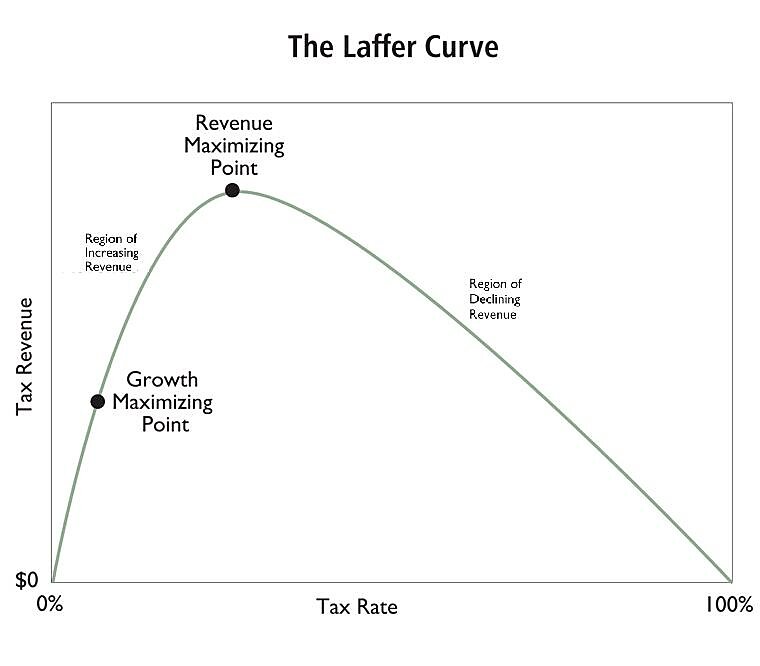
Unfortunately, some people misinterpret the insights of the Laffer Curve. Politicians, for instance, tend to either pretend it doesn’t exist, or they embrace it with excessive zeal and assume all tax cuts “pay for themselves.”
Another problem is that people assume that tax rates should be set at the revenue-maximizing level. I explained back in 2010 that this was wrong. Policy makers should strive to set tax rates at the growth-maximizing level. But since a growth-generating tax is about as common as a unicorn, what this really means is that tax rates should be set to produce enough revenue to finance the growth-maximizing level of government — as illustrated by the Rahn Curve.
That’s the theory of the Laffer Curve. What about the evidence? Where are the revenue-maximizing and growth-maximizing points on the Laffer Curve?
Well, ask five economists and you’ll get nine answers. In part, this is because the answers vary depending on the type of tax, the country, and the time frame. In other words, there is more than one Laffer Curve.
With those caveats in mind, we have some very interesting research produced by two economists, one from the Federal Reserve and the other from the University of Chicago. They have authored a new study that attempts to measure the revenue-maximizing point on the Laffer Curve for the United States and several European nations. Here’s an excerpt from their research.
Figure 6 shows the comparison for the US and EU-14. …Interestingly, the capital tax Laffer curve is affected only very little across countries when human capital is introduced. By contrast, the introduction of human capital has important effects for the labor income tax Laffer curve. Several countries are pushed on the slippery slope sides of their labor tax Laffer curves. …human capital turns labor into a stock variable rather than a flow variable as in the baseline model. Higher labor taxes induce households to work less and to acquire less human capital which in turn leads to lower labor income. Consequently, the labor tax base shrinks much more quickly when labor taxes are raised.
There’s a bit of jargon in this passage, so here are the charts from Figure 6. They look complex, but here are the basic facts to make them easy to understand.
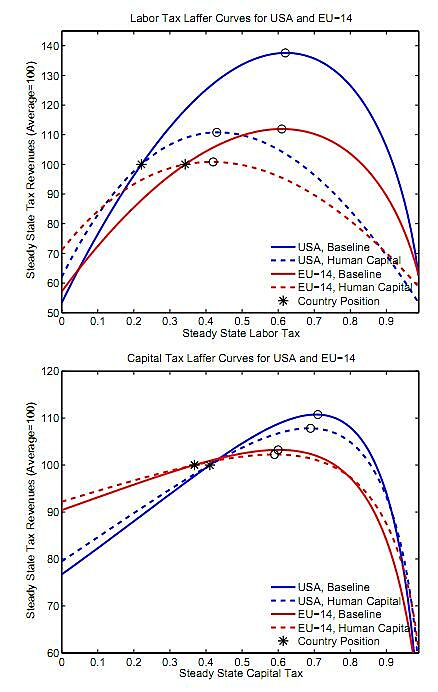
The top chart shows the Laffer Curve for labor taxation, and the bottom chart shows the Laffer Curve for capital taxation. And both charts show different curves for the United States and an average of 14 European nations. Last but not least, the charts show how the Laffer Curves change is you add some real-world assumptions about the role of human capital.
Some people will look at these charts and conclude that there should be higher tax rates. After all, neither the U.S. or E.U. nations are at the revenue-maximizing point (though the paper explains that some European nations actually are on the downward-sloping portion of the curve for capital taxes).
But let’s think about what higher tax rates imply, and we’ll focus on the United States. According to the first chart, labor taxes could be approximately doubled before getting to the downward-sloping portion of the curve. But notice that this means that tax revenues only increase by about 10 percent.
This implies that taxable income would be significantly smaller, presumably because of lower output, but also perhaps due to some combination of tax avoidance and tax evasion.
The key factoid (assuming my late-at-night, back-of-the-envelope calculations are right) is that this study implies that the government would reduce private-sector taxable income by about $20 for every $1 of new tax revenue.
Does that seem like good public policy? Ask yourself what sort of politicians are willing to destroy so much private sector output to get their greedy paws on a bit more revenue.
What about capital taxation? According to the second chart, the government could increase the tax rate from about 40 percent to 70 percent before getting to the revenue-maximizing point.
But that 75 percent increase in the tax rate wouldn’t generate much tax revenue, not even a 10 percent increase. So the question then becomes whether it’s good public policy to destroy a large amount of private output in exchange for a small increase in tax revenue.
Once again, the loss of taxable income to the private sector would dwarf the new revenue for the political class. And the question from above bears repeating. What should we think about politicians willing to make that trade?
And that’s the real lesson of the Laffer Curve. Yes, the politicians usually can collect more revenue, but the concomitant damage to the private sector is very large and people have lower living standards. So that leaves us with one final question. Do we think government spending has a sufficiently high rate-of-return to justify that kind of burden? This Rahn Curve video provides the answer.