Menu

Main navigation

  • About
    • Annual Reports
    • Leadership
    • Jobs
    • Student Programs
    • Media Information
    • Government & External Affairs
    • Store
    • Contact
    LOADING...
  • Experts
    • Policy Scholars
    • Adjunct Scholars
    • Fellows
  • Events
    • Upcoming
    • Past
    • Event FAQs
    • Sphere Summit
    LOADING...
  • Publications
    • Studies
    • Commentary
    • Survey Reports and Polling
    • Books
    • Reviews and Journals
    • Public Filings
    LOADING...
  • Blog
  • Donate
    • Sponsorship Benefits
    • Ways to Give
    • Planned Giving
    • Meet the Development Team

Issues

  • Constitution and Law
    • Constitutional Law
    • Criminal Justice
    • Free Speech and Civil Liberties
  • Economics
    • Banking and Finance
    • Monetary Policy
    • Regulation
    • Tax and Budget Policy
  • Politics and Society
    • Education
    • Government and Politics
    • Health Care
    • Poverty and Social Welfare
    • Public Opinion
    • Technology and Privacy
  • International
    • Defense and Foreign Policy
    • Global Freedom
    • Immigration
    • Trade Policy
Live Now

Cato at Liberty


  • Blog Home
  • RSS

Email Signup

Sign up to have blog posts delivered straight to your inbox!

Topics
  • Banking and Finance
  • Constitutional Law
  • Criminal Justice
  • Defense and Foreign Policy
  • Education
  • Free Speech and Civil Liberties
  • Global Freedom
  • Government and Politics
  • Health Care
  • Immigration
  • Monetary Policy
  • Poverty and Social Welfare
  • Public Opinion
  • Regulation
  • Tax and Budget Policy
  • Technology and Privacy
  • Trade Policy
Archives
  • October 2021
  • September 2021
  • August 2021
  • July 2021
  • June 2021
  • May 2021
  • April 2021
  • March 2021
  • February 2021
  • January 2021
  • December 2020
  • November 2020
  • October 2020
  • September 2020
  • August 2020
  • July 2020
  • June 2020
  • May 2020
  • April 2020
  • March 2020
  • February 2020
  • January 2020
  • December 2019
  • November 2019
  • October 2019
  • September 2019
  • August 2019
  • July 2019
  • June 2019
  • May 2019
  • April 2019
  • March 2019
  • February 2019
  • January 2019
  • December 2018
  • November 2018
  • October 2018
  • September 2018
  • August 2018
  • July 2018
  • June 2018
  • May 2018
  • April 2018
  • March 2018
  • February 2018
  • January 2018
  • December 2017
  • November 2017
  • October 2017
  • September 2017
  • August 2017
  • July 2017
  • June 2017
  • May 2017
  • April 2017
  • March 2017
  • February 2017
  • January 2017
  • December 2016
  • November 2016
  • October 2016
  • September 2016
  • August 2016
  • July 2016
  • June 2016
  • May 2016
  • April 2016
  • March 2016
  • February 2016
  • January 2016
  • December 2015
  • November 2015
  • October 2015
  • September 2015
  • August 2015
  • July 2015
  • June 2015
  • May 2015
  • April 2015
  • March 2015
  • February 2015
  • January 2015
  • December 2014
  • November 2014
  • October 2014
  • September 2014
  • August 2014
  • July 2014
  • June 2014
  • May 2014
  • April 2014
  • March 2014
  • February 2014
  • January 2014
  • December 2013
  • November 2013
  • October 2013
  • September 2013
  • August 2013
  • July 2013
  • June 2013
  • May 2013
  • April 2013
  • March 2013
  • February 2013
  • January 2013
  • December 2012
  • November 2012
  • October 2012
  • September 2012
  • August 2012
  • July 2012
  • June 2012
  • May 2012
  • April 2012
  • March 2012
  • February 2012
  • January 2012
  • December 2011
  • November 2011
  • October 2011
  • September 2011
  • August 2011
  • July 2011
  • June 2011
  • May 2011
  • April 2011
  • March 2011
  • February 2011
  • January 2011
  • December 2010
  • November 2010
  • October 2010
  • September 2010
  • August 2010
  • July 2010
  • June 2010
  • May 2010
  • April 2010
  • March 2010
  • February 2010
  • January 2010
  • December 2009
  • November 2009
  • October 2009
  • September 2009
  • August 2009
  • July 2009
  • June 2009
  • May 2009
  • April 2009
  • March 2009
  • February 2009
  • January 2009
  • December 2008
  • November 2008
  • October 2008
  • September 2008
  • August 2008
  • July 2008
  • June 2008
  • May 2008
  • April 2008
  • March 2008
  • February 2008
  • January 2008
  • December 2007
  • November 2007
  • October 2007
  • September 2007
  • August 2007
  • July 2007
  • June 2007
  • May 2007
  • April 2007
  • March 2007
  • February 2007
  • January 2007
  • December 2006
  • November 2006
  • October 2006
  • September 2006
  • August 2006
  • July 2006
  • June 2006
  • May 2006
  • April 2006
  • Show More
April 15, 2012 12:46PM

The Laffer Curve Shows that Tax Increases Are a Very Bad Idea – even if They Generate More Tax Revenue

By Daniel J. Mitchell

SHARE

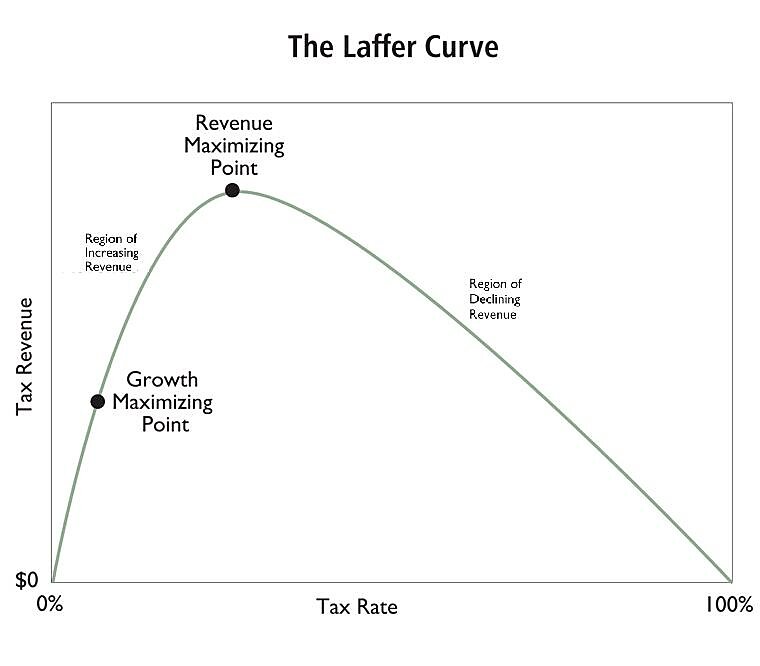
The Laffer Curve is a graphical representation of the relationship between tax rates, tax revenue, and taxable income. It is frequently cited by people who want to explain the common-sense notion that punitive tax rates may not generate much additional revenue if people respond in ways that result in less taxable income.

Media Name: Laffer-Curve.jpg

Unfortunately, some people misinterpret the insights of the Laffer Curve. Politicians, for instance, tend to either pretend it doesn't exist, or they embrace it with excessive zeal and assume all tax cuts "pay for themselves."

Another problem is that people assume that tax rates should be set at the revenue-maximizing level. I explained back in 2010 that this was wrong. Policy makers should strive to set tax rates at the growth-maximizing level. But since a growth-generating tax is about as common as a unicorn, what this really means is that tax rates should be set to produce enough revenue to finance the growth-maximizing level of government - as illustrated by the Rahn Curve.

That's the theory of the Laffer Curve. What about the evidence? Where are the revenue-maximizing and growth-maximizing points on the Laffer Curve?

Well, ask five economists and you'll get nine answers. In part, this is because the answers vary depending on the type of tax, the country, and the time frame. In other words, there is more than one Laffer Curve.

With those caveats in mind, we have some very interesting research produced by two economists, one from the Federal Reserve and the other from the University of Chicago. They have authored a new study that attempts to measure the revenue-maximizing point on the Laffer Curve for the United States and several European nations. Here's an excerpt from their research.

Figure 6 shows the comparison for the US and EU-14. ...Interestingly, the capital tax Laffer curve is affected only very little across countries when human capital is introduced. By contrast, the introduction of human capital has important effects for the labor income tax Laffer curve. Several countries are pushed on the slippery slope sides of their labor tax Laffer curves. ...human capital turns labor into a stock variable rather than a flow variable as in the baseline model. Higher labor taxes induce households to work less and to acquire less human capital which in turn leads to lower labor income. Consequently, the labor tax base shrinks much more quickly when labor taxes are raised.

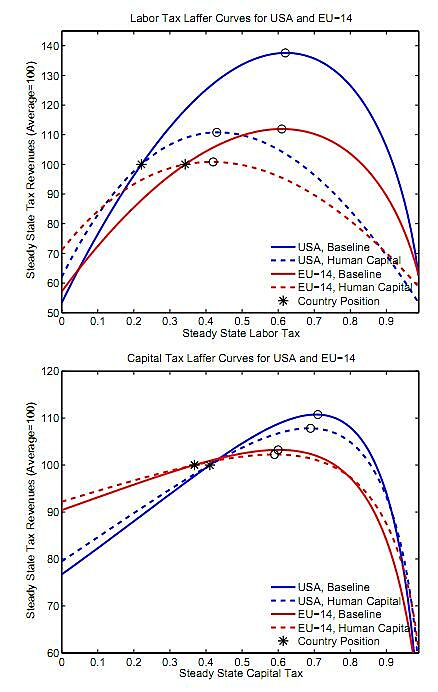
There's a bit of jargon in this passage, so here are the charts from Figure 6. They look complex, but here are the basic facts to make them easy to understand.

Media Name: Laffer-Curve-Trabandt-Uhlig1.jpg

The top chart shows the Laffer Curve for labor taxation, and the bottom chart shows the Laffer Curve for capital taxation. And both charts show different curves for the United States and an average of 14 European nations. Last but not least, the charts show how the Laffer Curves change is you add some real-world assumptions about the role of human capital.

Some people will look at these charts and conclude that there should be higher tax rates. After all, neither the U.S. or E.U. nations are at the revenue-maximizing  point (though the paper explains that some European nations actually are on the downward-sloping portion of the curve for capital taxes).

But let's think about what higher tax rates imply, and we'll focus on the United States. According to the first chart, labor taxes could be approximately doubled before getting to the downward-sloping portion of the curve. But notice that this means that tax revenues only increase by about 10 percent.

This implies that taxable income would be significantly smaller, presumably because of lower output, but also perhaps due to some combination of tax avoidance and tax evasion.

The key factoid (assuming my late-at-night, back-of-the-envelope calculations are right) is that this study implies that the government would reduce private-sector taxable income by about $20 for every $1 of new tax revenue.

Does that seem like good public policy? Ask yourself what sort of politicians are willing to destroy so much private sector output to get their greedy paws on a bit more revenue.

What about capital taxation? According to the second chart, the government could increase the tax rate from about 40 percent to 70 percent before getting to the revenue-maximizing point.

But that 75 percent increase in the tax rate wouldn't generate much tax revenue, not even a 10 percent increase. So the question then becomes whether it's good public policy to destroy a large amount of private output in exchange for a small increase in tax revenue.

Once again, the loss of taxable income to the private sector would dwarf the new revenue for the political class. And the question from above bears repeating. What should we think about politicians willing to make that trade?

And that's the real lesson of the Laffer Curve. Yes, the politicians usually can collect more revenue, but the concomitant damage to the private sector is very large and people have lower living standards. So that leaves us with one final question. Do we think government spending has a sufficiently high rate-of-return to justify that kind of burden? This Rahn Curve video provides the answer.

Related Tags
General, Government and Politics, Political Philosophy, Tax and Budget Policy
Creative Commons License
This work is licensed under a Creative Commons Attribution-NonCommercial-ShareAlike 4.0 International License.

Stay Connected to Cato

Sign up for the newsletter to receive periodic updates on Cato research, events, and publications.

View All Newsletters

1000 Massachusetts Ave. NW
Washington, DC 20001-5403
202-842-0200
Contact Us
Privacy

Footer 1

  • About
    • Annual Reports
    • Leadership
    • Jobs
    • Student Programs
    • Media Information
    • Government & External Affairs
    • Store
    • Contact
  • Podcasts

Footer 2

  • Experts
    • Policy Scholars
    • Adjunct Scholars
    • Fellows
  • Events
    • Upcoming
    • Past
    • Event FAQs
    • Sphere Summit

Footer 3

  • Publications
    • Books
    • Cato Journal
    • Regulation
    • Cato Policy Report
    • Cato Supreme Court Review
    • Cato’s Letter
    • Human Freedom Index
    • Economic Freedom of the World
    • Cato Handbook for Policymakers

Footer 4

  • Blog
  • Donate
    • Sponsorship Benefits
    • Ways to Give
    • Planned Giving
    • Meet the Development Team
Also from Cato Institute:
Libertarianism.org
|
Humanprogress.org
|
Downsizinggovernment.org