Remote Area Medical’s Stan Brock, who spoke at the Cato Institute’s 2012 State Health Policy Summit, explains:
The culprit is state medical licensing laws. For more, read Cato adjunct scholar Shirley Svorny.
Remote Area Medical’s Stan Brock, who spoke at the Cato Institute’s 2012 State Health Policy Summit, explains:
The culprit is state medical licensing laws. For more, read Cato adjunct scholar Shirley Svorny.
The lead article in the new Cato Policy Report is entitled “We Can Cut Government: Canada Did.” The article reviews Canada’s economic reforms since the 1980s, which have included free trade, privatization, spending cuts, sound money, large corporate tax cuts, personal tax reforms, balanced federal budgets, block grants, and decentralizing power by cutting the central government.
Those all sound like things we ought to pursue in America. The political systems of the two countries are different, but Canada’s pro-market reform lessons are universally applicable.
Canada’s reforms, for example, refute the Keynesian notion that cutting government spending harms economic growth. Canadian federal spending was cut from 23.3 percent of GDP in 1993 to 16.5 percent by 2000. Keynesians and their macro models would predict a crushing economic blow from such a spending reduction. They would argue that the “austerity” would slash “aggregate demand” and “take money out of the economy.”
Yet Canada’s spending cuts of the 1990s were coincident with the beginning of a 15-year economic boom that only ended when the United States dragged its neighbor into recession in 2009. As the government shrank in size during the 1990s, the Canadian unemployment rate plunged from more than 11 percent to less than 7 percent.
Canada still has a large welfare state, and its provincial governments are prone to overspending. However, its experience shows that even a modest dose of public sector austerity combined with pro-market reforms can lead to substantial gains in private-sector prosperity. American and European leaders still under the Keynesian spell should take note.
I sometimes wonder whether journalists have the slightest idea of how capitalism works.
In recent weeks, we’ve seen breathless reporting on the $2 billion loss at JP Morgan Chase, and now there’s a big kerfuffle about the falling value of Facebook stock.
In response to these supposed scandals, there are all sorts of articles being written (see here, here, here, and here, for just a few examples) about the need for more regulation to protect the economy.
Underlying these stories seems to be a Lake Wobegon view of financial markets. But instead of Garrison Keillor’s imaginary town where “all children are above average,” we have a fantasy economy where “all investments make money.”
I don’t want to burst anyone’s bubble or shatter any childhood illusions, but losses are an inherent part of the free market movement. As the saying goes, “capitalism without bankruptcy is like religion without hell.”
Moreover, losses (just like gains) play an important role in that they signal to investors and entrepreneurs that resources should be reallocated in ways that are more productive for the economy.
Legend tells us that King Canute commanded the tides not to advance and learned there are limits to the power of a king when his orders had no effect.
Sadly, modern journalists, regulators, and politicians lack the same wisdom and think that government somehow can prevent losses.
But perhaps that’s unfair. They probably understand that losses sometimes happen, but they want to provide bailouts so that nobody ever learns a lesson about what happens when you touch a hot stove.
Government-subsidized risk, though, is just as foolish as government-subsidized success.
The collusion between big business and big government that fleeces the rest of us has struck again — Tim Carney, iMessage your office — this time in the sports world.
Minnesota governor Mark Dayton recently signed the midnight deal that state lawmakers struck with the owners of the state’s football team, the Minnesota Vikings, to build the team a new stadium. This caused plenty of celebration in Minneapolis and elsewhere across the Gopher State. Alas, the hangover is about to come for taxpayers regardless of their gridiron allegiance or level of fandom.
As former Cato legal associate (and Minnesotan) Nick Mosvick and I write in the Huffington Post, these stadium deals hurt most fans:
That’s because they lead to increased taxes and higher prices, squeezing the average fan for the benefit of owners and sponsors. And that’s not even counting the overwhelming majority of taxpayers, regardless of fandom, who never set foot in these gladiatorial arenas.
Let’s look at this particular deal. The stadium costs $975 million on paper, with over half coming from public funds, $348 million from the state and $150 million from Minneapolis—not through parking taxes or other stadium-related user fees, but with a new city sales tax. In return, the public gets an annual $13 million fee and the right to rent out the stadium on non-game-days.
Vikings ownership, NFL commissioner Roger Goodell, and local politicians make a typical pitch for the deal: the stadium will attract investment to the area; local establishments will see a rise in game-day sales of $145 million; jobs will be created, including 1,600 in construction worth $300 million ($187,500 per job?!); tax revenues will increase $26 million; property values will rise; and, of course, the perennially underachieving team’s fortunes will improve.
Such arguments are always trotted out for these sweetheart deals, but the evidence regarding the economic effects of publicly financed stadiums consistently tells a different story. For example, Dennis Coates and Brad Humphreys performed an exhaustive study of sports franchises in 37 cities between 1969 and 1996 and found no measurable impact on per-capita income. The only statistically significant effects were negative ones because revenue gains were overshadowed by opportunity costs that politicians inevitably ignore.
An older study looked at 12 stadium areas between 1958 and 1987 and found that professional sports don’t drive economic growth. A shorter-term study looked at job growth in 46 cities from 1990 to 1994 and found that cities with major league teams grew more slowly. Even worse, taxpayers still service debt on now-demolished stadiums, including the $110 million that New Jersey still owes on the old Meadowlands and the $80 million that Seattle’s King County owes on the Kingdome. And we shouldn’t forget that local governments often employ property-rights-trampling eminent domain to facilitate these money-squandering projects.
Read the whole thing. It’s not a matter of ideology; we even quote Keith Olbermann approvingly!
The point is that these deals benefit team owners and the politicians who get to wrap themselves in team colors to the exclusion of taxpayers or fans (who are priced out of the games their increased taxes support). If luxury stadiums were hugely profitable, why would the savvy businessmen who own the teams let the politicians in on the windfall?
Over the years, I’ve strenuously objected to schemes that would enable international bureaucracies to levy taxes. That’s why I’ve criticized “direct funding” proposals, most of which seem to emanate from the United Nations.
Interestingly, the American left is somewhat divided on these schemes. House Democrats have expressed sympathy for global taxes, but the Obama administration has come out against at least certain worldwide tax proposals.
Unfortunately, proponents of global taxes are like the Energizer Bunny of big government, relentlessly pushing a statist agenda. If the world economy is growing, it’s time for a global tax. If the world economy is stagnant, it’s time for a global tax. If it’s hot outside or cold outside, it’s time for a global tax (since “global warming” is one of the justifications for global taxation, I’m not joking).
Given this ongoing threat, I’m glad that Brian Garst of the Center for Freedom and Prosperity has put together a two-page Libertas explaining why international bureaucracies should not get taxing powers or direct funding.
…it would be imprudent to give international bureaucracies an independent source of revenue. Not only would this augment the already considerable risk of imprudent budgetary practices, it would exacerbate the pro-statism bias in these organizations. …The issue of taxing powers and direct funding has become an important issue because international organizations are challenging the contribution model and pushing for independent sources of revenue. The United Nations has been particularly aggressive in pushing for global taxes, seeking to expand its budget with levies on everything from carbon to financial transactions.
He then highlights one of the most dangerous proposals, a scheme by the World Health Organization to impose a “Solidarity Tobacco Contribution.”
Another subsidiary of the United Nations, the World Health Organization (WHO), is also looking to self-fund through global taxes. The WHO in 2010 publicly considered asking for global consumer taxes on internet activity, online bill paying, or the always popular financial transaction tax. Currently the WHO is pushing for increased excise taxes on cigarettes, but with an important condition that they get a slice of the added revenue. The so-called Solidarity Tobacco Contribution would provide billions of dollars to the WHO, but with no ability for taxpayers or national governments to monitor how the money is spent.
I have to give the left credit. They understand that few people are willing to defend tobacco, so proposing a global tax on cigarettes sounds noble, even though the real goal is to give the WHO a permanent stream of revenue.
Brian explains, though, why any global tax would be a mistake.
What all of these proposals have in common – in addition to their obvious intended use in promoting statist policies – is that they would erode the influence of national governments, reduce international accountability, promote waste, and undermine individual sovereignty and liberty. …Before long, international organizations will begin proposing – no doubt in the name of efficiency or reducing the burden on nation states – that affected taxpayers withhold and transfer taxes directly to the international body. This would effectively mean the end of the Westphalian system of sovereign nation states, and would result in a slew of new statist policies, and increased waste and corruption, as bureaucrats make use of their greater freedom to act without political constraint.
He concludes by noting that a global tobacco tax would be the proverbial camel’s nose under the tent. Once the statists succeed in imposing the first global tax, it will simply be a matter of time before additional levies are imposed.
National governments should not be fooled. Any sort of taxing power or direct funding for international bureaucracies would undermine national sovereignty. More importantly, it will further weaken the ability of people to influence and control the policies to which they are subjected. Moreover, once the first global tax is imposed, the floodgates will be opened for similar proposals.
The point about fiscal sovereignty is also important. Not because national governments are keen to adopt good policy, but because nations at least have to compete against each other.
Over the years, tax competition among governments has led to lower tax rates on personal and corporate income, as well as reductions in the double taxation of income that is saved and invested.
Politicians don’t like being pressured to lower tax rates, which is why international bureaucracies such as the Organization for Economic Cooperation and Development, acting on behalf of Europe’s welfare states, are pushing to undermine tax competition. But so long as there’s fiscal sovereignty, governments will have a hard time imposing confiscatory tax burdens.
Any form of global taxation, however, cripples this liberalizing process since taxpayers would have no safe havens.
Today POLITICO Arena asks:
Should Dems stop Bain Capital attacks?
My response:
Should Dems stop Bain Capital attacks? Absolutely not, not when they illustrate the utter ignorance of those who make them about how markets work; or worse, the administration’s true underlying agenda — more centralized management of the economy, as with ObamaCare and so much else this administration has foist upon us in just three and a half years.
Politically, of course, the attacks are designed to distract attention from Obama’s dismal economic record. But that won’t last forever, especially if the Romney campaign seizes the opportunity afforded by the attacks as a teaching opportunity. Flimflammery, Obama’s stock in trade, can last only so long. The defenses of Bain Capital that have come from Cory Booker and others are a sign that its end is near as the spotlight shifts to Obama.
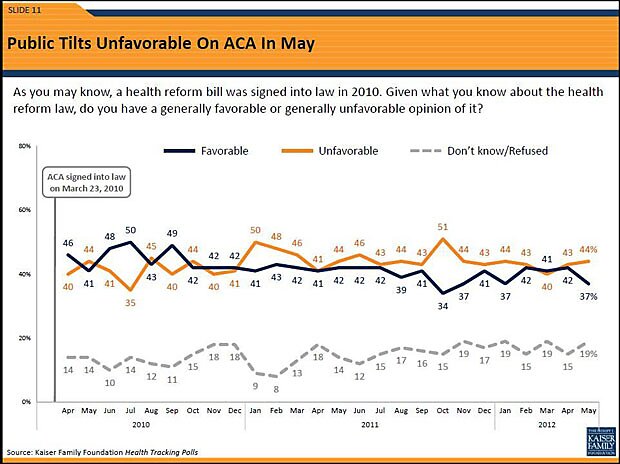
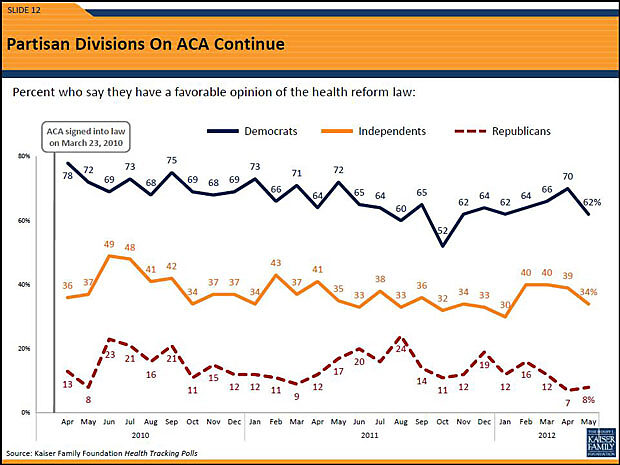
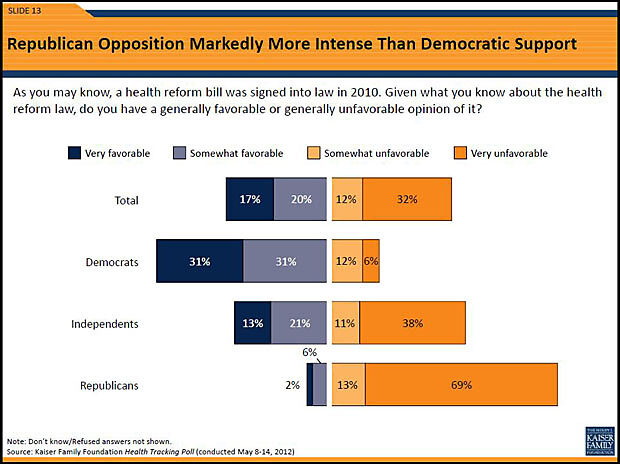
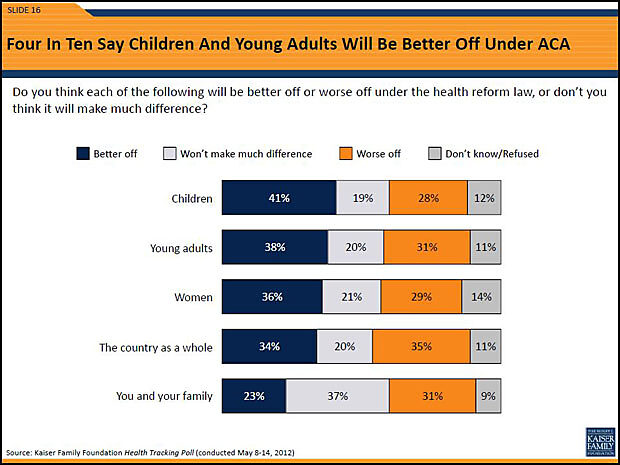
On May 11, the Department of Health & Human Services finalized rules requiring insurers to tell any of their customers who get premium rebates this summer that the windfall comes courtesy of Obamacare. Here’s the official required language: “This letter is to inform you that you will receive a rebate of a portion of your health insurance premiums. This rebate is required by the Affordable Care Act-the health reform law.”
Given that Obamacare is already increasing costs for most patients — insured or otherwise — I wonder who the lucky few will be who get a chance to read the government’s prose. Moreover, it’s a bit rich to create this “language mandate” when HHS Secretary Kathleen Sebelius had earlier advised insurance companies not to speak against Obamacare’s cost-increasing features. As the Competitive Enterprise Institute’s Hans Bader put it:
Obama’s HHS secretary sought to gag insurers that disclosed how Obamacare’s mandates are increasing the cost of health insurance, even though such speech is clearly protected by the First Amendment, telling them if they did so, they could be excluded from health insurance exchanges. Prior to that, the Obama administration attempted to gag insurers from disclosing how Obamacare harms Medicare Advantage participants, drawing criticism from First Amendment experts like UCLA law professor Eugene Volokh, the author of two First Amendment textbooks.
Beyond the unseemliness of it all, however, there’s also a constitutional problem: The government can’t require people to make politicized statements, whether that’s “Live Free or Die” on license plate or the labeling of consumer products where the labels aren’t justified on fraud-prevention or public health grounds. See some other examples and legal analysis in Bader’s post at CEI’s blog.
The bottom line is that just like the First Amendment stops the government from censoring speech, it stops it from forcing speech. And just like there’s no “health care is unique” exception to the Commerce Clause, there isn’t one to the First Amendment.